Posts filed under ‘– Foss –’
SMG Research Blog and FB Page
| Nicolai Foss |
The department for which I serve as Head, the Department of Strategic Management and Globalization (SMG) at the Copenhagen Business School, has set up a new research blog, where we plan to report on our cooler recent publications. SMG is doing increasingly well in the publication dimension, at least for a very small Euro-department at a state business school, with publications/acceptances in the last few months in the Academy of Management Review, Academy of Management Journal, Organization Science (mult.), and the Journal of International Business Studies (mult.), and we want to advertise these successes a bit. Also, SMG has a Facebook page. Please visit it — and “like” it.
Rick Perry Episodes
| Nicolai Foss |
Watching Rick Perry commit political harakiri made me wonder whether academia can report similar incidents (and with similar career-destroying results?). To be sure, many of us academics have engaged in Rick Perry-like behaviors — as is only to be expected when, as many of us do, we regularly talk to (student, executive, colleague) audiences of varying sizes, often several times a week.
I have certainly had my share of situations similar to the Perry episode. Thus, about a decade ago I was supposed to talk about the challenges of managing “knowledge workers” to a bunch of middle-aged (and beyond) medical professors, all with management responsibilities, very impressive scientific records, and all supremely arrogant and self-confident. I got 5 mins into my talk, before I was cut down. Totally. Decisively. Left dumbfounded. Another example, more research-oriented, derives one from one of the BYU-UUtah winter conferences on strategy. I gave a talk on transaction costs economics and competitive strategy. It was rather abstract. After the talk a very (in fact, extremely) prominent strategy scholar asked me in a very pointed and inquisitive manner: “What is in this that I can teach my MBA students?” Again, I was left dumbfounded, probably in awe of this person (and didn’t come up with the obvious answer: “So, do you think that is a good criterion for scientific progress?”).
Of course, there are other Rick Perry episodes from my career, but these two must suffice. Of course, these gaffes just emphasize my humanity. And your Rick Perry episodes?
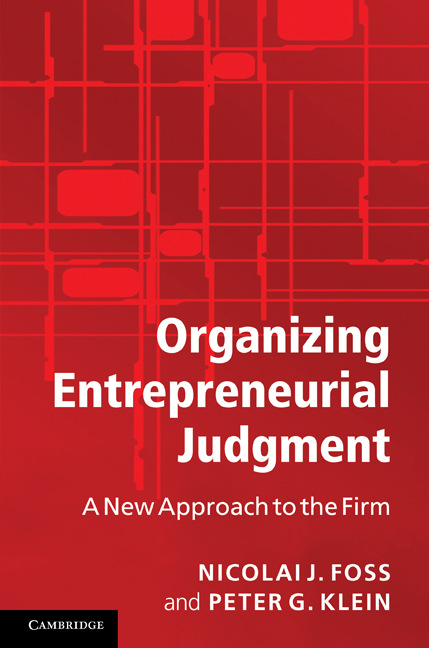
Now Ready for Pre-Order!
| Peter Klein |
This is a placeholder page without much detail, but you can pre-order today! The best news is the price: just £55.00 for the hardback and a mere £19.99 for the paperback — less than a family outing to the cinema, and far more rewarding!
“Micro Chauvinists” Pushing Back …
| Nicolai Foss |
A reviewer of a recent book proposal by Teppo Felin and me (which was accepted, BTW; details later) had the effrontery to note that “Felin and Foss get considerable pushback when they take a strong stand on methodology.” Of course, this reviewer got it all wrong. To wit:
- Teppo and I recently published “The endogenous origins of experience, routines and organizational capabilities: The poverty of stimulus” in the Journal of Institutional Economics, accompanied by critical comments by Sidney Winter, Brian Pentland, Geoff Hodgson and Thorbjørn Knudsen. Here is our response to the comments of our critics. The response has been accepted for publication in the Journal of Institutional Economics.
- In a recent paper in Sociological Theory, influential sociologists Ronald Jepperson and John W Meyer took issue with the rampant “micro-chauvinism” that, in their opionion, increasingly dominates social science, and called for multi-level explanation that admits a role for causation that (in some unexplained fashion) takes place at levels above that of individuals. In this brief note, Teppo and I (and Peter Abell of LSE) take issue with their arguments, and argue that they fundamentally misunderstand methodological individualism and its crucial role in understanding those phenomena that are “multi-level”, “complex” and “emergent.”
Thus, the macro chauvinists are the ones who are getting the pushback ;-)
More on Selective Intervention
| Nicolai Foss |
“Selective intervention” and the more narrow notion of the “impossibility of selective intervention” are among the more elusive notions in the theory of the firm. We have blogged on them a number of times (the most explicit treatment is here). Coined by Oliver Williamson, selective intervention simply means intervention to produce net gains. Thus defined, selective intervention is, of course, not “impossible.” The” impossibility” refers to the conjecture that firms cannot just be grown continuously by selective intervention; at some point various commitment and enforcement problems associated with managerial intervention kicks in, resulting in zero net gains. However, demonstrating this is a “puzzle.”
A new paper, “Solving the Selective Intervention ‘Puzzle’,” by noted French economist, Jacques Cremer, usefully places the problem in context, provides a nice overview of the extant literature, and argues that the problem has essentially been solved:
I have shown that the common thread to all the solutions is the fact that the principal stays in the game” after the contract is signed, and cannot commit himself to a policy which would make the world similar to the world in which there would be no vertical integration. On this basis, solutions that stress incompleteness of contracts, the change in the allocation of authority, the change in the amount of information available to the principal, all provide solutions that are theoretically consistent, and, furthermore, often not incompatible with each other. Determining which solution provides a better guide to applied analysis requires an examination of other features of the model.
C. K. Prahalad Interview
| Nicolai Foss |
The late über-influential management thinker C K Prahalad would have been 70 this August. booz&co’s strategy+business magazine features an interesting interview with CK, “The Life’s Work of a Thought Leader.” It may surprise some that Prahalad was trained as a physicist, and in the beginning of his career worked as an industrial engineer. And for someone, like myself, who has criticized the absence of microfoundations for notions such as “core competence” (e.g., here), it certainly came as a surprise to find Prahalad stating that
If I had to characterize my deepest belief, I would say it’s the centrality of the individual…. Institutions are not central. Institutions are different ways of combining skills and capabilities of the moment. That, of course, is the opposite of the traditional way of thinking, starting from Max Weber and Frederick Taylor in the early 20th century. They posited that institutions were central to society, not individuals. I believe the contrary is true.
Another notable feature in the interview is Prahalad’s view of scientific progress in strategic management which does not come from the kind of cross-sectional studies that take up 93 % of the pages of the Strategic Management Journal, but, he says, from in-depth small-N research:
If you look historically at the strategy literature, starting with Alfred D. Chandler Jr.’s Strategy and Structure: Chapters in the History of the Industrial Enterprise [MIT Press, 1962], the most powerful ideas did not come out of multiple examples. They came out of single-industry studies and single case studies. Big impactful ideas are conceptual breakthroughs, not descriptions of common patterns. You can’t define the “next practice” with lots of examples. Because, by definition, it is not yet happening.
Journal of Institutional Economics
| Nicolai Foss |
I confess that I was a bit skeptical when I was invited by Geoff Hodgson eight years ago (or so) to join the editorial board of the Journal of Institutional Economics. Given Hodgson’s prolific work within the tradition of so-called “old” institutional economics, I frankly saw a risk that what was lined up could end up as another (in addition to the Journal of Economic Issues or the Cambridge Journal of Economics) journal specialized in Williamson-bashing and Veblen-exegesis, crusading against “individualism” (methodological, ontological, political), “mainstream economics,” and the like.
Now, Hodgson is, of course, non-doctrinaire and open-minded, and he enlisted prolific co-editors (O&M blogger Dick Langlois, Esther-Mirjam Sent, Benito Arrunada and Jason Potts), who, although all non-mainstream, were non-mainstream in quite different ways. The result, now in its 7th year of existence, has been an undeniable success, publishing all sorts of institutional economics papers (including some relatively mainstream ones), and featuring contributions by luminaries such as Robin Dunbar and Richard Posner.
As a result of a sustained emphasis on quality, JoIE has now been selected by Reuters Thomson for the SSCI, Journal Citation Reports (Social Sciences Edition) and Current Contents (Social and Behavioral Sciences), that is, it is now what was formerly called an ISI journal. Congratulations to Geoff, Dick and the rest of the gang for founding and very efficiently running a journal that caters to the interests of O&M and our readers!
Leijonhufvud on the Current Crisis
| Nicolai Foss |
We have often blogged on the work of Axel Leijonhufvud on O&M (here). Here is a 2008 talk which was given in Denmark (and which, unfortunately, somehow missed my attention at that time) on “Keynes and the Crisis.” The talk contains many characteristic Leijonhufvudian themes (smashing of Ricardian equivalence, representative agent modeling, and the foundations of financial theory), little on Keynes (luckily!), and much critique of monetarism, in particular the choice of the CPI as the unique target of central bank policies and the notion of the independence of central banks from the political system. Here is Leijonhufvud’s overall diagnosis of the root causes of the current crisis:
The process leading up to today’s American financial crisis had the dollar exchange rate supported by foreign central banks exporting capital to the United States. This capital inflow was not even to be discouraged by a Federal Reserve policy of extremely low interest rates. The price elasticity of exports from the countries that prevented the appreciation of their own currencies in this way kept US consumer goods prices from rising. Operating an interest-targeting regime keying on the CPI, the Fed was lured into keeping rates far too low far too long. The result was inflation of asset prices combined with a general deterioration of credit quality (Leijonhufvud 2007a). This, of course, does not make a Keynesian story. It is rather a variation on the Austrian overinvestment theme.
A Krugmanian Slasher Flick
 | Peter Klein |
Paul Krugman is furious about the deficit-reduction plan reportedly agreed to yesterday, which Krugman says will “slash government spending,” introducing “big spending cuts” that “will depress the economy even further.” And yet, the deal apparently does not cut one penny of government expenditures, but simply increases them at a slower pace (over ten years) than originally projected by the CBO. Remember, in Washington-speak, “cut” means “reduction in the planned rate of increase.”
Imagine a scene from a Krugman-style slasher flick: the villain approaches the victim, and gives him a smaller hug than the victim was expecting! The audience gasps as the victim screams in terror and flees from the vicious attack.
Two New Papers …
| Nicolai Foss |
… by Yours Truly. The Academy of Management Review just published my paper with Siegwart Lindenberg, “Managing Joint Production Motivation: The Role of Goal Framing and Governance Mechanisms,” and Organization Science just published “Linking Customer Interaction and Innovation: The Mediating Role of New Organizational Practices,” by me, Keld Laursen and Torben Pedersen. Here are the abstracts: (more…)
More Serious Stuff
| Nicolai Foss |
Economists may have models of zero intelligence traders, but so far there are no models of zombie traders (that I know of). Possible inspiration for future modeling efforts here.
Gans on Google+
| Nicolai Foss |
I have been using Google + for about a week now. I am unimpressed, and I think I will remain unimpressed. Quite simply, it doesn’t do a lot for me. On his HBR blog, the always thoughtful Joshua Gans points out that because Google+ is a network technology it must build sufficient installed base. However, G+ may face difficulties doing just that, because it offers users rather little extra problem-solving value compared to the existing alternatives:
Facebook provides “hyper-local news,” allowing people to broadcast news, opinions, and interests to their social circle in a way that feels authentic. Twitter, because it is essentially public and open, delivers news fast and also permits users to follow famous or interesting individuals.
Google+ does both of these things in one. But because the problems are already solved separately, then Google+ only solves the increment: you can view private and public content on the one “page.” To be sure, some harmonization across content platforms can be valuable to consumers. But Google+ is only adding the increment and not the whole lot. So while it might be argued that if Google+ happened five years ago, its technical implementation might have made it a clear winner, that is not the world we find ourselves in now.
Pomo Periscope XXII: There Is No Such Thing as a Free Diversocrat
| Nicolai Foss |
The California budget crisis may be tough on the university system. But as Heather MacDonald points out in City Journal, California universities (specifically, UC San Diego) are still adding “diversity fat even as it snuffs out substantive academic programs.” As she notes, the opportunity costs of pomo are becoming very visible indeed:
UC San Diego just lost a trio of prestigious cancer researchers to Rice University. Rice had offered them 40 percent pay raises over their total compensation packages, which at UCSD ranged from $187,000 to $330,000 a year. They take with them many times that amount in government grants. Scrapping the new Vice Chancellorship for Equity, Diversity, and Inclusion could have saved at least one, if not two, of those biologists’ positions.
Do Senior Managers Make Better Decisions Than Students?
| Nicolai Foss |
Even management students may occasionally suffer from confidence and self-esteem problems. I have had many students confide that they were more than a little scared at the prospect of landing a real job where their decision-making skills would be compared to older, wiser, smarter, etc. colleagues. Rather than directing them to this site, in the future I am going to give such students a copy of Gary E. Bolton, Axel Ockenfels and Ulrich Thonemann’s “Who Is the Best at Making Decisions? Managers or Students?” They set up a simple experiment based on a simple profit maximizing problem, and find that practitioner performance isn’t as good as graduate business students’. Moreover, the learning curve of the latter is steeper than that of practicioners. (more…)
More on Free Speech
| Nicolai Foss |
We have blogged a number of times in the past on (the economics of) free speech. John Stuart Mill is, of course, the towering figure when it comes to philosophical defenses of free speech. Here is a recent working paper, “Speech, Truth, and Freedom: An Examination of John Stuart Mill’s and Justice Oliver Wendell Holmes’s Free Speech Defenses,” that compares Mill with Holmes’ views, undertakes a dehomogenization exercise, and argues that their different free speech positions are rooted in different underlying views of liberty. For free speech afficionados, perhaps, but still recommended.
More on Routines
| Nicolai Foss |
The Journal of Institutional Economics, now in its seventh year of operation, is emerging as an important outlet in the intersection of new and old institutional economics, evolutionary economics and other more or less heterodox approaches. In addition, Geoff Hodgson and Benito Arrunada, the editors, are doing a splendid job of attracting contributions, not only from luminaries such as Richard Posner, but also from important non-economist thinkers whose work may have a bearing on economic issues (e.g., philosopher John Searle and evolutionary anthropologist Robin Dunbar).
The most recent issue of JoIE features a special issue on “Business Routines.” The SI includes particularly thoughtful essays by Ulrich Witt and Jack Vromen. As readers of this blog will know, probably ad nauseam, Teppo Felin and I have repeatedly discussed the troubling lack of micro-foundations for understanding the emergence, stability, change, etc. of routines (and other similar constructs, like capabilities). We also have a paper in the SI, launching related, but different critiques. Specifically, we explicate the behaviorist and empiricist foundations of the organizational routines and capabilities literature and the extant emphasis placed on experience, repetition, and observation as the key antecedents and mechanisms of routines and capabilities.
This paper is followed by three comments by Sidney Winter, Brian Pentland, and Geoff Hodgson and Thorbjørn Knudsen, respectively, that take critical (in the case of Pentland, extremely critical) issue with various aspects of our argument. Winter and Knudsen and Hodgson raise many fundamental points, but unfortunately Pentland has thoroughly misunderstood the nature of the micro-foundations projects we advocate, and therefore concludes that all we add to the field is “confusion.” Although there is no such thing as bad publicity, Teppo and I are working on a rejoinder to these comments. More to come!
The Performative Effects of Social Constructionist Professors in Business Schools
| Nicolai Foss |
Many European business schools praise disciplinary diversity. Some style themselves as “business universities,” rather than “traditional” business schools. Such schools may have a substantial contingent of faculty from the humanities, including historians, literary theorists, and philosophers, as well as sociologists and political scientists. The probability of such faculty subscribing to social constructionism is high. Typically, this perspective is taught to the students in courses on communication, whether intercultural or not, the theory of science, cross-cultural management, and so on. It is pretty much everywhere.
Those in sociology who stress “reflexivity” and “performativity” tell us that our theorizing, as mediated through teaching, influences the objects of theorizing. What may be the performative effect of social constructionist professors? My hypothesis is that the students they teach will end up acting like Hayek’s “constructivist rationalists” on the level of society, that is, managers who believe everything in organizations is malleable, and may therefore do substantial damage to the organizations they manage. The Wiki on social constructionism provides a neat summary of Ian Hacking’s celebrated critique of social constructionism:
Ian Hacking, having examined a wide range of books and articles with titles of the form “The social construction of X” or “Constructing X”, argues that when something is said to be “socially constructed”, this is shorthand for at least the following two claims:
(0) In the present state of affairs, X is taken for granted; X appears to be inevitable.
(1) X need not have existed, or need not be at all as it is. X, or X as it is at present, is not determined by the nature of things; it is not inevitable.
Hacking adds that the following claims are also often, though not always, implied by the use of the phrase “social construction”:
(2) X is quite bad as it is.
(3) We would be much better off if X were done away with, or at least radically transformed.
If this is foundational for you as a manager, you will likely have little respect for what has evolved inside an organization, because “it is not inevitable.” You will be unimpressed by efficiency arguments from economics and functionalist arguments from sociology that explain the presence of a given feature of an organization. Your urge is to change the organization erratically according to your whims, and nourish ongoing turmoil. Psychological/implicit contracts suffer. Negative implications for productivity and firm-level performance follow.
Too Cool to Update …
| Nicolai Foss |
We generally think of setting up a webpage (or a blog or a CV) as great fun, and maintaining it as less fun. But not maintaining your webpage (in terms of design and content) may be a signalling device. For example,
- “I am so big that the minor details since 2001 are really best left to my biographers.”
- “I remain the master of 1994-style animated GIFs.”
- “Please — I am a mathematical economist, not a mere web designer.”
And your examples?
Three New Review Papers
| Nicolai Foss |
Although they are in general not highly regarded, I love writing review papers. Writing such a paper is an excellent opportunity to revisit classic papers. Sometimes you get a new idea while reflecting on the current research frontier. They are great for establishing research contacts, for although review papers may not be cited a lot, they are read a lot. And they can usually be put quickly together. Here are three new review papers/chapters written over the last month or so:
- “Entrepreneurship in the Context of the Resource-Based Theory of the Firm.” Written for Kevin Mole and Monder Ram, eds., Perspectives in Entrepreneurship (Palgrave).
- “The Emerging Strategic Entrepreneurship Field.” Written with my PhD student Jacob Lyngsie for Daniel Hjorth, ed., Handbook of Organisational Entrepreneurship (Elgar).
- “Entrepreneurship and the Economics of the Firm.” Written with Peter G. Klein and Peter’s PhD student Per L. Bylund for the above-mentioned Hjorth volume.





 Organizations and Markets
Recent Comments