Posts filed under ‘History of Economic and Management Thought’
Against Scientism
| Peter Klein |
Hayek defined “scientism” or the “scientistic prejudice” as”slavish imitation of the method and language of Science” when applied to the social sciences, history, management, etc. Scientism represents “a mechanical and uncritical application of habits of thought to fields different from those in which they have been formed, and as such is “not an unprejudiced but a very prejudiced approach which, before it has considered its subject, claims to know what is the most appropriate way of investigating it.” (Hayek’s Economica essays on scientism were collected in his 1952 Counter-Revolution of Science and reprinted in volume 13 of the Collected Works.)
Austin L. Hughes has a thoughtful essay on scientism in the current issue of the New Atlantis (HT: Barry Arrington). Hughes thinks “the reach of scientism exceeds its grasp.” The essay is worth a careful read — he misses Hayek but discusses Popper and other important critics. One focus is the “institutional” definition of science, defined with the trite phrase “science is what scientists do.” Here’s Hughes:
The fundamental problem raised by the identification of “good science” with “institutional science” is that it assumes the practitioners of science to be inherently exempt, at least in the long term, from the corrupting influences that affect all other human practices and institutions. Ladyman, Ross, and Spurrett explicitly state that most human institutions, including “governments, political parties, churches, firms, NGOs, ethnic associations, families … are hardly epistemically reliable at all.” However, “our grounding assumption is that the specific institutional processes of science have inductively established peculiar epistemic reliability.” This assumption is at best naïve and at worst dangerous. If any human institution is held to be exempt from the petty, self-serving, and corrupting motivations that plague us all, the result will almost inevitably be the creation of a priestly caste demanding adulation and required to answer to no one but itself.
Coase on the Economists
| Peter Klein |
Ronald Coase has a short piece in the December 2012 Harvard Business Review, “Saving Economics from the Economists” (thanks to Geoff Manne for the tip). Not bad for a fellow about to turn 102! I always learn from Coase, even when I don’t fully agree. Here Coase decries the irrelevance of contemporary economic theory, condemning economics for “giving up the real-world economy as its subject matter.” He also provides a killer quote: “Economics thus becomes a convenient instrument the state uses to manage the economy, rather than a tool the public turns to for enlightenment about how the economy operates.”
I’m sure that’s true for many economists and for some branches of the field, such as Keynesian macroeconomics. But Coase seems to reject economic theorizing altogether, even the “causal-realist” approach popular in these parts. To be useful, he argues, economics should provide practical guidance for the businessperson. However, “[s]ince economics offers little in the way of practical insight, managers and entrepreneurs depend on their own business acumen, personal judgment, and rules of thumb in making decisions.”
Well, that sounds about right to me. Economics provides general principles, or laws, about human action and interaction, mostly stated as “if-then” propositions. Applying the principles to concrete, historical cases requires Verstehen, and is the task of economic historians (as analysts) and entrepreneurs (as actors), not economic theorists. Deductive theory does not replace judgment. Without deductive theory, however, we’d have no principles to apply, and nothing to contribute to our understanding of the economy except — to quote Coase’s own critique of the Old Institutionalists — “a mass of descriptive material waiting for a theory, or a fire.” To be sure, Coase’s own inductive method has led to several brilliant insights. Coase himself has a knack for intuiting general principles from concrete cases (e.g., theorizing about transaction costs from observing automobile plants, or about property rights from studying the history of spectrum allocation), though not perfectly. But, as I noted before, Coase himself is probably the exception that proves the rule — namely that induction is a mess.
Handbook of Economic Organization
| Peter Klein |
Kudos to Anna Grandori for her edited volume, Handbook of Economic Organization: Integrating Economic and Organization Theory, currently making its way through the editorial process at Edward Elgar. Blurb:
The volume distinctively aims at integrating economic and organization theories for the explanation and design of economic organization. Economic organization is therefore intended both as an object of enquiry and as an emerging disciplinary field: not economics applied to organization as an object, but a forefront interdisciplinary field attracting researches and integrating insights from economics, organization theory, strategy and management, economic sociology, and cognitive psychology. The authors are distinguished scholars at their productive peak in those fields, sharing an in interest in an integrated and enlarged approach to economic organization. Each chapter not only addresses foundational issues and provides a state-of-art, but also offers original contributions and identifies key issues for future research.
Table of Contents is below the fold. You”ll find many of your favorite authors. (more…)
Interview with Gary Becker on Rational Choice
| Peter Klein |
The latest issue of the Erasmus Journal for Philosophy and Economics features an interview with Gary Becker on rational choice. I am not a Chicagoite positivist, but I sympathize with Gary’s overall take on the behavioral revolution: Meh.
Interviewer: Following the crisis, many economists and methodologists have argued that more realistic behavioral underpinnings of economic theory would have made forecasts more accurate. Do you think that one of the things the recent crisis has shown us is that people just do not behave rationally? Or did the crisis rather show exactly the opposite—that people did in fact react to incentives and that the consequences of introducing new financial instruments were just not foreseeable?
Becker: I think it is mainly the latter. There were incentives, both on the borrower and on the lender side, that these subprime loans would be made available at the lowest interest rates; and there was pressure from the government to do so; and probably those involved did not understand the financial instruments. Now, is it that we have to change our theories radically with respect to their behavioral structure or even switch to a new behavioral framework? There is very little evidence that would support such a move.
A later remark supports my argument that “disequilibrium analysis” is not the defining characteristics of the Austrian school:
I have read some of the literature on the critique of equilibrium, not so much by philosophers but by the Austrian school of economics, and I could just never make sense out of it, because I do not see what they are substituting for it. Even Friedrich Hayek, who is listed as one of the top Austrians, if you read his analysis, you see that he is using equilibrium analysis.
Lewin on Austrian Capital Theory
| Peter Klein |
A very nice overview of “Austrian” capital theory and its relevance for the current economic crisis from former guest blogger Peter Lewin.
With the resurgence of Keynesian economic policy as a response to the current crisis, echoes of past debates are being heard — in particular the debate from the 1930s between John Maynard Keynes and Friedrich Hayek. . . . Hayek pointed out that capital investment does not simply add to production in a general way but rather is embodied in concrete capital items. That is, the productive capital of the economy is not simply an amorphous “stock” of generalized production power; it is an intricate structure of specific interrelated complementary components. Stimulating spending and investment, then, amounts to stimulating specific sections and components of this intricate structure.
See also the recent SO!APbox essay by Rajshree Agarwal, Jay Barney, Nicolai, and me, “Heterogeneous Resources and the Financial Crisis: Implications of Strategic Management Theory.”
Why Do Firms Differ?
| Peter Klein |
This year marks the thirtieth anniversary of two major contributions to strategy and organization, Nelson and Winter’s Evolutionary Theory of Economic Change and Lippman and Rumelt’s “Uncertain Imitability: An Analysis of Interfirm Differences in Efficiency under Competition.” Both tried to explain inter-firm performance differences without reference to market power or random shocks. Interestingly, as Ruff Coff points out, both were aimed at economists, but had little impact there, instead becoming foundational contributions to the emerging strategy field. Here’s a concise summary of Lippman and Rumelt from Peter Zemsky:
Lippman and Rumelt (1982), in the first formal theoretical paper inspired by the distinctive concerns of the strategy literature, demonstrate how superior performance can arise without assumptions of imperfect competition and market power, which are the defining features of the IO approach. In their model there are a large number of potential entrants that can pay a fixed cost to enter an industry. The key assumption is that there is imperfect imitability so that each entrant’s cost function is determined by an independent draw from a known distribution. In equilibrium, firms with bad draws exit and the remaining firms on average must have abnormal returns even when in the case where the firms are all small and have no market power. Ex ante however expected profits from entry are zero. The paper remains an outstanding example of high quality theorizing in strategy. Barney (1986) in his paper on strategic factor markets applies the same reasoning in his verbal argument that from an economics perspective superior performance must be the result of luck.
L&$ also explain the background and context of their article in a new video.
Kirzner’s theory of entrepreneurship is another example of a contribution intended to change the conversation in economics — by shifting attention from equilibrium states to adjustment processes — that seems to have little impact upon its intended audience, while becoming hugely influential in a different field (entrepreneurship).
Paradigm Shift
| Peter Klein |
 Did you know this year is the semicentennial of Kuhn’s Structure of Scientific Revolutions? David Kaiser offers some reflections at Nature.
At the heart of Kuhn’s account stood the tricky notion of the paradigm. British philosopher Margaret Masterman famously isolated 21 distinct ways in which Kuhn used the slippery term throughout his slim volume. Even Kuhn himself came to realize that he had saddled the word with too much baggage: in later essays, he separated his intended meanings into two clusters. One sense referred to a scientific community’s reigning theories and methods. The second meaning, which Kuhn argued was both more original and more important, referred to exemplars or model problems, the worked examples on which students and young scientists cut their teeth. As Kuhn appreciated from his own physics training, scientists learned by immersive apprenticeship; they had to hone what Hungarian chemist and philosopher of science Michael Polanyi had called “tacit knowledge” by working through large collections of exemplars rather than by memorizing explicit rules or theorems. More than most scholars of his era, Kuhn taught historians and philosophers to view science as practice rather than syllogism.
Kuhn did not, to my knowledge, say much about the social sciences, though in a later essay he described them in somewhat unflattering terms:
[T]here are many fields — I shall call them proto-sciences — in which practice does not generate testable conclusions but which nonetheless resemble ph9ilosophy and the arts rather than the established sciences in their developmental patters. I think, for example, of fields like chemistry and electricity before the mid-eighteenth century, of the study of heredity and phylogeny before the mid-nineteenth, or many of the social sciences today. In those fields, . . . though they satisfy [Popper’s] demarcation criterion, incessant criticism and continual striving for a fresh start as primary forces, and need to be. No more than in philosophy and the arts, however, do they result in clear-cut progress.
Murray Rothbard took an explicitly Kuhnian approach to his history of economic thought, agreeing with Kuhn that there is no linear, upward progression and condemning what he called the “Whig theory” of intellectual history.
Hayek on Schumpeter on Methodological Individualism
| Peter Klein |
Our QOTD comes from the 2002 version of Hayek’s “Competition as a Discovery Procedure.” (Thanks to REW for the inspiration.) Hayek delivered two versions of the lecture, both in 1968, one in English and one in German. The former appeared in Hayek’s 1978 collection New Studies in Philosophy, Politics, Economics, and the History of Ideas, and is the version most familiar to English-speaking scholars. In 2002 the QJAE published a new English translation of the German version which includes two sections (II and VII) omitted from the earlier English version. In this passage from section II Hayek distinguishes macroeconomics (“macrotheory”) from microeconomics (“microtheory”):
About many important conditions we have only statistical information rather than data regarding changes in the fine structure. Macrotheory then often affords approximate values or, probably, predictions that we are unable to obtain in any other way. It might often be worthwhile, for example, to base our reasoning on the assumption that an increase of aggregate demand will in general lead to a greater increase in investment, although we know that under certain circumstances the opposite will be the case. These theorems of macrotheory are certainly valuable as rules of thumb for generating predictions in the presence of insufficient information. But they are not only not more scientific than is microtheory; in a strict sense they do not have the character of scientific theories at all.
In this regard I must confess that I still sympathize more with the views of the young Schumpeter than with those of the elder, the latter being responsible to so great an extent for the rise of macrotheory. Exactly 60 years ago, in his brilliant first publication, a few pages after having introduced the concept of “methodological individualism” to designate the method of economic theory, he wrote:
If one erects the edifice of our theory uninfluenced by prejudices and outside demands, one does not encounter these concepts [namely “national income,” “national wealth,” “social capital”] at all. Thus we will not be further concerned with them. If we wanted to do so, however, we would see how greatly they are afflicted with obscurities and difficulties, and how closely they are associated with numerous false notions, without yielding a single truly valuable theorem.
The reference is to Schumpeter’s 1908 book, Das Wesen und der Hauptinhalt der theoretischen Nationalökonomie which, to my knowledge, has never been translated (though an excerpt, and some commentary, are here). For more on the different versions of Hayek’s essay see here and here.
NB: Krugman blogged over the weekend about microfoundations, offering a remarkably (sic) shallow and misguided critique based on what Hayek would call the scientistic fallacy. E.g.: “meteorologists were using concepts like cold and warm fronts long before they had computational weather models, because those concepts seemed to make sense and to work. Why, then, do some economists think that concepts like the IS curve or the multiplier are illegitimate because they aren’t necessarily grounded in optimization from the ground up?” Ugh.
Interdisciplinarity Chart of the Day
| Peter Klein |
This is from a study of economics PhD dissertations at one French university, the EHESS (École des hautes études en sciences sociales).

In the 1960s, three-fourths of economics PhD dissertation committee members were from another discipline, and in the 1990s, less than 15 percent. Other disciplines have also become more self-reliant, but in much less dramatic fashion.
The paper, “The Mainstreaming of French Economics” by Olivier Godechot is here and the pointer goes to Art Goldhammer. The paper focuses on the transformation of the French profession led by US-trained or -oriented economists such as Jacques Mairesse, Jean-Jacques Laffont, and Robert Boyer. Godechot concludes that “scientific life in general and, moreover, paradigmatic change are not only a question of truth, of evidences, and of proofs but also of politics. Evaluating, influencing, building coalitions, voting, and selecting are regular practices both within disciplines and in wider interdisciplinary arenas when articles are submitted, grants are distributed (Lamont, 2009), positions are opened (Musselin, 2005), and candidates are selected.” Right on that.
What Did Keynes Mean by “Animal Spirits”?
 | Peter Klein |
Keynes’s idea that investors are motivated by “animal spirits” has come back into vogue with the recent Keynesian revival, but the term is often misunderstood. Keynes referred not to psychological factors that make investors reluctant to invest, but those that make them invest at all — in the face of deep uncertainty, he thought, only a manic, driven, strong-willed person would put capital at risk. When animal spirits are strong, investment is sufficient to maintain aggregate demand; when they lag, aggregate demand falls, and the economy lapses into depression. (Lord Skidelsky approvingly calls this the “mood swings theory” of business cycles — an idea just crazy enough to spawn a recent NBER paper.)
The new issue of Capitalism and Society features a piece on What Keynes Really Meant on this issue, and it’s a good read:
Alexander Dow, Glasgow Caledonian University
Sheila C. Dow, University of StirlingThe term ‘animal spirits’ has returned to academic and public discourse in a way which departs significantly from the original use of the term by Keynes. The new behavioural economics literature uses the term to refer to a range of behaviour which falls outside what is normally understood as rational. This treatment follows from the mainstream dichotomisation between rationality and irrationality. However, Keynes explained that, given fundamental uncertainty, rationality alone was insufficient to justify action. Animal spirits was the name he gave to the (psychological) urge to action which explained decisions being taken in spite of uncertainty; animal spirits for him were neither rational nor irrational. Nor are they beyond analysis. We explore how the nature and role of animal spirits can vary according to context (as between different sectors, types of firm and within firms). This analysis indicates ways in which policy can promote structural change to strengthen animal spirits in the long term as well as offset short-term weakening in animal spirits.
Disaggregation
| Peter Klein |
The idea that mainstream macroeconomic thinking focuses at too high a level of aggregation is a frequent complaint on this blog (e.g., here, here, here, and here). Our recent Strategic Organization paper hammers home this point. The level of aggregation is of course a fundamental difference between Keynesian and Austrian theorizing about economic fluctuations. But Keynesian economists don’t seem to recognize this.
The other day I posted a snarky blog entry at The Beacon, responding to a Krugman smear of Hayek (yawn). Today Mario Rizzo pens a more thoughtful response, emphasizing exactly this level-of-analysis issue:
I think the real issue is this. Hayek’s approach attacks, root-and-branch, the macroeconomic way of thinking. It is not simply a challenge to a particular theory of the determinants of mass unemployment, inflation, business cycles and the like. Hayek is not accepting the rules of the game or the parameters of the sub-discipline of modern macroeconomics. Hayek does not want to argue that the government expenditure multiplier is 0.5 instead of 2.0, for example. He does not want to discuss just how much fiscal stimulus should be undertaken and what form it should assume.
In short, he does not want to focus on aggregate spending and aggregate consequences. Hayek’s approach says: Let us pierce the veil of aggregates and look at the distortive effects on relative prices and relative output produced by boom-time credit expansions. Let us look at the distortive effects that booms leave us as we work our way through a recession. Let us concentrate on sustainable lines of expenditure both during the boom and during the road out from the bust.
Rafe Champion at Missouri
| Peter Klein |
 It’s been fun hosting Australian writer (and frequent O&M commenter) Rafe Champion at Missouri the last couple of days. Rafe spoke to the economists about the philosophy of science (handout here), and to the graduate philosophy seminar of my colleague André Ariew on current research topics in the philosophy of biology. We’ve had many talks about Hayek, Mises, Popper, Parsons, and our mutual friend Bill Bartley, among others. Rafe blogs at Catallaxy Files and the Critical Rationalist blog, and his website The Rathouse contains a treasure-trove of writings by, and commentary on, the most important twentieth-century philosophers of science.
New Book on the Austrian School from Austria, Featuring Schumpeter and Others
| Peter Lewin |
I am reading an interesting new book from the Mises Institute — The Austrian School of Economics: A History of its Ideas, Ambassadors, and Institutions by two living Austrian authors, Eugen Maria Schulak and Hebert Unterköfler. I will leave the task of a full-blown critical review to experts in the history of thought, but a few passing observations might be of interest to this audience.
One might wonder about yet another history of the Austrian School, but there may be a genuine claim for value-added here, certainly in my case. For one thing, this is a translation from the German edition, so the majority of the references are in German. We parochial English speakers often proceed in isolation from important contributions in other languages. I was struck for example by the volume of work Carl Menger has done in German that has never been translated. And this is the case with all of the usual suspects.
As it turns out, this is particularly important in one case: the case of Schumpeter’s Theory of Economic Development — to which one of the short chapters is devoted. The one English edition that exists is a translation of an earlier German edition. So it fails to capture many aspects of Schumpeter’s later vision.
Many things derive from this early work, namely, Schumpeter’s entrepreneur, in its earliest incarnation (and its evolution in subsequent editions), the idea of the entrepreneur as the combiner of capital goods, and, of course, the notion of entrepreneurship bringing gales of “creative destruction.” The authors describe the development of the work through its various editions as Schumpeter matured as a scholar and became more confident, less nuanced, in his assertions. An example is his story of the business cycle — how the innovating entrepreneur was necessarily involved in “credit creation,” which thus precipitated a cycle (Richard Ebeling has recently done some interpretative work on this). At the time he first proposed this idea, he was vigorously criticized by Böhm-Bawerk and others — and our authors see this as the emergence of the first significant breech with the Austrian School. Dare I be so bold as to suggest that the contemporaries might have gotten it wrong, and, along the lines of Ebeling’s interpretation (reference below, also see my blog here and here), that Schumpeter may be understood more plausibly within a modern central bank institutional setting as hatching a variation of the Austrian Business Cycle story? (more…)
Now Ready for Pre-Order!
| Peter Klein |
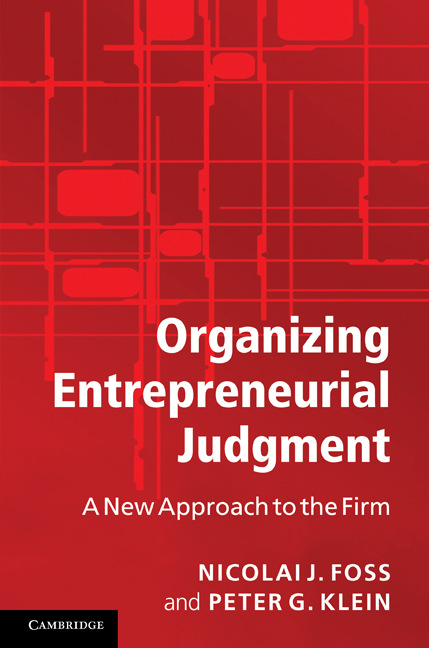
This is a placeholder page without much detail, but you can pre-order today! The best news is the price: just £55.00 for the hardback and a mere £19.99 for the paperback — less than a family outing to the cinema, and far more rewarding!
Schumptoberfest
| Peter Klein |
Kudos to former guest blogger David Gerard for helping organize and host the conference with the über-cool name, Schumptoberfest, 21-23 October at Lawrence University in Appleton, Wisconsin. David Hounshell is giving the keynote address, and the rest looks good too.

New Book on American Institutionalism
| Peter Klein |
It’s by Malcolm Rutherford, titled The Institutionalist Movement in American Economics, 1918-1947: Science and Social Control (Cambridge University Press, 2011). Rutherford reinterpretes the American (or “Old”) Institutional Economics as a much broader and deeper movement than simply the ideas of Veblen, Commons, and Mitchell. Reviewers Robert Van Horn and Richard McIntyre say that “institutional economics should be understood as a ‘movement’ that shared core ideas and beliefs and as a network of people with a self-conscious unity, and Rutherford marvelously shows how the self-conscious unity of this network shaped institutionalist economics and American economics more generally in the first half of the twentieth century.” The reviewers also praise Rutherford for debunking three important “myths” about the Old Institutionalists:
First, he challenges the notion that institutional economics was only a critique of neoclassical economics and that institutional economics disappeared because it did not make any substantial contributions to economics. Second, Rutherford successfully assails the idea that institutional economics was just a set of facts and bereft of theory. Third, Rutherford dispels the notion that institutional economics was Veblenian; he shows that Veblen was an intellectual inspiration to the movement but not central to the networking process.
My previous forays into the writings of the Old Institutionalists have not yielded much fruit, but I will look at Rutherford’s book and try to keep an open mind.
Peter Lewin Interview
| Peter Klein |
Adrián Ravier has put together a nice collection of Spanish-language interviews with economists of the Austrian school (volume 1, volume 2). The leading modern figures are all included: Mises, Hayek, Machlup, Lachmann, Rothbard, Kirzner, fellow travelers such as Buchanan and Shackle, and contemporary Austrians such as Garrison, Block, Hoppe, Higgs, Ebeling, Salerno, Boettke, and more.
Guest blogger Peter Lewin’s interview is coming out in a third volume, to be published later this year, and Adrián has given me permission to post the English version here. You’ll find Peter’s intellectual odyssey very interesting!
(I am also featured in the collection, via translation of an old interview from 1995. Those were the days!)
Warning to My Future Biographers
| Peter Klein |
Daniele Besomi, writing at the SHOE list (and shared with permission):
[N]ot only memory is treacherous and selective, but even archival sources are not always fully reliable. In my work on the papers of Roy Harrod I have found examples of self-selection of documents to be preserved for posterity. Already aged 30 he annotated some documents as witnessing his position on some university matters; at 32 he preserved his own side of the correspondence he entertained with some politicians apparently because he deemed it important to keep a trace of it (he normally never kept copies of his outgoing correspondence, almost all handwritten); at 45 he started going through his own archives, annotating some correspondence for the benefit of “future historians of thought.”
At some (probably later) point in life he organized his own archives for the benefit of future readers, and he is likely to have manipulated some contents (besides rearranging the correspondence: annoyingly, the archivists undid some of Harrod’s work and moved some papers to different folders …).
It is in fact very strange that one who preserved tailor’s bills and bus tickets had kept no documents relating to his activities with the New Fabian Research Bureau in the early 1930s: he didn’t keep any of the memoranda he wrote (two at least survive in the NFRB’s archives) nor the correspondence he received about it (but the outgoing letters are in the recipients’ archives), except for a letter from James Meade dealing with theoretical matters and mentioning the NFRB in a postscript — perhaps (I am speculating here) Sir Roy turned conservative was embarrassed of the left-wing tendencies of his younger self.
Look below the fold for some annotations and sources (via Daniele). (more…)
Confronting Convenient Historical Distortions
| Peter Lewin |
From management professor Richard Rumelt. This is very interesting.
Today, households carry a much greater relative debt burden than they did in 1929, largely due to a 25-year mortgage binge. Between 1980 and 2007, disposable income grew at 5.9% per year while household indebtedness grew at 8.7% per year — a clearly unsustainable situation. As in 1939, this hangover of debt blocks new rounds of consumption and dulls the impact of fiscal and monetary stimuli.
From today’s WSJ: here.
Weird Economics Dissertation of the Day
| Peter Klein |
John Nash’s 1950 Princeton dissertation is odd, though brilliant. Khieu Samphan’s 1959 University of Paris dissertation, “Cambodia’s Economy and Problems of Industrialization,” is frightening, as it foreshadows the genocidal policies Samphan implemented as a top Khmer Rouge official in the 1970s. A NYT story excerpts key passages like this one, arguing that white-collar workers
add no value to the society from the perspective of the economy as a whole. They simply profit from a transfer of value issuing from other productive activities within society (agriculture, crafts, small industry). And the transfer of produce within society does not enlarge the total value of production obtained by society in any way. The distinction made by the Scottish economist Adam Smith between productive and unproductive work deserves to be carefully considered here.
This is far from saying, for example, that a civil servant or a soldier would be useless to society. However, the greater the reduction in numbers of individuals concerned with general social organization, the greater the number who can contribute to production and the faster the enrichment of the nation.
Presumably this was in Samphan’s mind when he had office workers marched at gunpoint to the fields, where many starved and where millions were later executed.





 Organizations and Markets
Recent Comments