Posts filed under ‘History of Economic and Management Thought’
Austrian Awakening?
| Peter Klein |
Following the Keynesian Consensus of the 1950s and 1960s Monetarism emerged as an alternative. By the late 1970s, there were Keynesians and Rational Expectations macroeconomists. When I took graduate macro in the late 1980s, I was told there were two schools of thought: New Keynesian and New Classical. (Elwood: “What kind of music do you usually have here?” Claire: “Oh, we got both kinds. We got country and western.”)
Old-style Keynesianism made a roaring comeback in the last two years. But cracks are starting to appear in the consensus edifice. An increasing number of commentators in the popular press are voicing disappointment with the results of deficit spending and money creation (aka “quantitative easing”), the classic Keynesian policy instruments. What are they turning to instead? Not Monetarism or New Classicism, which don’t seem like viable alternatives. Surprisingly, the mainstream press is rediscovering the Austrians.
 “We’re All Austrians Now,” declares CNBC, saying the Mises-Hayek theory “provides the best explanation for the business cycle we just lived through.” And pity the poor Fed: “the resurgent popularity of Austrian economics may actually be hampering the ability of the Federal Reserve to reflate the economy with low interest rate policies. Businesses, now aware of the dangers of a low inflation-sparked economic bubble, may simply be refusing to fall for the age-old boom-bust trap.” Sunday’s Newsweek noted “The Triumphant Return of Hayek,” citing “a growing backlash against the Fed’s monetary activism” and adding that Bernanke’s policy “suffers from the same fundamental flaw as Keynesianism, in that it protects inefficient players instead of injecting renewed vigor into the economy.” (Bonus quotation, via Larry White: “Keynesian theory . . . advocates a policy opposed to the interest of large investors and entrepreneurs and then, when this policy is about to be realized, holds the high liquidity preference of investors and the timidity of entrepreneurs responsible for the necessity further to increase taxation and public works.” — Otto von Mering, 1944) Even the staid Economist thinks the Austrian theory deserves more attention from policymakers.
Is there a shift in public attitude toward government management of the economy? Is the opinion-molding class changing its tune? Or are these reports anomalies? If public opinion and opinion among elites is changing, what explains the change? New evidence? Change in ideology? Self-interest?
Mmmmmm. . . . Bacon!
| Peter Klein |
 This post begged to be written. It started last weekend when I heard Jim Gaffigan’s bacon routine on the Slacker Comedy Channel. Then, during the week, the Mises Institute ran an excerpt from Murray Rothbard’s History of Economic Thought on Francis Bacon. (Rothbard wasn’t impressed, calling Bacon “the prophet of primitive and naive empiricism, the guru of fact grubbing.”) As if that weren’t enough, Rafe Champion decided around the same time to summarize Terence Kealey’s Economic Laws of Scientific Research, the first chapter of which contrasts Bacon’s and Adam Smith’s views on the relationship between science and economic growth. (Bacon’s model: State support -> Basic Research -> Technology -> Progress in human welfare. Smith’s model: Old technology -> New Technology -> Wealth and Welfare.) Bacon — you just can’t get enough!
Richard T. Ely’s Influence on Woodrow Wilson
| Peter Klein |
Researching and teaching sound economics during the Dark Era (i.e., the Keynesian Revival) can be frustrating and depressing. Keynesian doctrine has been refuted again and again; why won’t this zombie stay dead? What, more generally, is the role of economic education? Can we really transform hearts and minds through reason and dialogue? Or do students and scholars simply seek intellectual cover to justify what they already believe?
Hayek reports that he was originally a mild Fabian but was converted by laissez-faire by Mises’s 1922 book Socialism. Such conversion stories are rare, however, in either direction. With this in mind, I was intrigued by Gary Pecquet and Clifford Thies’s paper, “The Shaping of a Future President’s Economic Thought: Richard T. Ely and Woodrow Wilson at ‘The Hopkins'” (Independent Review, Fall 2010). Pecquet and Thies report that “Woodrow Wilson entered graduate studies at Johns Hopkins University as a classical liberal in his economic views but departed as a progressive. His fateful transformation had much to do with his apprenticeship with Richard T. Ely, who disparaged the laissez-faire policy prescriptions and deductive methodology of classical economics.” Worth a look for those interested in the impact of economic education on economic policy.
Austrian Economics in Transition
| Nicolai Foss |
The Austrian School of Economics continues to provide grist for the doctrinal historian’s mill. New interpretations are developed. Forgotten manuscripts by prominent Austrians are still being discovered. The discovery of the Mises archive about a decade ago by Jörg Guido Hülsmann comes to mind. I recently had the pleasure of reading four hitherto unpublished Hayek papers (including his talk at Cambridge in 1931, immediately before the lectures at LSE that became Prices and Production, that Joan Robinson later described/dissed in this manner, referring to a question by Richard Kahn: “Is it your view that if I went out tomorrow and bought a new overcoat that would increase unemployment?” “Yes,” said Hayek, “but,” pointing to his triangles on the board, “it would take a very long mathematical argument to explain why”).
Many of those who have done important work on the history of the school includes committed contemporary Austrians (e.g., Joe Salerno, Roger Garrison, Richard Ebeling, etc.), but very substantial research has also been contributed by economists who may may not consider themselves Austrians (this includes many European scholars, such as Hansjoerg Klausinger, Meghnad Desai, Rudy van Zijp, Jacb Birner and many others). This evening I had the opportunity to browse Austrian Economics in Transition, which is an example of this kind of doctrinal history scholarship. The book is edited by Harald Hagemann, Tamotsu Nishizawa, and Yukihiro Ikeda, and was published a couple of months ago by Palgrave MacMillan. It is a collection of essays, 16 in total, by European and Japanese scholar, originating from a conference on Menger in Japan in 2004, and addressing the history of the Austrian School until approximately the end of World War II. (more…)
Cities and the Fetters of Nations
| Dick Langlois |
In Cities and the Wealth of Nations, Jane Jacobs argued that currencies should be promulgated by cities not nation states. If, for example, the currency of Detroit (the cadillac, let us say) could have floated against the currency of San Francisco (the silicon) during the late 20th century, there would have been another margin (other than the movement of capital and people) on which adjustments to technological change and shifting relative prices could have taken place, perhaps making Detroit less of a disaster area. I always found this idea appealing; but, not being a monetary economist and not having heard the idea discussed within professional economics, I wondered whether I might be missing some obvious counter-argument. Recently, however, I saw an NBER Working paper by Barry Eichengreen and Peter Temin that seems to make a similar point. Called “Fetters of Gold and Paper,” it argues that the euro and the dollar-renminbi peg are fixed-exchange-rate regimes like the gold standard. Such fixed-rate regimes may lower transaction costs in good times, but they prevent necessary adjustments in bad times, potentially leading to crises. Adjustment takes place via deflation that would otherwise have taken place through exchange-rate movement.
This is essentially the Eichengreen-Temin story about the Great Depression, which (to oversimplify) isn’t really very different from the Monetarist version. The Monetarists essentially say that gold wasn’t a fetter because there was never a real gold standard; it was a badly manipulated facsimile, which the Fed mismanaged. Eichengreen and Temin acknowledge this, but apply spin so that it was the mentalité of the gold standard that caused monetary authorities to behave as they did. In any case, as Eichengreen and Temin point out, the euro is actually a much stronger version of the fetters problem, since there is no adjustment mechanism akin to gold flows, however imperfect that mechanism might have been. Moreover, countries could (and eventually did) go off the gold standard; but there is no mechanism for countries to pull out of the euro without causing a major crisis. Interestingly, they see Bretton Woods as less of a problem, since there were international adjustment mechanisms in place. Also interestingly (for two economists of a Keynesian bent), they worry at length about the federal budget deficit and the level of government spending in the face of the renminbi peg and the current-account deficit. Usually, free-market economists worry about the budget deficit but not the current-account deficit, whereas left-of-center economists worry about the current account but not the budget. The renminbi peg makes them linked problems.
Which brings us back to Jacobs. The American dollar — one currency for all 50 states — was a prime model for the euro. And a Google search brings up dozens of comparisons between California and Greece. Why should the nation-state — whether the US or Europe — be the appropriate geographical domain of a currency?
Austrian Economics PhD Course
| Peter Klein |
This semester I am teaching a PhD course in the Austrian school of economics. Here’s a preview. Visitors to Columbia, Missouri are welcome to sit in!
Excerpt from the syllabus:
It is difficult to cover an entire school of thought in one semester. Austrian economics, after all, is not an applied field like development economics or international trade policy or biotechnology but an alternative approach to all fields of economics. The course objective is not to provide a comprehensive review and critique of the entire Austrian tradition, but to give students a sampler of high-quality Austrian writings, classic and modern, on a variety of issues and topics. One goal is to show that while Austrian economists share a common conceptual framework, theoretical core, and historical context, the Austrian literature contains tremendous variety, both stylistic and substantive. Like any living, breathing tradition the Austrian literature continues to expand and diversify, often at a dizzying pace.
Add to: Facebook | Digg | Del.icio.us | Stumbleupon | Reddit | Blinklist | Twitter | Technorati
Lachmann on Capital Heterogeneity
| Peter Klein |
We have written often on the role of capital heterogeneity in an entrepreneurial theory of the firm. “We are living in a world of unexpected change,” wrote Ludwig Lachmann in 1956; “hence capital combinations . . . will be ever changing, will be dissolved and reformed. In this activity, we find the real function of the entrepreneur.” Of course, the concept of heterogeneous resources is fundamental to transaction cost and resource-based views of the firm. It is mostly ignored by mainstream economists, however — macroeconomists in particular, as evidenced by the Old School Keynesianism that drives bailout and stimulus policy.
Here is Richard Ebeling with a fine overview of Lachmann’s capital theory, in contrast to Keynes’s superficial treatment:
A crucial element in Lachmann’s view of capital . . . is that the relationships between and among capital goods are those of substitutes and complements.
The Keynesian fallacy, Lachmann implies, is that Keynes tended to view and consider the capital stock has a more or less homogeneous aggregate under which all capital goods might be considered as interchangeable substitutes. Thus, any increase in capital investment lowers the “marginal efficiency of capital” (Keynes’ term) of every other unit of capital, since every unit of capital is a substitute with all other capital. . . .
Thus, if monetary manipulation brings about an increase in money and credit, and a resulting distortion of the rates of interest, and if this generates a tendency for misguided capital and related investments, and as a consequences capital goods and various types of labor are drawn into particular sectors of the economy and “stages” of the time structure of production, then . . .
You know the rest. And the coda too:
Government interventions and “stimulus” gimmicks merely serve to delay the adjustments and further distort an already distorted market. It is an attempt to maintain capital and labor complementary production and investment structures that are unsustainable in many of the patterns generated during the boom phase of the business cycle.
Add to: Facebook | Digg | Del.icio.us | Stumbleupon | Reddit | Blinklist | Twitter | Technorati
Hayek Interviews
| Peter Klein |
 In 1983 the Earhart Foundation sponsored a lengthy set of interviews with F. A. Hayek in Los Angeles. The transcripts have long been available (and form the basis of the interview parts of Hayek on Hayek), but the complete set of videos has just now been put online, courtesy of the Universidad Francisco Marroquín. The interviewers are an impressive lot as well: James Buchanan, Armen Alchian, Axel Leijonhufvud, Robert Bork, Tom Hazlett, Jack High, Bob Chitester, Leo Rosten, and Earlene Craver. (I hardly recognized the youthful Hazlett!) You can also get the transcripts, if you prefer plain text.
Add to: Facebook | Digg | Del.icio.us | Stumbleupon | Reddit | Blinklist | Twitter | Technorati
Buridan’s Ass
 | Peter Klein |
This week’s A.Word.A.Day features “Words not named after the person they should be,” including McKenzie, orrery, philippic, and guillotine. Thursday’s entry, on Buridan’s ass, reminded me of Murray Rothbard’s insightful discussion of Buridan. Rothbard treats Buridan as an important contributor to the theory of value, price, and exchange, particularly the theory of money. Buridan’s ass makes the daily word list because a) the famous example of an animal who, indifferent between two equidistant bales of hay, can choose neither and hence starves to death, did not originate with Buridan, who merely commented on a familiar story, and b) Buridan referred to a dog, not a donkey — it was Buridan’s critics who changed the animal in the story to an ass, as an insult.
Add to: Facebook | Digg | Del.icio.us | Stumbleupon | Reddit | Blinklist | Twitter | Technorati
Miscellaneous Conference and Paper Links
| Peter Klein |
SSRN has a new Philosophy and Methodology of Economics working-paper series, sponsored by the International Network for Economic Method.
Here’s a CFP for a Special Issue of the E-conomics e-Journal on the Social Returns to Higher Education, R&D and Innovation.
You can watch a live stream of this weekend’s SEJ Special Issue Conference on Knowledge Spillovers & Strategic Entrepreneurship.
The registration and accommodations section of the ISNIE 2010 website is now open.
Add to: Facebook | Digg | Del.icio.us | Stumbleupon | Reddit | Blinklist | Twitter | Technorati
New Issue of EJPE
| Peter Klein |
The new issue of the Erasmus Journal for Philosophy and Economics has several interesting items. Here’s Sen on Adam Smith:
In ethics, Smith’s concept of an impartial spectator who is able to view our situation from a critical distance has much to contribute to a fuller understanding of the requirements of justice, particularly through an understanding of impartiality as going beyond the interests and concerns of a local contracting group. Smith’s open, realization-focussed and comparative approach to evaluation contrasts with what I call the “transcendental institutionalism” popular in contemporary political philosophy and associated particularly with the work of John Rawls.
An essay on Gerard Debreu’s methodology looks promising, along with several of the book reviews. Check it out!
Ross Emmett on Innovation
| Peter Klein |
Here are some provocative videos on innovation from Ross Emmett. The series is called “The Constitution of Innovation.” The first three are posted at vimeo:
- Why “Picking Winners” Robs Us All of a Better Future
- National Innovation Systems: Too “National”; Not “Constitutional”
- The Promise of Failure
See Ross’s website for more information.
Mises Quote of the Day
| Peter Klein |
Nothing can be known about such matters as inflation, economic crises, unemployment, unionism, protectionism, taxation, economic controls, and all similar issues, that does not involve and presuppose economic analysis. All the arguments advanced in favor of or against the market economy and its opposites, interventionism or socialism (communism), are of an economic character. A man who talks about these problems without having acquainted himself with the fundamental ideas of economic theory is simply a babbler who repeats parrotlike what he has picked up incidentally from other fellows who are not better informed than he himself.
This is from Mises’s introduction to the 1959 edition of Böhm-Bawerk’s massive 3-volume set, Capital and Interest. Mises gives some further admonitions: “A man not perfectly familiar with all the ideas advanced in these three volumes has no claim whatever to the appellation of an economist.” This is, shall we say, a minority view. And my personal favorite: “A citizen who casts his ballot without having studied to the best of his abilities as much economics as he can fails in his civic duties. He neglects using in the appropriate way the power that his citizenship has conferred upon him in giving him the right to vote.”
Those lacking time to study Capital and Interest in its entirety may enjoy this new edition of Böhm-Bawerk’s essay “Control or Economic Law,” which is more easily digested.
New Issue of QJAE
| Peter Klein |
The new issue of the Quarterly Journal of Austrian Economics (volume 12, no. 3) has several papers of likely interest to O&Mers. For instance:
Jack High, “Entrepreneurship and Economic Growth: The Theory of Emergent Institutions”
This paper enlarges Menger’s theory of the origins of money by making explicit the role of entrepreneurship in the theory and by extending the theory to market institutions other than money. Drawing on the research of anthropologists, archaeologists, and historians, the paper considers the origins of three institutions that underlie economic growth — the division of labor, monetary accounting, and private property. Menger’s generalized theory of the origins of institutions is used to interpret each of these institutions.
Laurent A.H. Carnis, “The Economic Theory of Bureaucracy: Insights from the Niskanian Model and the Misesian Approach”
Governmental interventions in the economy take numerous forms, and they require the existence of a public authority, a bureaucracy, to implement them. This article proposes an analysis of the origins and the dynamics of bureaucracy, and discusses means of escaping bureaucracy’s disadvantages. I will proceed by means of a comparison between the theories of Niskanen and Mises, two impressive and very representative works from the Public Choice School and the Austrian School of economics. Although Mises and Niskanen share a common analysis of the defect of bureaucratic management, there are strong disagreements between the two authors about the reasons for the existence of bureaus and about their functioning and their deficiencies. Inevitably, the means proposed by Niskanen and Mises for escaping the disadvantages of bureaucracy are different and cannot be reconciled.
Happy Schumpeter Day
| Peter Klein |
Today’s the birthday of Joesph A. Schumpeter, one of the great theorists — and one of the great characters — in the history of economics. To celebrate, how about remembering some of the classic Schumpeter quotes:
“[Competitive] behavior . . . is the result of a piece of past history and . . . as an attempt by those firms to keep on their feet, on ground that is slipping away from under them.”
“The process of Creative Destruction is the essential fact about capitalism … it is not [price] competition which counts but the competition from . . . new technology . . . competition which strikes not at the margins of profits . . . of existing firms but at their foundations and their very lives.”
“Intellectuals are people who wield the power of the spoken and written word, and one of the touches that distinguishes them from other people who do the same is the absence of direct responsibility for practical affairs . . . .The critical attitude [arises] no less from the intellectual’s situation as an onlooker — in most cases, also an outsider — than from the fact that his main chance of asserting himself lies in his actual or potential nuisance value.”
“[C]apitalism, while economically stable, creates a mentality and a style of life incompatible with its own fundamental conditions. [It] will be changed, although not by economic necessity and probably even at some sacrifice of economic welfare, into an order of things which it will be merely a matter of taste and terminology to call Socialism or not.”
Update: Walter Grinder reminds me that it’s also Julian Simon’s birthday. Here’s a nice tribute from Steven Moore.
Stuck on the Methodological Hamster Wheel
| Craig Pirrong |
I’ve read John Cassidy’s New Yorker article (not available online) in which he described his journey to the freshwater provinces in his attempt to see whether the financial crisis had caused Chicago economists to reject their reactionary views. (With one exception, the answer is blessedly “no.”) I’ve also read his paean to Pigou in the WSJ. So I pretty much knew what to expect when I picked up his How Markets Fail. Let’s say I wasn’t disappointed, in the sense that my very low expectations were met.
The book is a very conventional, Stiglitz-esque critique of market economics and those who defend markets. The latter are always described with Homer-esque modifiers, just so you’ll know that they [we!] are retrograde knuckle draggers. (more…)
Paging John Stuart Mill
| Dick Langlois |
I have been amused by the firestorm of outrage in the press over the Supreme Court’s recent mild affirmation of the free-speech rights of corporations. As many readers of this blog will probably appreciate, the point of a right to free speech is that it must apply even to speech, and to speakers, we don’t like. Many if not most angry commentators, like the writers of the Times editorial on the subject, don’t even bother to worry about the nature of rights. To the Times and many others, constitutional jurisprudence is a purely consequentialist exercise no different from legislation (which, sadly, may be often be true in practice). But other writers and organizations aghast at the Court’s decision have a thorny problem of argument, to the extent that they have themselves invoked the First Amendment in an effort to protect speech of which they approve (or, more generally, to protect specific sub-spheres of discourse in which they themselves participate). A case in point is People for the American Way, which has called for a constitutional amendment to outlaw corporate political speech (via William Saletan). “People For the American Way,” they write, “has been at the forefront of defense of free speech and the First Amendment for almost 30 years. We continue in that role today.” In order to square the circle, PFAM and like-minded pundits and Justices have to find a way to define corporate speech as not speech. The answer? Spending is not speech and corporations aren’t people. So: does this mean that it would be OK under this logic for the government, say, to decree that the New York Times must limit its editorial budget — limiting dollars not ideas, after all — because the Times is a corporation not an individual? Why should this logic not apply to the other Amendments as well? The Times should flat-out not have freedom of the press because it is a corporation; and the Roman Catholic Church should certainly not have freedom of religion.
My favorite line, from Justice Stevens (in dissent): “The Court’s blinkered and aphoristic approach to the First Amendment may well promote corporate power at the cost of the individual and collective self-expression the Amendment was meant to serve.” So freedom of speech is really a neoclassical or Benthamite exercise in which we aren’t trying to protect individual (let alone corporate) speech but are instead trying to maximize the total amount of self-expression in society.
In its recent obituary of Erich Segal, the Times cites the following cringe-inducing line, spoken by college-student protagonist Oliver Barrett IV, as a measure of the literary caliber of Segal’s novel Love Story: “Jenny, for Christ’s sake, how can I read John Stuart Mill when every single second I’m dying to make love to you?” This suggests that many a Justice, editorial writer, and pundit must have fallen prey to similar distractions in college. They certainly failed to read John Stuart Mill.
Separated at Birth?
| Dick Langlois |
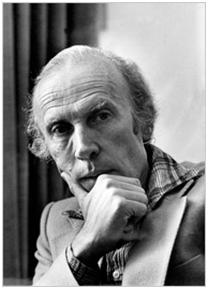
In reading the obituary of French New Wave director Eric Rohmer, I was struck by his uncanny resemblance to (fellow Frenchman) Gérard Debreu. Many things to ponder here, including the relationship of general-equilibrium theory to the cinema of the nouvelle vague.

Samuelson and Schumpeter
| Peter Klein |
Paul Samuelson, the enormously influential economic theorist, textbook writer, and teacher, died yesterday. The Times calls him “the foremost academic economist of the 20th century,” which may be true, depending what’s meant by “foremost.” He was certainly brilliant, talented, and creative. His Foundations of Economic Analysis (1949) changed forever the way economists think about their discipline (formerly a distinct, mostly verbal, logical science, economics became a branch of classical mechanics). His textbook Economics established a new style for introductory texts: lengthy, comprehensive, but ad hoc and unsystematic (Murray Rothbard called it a “vast potpourri . . . of bits and smidgens of technique and of data, none of them integrated into any sort of digestible or comprehensible whole”).
The blogosphere is beginning to spew out commentary, not all of it flattering (Krugman fawns, Ed Glaeser and Arnold Kling are more nuanced, Yuri Maltsev is gracious, Mario Rizzo is blunt). I don’t have much to add specifically for O&M readers, but I’m curious about one issue that may not get much play: the influence on Samuelson’s thought of Joseph Schumpeter, Samuelson’s dissertation supervisor at Harvard.
In many ways, they were opposites: Schumpeter the flamboyant, dramatic innovator, Samuelson the careful, rigorous systematizer; Schumpeter the defender of capitalism and critic of Keynes, Samuelson the interventionist and foremost American Keynesian; Schumpeter, someone I greatly admire, Samuelson. . . . well, you get the picture. Both were brilliant and egocentric (you all know the Schumpeter quip about wishing to become the greatest horseman, economist, and lover in Vienna, but achieving only two of the three; Samuelson once declared, “I can claim in talking about modern economics I am talking about me”).
Samuelson is mentioned in the Schumpeter biographies, including McCraw’s, mostly to illustrate Schumpeter’s enthusiasm for Samuelson’s brand of mathematical economics, which Schumpeter greatly admired even if he himself was not a practitioner. Samuelson has written a bit on his old teacher, mostly to praise Schumpeter’s brilliance (and celebrate his quirkiness, particularly in the classroom), but not much on Schumpeter’s specific theoretical contributions. (Here is Samuelson’s 1951 paper “Schumpeter as a Teacher and Economic Theorist,” which is a good read but not, ultimately, very informative; here is Samuelson’s critique of Schumpeter’s theory of equilibrium interest rates). Samuelson certainly didn’t give the entrepreneur a prominent place in his own system (here is a technical paper on innovation); what did he think of Schumpeter’s account of entrepreneurship and economic change?
War, Taxes, and Doux Commerce
| Dick Langlois |
Uwe Reinhardt, a health economist at Princeton, is eminently familiar with the idea of moral hazard. In a recent blog in the New York Times, he applies the idea to war. “If the monetary and the blood cost of war are shifted mainly to citizens other than the elites who are empowered to declare war and decide how it is conducted,” he writes, “then that elite is more likely to embrace war and to spend on it.” (I’m sure others have said this before, though I’ll rely on my colleagues and readers to supply the cites. Bob Higgs?) Reinhardt points out that, rather than raise taxes to pay for war, Bush cut taxes after entering Afghanistan. This had the effect of hiding the cost and pushing the financing into deficit spending, which is less easy for voters to detect. Those of us of a certain age remember how Lyndon Johnson, with the acquiescence of the Fed, financed Vietnam (and his domestic programs) largely through inflation. Apparently, some in Congress are calling for a law that would require a tax surcharge whenever war is declared.
As I say, these ideas may already be familiar to O&M readers and may even have been touched on in previous posts. But the Reinhardt piece reminded me of an idea I’ve been playing with for a long time. There is a large literature on the doux commerce thesis (see especially Albert Hirschman): the idea that increasing trade and wealth (increasing capitalism, if you will) leads to less violent and warlike societies. Oversimplifying more than a bit, the idea is that increased wealth increases the opportunity cost of war and violence. Maybe this is already in Hirschman or elsewhere, but it seems to me, however, that there must be not just a substitution effect but also an income effect. Higher GDP increases the opportunity cost of war on average (even if, as Reinhardt points out, not necessarily for the elites). At the same time, however, a wealthier society is more able to buy more war, all other things equal. Someone with the wherewithal might try to see which effect is more important by using cross-country historical data sets in the Acemoglu-Johnson-Robinson vein. If you ever run into somebody doing that sort of thing, remember that you heard it here first.





 Organizations and Markets
Recent Comments