Posts filed under ‘History of Economic and Management Thought’
Opening Lines I Wish I’d Written
| Peter Klein |
Last week was tough for Shakespeare scholars who wear tweed jackets with leather elbow patches and sip sherry in the faculty lounge. You know, the people otherwise known as Saab drivers.
That’s from a Friday WSJ piece on GM’s attempt to dump its Saab subsidiary. Readers outside the US may not get the joke. Trust me, it’s funny.
The article is actually pretty interesting, an illustration of Williamson’s “impossibility-of-selective-intervention” thesis. “The Saab saga also demonstrates how hard it is for a boutique company to retain its special appeal after being bought by a corporate goliath. GM did make some good Saabs over the years (the midsize 9-5 model of a decade ago was one), but they didn’t seem as special as the pre-GM Saabs, even though the key stayed in the floor.” Maybe, but it isn’t obvious why the mismanagement of the Saab brand (in the US) was GM’s fault, rather than that of Saab’s division heads. Saab may have tanked anyway. Anyway, I did learn a good line from Sir John Egan, the last independent CEO of Jaguar before its acquisition by Ford, that I’ll use the next time I’m teaching about selective intervention: “When an elephant gets in bed with a mouse, the mouse gets killed and the elephant doesn’t have much fun.” Oh, and the article ends well too: “As for those sherry-sipping profs, maybe they should consider buying Chevy Silverado pickups with all the trimmings: Mars lights, gun racks and monster-truck tires. Iconoclasm can take different forms, and the talk in the faculty lounge will never be the same.”
Bonus: That same issue of the Journal also contained a strange piece by John Cassidy praising Pigou, on the grounds that Pigou’s analysis of externalities gives us unique insight into the financial crisis. “Thus, for example, a blow-up in a relatively obscure part of the credit markets—the subprime mortgage industry—can undermine the entire banking system, which, in turn, can drag the entire economy into a recession, as banks refuse to lend.” Um, duh. “Externalities” are ubiquitous, and the idea of the general interdependence of markets has been discussed since, well, Bastiat, if not the Scholastics. Certainly Pigou didn’t offer any special insight into the interdependencies across financial markets or between financial markets and product markets. Writes Cassidy: “Economics textbooks have long contained sections on how free markets fail to deal with negative spillovers such as pollution, traffic congestion and the like. Since August 2007, however, we have learned that negative spillovers occur in other sectors of the economy, especially banking.” Since August 2007? Gee, before that, we all thought banking was an isolated sector of the economy with no connection to anything.
CFP: “Institutions in Economic Thought”
| Peter Klein |
That’s the theme for the next meeting of the Charles Gide Association for the Study of Economic Thought (ACGEPE), to be held at the University of Paris Panthéon-Sorbonne, 27-29 May 2010. Steve Medema, Malcolm Rutherford, and O&M friend Claude Ménard are the keynote speakers. Proposal deadline is 27 November. Details here.
Penrose (1959) Golden Anniversary
| Peter Klein |
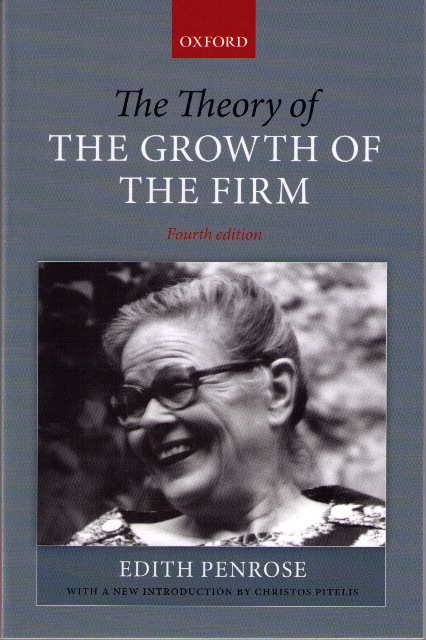 This year marks the 50th anniversary of Edith Penrose’s Theory of the Growth of the Firm (1959), one of the most important and influential books on the firm and firm strategy. To celebrate, Yasemin Kor and Christos Pitelis organized a roundtable at last week’s SMS conference with remarks by Christos, Yasemin, Joe Mahoney, Margie Peteraf, and Maurizio Zollo. The participants have graciously allowed me to post their slides and materials (1, 2, 3, 4). Christos, Penrose’s friend and literary executor, has edited and introduced a new edition of the 1959 book, which you can purchase here. You can read his introduction here. Nice!
Penrose trivia: During the 1950s Murray Rothbard made his living by reviewing literature and grant proposals for the William Volker Fund. When going through Rothbard’s correspondence a few years ago I came across a proposal for a study on firm growth submitted jointly by Penrose and Fritz Machlup, her dissertation supervisor at Johns Hopkins. Apparently at one point, the book was going to be a joint project. (Rothbard thought the ideas in the proposal didn’t fit with Penrose’s earlier warnings about the use of biological analogies in economics. However, as Joe Mahoney has noted, there is no inconsistency between the 1952 article and the 1959 book; Penrose is careful in her work on growth not to treat growth tendencies in firms as automatic, but to model them based on the preferences, beliefs, and actions of the firm’s personnel. In other words, she accepts natural selection in this context but not random mutation.)
BTW, what other important works in our field appeared in 1959, to be celebrated this year? Coase’s article on the Federal Communications Commission is one. The 1970s may have been the golden decade but there were major contributions in the previous decades as well. What are your favorites? Whose anniversary should we be preparing to celebrate?
The Fate of Famous Economists
| Peter Klein |
 Even very famous ones. The Dundee Courier (what, you don’t read it?) reports that Adam Smith’s gravestone, in the courtyard of Canongate Kirk in Edinburgh, is in bad shape: “Smith’s gravestone could be in danger of deterioration after years of exposure to the elements, vandalism and neglect” (HT: MGK). According to a spokesperson for the World Monument Fund, cemeteries in the central parts of cities like Edinburgh have become “unsafe environment[s] home to illicit activities.” Apparently David Hume’s grave, elsewhere in Edinburgh, is also threatened. How ironic that we put dead politicians in great cathedrals and mausoleums (and, while living, give them Nobel Prizes), while actual heroes are abandoned and forgotten.
Masters of Finance
| Peter Klein |
The American Finance Association has assembled a terrific set of video interviews and lectures with eminent financial economists including Markowitz, Sharpe, Samuelson, Merton, Scholes, Arrow, Fama, and Myers. (HT: Fama/French.)
Bentham and Hume in the West Wing
| Dick Langlois |
From a perhaps uncharacteristic source — David Brooks at the New York Times — comes a funny and spot-on column about Bentham and Hume as present-day DC policy advisors.
The people on Mr. Bentham’s side believe that government can get actively involved in organizing innovation. . . . The people on Mr. Hume’s side believe government should actively tilt the playing field to promote social goods and set off decentralized networks of reform, but they don’t think government knows enough to intimately organize dynamic innovation.
So let’s have the debate. But before we do, let’s understand that Mr. Bentham is going to win. The lobbyists love Bentham’s intricacies and his stacks of spending proposals, which they need in order to advance their agendas. If you want to pass anything through Congress, Bentham’s your man.
History of Economic Thought Boot Camp
| Peter Klein |
A message from Bruce Caldwell:
I am pleased to announce that the Center for the History of Political Economy at Duke University has been awarded a grant by the National Endowment for the Humanities to support a Summer Institute to be held at Duke June 6 – 25, 2010. The institute will bring 25 faculty members from colleges and universities in the US with no previous experience teaching history of economic thought to Duke for a three week “Boot Camp,” with the goal that the participants will go back to their home institutions both prepared and eager to teach an undergraduate course in the field. A number of HES members (past or present Society presidents all, in fact) will serve as lecturers and discussion leaders, including Brad Bateman, Bruce Caldwell, Craufurd Goodwin, Kevin Hoover, Steve Medema, Sandy Peart, and Roy Weintraub. We are hopeful that this institute, if successful, will be continued in future years, and that if alternative sources of funding become available, could be opened up to include graduate students and non-US citizens. (The current constraints on eligibility are due to NEH rules.)
You can contact Bruce for more information.
Idea for Historical Law and Economics Thesis
| Nicolai Foss |
Apropos the always-topical issue of the efficacy of the death penalty, I was recently told by Siegwart Lindenberg that one of Gordon Tullock’s characteristically quirky proposals for reform was to institute the death penalty as the sanction that any crime would meet in the criminal justice system. However, there was a twist, because although any criminal would receive a death penalty, not all criminals would actually be executed. Specifically, all criminals would be strapped to the chair, but there was only a probability that the button would be pressed, the probability depending on the severity of the crime. Because of risk aversion and a tendency to overestimate probabilities (and for the Draconian symbolic value), this scheme would put an effective end to much crime. (I haven’t been able to find a reference for this idea; perhaps it exists only in the oral tradition that surrounds the Tullock figure).
It is easy to dismiss the Tullock scheme as “cruel,” “inhuman,” “far out,” “not practicable,” etc. But perhaps it does have a historical precursor. At its height the criminal law of England (the “Bloody Code”) included more than 220 crimes that were punishable by death, including “being in the company of gypsies for more than one month” (here is the Wiki). Other countries have had similar broad approaches to which crimes were punishable by death, though perhaps few as Draconian as England’s. However, one has to bear in mind that there generally was a pardon system, and that it is quite likely that some of the weirder crimes leading to death sentences were more likely to be pardoned than the really serious ones (e.g., a pardon may have been more likely in the case of the “crime” of being in the company in gypsies than outright murder). Could it be that this pardon system functioned in such a way that the probabilities of actual execution directly reflected the real severity of the crime? It seems likely. The data are definitely there. It is just collecting them and doing the analysis.





 Organizations and Markets
Recent Comments