Posts filed under ‘Innovation’
Da Vinci in the Kitchen
| Peter Klein |
More on engineering versus economic perspectives on innovation:
For Leonardo, every food was only as good as the machine that created it, the technique was as important as the taste. Leonardo’s work in the Sforza kitchen strove for efficiency, but often the result of all this time — saving was sheer insanity, reported the humanist courtier Sabba da Castiglione:
“Master Leonardo da Vinci’s kitchen is a bedlam. . . . At one end of the premise, a great waterwheel, driven by a raging waterfall over it, spewed and spattered forth its waters over all who passed beneath and made the floor a lake. Giant bellows, each twelve feet long, were suspended from the ceilings, hissing and roaring with intent to clear the fire smoke, but all they did accomplish was to fan the flames to the detriment of all who needed to negotiate by the fires — so fierce the wandering flames that a constant stream of men with buckets was employed in trying to quell them, even though other waters spouted forth on all from every corner of the ceilings.”
Every kitchen task could be mechanized — crushing garlic, pulling spaghetti, plucking ducks, cutting a pig into cubes — but the machines Leonardo imagined were sometimes far more elaborate than the task required. His invention for a giant whisk twice the size of a man involved an operator from within who was constantly in danger of being wisked into the sauce. . . . Another model involved a team of three horses engaged in the task of crushing a nut.
Michelle Legro has all the details (via Robin Varghese).
In the Journals
| Peter Klein |
Three newly published papers of likely interest to O&Mers:
- Jeffrey L. Furman and Scott Stern, “Climbing atop the Shoulders of Giants: The Impact of Institutions on Cumulative Research,” American Economic Review 101, no. 5 (August 2011).
While cumulative knowledge production is central to growth, little empirical research investigates how institutions shape whether existing knowledge can be exploited to create new knowledge. This paper assesses the impact of a specific institution, a biological resource center, whose objective is to certify and disseminate knowledge. We disentangle the marginal impact of this institution on cumulative research from the impact of selection, in which the most important discoveries are endogenously linked to research-enhancing institutions. Exploiting exogenous shifts of biomaterials across institutional settings and employing a difference-in-differences approach, we find that effective institutions amplify the cumulative impact of individual scientific discoveries.
- Antti Kauhanen, “The Perils of Altering Incentive Plans: A Case Study,” Managerial and Decision Economics 32, no. 6 (September 2011).
This paper studies a retail chain that introduced a sales incentive plan that rewarded for exceeding a sales target and subsequently cut the incentive intensity in addition to increasing the target. Utilizing monthly panel data for 54 months for all 53 units of the chain the paper shows that the introduction of the sales incentive plan increased sales and profitability, whereas the changes in the plan lead to a marked drop in sales and profitability. Thus, modifying the incentive plan proved costly for the firm. The results are consistent with the gift-exchange model of labor contracts.
- Oriana Bandiera, Iwan Barankay, and Imran Rasul, “Field Experiments with Firms,” Journal of Economic Perspectives 25, no. 3 (Summer 2011).
We discuss how the use of field experiments sheds light on long-standing research questions relating to firm behavior. We present insights from two classes of experiments—within and across firms—and draw common lessons from both sets. Field experiments within firms generally aim to shed light on the nature of agency problems. Along these lines, we discuss how field experiments have provided new insights on shirking behavior and the provision of monetary and nonmonetary incentives. Field experiments across firms generally aim to uncover firms’ binding constraints by exogenously varying the availability of key inputs such as labor, physical capital, and managerial capital. We conclude by discussing some of the practical issues researchers face when designing experiments and by highlighting areas for further research.
The Stresses of New Technology in Firm and Family
| Peter Lewin |
Many of the same theoretical tools and concepts that we use for the business firm are applicable to that other ubiquitous social institution, the family; though of course there are important differences (even though I am sure you know people who are “all business”). Steve Horwitz and I have written a paper that illustrates some of this.
The affects of the march of technology on the firm — for example, rendering obsolete certain kinds of physical and human capital, reducing production cost, increasing specialization and product variation, etc. — receive considerable attention. I have not seen much on these affects insude the family. Our article does analyze the long-term effects of the rising opportunity cost of labor in general and of women’s work in particular, which is the theme of a massive research literature. I have in mind rather the “mundane” effects on the family, and on the marriage, of unanticipated technological changes that, for example, affect the spouses differently. In effect, this is an unanticipated change in the marriage bargain that will plausibly bring with it additional un-bargained for stresses and tensions — an unanticipated rise in the cost of marriage (or of staying in the marriage).
I love my wife and I am not contemplating leaving, but I do feel the stress of having to perform all of the 21st century tasks for which I have a substantial comparative advantage, and which have become necessary and routine — like ordering things online, backing up data, downloading audio books (a necessity for exercising!) and so on. I wonder how common this is.
I might be in real trouble for this one :-).
Technology Quote of the Day
| Peter Klein |
Jobs and Apple have done the best job of answering with their products the question posed by wiki inventory Ward Cunningham: What’s the simplest thing that could possibly work? As I’ve stressed before, most technologists / nerds / geeks don’t think this way — they think that success comes from cramming in features and functions, bells and whistles.
I’ve made this point many times in my speaking and teaching on technology and innovation, particularly with regard to so-called “QWERTY effects” and the claim that markets with network externalities tend to select suboptimal technologies. A serious problem in this literature is that “optimal” is almost always defined from the engineer’s point of view, not the consumer’s (e.g., Betamax was “really” better than VHS because the picture quality was higher and the tapes more compact, even though the recording time was shorter and the recorders much more expensive). Aside from what the market chooses, by what standard do we deem one technology more “efficient” — in an economic sense — than another?
As one disgruntled RIM employee complained recently to upper management: “The whole campaign around the [Blackberry] Playbook seems to be ‘IT DOES FLASH! LOOK!’ . . . but honestly, my mother doesn’t know or care about that. She wants to know ‘can I play Angry Birds?'”
User-Driven Innovation, India Edition
| Peter Klein |
[E]very now and again one encounters an article in the American business press about jugaad, the uniquely Indian capacity to join broken things, and make them work, using country fixes. In on-going debates about innovation in India, it seems inevitable that one returns to the ‘ingenious fixes’ of those days, to ask how that talent and human inventiveness can be better harnessed towards the future.
The classic theory of innovation is provided in economic terms by Joseph Schumpeter, who listed several different kinds of changes that could be brought about through entrepreneurial action. These included the discovery and creation of new markets, the development of new methods of production and transportation, as well as new forms of industrial organization, and — this is critical — new kinds of consumer goods and the new experiences of value that they afford. It is striking to me that even though the country-mechanics and other jugaad specialists of India are capable of achieving none of these aims, they are still held up as somehow occupying a place or showing a kind of direction for innovation, that is not otherwise visible to us. It is as if we know, somehow, that all the abstract jargon of business thinking and economic reasoning has its place, but that it cannot replace that hands-on messing about with tools and things that artisans, craftspeople, and repairmen share. Jugaad seems to serve as a figure for design-thinking and problem-solving in the real world, capabilities which are scarce to the point of being unknown and unheard in many corners of Indian industry and public life.
Navi Radjou, Jaideep Prabhu, and Simone Ahuja, writing last year in HBR, call jugaad “the art of creative improvisation,” the Indian version of the long-standing tradition of user-driven innovation associated with Cyrus McCormick, the Danish windmill industry, and open-source software.
Entrepreneurship in Africa
| Dick Langlois |
Inspired by Peter Lewin’s recent post on the beauty of Africa, I decided to hop on a plane to Peter’s native South Africa. I haven’t been to a wildlife park, though I have found myself twice down in caves, one containing fossils and one a disused gold mine. I also took in the Apartheid Museum, which seemed to me (as an outsider) to be extremely well done. It didn’t pull any punches but always appeared neutral, even analytical. For me, the museum’s story underscored the point that Walter Williams and others always used to argue while apartheid was going on: that the system required, and was implemented through, central planning and massive government intervention in markets. (Apparently they even had a wacky scheme to move people from their distant segregated homes to and from urban work using high-speed bullet trains.) I was struck by how similar the revolution here was to the contemporaneous one in Eastern Europe. It was a revolt by a middle class that was denied human and political rights — and also economic opportunity — by an increasingly inefficient and distortive state apparatus.
A couple of exhibits at the Apartheid Museum asserted that in the heyday of gold mining the British had “fixed the price of gold.” This price fixing forced the mine owners constantly to lower production costs, which they did by deskilling mining operations – using technology to break the process into simpler tasks (Ames and Rosenberg 1965) — in order to hire cheaper labor. By contrast, the mining museum suggested that there was plenty of skill-enhancing innovation as well, like pneumatic drills replacing the hammer and chisel, which reduced from eight hours to five minutes the time it took a worker to carve out a blasting hole.
Oddly, neither museum mentioned that gold was the monetary standard. (You know this already: it’s not that the “price of gold” was fixed; it’s that the value of the currency was defined in terms of units of gold.) This might sound like an economist’s carping. But I mention it because on this trip I also encountered the strange combination of task design and monetary economics in a strikingly different African context. I’m actually in south Africa not primarily for the tourism (at least in principle) but to visit Giampaolo Garzarelli and his Institutions and Political Economy Group at the University of the Witwatersrand and, as Peter Klein mentioned in an earlier post, to attend a conference on “Open Source, Innovation, and New Organizational Forms,” which took place on Monday. Joel West, another of the participants, has already blogged elsewhere about the conference. One paper, by an MA student from Kenya – Joel has already blogged about this as well – discussed an amazing phenomenon I had never heard about before: crowdsourcing in developing countries using mobile phones. A company called txteagle allows customers to outsource cognitive work by breaking tasks into small pieces, which pieces are then sent to participants via text message. (As phones have become cheaper they have become ubiquitous in the developing world.) For example, the participant could be asked to translate a phrase into his or her local language or to transcribe a voice snippet. The txteagle computers then aggregate the output and use redundancy and artificial intelligence to validate the results. The participant is paid for the task, via the same mobile phone, using M-Pesa, a system I first heard about only a couple of weeks ago. Interestingly, M-Pesa is itself a formalization of a spontaneous monetary system – think cigarettes at a prison camp – in which people without access to banks would save and transact in airtime minutes. The amount a participant can earn in this system is quite meaningful in the context of poor countries with high unemployment.
Is the Internet “Transforming” Business?
| Peter Klein |
In the 1990s and early 2000s there was a huge debate about the impact of information technology on productivity. Robert Solow famously quipped, “You can see the computer age everywhere but in the productivity statistics.” Robert Gordon, Erik Brynjolfsson, Jack Triplett, and many others participated in this debate, with issues revolving around productivity measurement, workplace incentives, organizational complementarities, and more. (I did some work on this too.) The end result was a rough consensus that IT did increase productivity, but that the effects were modest.
The buzz over “wikified” organizations — open-source communities, highly disaggregated firms, crowdsourced production, and the like — gives me a strong sense of déjà vu. Indeed, we have not been kind to the wikinomics view in these pages. Now Don Tapscott, a leader of this movement, seems to be having second thoughts:
In our 2006 book Wikinomics, Anthony D. Williams and I looked at dozens of companies that have used the Internet to transform their business models and achieve tremendous success.
However, in the five years since the book’s publication, we’ve noticed something striking: the rate of business model innovation has not accelerated. Yes, some individual companies have achieved competitive advantage by exploiting the web and networked business models. But overall the gains have been modest.
The reason, says Tapscott, is that “it’s becoming difficult or even impossible for companies to achieve breakthrough success without changing their entire industry’s modus operandi.” This reminds me of the conclusion from the earlier literature that IT has the biggest effect when combined with complementary organizational practices (e.g., Milgrom and Roberts, 1995), which suggests that change doesn’t occur until all elements of the complementary bundle are in place — maybe a long time after the initial innovation.
Upcoming Conferences
| Peter Klein |
- ISNIE, 16-18 June in Palo Alto. Registrations are closed but latecomers could try lobbying the Treasurer to accept a late payment — never mind, that’s me, don’t bother.
- “Open Source, Innovation, and New Organizational Forms,” 1 August in Johannesburg. “This first IPEG conference intends to explore new theoretical and empirical advances in open source organization: the interest is not just on voluntary Open Source Software production and its potential innovation implications, but also on such related ‘open source’ phenomena as collective invention, online collaboration (e.g., Wikipedia), online social networking (e.g., Facebook), open innovation, open science, open source biology, and open standards.” The conference website is not live as of this posting, but organizer Giampaolo Garzarelli can provide details. O&M’s Dick Langlois is a keynote speaker. 500-word abstracts are due 24 June.
- “Achieving Coexistence of Biotech, Conventional & Organic Foods in the Marketplace,” 26-28 October in Vancouver. Speakers include FAO Deputy Director General Ann Tutweiler and Canadian Ag Minister Gerry Ritz. Coexistence conferences have been held every other year since 2003; the first 3 conferences came out of EU Commission efforts, the next was in Australia, and this one is the first to be held in North America. A co-organizer tells me “we hope to bring a more ‘practical’ view of coexistence than is commonly held in Europe.”
Inventors During the Industrial Revolution
| Peter Klein |
Following up an earlier post on apprenticeship: Ralf Meisenzahl and Joel Mokyr discuss the role of apprenticeship in the diffusion of innovation among skilled craftsmen during the British Industrial Revolution. “Using a sample of 759 of these mechanics and engineers, we study the incentives and institutions that facilitated the high rate of inventive activity during the Industrial Revolution. First, apprenticeship was the dominant form of skill formation. Formal education played only a minor role. Second, many skilled workmen relied on secrecy and first-mover advantages to reap the benefits of their innovations. Over 40 percent of the sample here never took out a patent. Third, skilled workmen in Britain often published their work and engaged in debates over contemporary technological and social questions. In short, they were affected by the Enlightenment culture.”
Managing Innovation
| Peter Klein |
My old classmate Hank Chesbrough offers some thoughts on managing innovation in HBR’s Conversation Blog. Previous decades brought us systems analysis, PERT, TQM, supply chain management, and open innovation. What’s next? Hank’s predictions:
First, management innovation will become more collaborative. Opening up the innovation process will not stop with accessing external ideas and sharing internal ideas. Rather, it will evolve into a more iterative, interactive process across the boundaries of companies, as communities of interested participants work together to create new innovations. . . .
Second, business model innovation will become as important as technological innovation. . . . Third, we will need to master the art and science of innovating in services-led economies. Most of what we know about managing innovation comes from the study of products and technologies. Yet the world’s top advanced economies today derive most of their GDP from services rather than products or agriculture.
Economics of Wikipedia
| Peter Klein |
 Wikipedia turns ten today, as you’ve no doubt heard. Most Wikipedia content is recycled, so let me honor the subject by recycling an old O&M post: “Hayek and Wikipedia.” The relationship between the Wikipedia model and Hayek’s concept of dispersed, tacit knowledge, exploited through decentralized decision-making, is perhaps to obvious to note, but consider it noted. See also this Reason piece which emphasizes the Hayek connection. (Of course, in Hayek’s model, information is communicated and actions coordinated through changes in market prices, a feature absent from systems like Wikipedia.) You may also amuse yourself with other old O&M posts about tacit knowledge.
Google Tries Selective Intervention?
| Peter Klein |
Can a large firm do everything a collection of small firms can do, and more? If not, how do we understand the limits to organization? Arrow focused on the information structure inside firms. I favor Mises’s economic calculation argument. Williamson’s preferred explanation for the limits to the firm is the impossibility of selective intervention — the idea that higher-level managers cannot credibly commit to leave lower-level managers alone, except when such selective intervention would generate joint gains. Williamson’s argument is not, however, universally embraced (or even understood the same way — see the comments to Nicolai’s post).
Google apparently sees things Williamson’s way and has formulated an explicit policy on “autonomous units” designed to address the problem. Such units “have the freedom to run like independent startups with almost no approvals needed from HQ, ” reports TechCrunch. “For these divisions, Google is essentially a holding company that provides back end services like legal, providing office space and organizing travel, but everything else is up to the pseudo-startup.” Can it work? Insiders are doubtful. The TechCrunch reporter even frames Williamson’s thesis in this folksy way:
There’s a lie that companies and entrepreneurs tell themselves in order to commit to an acquisition.
Oh, we’re not going to change anything! We’re just going to give you more resources to do what you’ve been doing even better!
Yeah! They bought us for a reason, why would they ruin things?
It usually works for a little while, but big company bureaucracy– whether it’s HR, politics or just endless meetings– almost always creeps in. It’s a law of nature: Big companies just need certain processes to run and entrepreneurs hate those processes because they stifle nimble innovation.
Short Course on Network Economics
| Peter Klein |
 I’m teaching a five-week, online course starting in January called “Networks and the Digital Revolution: Economic Myths and Realities.” It’s offered through the Mises Academy, an innovative course-delivery platform that is becoming its own educational ecosystem. A description and course outline is here, signup information is here. I’d love to have you join me!
CFP: “Competition, Innovation and Rivalry”
| Peter Klein |
The European Society for the History of Economic Thought (ESHET) is having its 15th annual meeting 19-22 May 2011 at Bogazici University, Istanbul. A special themed section, headlined by keynoters (and O&M friends) Dick Nelson and Stavros Ioannides, is “Competition, Innovation and Rivalry”:
The way in which innovation has been described, categorised, contextualised and theorised by various figures as well as schools of thought in the discipline of economics warrants a thorough investigation from a history of economic thought perspective. Although it is a truism that some approaches in economics by focusing on the conditions of allocating resources efficiently within a static framework failed to consider innovation properly, other approaches by underscoring the evolutionary characteristics of the economy, and thus by paying attention to dynamic efficiency, aimed at shedding light on innovation in an explicit manner. Knowledge and entrepreneurship standing as natural ingredients of innovation, much debate has been devoted to the roles played by competition, rivalry and collaboration among economic actors. A corollary of this debate has been on the characterisation of different economic systems in boosting or hampering innovation. . . . We are interested in papers that expose the history of economic ideas concerning innovation, competition and rivalry as well as papers that provide a historical or methodological perspective concerning methodological, ideological and political debates which evolved around these concepts.
Abstracts are due 15 December; see the above link for details.
Mirowski on Backhouse and Fontaine, eds., The History of the Social Sciences since 1945
| Peter Klein |
I enjoyed Philip Mirowski’s first book, though I find his more recent stuff increasingly tendentious and repetitive. Still, a Mirowski review of Backhouse and Fontaine, eds., The History of the Social Sciences since 1945 (Cambridge, 2010) is worth a read. Interesting bit on organizational structure:
The historical generalization overlooked by the editors is that “interdisciplinary” social science units shoehorned into postwar university structures almost uniformly failed, whereas those founded as freestanding think tanks, from RAND to American Enterprise Institute to Cato and the Manhattan Institute, all persevered and succeeded. This is true even for the odd case of Carnegie GSIA, which became the model for other business schools across the nation, but only upon dispensing with the original interdisciplinary structures initially promoted by Herbert Simon (himself then exiled to a Department of Psychology). The lesson may be that the postwar American research university could not sustain true interdisciplinarity in social science inquiry, but that military and corporate sponsors of the think tanks could manage it, but only by yoking it to a format that enforced unquestioned responsiveness to the whims of the funders.
A familiar point of course to students of entrepreneurship and innovation, and yet another reason to suspect that innovation in higher education is more likely to come from outsiders (e.g., the notorious for-profit institutions) than incumbents.
CFP: Searle Center Conference on Entrepreneurship and Innovation
| Peter Klein |
I’m a big fan of the Searle Center conferences on entrepreneurship and innovation, organized by Dan Spulber. The Call for Papers for the fourth annual conference, 16-17 June 2011, has just been distributed. “The goal of this conference is to provide a forum where economists and legal scholars can gather together with Northwestern’s own distinguished faculty to present and discuss high quality research relevant to entrepreneurship and innovation.” Details below the fold. (more…)
Two New Books on Economic Growth
| Dick Langlois |
In addition to the review of Doug Puffert’s book that Peter discusses in his most recent post, EH.net has also just issued reviews of two books on economic growth that should be of interest to O&M readers. One is of Michael Heller’s Capitalism, Institutions, and Economic Development. I hope this one gets wide circulation despite being an expensive Routledge title. The other is of Matt Ridley’s The Rational Optimist: How Prosperity Evolves. That one should get a lot of attention.
Mmmmmm. . . . Bacon!
| Peter Klein |
 This post begged to be written. It started last weekend when I heard Jim Gaffigan’s bacon routine on the Slacker Comedy Channel. Then, during the week, the Mises Institute ran an excerpt from Murray Rothbard’s History of Economic Thought on Francis Bacon. (Rothbard wasn’t impressed, calling Bacon “the prophet of primitive and naive empiricism, the guru of fact grubbing.”) As if that weren’t enough, Rafe Champion decided around the same time to summarize Terence Kealey’s Economic Laws of Scientific Research, the first chapter of which contrasts Bacon’s and Adam Smith’s views on the relationship between science and economic growth. (Bacon’s model: State support -> Basic Research -> Technology -> Progress in human welfare. Smith’s model: Old technology -> New Technology -> Wealth and Welfare.) Bacon — you just can’t get enough!
The Myth of the Razors-and-Blades Strategy
 | Peter Klein |
Not quite as exciting as the GM-Fisher contretemps, but in the same revisionist vein: Randy Picker’s new paper, “The Razors-and-Blades Myth(s).”
From 1904-1921, Gillette could have played razors-and-blades — low-price or free handles and expensive blades — but it did not do so. Gillette set a high price for its handle — high as measured by the price of competing razors and the prices of other contemporaneous goods — and fought to maintain those high prices during the life of the patents. For whatever it is worth, the firm understood to have invented razors-and-blades as a business strategy did not play that strategy at the point that it was best situated to do so.
Here’s a PPT version.
Well, as Bogey might have said to Bergman: “We’ll always have printer ink.”
Analyzing the WikiLeaks Data
| Peter Klein |
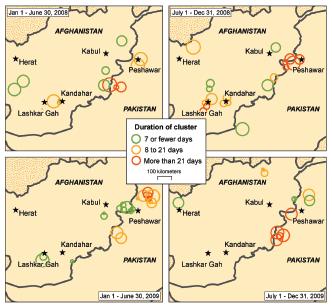
Once more on WikiLeaks: A team of University of Colorado researchers has already produced a geospatial analysis of the incident reports contained in the dataset. “By mapping the violence and examining its temporal dimensions, the authors explain its diffusion from traditional foci along the border between the two countries. While violence is still overwhelmingly concentrated in the Pashtun regions in both countries, recent policy shifts by the American and Pakistani governments in the conduct of the war are reflected in a sizeable increase in overall violence and its geographic spread to key cities. . . .” This is exactly the kind of analysis the military intelligence agencies are not doing, or at least not sharing.
Economists, geographers, entrepreneurship and innovation researchers, and other social scientists have a lot of expertise in network and cluster analysis. Why not turn them loose on these kinds of raw data? It’s also cheap: as Karen Kwiatkowski notes, “[t]he study was honestly, scientifically, and nimbly completed and published at no direct cost to the intelligence community. It was made possible by the decentralization, fluidity, and constant sharing and shifting of roles and responsibilities that comprise the Internet.”





 Organizations and Markets
Recent Comments