Posts filed under ‘Institutions’
Financing Constraints and Entrepreneurship
| Peter Klein |
Speaking of banks, here’s a very good survey of the entrepreneurship literature on financing constraints by William Kerr and Ramana Nanda, just out from NBER. From the introduction:
The first research stream considers the impact of financial market development on entrepreneurship. These papers usually employ variations across regions to examine how differences in observable characteristics of financial sectors (e.g., the level of competition among banks, the depth of credit markets) relate to entrepreneurs’ access to finance and realized rates of firm formation. The second stream employs variations across individuals to examine how propensities to start new businesses relate to personal wealth or recent changes therein. The notion behind this second line of research is that an association of individual wealth and propensity for self-employment or firm creation should be observed only if financial constraints for entrepreneurship exist.
These two streams of research have remained mostly separate literatures within economics, driven in large part by the different levels of analysis. Historically their general results have been mostly complementary. More recently, however, empirical research using individual-level variation has questioned the extent to which financing constraints are important for entrepreneurship in advanced economies. This new work argues that the strong associations between the financial resources of individuals and entrepreneurship observed in previous studies are driven to large extents by unobserved heterogeneity rather than substantive financing constraints. These contrarian studies have led to renewed interest and debate in how financing environments impact entrepreneurship in product markets.
Further My Last
| Craig Pirrong |
My previous post on the Acharya et al (AEFLS) assertion of the purported externality in bilateral OTC markets focused on whether there was actually an unpriced “bad.” I judged otherwise based on the fact that credit and counterparty risks are repriced repeatedly (and ruthlessly).
There is another reason to reject their analysis. It should be incumbent on one who justifies the existence of an externality to justify a particular policy to (a) identify the transactions costs that preclude internalization of this externality, and (b) demonstrate that their policy would create a net benefit, by, for instance, reducing transactions costs. AEFLS don’t even try to do this (another symptom of the Nirvana fallacy). And when one examines the particulars, it is highly doubtful that the costs of the purported externality are as large as AEFLS insinuate that they are.
The AEFLS story is that contracts between two counterparties to an OTC derivatives deal impose costs on other market participants, notably, the firms’ other counterparties to earlier derivatives deals, and the counterparties’ counterparties, and on and on. OTC market participants don’t take these costs into account, trade too much, and create too much risk.
Which raises the Coase Question: if these costs are so large, why don’t the affected parties craft a solution that mitigates them? If, as AEFLS argue, a central counterparty would reduce these costs, why don’t the affected parties create one to internalize the externality and enhance their welfare? (more…)
Just So Stories: Financial Regulation Edition
| Craig Pirrong |
All of the legislative proposals relating to over-the-counter derivatives would impose seismic changes on the way that these instruments are traded, and the performance risks related to them are managed. Indeed, it is fair to say that these proposals, if implemented would dramatically shrink the OTC market, and perhaps destroy it altogether. Under either the House (Frank) or Senate (Dodd) bills, most derivatives would have to be traded on exchanges, and be cleared. (Clearing is a way of mutualizing default risks. At present, default risks in a particular contract are directly limited to the buyer and seller.) (BTW, when you hear “Frank and Dodd” do you think Fannie Mae and Freddie Mac? I do. Does this inspire confidence? Self-answering question.) These efforts are strongly supported by Treasury Secretary Timothy Geithner, CFTC head Gary Gensler, and SEC head Mary Shapiro.
These legislative proposals are clearly predicated on a very strong belief: participants in the derivatives markets routinely chose the wrong institutional arrangements. That this immense market is and was in fact arguably the largest market failure in financial history. (more…)
CFP: “Institutions in Economic Thought”
| Peter Klein |
That’s the theme for the next meeting of the Charles Gide Association for the Study of Economic Thought (ACGEPE), to be held at the University of Paris Panthéon-Sorbonne, 27-29 May 2010. Steve Medema, Malcolm Rutherford, and O&M friend Claude Ménard are the keynote speakers. Proposal deadline is 27 November. Details here.
QWERTY in the Long Run
| Dick Langlois |
The new issue of Industrial and Corporate Change has an article by Andreas Reinstaller and Werner Hölzl called “Big Causes and Small Events: QWERTY and the Mechanization of Office Work.” Although it’s an interesting paper in many respects, I think it fails in its avowed aim to defend Paul David against the attack of Liebowitz and Margolis. Mostly, they don’t get L&M right (and explicitly get them wrong in footnote 1). The issue is whether the QWERTY keyboard is an example of what L&M call “third-degree” path dependency, that, is path dependency leading to an outcome that is both regrettable ex post and would somehow have been remediable ex ante. The criterion of “remediable” to R&H seems to be whether contemporaries “knew about” superior alternatives. That’s not quite right, of course: the real issue is whether any alternative institutional structure could have done a better job of choosing a standard under the conditions of knowledge at the time. Their only example is the existence of a French “Ideal” keyboard layout (which some people “knew about”) that was swept aside by the tidal wave of the American QWERTY standard (and became AZERTY in France). But they have no evidence about how much better this keyboard was — or if it was better at all. In footnote 1 they cite Donald Norman’s interesting book on design to the effect that the Dvorak keyboard is 10 per cent faster than QWERTY. But (A) Norman’s point in the book is how insignificant this difference is and (B) that doesn’t demonstrate third-degree path dependency, since no one “knew about” the Dvorak keyboard until Dvorak invented it (an extremely laborious process, according to Norman).
Again, I don’t want to be too hard on R&H: I think there’s a lot that’s interesting in the paper, especially the discussion of the mechanization of office work. What really struck me in this context, however, is how irrelevant, or at least dated, the QWERTY saga is. And I say this not for the usual reason: that computers now allow us to have any keyboard layout we like. Rather, what struck me is that the production of documents has long since become demechanized, making even more-than-nominal differences in typing speed irrelevant. Since we now all (or almost all) compose right on the computer, and never send our documents out to the typing pool, manuscript production has become a craft again. What is slowing us down is how quickly we think of something to say, not how fast we can type. And I doubt that, fifties nostalgia notwithstanding, we are unlikely to see the return of the typing pool anytime soon. So, from a historical perspective, QWERTY will have been technically inefficient (though not therefore economically inefficient) only for that brief historical period between the invention of Dvorak and the coming of the personal computer.
The same issue of ICC also has a paper by Ashish Arora and coauthors that’s worth a look.
What Does the Rule of Law Variable Measure?
| Peter Klein |
Bill Easterly poses this question, referring to his NYU colleague Kevin Davis’s work on law and development. Davis has several papers criticizing economists’ use of rule-of-law variables in development research (1, 2, 3). As summarized by Easterly:
Kevin points out that two current measures of “rule of law” used by economists in “institutions cause development” econometric research are by their own description a mixture of some characteristics of the legal system with a long list of non-legalistic factors such as “popular observance of the law,” “a very high crime rate or if the law is routinely ignored without effective sanction (for example, widespread illegal strikes),” “losses and costs of crime,” “corruption in banking,” “crime,” “theft and crime,” “crime and theft as obstacles to business,” “extent of tax evasion,” “costs of organized crime for business” and “kidnapping of foreigners.” Showing that this mishmash is correlated with achieving development tells you what exactly? Hire bodyguards for foreigners?
What if “institutions” are yet another item in the long list of panaceas offered by development economists that don’t actually help anyone develop?
Easterly opens with a clever example of a legal rule that doesn’t make sense outside an informal, non-rule context. But overall I think he’s a little unfair to the development and financial economists working in this area, many of whom are sensitive to these problems but are doing the best they can with the data available. It’s true, however, that much of the early work, particularly in the LLSV tradition, conflated de jure and de facto rules (particularly in over-emphasizing differences between common-law and civil-law countries). Benito Arruñada’s critique of the Doing Business Project is also informative in this regard.
Times Are Tough
| Peter Klein |
At the University of Southern Mississippi, which is responding to the economic crisis by eliminating its economics department (Tomas Sjostrom via Sandeep Baliga). Even tenured faculty will go
Stanford dumped its Food Research Institute (where a good friend of mine was employed) about a decade ago, also terminating the contracts of tenured economists, though not in response to a particular external event (as far as know). I’m sure there are other examples. Thank goodness it wasn’t sociology!
Greif Under Fire Again
| Peter Klein |
We noted previously Jeremy Edwards and Sheilagh Ogilvie’s challenge to Avner Greif, contenting that he misread his primary source material, and Greif’s response. Now Charles Rowley has published a paper in Public Choice accusing Greif of academic dishonesty, namely by failing to cite Janet Landa’s prior work on the economics of identity and trust:
This commentary demonstrates that Avner Greif, through his citation practices, has denied Janet Landa her full intellectual property rights with respect to her contributions to the economic analysis of trust and identity. He has done so by systematically failing to cite her published papers in this field, incidentally promoting his own publications as meriting priority. In consequence, he has effectively blocked out Janet Landa’s work from the mainstream economics literature, albeit not from the literature of law and economics, where his own writings have not been directed.
It’s an odd piece. I’m not sufficiently familiar with Landa’s work to evaluate its place in the history of thought in this area, or to judge whether Greif has appropriated her ideas without attribution. Rowley doesn’t accuse Greif of plagiarism, only of failing to cite an important predecessor and overstating the novelty of his own work. This is a difficult claim to substantiate; obviously the evaluation of prior contributions in one’s own area is highly subjective. And the implication (later in the piece) that Greif’s citation practices contributed to his Genius Award seems like a cheap shot. It is true, however, that contemporary economists tend to be woefully ignorant of the history of economic thought (and, as Rowley implies, that game theorists have what might be called a “healthy sense of self”).
Update: I missed earlier discussions of the Rowley piece at Monkey Cage and Crooked Timber. The Monkey Cage commentary is disappointing, mostly ad hominem snarks at Rowley, the field of public choice, and (most bizarre, but it’s Brad Delong), the Mont Pelerin Society. Henry’s analysis at Crooked Timber is more serious, and I think he gets it right.
Heterogeneity and Health Care
| Peter Klein |
Further to Russ’s post: One of the most frustrating aspects of the discussion surrounding health-care reform is the tendency of politicians, activists, and even a few economists to talk about “health care” as if it’s a homogeneous blob, or an intangible thing like “love” or “happiness.” Of course, what we produce and consume, what we exchange on markets, is not “health care” but specific, discrete health-care goods and services (procedures, medications, insurance policies, etc.). If you never go to the doctor and consume only one aspirin per year, do you have “health care”? If not, what specific bundle of goods and services constitutes a unit of “health care”?
Once we realize we are really talking about discrete, marginal units of particular goods and services the very notion of “universal access to health care” becomes problematic. What exactly is it that people have a universal right to? It’s analogous to debates about the environment. One can have a sort of philosophical or meta-economic commitment to “the environment,” and its protection (hoo-boy), but this means very little in terms of specific trade-offs at the margin. Is it better to have one more house or airport runway or corn field, or one more patch of meadow or forest? Being an “environmentalist” doesn’t answer that question. You know the old story: everybody values “safety,” but that doesn’t mean you never leave your house or, when you do, drive to work in a Sherman tank. You willingly sacrifice some amount of safety in exchange for units of other scarce and valuable goods (like access to the world outside your house, time spent traveling, money). Each of us evaluates this trade-off differently. Likewise, the marginal valuations of specific health-care goods and services, relative to other consumption and investment goods, cash balances, etc. varies from individual to individual. There’s no such thing as “health care.” As always, heterogeneity matters.
Organizations, Markets, and Health Care Reform
| Russ Coff |
Amidst the fierce debate about the U.S. health care system is a raving lack of clarity. At the core, is whether organizations and markets fail to produce an optimal solution. Even the most neoclassical of economists these days acknowledge that market externalities exist and that these should be the focus of government intervention. Unfortunately, I don’t feel that the debate has been rigorous or well-informed in defining the market failure or why a government run system would be superior.
Liberal Economist Paul Krugman explains why markets fail summarizing Kenneth Arrow’s arguments (here). Basically, the third-party payee system and the information asymmetries render comparison shopping ineffective (and hence competition fails to yield an optimal solution).
Indeed, there is a good bit of inefficiency in the current U.S. system. A recent NY Times article notes that health care costs the average U.S. household $6,500 more each year than other comparable wealthy nations. Unfortunately, looking at many of the important outcomes, it appears that consumers are not getting much for their money on many dimensions (e.g., chronic disease outcomes). So it should be possible to lower costs and improve outcomes. Of course, this ignores the question of whether costs are higher to subsidize R&D that ultimately spills over into other countries.
Unfortunately, the article continues to point out how the reform efforts seem to ignore this low-hanging fruit. (more…)
Federal Reserve “Independence”
| Peter Klein |
I was invited to sign the Open Letter in support of Fed independence but, like Jerry O’Driscoll, Bob Higgs, and Larry White, I don’t support the cause. Follow the links above for detailed arguments. For my part:
1. The Open Letter focuses exclusively on monetary policy, as if the Fed’s Congressional critics like Ron Paul just want to know how the Federal Funds Rate is set. But the Fed conducts not only monetary policy, but fiscal policy as well, especially during the last 18 months. If the Fed can buy and hold any assets it likes, if it works hand-in-hand with the White House and the Treasury to coordinate trillion-dollar bailouts, isn’t it reasonable to have some oversight? (And don’t forget bank supervision. Even the Fed’s defenders recognize a need to separate its monetary-policy and bank-supervision roles. But as long as the Fed continues as a bank regulator, shouldn’t someone should be watching the watchmen?)
2. The Open Letter itself is poorly crafted, full of unsubstantiated assertions and misleading statements. There’s no argument there, as Higgs emphasizes. Actually, neither the time-series or cross-sectional evidence suggests any correlation between central-bank independence (whatever that means) and economic performance.
3. More generally, the Fed is a central planning agency, and it performs about as well as every central planning agency in history. Have we learned nothing from the huge literature on comparative economic systems? “Independence,” in this context, simply means the absence of external constraint. There are no performance incentives and no monitoring or governance. There is no feedback or selection mechanism. There is no outside evaluation (outside the blogosphere). Why on earth would we expect an organization operating in that environment to improve social welfare? Is this institution run by men, or gods?
The Organization of Firms Across Countries
| Peter Klein |
Interesting new NBER paper by Nicholas Bloom, Raffaella Sadun, and John Van Reenen, “The Organization of Firms Across Countries” (ungated version here, may be older):
We argue that social capital as proxied by regional trust and the Rule of Law can improve aggregate productivity through facilitating greater firm decentralization. We collect original data on the decentralization of investment, hiring, production and sales decisions from Corporate Head Quarters to local plant managers in almost 4,000 firms in the US, Europe and Asia. We find Anglo-Saxon and Northern European firms are much more decentralized than those from Southern Europe and Asia. Trust and the Rule of Law appear to facilitate delegation by improving co-operation, even when we examine “bilateral trust” between the country of origin and location for affiliates of multinational firms. We show that areas with higher trust and stronger rule of law specialize in industries that rely on decentralization and allow more efficient firms to grow in scale. Furthermore, even for firms of a given size and industry, trust and rule of law are associated with more decentralization which fosters higher returns from information technology (we find IT is complementary with decentralization). Finally, we find that non-hierarchical religions and product market competition are also associated with more decentralization. Together these cultural, legal and economic factors account for four fifths of the cross-country variation in the decentralization of power within firms.
The emphasis on institutional determinants of organizational form makes this a welcome addition to the (slim) set of papers relating institutional arrangements to the institutional environment. (more…)
The Higher Education Bubble
| Peter Klein |
Will it be the next to burst? Yes, say Joseph Marr Cronin and Howard E. Horton. “Consumers who have questioned whether it is worth spending $1,000 a square foot for a home are now asking whether it is worth spending $1,000 a week to send their kids to college. There is a growing sense among the public that higher education might be overpriced and under-delivering.” Of course it is, which explains the unbridled hostility of the higher-ed establishment toward alternative organizational models. Adds Mark Taylor:
Make no mistake about it, education is big business and, like other big businesses, it is in big trouble. What people outside the education bubble don’t realize and people inside won’t admit is that many colleges and universities are in the same position that major banks and financial institutions are: their assets (endowments down 30-40 percent this year) are plummeting, their liabilities (debts) are growing, most of their costs are fixed and rising, and their income (return on investments, support from government and private donations, etc.) is falling.
These commentators do not, however, speculate on root causes. There’s no doubt the traditional model for producing higher education is grossly inefficient and that there’s been tremendous overinvestment in facilities and staff (malinvestment, in Austrian lingo) over many decades. But why, and why now? One hypothesis is that the democratization of higher education that began in the 1960s not only increased enrolments, but created a wedge between expectations of faculty (we’re here to create and disseminate knowledge and to challenge, engage, and enlighten our students — in the humanities, to teach them political slogans) and those of students (we’re here to party, find mates, and prepare for the job market). Another possibility is that political correctness has distorted the curriculum, creating large and well-funded departments in ethnic studies and postmodern literature with high overhead and few students, leaving insufficient resources for, and interest in, traditional subjects like math and history. What are some other hypotheses? (Thanks to Dennis Lubahn for the pointers.)
Organizations or Markets in Morality?
| Benito Arruñada |
Moral codes can be produced and enforced through markets or through organizations. In particular, Catholic theology can be interpreted as a paradigm of the organizational production of morality. In contrast, the dominant moral codes are now produced in something resembling more a market.
The organizational character of Catholicism comes from its centralized production and enforcement of the moral code by theologians and priests and the mediation role played by the Church between God and believers. The epitome of both features is the old institution of confession of sins, a cultural universal that reaches full sophistication — for good and for bad — within Catholicism. My forthcoming JSSR paper argues that confession was a strikingly organizational solution to the production and enforcement of morality, something that Western societies now do mostly through markets. (more…)
Why “Doing Business” Leads to Bad Policy
| Benito Arruñada |
In a post at the PSD blog, David Kaplan sees little difference between the “Doing Business” position and my own. He writes:
Part of Professor Arruñada’s argument is that the Doing Business indicators do not capture all the relevant components of the business environment. The writers of the Doing Business 2009 report agree. . . .
I believe that the debate is not mainly about what Doing Business measures. Really, the debate is about how these measures are used in shaping public policy. Critics of Doing Business are concerned that countries will ignore the above warnings and only reform in areas that are measured in Doing Business.
I doubt that one can separate what DB measures and how it does it from how DB measures are used in the field. My main complaint, however, is different, namely that the DB method has often led to bad policy. (more…)
Doug North Line of the Day
| Peter Klein |
From Bob Margo’s EH.Net review of North, Wallis, and Weingast’s Violence and Social Orders: A Conceptual Framework for Interpreting Recorded Human History:
In my book people are iconic if I can summarize their life’s work in ten words or less. North takes two: “Institutions matter.”
He adds: “The opposite perspective — viewed in isolation most institutions don’t matter much, being Harberger triangles and small ones at that — has its fans in modern economics. But North has convinced the majority of economic historians, a goodly share of world’s development wonks, and the Nobel Prize Committee that he’s right.”
Update: Art Carden beat me to this.
Does Capitalism Suffer Cycles of Statism?
| Benito Arruñada |
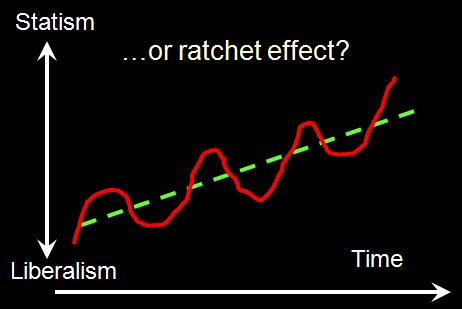
Does the current expansion of the State reverse a previous reduction, to be reduced once again in the future? Or, alternatively, is there a sort of ratchet effect, with a trend towards greater statism disguised by cycles along such increasing trend?
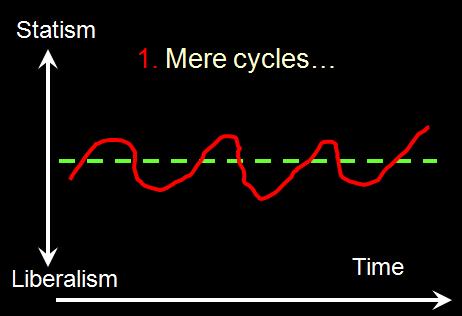 I am inclined to think that cycling has not taken place around a stationary average but around an increasing tendency (see the figures). But perhaps a better way of facing these questions would be to disaggregate in different dimensions. For instance, in several papers with Veneta Andonova we argue that freedom
  of contract has been in decline for more than a century in Western Law, both in civil- and common-law countries. Something similar could probably be said about trade, but in the opposite direction. However, in both freedom of contract and trade, it might be the case that exchange opportunities have expanded mainly as a result of technological change (e.g., cheaper transportation and communications), whatever the legal constraints. In terms of research, how could these trends be measured?
These thoughts were triggered by a timely and extremely suggestive paper by Witold J. Henisz presented at the Workshop on “Manufacturing Markets” organized last week in Villa Finaly, Florence, by Eric Brousseau and Jean-Michel Glachant. My next few blogs will address other aspects of Henisz’s views on the broader challenges facing capitalism.
Events @CBS
| Peter Klein |
I’ve just arrived in Copenhagen, where I’m spending a month as a visiting professor at the SMG. Copenhagen Business School has become one of the most intellectually exciting places in Europe. This week alone the school is hosting the DRUID summer conference which features people like Anita McGahan, Sid Winter, Will Mitchell, Russ Coff, Mike Ryall, and many others, along with a workshop on corporate governance with keynotes by Mark Roe, Randall Morck, Annette Poulsen, and Florencio Lopez-de-Silanes Molina. Of course these are only appetizers for the next week’s main course, the PhD seminar on The Theory of the Firm and Its Applications in Management Research conducted by Professors F. and K. Truly an embarrassment of riches!
De Figueiredo on Political Strategy
| Peter Klein |
We’ve previously mentioned the chapters by Nicolai and Nils Stieglitz and by Lasse and me in the forthcoming Advances in Strategic Management volume titled Economic Institutions of Strategy. John de Figueiredo’s chapter, “Integrated Political Strategy,” is now available as an NBER Working Paper. John is a leader of this emerging field, which studies how firms attempt to influence the legal and political environment to achieve competitive advantage. As he points out:
Legal and acceptable competitive behavior is determined endogenously by legislators, regulators and judges who are influenced, positively and negatively, by the very same firms the regulations are designed to control. By understanding the theories of how firms affect politics, one can better determine how to gain competitive advantage through political institutions. This is a natural extension of the traditional tools of strategic management. Moreover, for young scholars, this is an area in which the lines of investigation are clear and the openings for serious research opportunities available. In this sense, it is robust area for future research and major contributions to understanding firm performance.
Introducing Guest Blogger Benito Arruñada
| Peter Klein |
We’re delighted to announce Benito Arruñada as our newest guest blogger. Benito is Professor of Business Organization at Pompeu Fabra University in Barcelona, a former President of ISNIE, and a prolific researcher in the areas of organization, law and economics. Most of his work focuses on the organizational conditions that facilitate impersonal exchange, from property titling or business regulation to moral systems. He has published widely in journals such the Journal of Law and Economics, Industrial & Corporate Change, Harvard Business Review, Journal of Law, Economics, and Organization, Journal of Economic Behavior & Organization, Journal of Comparative Economics, and International Review of Law and Economics.
Benito will be blogging about his new book on property and business formalization, Building Market Institutions: Property Rights, Business Formalization, and Economic Development, coming out next year from the University of Chicago Press, and other topics that strike his fancy. Welcome, Benito!





 Organizations and Markets
Recent Comments