Posts filed under ‘Institutions’
A Billion Here, A Trillion There
| Peter Klein |
How expensive is the bailout? Where will the money come from?
Consider the numbers: $29 billion for the Bear Stearns mess; $700 billion to buy spoiled assets; $200 billion to buy stock in Fannie Mae and Freddie Mac; an $85 billion loan to AIG insurance; another $37.8 billion for AIG; and $250 billion for bank stocks. Hundreds of billions in guarantees to back up money market funds and to guarantee bank deposits. And who knows what expenses are still to come. . . .
How will the U.S. pay for it all? Answer: by borrowing — raising worries about how the country’s ballooning annual budget deficits and aggregating debt will affect the economy and financial markets. Some guidelines, such as interest rates and the ratio of debt and deficits to gross domestic product, suggest the new debt will be digested easily. But some experts think those guidelines are misleading, warning that obligations are piling up like tinder on a forest floor.
“This kind of accounting that the government does — if they did it in the private sector they would go to jail,” says Kent Smetters, a professor of insurance and risk management at Wharton.
From Knowldge@Wharton, which reminds us that there’s plenty more to come — a probable bailout of Chrysler and G.M., for instance. And who knows what else. Of course, the US government now has a $10.5 trillion national debt. “To economists, the most frightening fact is that the enormous cost of today’s financial rescues is just a drop in the bucket.”
Heckman on Academia
| Peter Klein |
Steve Levitt links to this update on the travails of the University of Chicago’s proposed Milton Friedman Institute. Jim Heckman, an Institute supporter who has recently expressed public doubts about its conception and development, is on the hot seat. Heckman makes an interesting observation, in passing, that relates to a previous discussion of research funding:
Heckman added that all institutes are affected by bias, citing hiring decisions as a source of bias throughout the University.
“I doubt there is a truly unbiased academic. Besides, most biased people don’t see themselves as biased. If you think the [Chicago Graduate School of Business] is an unbiased environment, think again. They are recruited for their views. I wonder also how many free marketers would get jobs in anthropology or sociology,” he said.
“It’s true for any institute. You state a mission, attract funders. They expect the mission to be fulfilled. Very rarely do people fund pure knowledge,” he said.
ESNIE School on NIE Archives
| Nicolai Foss |
The European Society for New Institutional Economics, the semi-formal Euro branch of ISNIE, runs a yearly School on New Institutional Economics, usually taking place on Corsica. Organized by Eric Brousseau, the School has now run for seven consecutive years. The line-up is impressive, including Oliver Williamson, Sid Winter, Avinash Dixit, Doug North, Giovanni Dosi, Dick Langlois, Joanne Oxley, Jackson Nickerson, Lee Alston and many other luminaries. The great thing is that the PPTs of their talks are online (here)! Enjoy.
Government Funding and the Economic Organization of Scienctific Research
| Peter Klein |
A prominent climate scientist, Richard Lindzen of MIT, argues that the politicization of climate science over the last decade is but a symptom of a larger, more general problem caused by government science funding: namely an emphasis on demonstrable results that satisfy the public and have “practical” implications, rather than the pursuit of scientific truth (via Sean Corrigan).
For a variety of inter-related cultural, organizational, and political reasons, progress in climate science and the actual solution of scientific problems in this field have moved at a much slower rate than would normally be possible. Not all these factors are unique to climate science, but the heavy influence of politics has served to amplify the role of the other factors. By cultural factors, I primarily refer to the change in the scientific paradigm from a dialectic opposition between theory and observation to an emphasis on simulation and observational programs. The latter serves to almost eliminate the dialectical focus of the former. Whereas the former had the potential for convergence, the latter is much less effective. The institutional factor has many components. One is the inordinate growth of administration in universities and the consequent increase in importance of grant overhead. This leads to an emphasis on large programs that never end. Another is the hierarchical nature of formal scientific organizations whereby a small executive council can speak on behalf of thousands of scientists as well as govern the distribution of ‘carrots and sticks’ whereby reputations are made and broken. The above factors are all amplified by the need for government funding. When an issue becomes a vital part of a political agenda, as is the case with climate, then the politically desired position becomes a goal rather than a consequence of scientific research. This paper will deal with the origin of the cultural changes and with specific examples of the operation and interaction of these factors. In particular, we will show how political bodies act to control scientific institutions, how scientists adjust both data and even theory to accommodate politically correct positions, and how opposition to these positions is disposed of.
The paper is well worth reading by social scientists and organization theorists. Business-school faculty will recognize the parallels with the call for “relevance” in management education (see the links in Teppo’s recent post). And there are important connections to the arts and humanities; recent scholarship, for example, challenges the notion that public funding produces better art (painting, music, literature, drama) than patronage or commercial funding (Cantor, Cowen, Scherer). Some readers may respond, with Pilate, “What is truth?” Somebody has to pay the bills, in other words, and that party will want something in return. (more…)
29 September 2008 at 10:17 am Peter G. Klein Leave a comment
More on Facebook
| Nicolai Foss |
We bloggers face strong competition from Facebook, as recognized in earlier O&M posts. FB integrates numerous functionalities, including blogging features, and allows narcissism to run amok in a more interactive fashion than blogging allows for. Irresistible. Therefore, smart bloggers embrace FB. As of today, O&M also has a category called “Facebook.”
Facebook is, of course, also an attractive hunting ground for all those ICT-obsesssed network sociologists or computer scientists-turned-sociologists (e.g., here and here) out there, as well as for personality psychologists. Concerning the latter, in the latest issue of Personality and Social Psychology Bulletin, Laura Buffardi and W. Keith Campbell report on “Narcissism and Social Networking Web Sites.” The authors conclude, among other things, that narcissists have more friends (rather, acquaintances), more personal info and more glamorous pics of themselves on FB than non-narcissists. (Now, check this profile).
Perhaps not a surprising finding, but still good to now (particularly for job applicants, given that employers now routinely check FB profiles). And surely it won’t take long before we see the first applications in network studies of the “narcissism index” as an antecedent of this or that (“Narcissism as an Antecedent of Knowledge Sharing in Networks”). Heck, they come up with a new measure every morning anyway. (more…)
The Financial Crisis
| Peter Klein |
A regular reader asks why we haven’t written much on the US financial crisis. What, he asks, do organizational economics, strategic management, Austrian economics, entrepreneurship theory, and the new institutional economics say about the events of recent weeks?
I can’t speak for Nicolai, Dick, and Lasse, but I personally have avoided talking about it because, well, I’m too depressed — not so much about the crisis itself, which I view as a necessary corrective to two decades of potentially ruinous malinvestment, but about the political reaction to it. I agree with Larry White that the general level of discourse not just among laypeople but also among the political and financial elites, top journalists, and academics, has been shockingly vapid and vacuous, even by the usual standards. Listening to government officials, pundits, and analysts analyzing the crisis is like listening to my son’s first-grade class discussing the finer points of postmodern French literature. It was too much deregulation! (Huh?) The free market broke down yet again, just like in the 1930s! Market failure! Thank goodness the government is “stepping in”! Excuse me while I blow my groceries.
My view, in brief, is that the current crisis is the predictable result of a massive credit bubble that began under Greenspan in the 1990s and spilled over into the housing market, following the general outlines of the boom-bust cycle described by the Austrians, along with moral hazard encouraged by the financial “safety net” and the implicit (and, increasingly explicit) guarantees of the “too-big-to-fail” mentality. Of course, the US government’s reaction — spending taxpayer money like candy to bail out favored groups and institutions — can only exacerbate the problem. You can do your own Googling like this or this to find informed commentary. I have little to add but will highlight a few favorite comments: (more…)
Testing for Bias in Peer Review
| Peter Klein |
In a working paper entitled “Can We Test for Bias in Scientific Peer Review?”, Andrew Oswald proposes a method of detecting whether journal editors (and the peer review process generally, I suppose) discriminate against certain kinds of authors. His approach, in a nutshell, is to look for discrepancies between the editor’s comparison of two papers and how those papers were ultimately compared by the scholarly community (based on citations). In tests he runs on two high-ranking American economics journals, he doesn’t find a bias by QJE editors against authors from England or Europe (or in favor of Harvard authors), but he does find that JPE editors appear to discriminate against their Chicago colleagues.
That’s Andy Eggers, writing in the Social Science Statistics Blog. As Andy points out, it’s not completely clear what (raw) citation counts, and hence the experiment itself, are measuring. Also, Oswald uses within-journal paper order as a signal of the editor’s assessment of quality. Still, the technique is interesting, particularly if being the “lead paper” of a top journal generates additional citations, independent of paper quality.
(From the You Can’t Win department: I once had a colleague who had published two or three papers in the JPE, but these papers weren’t highly cited, which the department counted as a strike against him, on the assumption that every JPE paper should get at least a few cites merely be appearing in the JPE.)
NB: An older, unpublished paper by Smart and Waldfogel uses the same technique.
How Well Does the Market Handle Network Effects?
| Peter Klein |
Quite well, according to Dan Spulber’s paper “Consumer Coordination in the Small and in the Large: Implications for Antitrust in Markets with Network Effects,” out recently in the Journal of Competition Law and Economics (June 2008). Dan distinguishes between network effects in small- and large-numbers bargaining situations; Coasean bargaining can solve the problem in the former while Hayekian “spontaneous order” can emerge in the latter. The paper also contains a useful, up-to-date summary of the network effects literature. Highly recommended!
Messin’ With Entrepreneurship Data
| Peter Klein |
OK, it’s not as much fun as Messin’ with Sasquatch. But what happens if you mess with the two leading sources of global entrepreneurship data, the Global Entrepreneurship Monitor, which tracks startups, and the World Bank Entrepreneurship Survey dataset, which measures formal business registrations? One could explain the differences in terms of coverage, the sensitivity of the measurement instrument, and various forms of error. Or, like Zoltan Acs, Sameeksha Desai, and Leora Klapper, use the differences to measure the stages of entrepreneurial development. For commensurate data, that is, the ratio of registrations to startups provides information on the rate at which entrepreneurial ideas are transformed into feasible ventures. The abstract, from SSRN:
This paper compares two datasets designed to measure entrepreneurship. The Global Entrepreneurship Monitor dataset captures early-stage entrepreneurial activity; the World Bank Group Entrepreneurship Survey dataset captures formal business registration. There are a number of important differences when the data are compared. First, GEM data tend to report significantly greater levels of early-stage entrepreneurship in developing economies than do the World Bank data. The World Bank data tend to be greater than GEM data for developed countries. Second, the magnitude of the difference between the datasets across countries is related to the local institutional and environmental conditions for entrepreneurs, after controlling for levels of economic development. A possible explanation for this is that the World Bank data measure rates of entry in the formal economy, whereas GEM data are reflective of entrepreneurial intent and capture informality of entrepreneurship. This is particularly true for developing countries. Therefore, this discrepancy can be interpreted as the spread between individuals who could potentially operate businesses in the formal sector – and those that actually do so: In other words, GEM data may represent the potential supply of entrepreneurs, whereas the World Bank data may represent the actual rate of entrepreneurship. The findings suggest that entrepreneurs in developed countries have greater ease and incentives to incorporate, both for the benefits of greater access to formal financing and labor contracts, as well as for tax and other purposes not directly related to business activities.
Something Useful for the Weekend
| Lasse Lien |
Maybe you’re going to a dinner party this weekend, and maybe you’re worrying that the conversation with the person (of the opposite sex) seated next to you is going to dry up. If so, O&M offers a solution. Read the paper whose abstract appears below beforehand, and just as conversation is starting to cool down, give a quick summary of it. That should bring the heat back up.
We examine why developed societies are monogamous while rich men throughout history have typically practiced polygyny. Wealth inequality naturally produces multiple wives for rich men in a standard model of the marriage market. However, we demonstrate that higher female inequality in the marriage market reduces polygyny. Moreover, we show that female inequality increases in the process of development as women are valued more for the quality of their children than for the quantity. Consequently, male inequality generates inequality in the number of wives per man in traditional societies, but manifests itself as inequality in the quality of wives in developed societies.
Another potential use of the paper is to give it to your spouse if he or she complaints too much. I.e. make the point that if you are low quality, then he or she is likely to be low quality too, so he or she would be better off praising you.
The full reference is: Gould, Eric D., Omer Moav, and Avi Simhon. 2008. “The Mystery of Monogamy,” American Economic Review, 98(1): 333–57. The paper can be found here.
Econ Academics Blog
| Peter Klein |
Christian Zimmerman of RePEc (and Dick’s colleague at UConn) has set up a blog aggregator focused on academic economics research, Econ Academics Blog. As Christian points out, there are lots of economics blogs, but only a few that deal primarily with academic economics (theories, research papers, debates). We’re happy to be included as a source.
O&M at the AoM
 | Peter Klein |
Ah, Los Angeles . . . land of “tattoos, breast implants, bleached hair, and vacuous egos,” as Nicolai recently wrote on Facebook. And then there are the people not in town for the Academy of Managment meeting!
As readers may know, the AoM is meeting this week in Anaheim. The O&M crowd is well represented, as usual. You can search the online program for your favorite person, subject, or interest area. Below are some of the sessions involving O&Mers, past and present: (more…)
IBES-AAEA
| Peter Klein |
As the next phase of my Plan for World Domination I’ve taken office as Chair-Elect of the Institutional and Behavioral Economics Section (IBES) of the Agricultural and Applied Economics Association. One of my duties is to organize the section’s sessions for next year’s AAEA annual meeting, 26-28 July 2009 in Milwaukee, Wisconsin. I welcome participation from the O&M crowd so please email me your suggestions for session topics, papers, special formats, themes, or other ideas. Milwaukee is a lovely and interesting town (just ask Alice), so make plans to join us!
Homogeneity and Cooperation
| Peter Klein |
Why are Scandinavians so cooperative? Nicolai and Lasse might suggest it’s their superior moral character. La Porta et al. (1997), Putnam et al. (1992), and others point to Protestantism: hierarchical religions like Catholicism and Islam, it is argued, tend to discourage trust and retard the development of social capital. The Protestants, who already have Max Weber in their corner, seem to be piling it on.
Not so fast, says Kevin O’Rourke in a recent paper, “Culture, Conflict, and Cooperation: Irish Dairying Before the Great War” (Economic Journal, October 2007). O’Rourke compares the Danish and Irish dairy industries before 1914 and argues that cultural and ethnic homogeneity, not religion, explains the success of Danish cooperatives. Unlike recent large-sample econometric work on trust, the paper uses deeper, more robust indicators of cooperation. Key findings:
At first sight, the contrast between Protestant Ulster and the Catholic South (as well as between Denmark and Ireland as a whole) seems a striking confirmation of the LLSV hypothesis that culture matters for the ability to cooperate, and that hierarchical religions such as Catholicism undermine both trust and cooperation. However, on closer examination it appears that politics, not culture, was responsible for the lower Irish propensity to cooperate. Suspicion between Catholics and Protestants, and tenants and landlords, spilled over into Nationalist suspicion of the cooperative movement and hindered its spread, despite the efforts of the [Irish Agricultural Organisation Society] to remain apolitical. To this extent, the results are more consistent with the stress on [ethnolinguistic fractionalisation] in Alesina and La Ferrara (2000) than with the cultural perspective of LLSV, Knack and Keefer (1997) and Zak and Knack (2001).
Denmark benefited from several relevant advantages that Ireland did not enjoy during this period. In particular, it was an extremely homogeneous country, ethnically, religiously and linguistically. There was no conflict over who should own the land, since land reform in Denmark had been underway since the late eighteenth century. . . . Nor was there any ethnic conflict, or disputes over where national boundaries should lie (all such controversies became redundant following the loss of Schleswig-Holstein in 1864). The results suggest that this homogeneity of Danish society is what explains the success of cooperation there.
Rothbard on Big Business
| Peter Klein |
We at O&M are sometimes described as “pro-business.” But this is not correct. We strongly support the economic function of commerce, and we think private ownership of capital, the profit-seeking activities of entrepreneurs and managers, and unfettered markets for consumer goods, factors of production, and financial assets are essential to a strong economy. But that doesn’t mean we admire the behavior and character of every capitalist, entrepreneur, and manager. Indeed, plenty are scoundrels. Empirically, the businesspeople who rise to the top in today’s mixed economy, with its peculiar blend of free markets and state controls, are likely to be those who excel in political entrepreneurship, in “working the system” to their advantage.
Murray Rothbard summarizes this view in a private letter written in 1966:
For some time I have come to the conclusion that the grave deficiency in the current output and thinking of our libertarians and “classical liberals” is an enormous blind spot when it comes to big business. There is a tendency to worship Big Business per se. . . and a corollary tendency to fail to realize that while big business would indeed merit praise if they won that bigness on the purely free market, that in the contemporary world of total neo-mercantilism and what is essentially a neo-fascist “corporate state,” bigness is a priori highly suspect, because Big Business most likely got that way through an intricate and decisive network of subsidies, privileges, and direct and indirect grants of monopoly protection.
Rothbard refers his correspondent to Gabriel Kolko, William Appleman Williams, James Weinstein, C. Wright Mills, and other New Left critics of the corporate state for details. For more on Rothbard’s own views see “Left and Right: The Prospects for Liberty” (1965) and “Confessions of a Right-Wing Liberal” (1968), as well as related essays by Joseph Stromberg and Roy Childs.
New Center for Economic Documents Digitization
| Peter Klein |
Below is an announcement from the St. Louis Fed about its new digital document library, the Center for Economic Documents Digitization (CEDD). A nice complement to the CORI K-Base, Connie Helfat and Steve Klepper’s FIVE project, and similar resources. Three cheers for the Digital Age!
The Federal Reserve Bank of St. Louis recently introduced the Center for Economic Documents Digitization (CEDD), with a mission to preserve the nation’s economic history through digitization. To date, CEDD has digitized more than 300,000 pages of published material and archival collections from the Federal Reserve System and selected partners — currently, the Brookings Institution, the Government Printing Office and the Missouri Historical Society.
This storehouse of documents includes U.S. government publications, Federal Reserve publications, photographs, manuscripts, and multimedia formats, all available on the St. Louis Fed’s FRASER (Federal Reserve Archival System for Economic Research) website: http://fraser.stlouisfed.org. (more…)
Research and Teaching: Friends or Foes?
| Peter Klein |
Administrators at every research university know the mantra, repeated endlessly to parents, funders, and overseers: cutting-edge research and top-notch (undergraduate) teaching go hand-in-hand. But there is surprisingly little work, theoretical or empirical, investigating the relationship. Here is an edited transcript of a discussion between economists Jim Gwartney (Florida State), Dirk Mateer (Penn State), Rich Vedder (Ohio U), and Russ Sobel (West Virginia) about the relationship between research and teaching. They were asked (1) is research needed for good teaching, and (2) can research activity harm teaching?
Higher education has two key missions: transferring existing knowledge to students, and discovering new knowledge. While the two functions are not mutually exclusive, there is a growing awareness that trade-offs exist between them. Does an emphasis on research detract from undergraduate education? Are too much time and money spent on research rather than teaching? Is career advancement (such as tenure) too dependent on research, a la “publish or perish?”
We asked four noted university-based economists to discuss those issues. . . .
Hat tip to Vedder, whose higher ed blog is on my regular reading list.
São Paulo Workshop on Institutions and Organizations
| Peter Klein |
See below for information on the Third Research Workshop on Institutions and Organizations, 13-14 October 2008 at Fundação Getúlio Vargas in Brazil. Session topics include “Organizations, law and corruption,” “Institutions and development,” “Institutions and environment,” “Psychological issues and organization strategies,” and “Industrial and competition policy.”
I participated in last year’s conference and enjoyed it tremendously. There is a growing network of Brazilian researchers working on various topics in the New Institutional Economics. It is a good group to be involved with. (more…)
Moral Hazard, For Real
| Peter Klein |
I suppose I posted a whimsical item about moral hazard because I was too angry to write anything about the Financial Irresponsiblity Bailout and Reward Act of 2008, the moral-hazard story of the decade. Buy more house than you can afford? Sign a mortgage contract you can’t understand? Invest in risky mortgage-backed securities that lose money? Run your financial institution into the ground? Don’t worry, the hapless US taxpayer will pick up the tab!
I have nothing but contempt in my heart for all who asked for, drafted, and voted for this odious piece of legislation. If there were any doubt that the US is, in many ways, a socialist economy, this massive socialization of financial-market risk should put such doubts to rest. Capitalism, requiescat in pace.
NIE Guidebook
| Peter Klein |
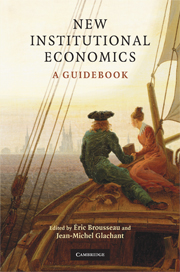 The long-awaited New Institutional Economics: A Guidebook is due out this September from Cambridge University Press. Editors Eric Brousseau and Jean-Michel Glachant assembled an all-star team including Oliver Williamson, Paul Joskow, John Nye, Gary Libecap, Lee Alston, Pablo Spiller, Benito Arruñada, Stéphane Saussier, Jackson Nickerson, Brian Silverman, Joanne Oxley, Mike Sykuta, Mike Cook, and many others — even Foss and Klein. You can pre-order yours today — the hardback’s a whopping $140 but the paperback’s only $59.
Here’s the official CUP page and here’s an information page put together by Eric Brousseau. It should be a valuable reference for years to come.





 Organizations and Markets
Recent Comments