Posts filed under ‘Institutions’
NIE Workshop for Law Professors
| Peter Klein |
The University of Colorado invites law professors to a one-day workshop, 11 June 2008, on the new institutional economics. Speakers are Lee Alston, Lynne Kiesling, Gary Libecap, Henry Smith, and Tom Ulen. Contents include:
(1) an introduction to NIE and why it matters to legal scholarship, particularly for property and intellectual property law; (2) an introduction to behavioral economics and experimental economics, including a simulation exercise that will demonstrate how experimental economics can be used to examine institutions in practice; and (3) an interactive discussion where all participants examine some case studies to evaluate the payoffs of using NIE and experimental economics to evaluate the merits of different legal regimes.
Sounds like fun (but where’s the theory of the firm?). Thanks to Thom Lambert, one of the lucky attendees, for the heads-up.
Did Avner Greif Misread the Geniza Documents?
| Peter Klein |
That’s the claim of this startling paper by Jeremy Edwards and Sheilagh Ogilvie, “Contract Enforcement, Institutions and Social Capital: The Maghribi Traders Reappraised.” Avner Greif’s influential papers (1989, 1993) and book argue, based on documentary evidence from the Cairo Geniza, that the medeival Maghribi traders developed an elaborate, informal network of trading relationships without central coordination or state enforcement. Close social ties, repeated interaction, and careful record-keeping allowed the Maghribi to overcome the prisoner’s dilemma — a perfect example of order without law.
Edwards and Ogilvie, returning to the primary sources, dispute this account. They claim that (1) the Maghribi relied primarily on the Jewish and Muslim state legal systems, not private enforcement, for settling disputes; (2) the Maghribi traded heavily with non-Maghribi; and (3) communications channels were too slow and unreliable to support the social-sanction mechanism proposed by Greif. In short, while reputation effects could be important for individual traders, there is no evidence of the broad Maghribi coalition described by Greif.
I don’t know the primary sources well enough to have an opinion on the merits of this critique, but it strikes me as a very serious critique indeed. Of course, we Hayekians have known about “spontaneous order” long before Greif set pen to paper (or fingers to keyboard), so losing this example wouldn’t be a devastating loss for the theory of decentralized social institutions, any more than losing the Fisher-GM example would wipe out the asset-specificity theory of vertical integration. But it’s important to get the details right.
Best Anti-IRB Article You’ll Read Today
| Peter Klein |
It’s Zachary Schrag’s “How Talking Became Human Subjects Research: The Federal Regulation of the Social Sciences, 1965-1991,” forthcoming in the Journal of Policy History.
In universities across the United States, institutional review boards, or IRBs, claim that they have the moral and legal authority to control the work of researchers in the humanities and social sciences. While IRBs may claim powers independent of federal regulations, they invariably point to these regulations as a key source of their authority. This article draws on previously untapped manuscript materials in the National Archives to trace the history of the federal regulation of social science research. Officials raised sincere concerns about dangers to participants in social science research, especially the unwarranted invasion of privacy as a result of poorly planned survey and observational research. On the other hand, the application of the regulations to the social sciences was far less careful than was the development of guidelines for biomedical research. Regulators failed to define the problem they were trying to solve, then insisted on a protective measure borrowed from biomedical research without investigating alternatives.
See also Schrag’s valuable Instituitional Reveiw Blog.
IRB oversight is particularly strong at the University of Missouri, across all departments, partly the result of a federal investigation in 1999 that came down hard on the medical school. One might wonder what this has to do with social-science research, but there you go.
Authors@Google
| Peter Klein |
From Marshall Jevons I just learned about the Authors@Google lecture series. Lots of good stuff there. The O&M crowd may especially enjoy the talks by Ian Ayres, Larry Lessig, Bob Litan, Richard Florida, John Searle, Daniel Solove, Steven Pinker, Robert Frank, Don Tapscott, Bill Easterly, and Tom Perkins.
Update: If you like this sort of thing check out TED as well (thanks to Art Carden for the pointer). The first person I saw when I visted the site yesterday was Yochai Benkler, whose book The Wealth of Networks I happen to be reviewing for The Independent Review.
Aoki on North
| Peter Klein |
Masahiko Aoki’s contribution to a forthcoming North symposium, “Understanding Douglss North in Game-Theoretic Language,” is available on SSRN. North’s 1990 book Institutions, Institutional Change and Economic Performance, writes Aoki,
laid the foundation for New Institutional Economics by conceptualizing institutions as the rules of the game, pointing out the vital importance of effective enforcement and arguing for the crucial roles they play in determining economic performance. Thus it became a seminal book. But if the rules of the game are so crucial, then why doesn’t a lagging economy emulates the rules that prevail in more advanced economies? Why cannot the rules of the game be changed and enforced by emulation? It seemed that in his [1990] book North regarded it as the essential role of polity to change and enforce the (formal) rules of the (economic) game. But in his view, political markets are imperfect and inefficient so that better rules cannot be emulated/devised or enforced as desired. Thus a further question is raised regarding how rules of political games are determined. This problem of potential infinite regression needs to be answered by going back in historical time to the past. Thus history matters to our understanding of institutions and thus the performance of an economy. . . .
In [Understanding the Process of Economic Change, 2005], particularly in Part I, he has made critical progress toward understanding to the nature of this process. He is now more explicit and vocal about the evolutionary nature of institutional change. . . . He innovatively focuses on the evolution of belief systems that human agents hold, arguing that we perceive the “human landscape,” interpret it, discover problems within it and intend to solve them. In this way, we collectively and incrementally change the societal rules of the game. In other words, we may say that there is a coevolution of belief systems and institutions.
See also reviews of the newer book by Alex Field, Stefan Voigt and Stanley Engerman.
Choice Architecture
| Steve Phelan |
Interesting article by Thaler and Sunstein in the LA Times on “choice architecture” and the concept of “libertarian paternalism”:
the organization of the context in which people make decisions. Choice architects are everywhere. If you design the ballot that voters use to choose candidates, you are a choice architect. If you are a doctor and must describe the alternative treatments available to a patient, you are a choice architect. If you design the form that new employees fill out to enroll in the company healthcare plan, you are a choice architect. If you are a parent, describing possible educational options to your son or daughter, you are a choice architect. If you are a salesperson, you are a choice architect (but you already knew that).
AND
The libertarian aspect of the approach lies in the straightforward insistence that, in general, people should be free to do what they like. They should be permitted to opt out of arrangements they dislike, and even make a mess of their lives if they want to. The paternalistic aspect acknowledges that it is legitimate for choice architects to try to influence people’s behavior in order to make their lives longer, healthier and better.
Hmmm….is this freedom (of choice)? How would we build a practice of choice architecture?
Newspapers as Coasian Firms
| Peter Klein |
The hunter-gatherer model of journalism is no longer sufficient. Citizens can do their own hunting and gathering on the Internet. What they need is somebody to add value to that information by processing it — digesting it, organizing it, making it usable.
This is why we still need newspapers — or something like them. Ronald Coase, the British economist, once asked why we need business firms. Why can’t all their activities be coordinated by individuals contracting with one another instead of working in a bureaucratic, command-and-control environment? The answer, he said, is transaction costs. If a manager had to negotiate with a free-lancer for every task, the cost in time would be unbearably high.
Searching for information on the Internet involves something like transaction costs because we have so many varied sources to evaluate. We need somebody we trust to organize them for us. That can be the task of the new journalism.
That’s from the retirement speech of UNC journalism professor
Mizzou J-School Centenary
| Peter Klein |
My colleague Steve Weinberg‘s new book on John D. Rockefeller and Ida Tarbell, Taking on the Trust, is reviewed in today’s Wall Street Journal. You can read an exerpt here (may be gated for non-subscribers). Steve has another new book, A Journalism of Humanity: A Candid History of the World’s First Journalism School, about the University of Missouri’s J-School, which is celebrating its centenary this year. As explained in the book the journalism school, like the first programs in business administration at Wharton, Tuck, HBS, and elsewhere, struggled to gain acceptance as a legitimate academic program and to escape the “trade-school” stigma.
While vocational programs in law and medicine have long been accepted as legitimate parts of the Academy, and engineering, agriculture, and architecture have been welcomed since at least the late 19th century (in the US, after the Morrill Act), business and journalism have faced particular difficulties becoming integrated into the academic mainstream. Actually, journalism today is even more of an outsider than business administration; for example, while many B-school faculty hold PhDs in economics, sociology, psychology, or other “traditional” disciplines, many J-school professors do not hold PhDs at all, with most being former industry professionals, more like B-school clinical professors. Those of you interested in the history and current problems of business schools might learn something from the experiences of journalism and other professional schools.
Shared Governance: Benefits and Costs
| Peter Klein |
Back in grad school I was regularly hectored by a fellow student about joining the Association of Graduate Student Employees (AGSE), our local collective-bargaining association. Despite his attempt to stigmatize me as a free rider, I never joined. I didn’t think I agreed with the organizations goals, and I was sure I didn’t want to be associated with AGSE’s parent organization, the United Auto Workers (go figure). One year there was even a strike, which I found silly (I scabbed).
This semester I’m getting repeated invitations to join the American Association of University Professors (AAUP). Again, I hesitate. Of course, as an American university professor, I’m happy to see more power, prestige, and perquisites go to American university professors (OK, specifically, to me). But the AAUP has a strange agenda. Its mission includes not only protecting academic freedom and defending the role of the university in public life, but also preserving shared governance. Having spent many years in university settings, I’m convinced that shared governance is grossly inefficient, at least most of the time. There can be benefits, of course, to offset these costs, as is the case with worker-owned cooperatives and other non-standard forms of organization. But one searches the AAUP’s website in vain for any analysis or evidence on shared governance. What are the benefits and costs, relative to other feasible organizational forms? Why should professors defend this peculiar institution? (more…)
A New Explanation for Scholarly Productivity
| Peter Klein |
I always suspected it: scholarly productivity is inversely related to — beer. That’s the finding of a new study of Czech ornithologists, as summarized in yesterday’s N.Y. Times (thanks to Brian McCann for the heads-up). The more beer a scientist drinks, the less likely he is to publish or to have his work cited. Apparently this is a cross-sectional result, without fixed effects or instrumental variables, so there is little information on causality. Perhaps unsuccessful Czech scientists tend to drown their sorrows at the local pub (no doubt drinking their copycat Budvar). Personally, I am more likely to grab a brew to celebrate the occasional citation, so I’d expect the correlation (under reverse causality) to run the other way. And what about these rats?
Economics and the Rule of Law
| Peter Klein |
This week’s Economist features a summary of recent economic controversies about the rule of law (thanks to Fabio Chaddad for the pointer). There is near-universal consensus among specialists in economic history and economic growth that the legal rules — and institutions more generally — “matter,” though the precise mechanisms are in dispute, and aspects of the institutional environment such as the quality of legal rules are difficult to measure consistently across societies and over time. We’ve touched on the closely related “legal origins” debate before. As with that controversy, the arguments in this one have become more subtle and complex in the last decade. As the Economist notes:
[A]s an economic concept the rule of law has had a turbulent history. It emerged almost abruptly during the 1990s from the dual collapses of Asian currencies and former Soviet economies. For a short time, it seemed to provide the answer to problems of development from Azerbaijan to Zimbabwe, until some well-directed criticism dimmed its star. Since then it has re-established itself as a central concept in understanding how countries grow rich — but not as the panacea it once looked like.
The Economist piece focuses on the distinction between “thick” and “thin” understandings of the rule of law. (more…)
Debt Bites Back
| Steve Phelan |
A nice cartoon presentation of the debt crisis by the Wasington Post that you might want to use in your classes.
Two questions:
1) Is the story essentially correct or is it overly damning?
2) What are the organizational implications of this story – for institution and policy building?
We can only assume that all sorts of “corrective” measures will be planned and taken in the immediate future. I believe we should be getting involved in the debate by honing our theoretical position. We are watching economic history in the making.
Steven Cheung Has a Blog
| Peter Klein |
Unfortunately it’s in Chinese. Perhaps one of our Chinese-speaking readers could summarize its contents?
Here is an English-language blog dedicated to Cheung’s ideas. Here is his wikipedia entry, which includes some information on the Late Unpleasantness. And of course the economic analysis of property rights, to which Cheung is a major contributor, is a popular topic on this blog.
Wages and Currency: Visualizing Wage Payments
| Peter Klein |
That’s the title of a virtual exhibition hosted by the International Institute of Social History in the Netherlands. Jan Lucassen has collected data and images showing the connection between coin circulation and wage payments throughout history, particularly for societies about which we know little of labor patterns and wage rates. “As far as wages are paid in currency, in particular in coin, specific patterns of denominations produced and used in space and time may provide insights into the importance of wage labour in those societies.”
Numismatists may also wish to pre-order George Selgin’s forthcoming Good Money: Birmingham Button Makers, the Royal Mint, and the Beginnings of Modern Coinage, 1775-1821, a chapter of which you can read here. Two other Selgin papers on private coinage are here and here. As you can see, Selgin’s work has improved considerably since he quit doing stuff like this.
Marshallian Industrial Economics
| Peter Klein |
Almost every recent paper on networks, clusters, agglomeration economies, and the like mentions Alfred Marshall’s concept of the “industrial district” and gives the obligatory cite to Book IV of Marshall’s Principles (Marshall’s term was the more colorful “thickly peopled industrial district”). But what exactly were Marshall’s views on industrial districts, and on industrial economics more generally? Attend this workshop to find out:
International Workshop: “Marshall and the Marshallians on Industrial
Economics”March 15-16th 2008, Mercury Tower, Hitotsubashi University, Tokyo (more…)
Still More on Legal Origins
| Peter Klein |
John Armour, Simon Deakin, Prabirjit Sarkar, Mathias Siems, and Ajit Singh add to the debate with a new dataset and a new interpretation: common-law countries offer better shareholder protection not because of the characteristics of common law per se, but because the emergence of a global common-law standard gave common-law countries a head start, a sort of network effect. Here is the paper. Abstract:
We test the ‘law matters’ and ‘legal origin’ claims using a newly created panel dataset measuring legal change over time in a sample of developed and developing countries. Our dataset improves on previous ones by avoiding country-specific variables in favour of functional and generic descriptors, by taking into account a wider range of legal data, and by considering the effects of weighting variables in different ways, thereby ensuring greater consistency of coding. Our analysis shows that legal origin explains part of the pattern of change in the adoption of shareholder protection measures over the period from the mid-1990s to the present day: in both developed and developing countries, common law systems were more protective of shareholder interests than civil law ones. We explain this result on the basis of the head start common law systems had in adjusting to an emerging ‘global’ standard based mainly on Anglo-American practice. Our analysis also shows, however, that civil law origin was not much of an obstacle to convergence around this model, since civilian systems were catching up with their counterparts in the common law. We then investigate whether there was a link in this period between increased shareholder protection and stock market development, using a number of measures such as stock market capitalisation, the value of stock-trading and the number of listed firms, after controlling for legal origin, the state of economic development of particular countries, and their position on the World Bank rule of law index. We find no evidence of a long-run impact of legal change on stock market development. This finding is incompatible with the claim that legal origin affects the efficiency of legal rules and ultimately economic development. Possible explanations for our result are that laws have been overly protective of shareholders; transplanted laws have not worked as expected; and, more generally, the exogenous legal origin effect is not as strong as widely supposed.
The Role of Missionaries in Social and Institutional Change
| Peter Klein |
First Brayden, then Fabio. Today another talented young sociologist, Robert Woodberry of UT-Austin, gave a research workshop in my building. Bob is leading a massive project to construct a comprehensive dataset of all Protestant and Catholic missionary activity from 1813 to 1968. Some of the data are here. Bob presented a working paper (not yet online) on the affect of missionary activity on the spread of democracy in the global south. Once Protestant missionary activity (missionaries per capita, length of time in host country, percent of local population evangelized) is controlled for, the usual predictors of democracy (British colonial origin, location, economic variables) drop out of regression models as statistically significant. One implication is that studies on the effect of religion on economic performance (e.g., Stulz and Williamson 2003) should control more carefully for the precise charactersitics of religious activity (not simply “Protestant,” “Catholic,” etc.).
Impact of B-School Research
| Peter Klein |
The AACSB has released its Impact of Research Task Force Report. Key excerpt:
The Task Force believes that it is critical for business schools to find ways to continuously enhance the value and visibility of scholarship and research of all types — basic, applied, and pedagogical. Through its analysis, the Task Force has uncovered five issues that, if addressed by AACSB International, its member schools, and other organizations, could assist business schools to achieve their fullest potential from scholarship and research. First, current measures of intellectual contributions focus on inputs rather than outcomes. That is, the focus is on how faculty spend time (engagement in scholarship) and not on the value of outcomes produced (impact of scholarship on intended audiences). Second, business school and individual faculty incentives tend to create an overwhelming emphasis on discipline-based scholarship at the expense of contributions to practice and to pedagogical development. Third, the relationship between management research and teaching and the
mechanisms to support their interaction, especially when these functions are not always performed by the same people, are not well-understood. Fourth, there are inadequate channels for translating academic research to impact practice. Fifth, opportunities to support deeper, more continuous interaction between faculty and practicing managers on questions of relevance have not been fully developed.
The recommendations are fairly generic — require accredited schools to demonstrate the impact of faculty research, find ways to reward faculty for producing high-impact work, study more closely the links between scholarship, education, and practice, and so on. There’s less detail on exactly how impact should be measured, however. A few examples are given:
- number of practitioners or firms adopting new approach or developed practice
- awards by industry or professional associations
- adoptions and integration in curricula of schools
- sales of book
- number of regional/national/international presentations
- reviews in magazines (e.g., BusinessWeek, Forbes)
These are all fine, but it’s difficult to imagine criteria that can be applied consistently across disciplines, across types of research (basic versus applied), and so on.
Here is some commentary from Inside Higher Ed.
Henry Manne, Academic Entrepreneur
| Peter Klein |
Henry Manne did as much as anyone to create the modern discipline of law and economics. I refer here not only to his scholarly contributions, particularly his work on the market for corporate control and on insider trading, but also his creation of institutions (such as the original Law and Economics Center at the University of Miami) to support the emerging field. So it’s nice to see this essay by Larry Ribstein, “Henry Manne: Intellectual Entrepreneur,” coming out in Pioneers of Law and Economics edited by LLoyd Cohen and Josh Wright. (Via Josh.)
Writing when there was a theory vacuum in legal academia, Manne breathed life into corporate law by using economic principles to formulate a sweeping new theory of the corporation. Then he took his show on the road with seminars, programs and ultimately a law school to create a market for his ideas. The Chapter shows that Manne was an entrepreneur not only in bringing people and ideas together, but also in the Schumpeterian sense Manne discussed in his work on insider trading — an active participant in the creative destruction of the existing paradigm rather than merely a manager of existing ideas. Manne’s career demonstrates that, under the right conditions, a single scholar can leave noticeable ripples in the stream of intellectual history. By demonstrating that corporations, and by inference other important institutions, are best analyzed in market terms, and by creating an intellectual market for these and other economic ideas, Manne changed the way scholars, judges, regulators and others think about the role of law in society.
See also this Manne essay on the emergence of the field. And these papers by my former student Alex Padilla on insider trading. (And these cool gowns worn by the examiners at Alex’s dissertation defense at l’Université d’Aix en Provence.)
Medieval Business Schools
| Peter Klein |
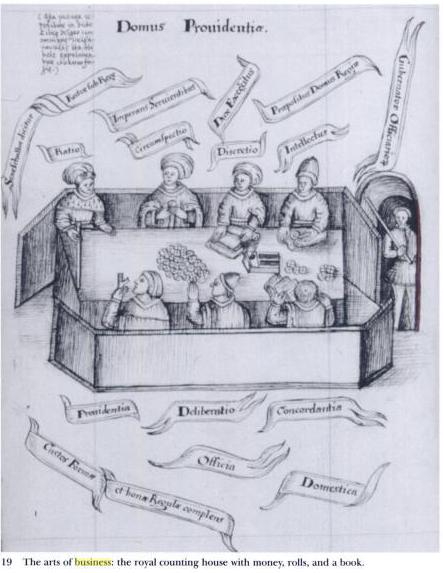
Contrary to popular belief, formal education in medieval times was not restricted to the clergy and the very wealthy. Nor was theology the most popular subject. Independent schools, unaffiliated with any particular religious body or royal institution and staffed by lay people, were common, and even taught business administration (writing letters, drafting contracts, keeping the books).
So says Nicholas Orme in Medieval Schools: From Roman Britain to Renaissance England (Yale, 2006). (Thanks to Tom Woods for the pointer.) In Britain, grammar schools were often supported by wealthy patrons and were open to students of modest means. Notes Orme:
Most [English] schoolmasters were probably broad rather than specialized teachers, catering for a wide range of needs, so it is not surprising that a brand of practical teacher emerged by the fourteenth century (at latest), offering more focused instruction for careers in trade and administration. Such instruction might include “dictamen” (the art of writing letters), the methods of drafting deeds and charters, the composition of court rolls and other legal record, and the keeping of financial accounts. Since documents of these kinds were often written in French between 1200 and 1400, the practical teachers came to teach French too.
This illustration, from p. 69 of the book, depicts such a class. How did they do it without PowerPoint?





 Organizations and Markets

Recent Comments