Posts filed under ‘Institutions’
Armen Alchian (1914-2013)
| Peter Klein |
Armen Alchian passed away this morning at 98. We’ll have more to write soon, but note for now that Alchian is one of the most-often discussed scholars here at O&M. A father of the “UCLA” property-rights tradition and a pioneer in the theory of the firm, Alchian wrote on a dizzying variety of topics and was consistently insightful and original.
Alchian was very intellectually curious, always pushing in new directions and looking for new understandings, without much concern for his reputation or legacy. One personal story: I once asked him, as a naive and somewhat cocky junior scholar, how he reconciled the team-production theory of the firm in Alchian and Demsetz (1972) with the holdup theory in Klein, Crawford, and Alchian (1978). Aren’t these inconsistent? He replied — politely masking the irritation he must have felt — “Well, Harold came to me with this interesting problem to solve, and we worked up an explanation, and then, a few years later, Ben was working on a different problem, and we started talking about it….” In other words, he wasn’t thinking of developing and branding an “Alchian Theory of the Firm.” He was just trying to do interesting work.
Updates: Comments, remembrances, resources, links, etc.:
- Robert Higgs
- David Henderson (1, 2)
- Jerry O’Driscoll
- Alex Tabarrok
- Doug Allen
- Dan Benjamin
- A 1996 Alchian symposium (gated)
- Alchian and Woodward’s review of Williamson (1985): “The Firm Is Dead, Long Live the Firm”
Arrunada Seminar: Benito Arruñada – Underprovision of Public Registries?
| Benito Arruñada |
Underprovision of Public Registries?
Organizing registries is harder than it seems. Governments struggled for almost ten centuries to organize reliable registries that could make enabling rules safely applicable to real property. Similarly, company registries were adopted by most governments only in the nineteenth century, after the Industrial Revolution. Moreover, though most countries have now been running property and company registries for more than a century, only a few have succeeded in making them fully functional: in most countries, adding a mortgage guarantee to a loan does not significantly reduce its interest rate.
US registries show that these difficulties do not only affect developing countries. Many US registries are stunted, shaky institutions whose functions are partly provided by private palliatives. In land, the public county record offices have been unable to keep up with market demands for speed and uniform legal assurance. Palliative solutions such as title insurance duplicate costs only to provide incomplete in personam guarantees or even multiply costs, as Mortgage Electronic Registry Systems (MERS) did by being unable to safely and comprehensively record mortgage loan assignments. In company registries, their lack of ownership information means that they are of little help in fighting fraud, and their sparse legal review implies that US transactions require more extensive legal opinions. In patents, a speed-oriented US Patent and Trademark Office combines with a strongly motivated patent bar to cause an upsurge of litigation of arguably dangerous consequences for innovation.
The introduction of registries has often been protracted because part of the benefits of registering accrue to others. They also have to compete with private producers of palliative services (i.e., documentary formalization by lawyers and notaries) who usually prefer weak or dysfunctional registries, as they increase the demand for their services. Moreover, most legal resources, including the human capital of judges, scholars, and practitioners is adapted to personal instead of impersonal and registry-mediated exchange.
Information and communication technologies have opened new possibilities for impersonal trade, thus increasing the demand for the institutions, such as registries, that support impersonal trade. Economic development therefore hinges, more than ever, on governments’ ability to overcome these difficulties, which are allegedly holding back the effective registries needed to enable impersonal exchange and exhaust trade opportunities.
Creativity and Property Rights
| Peter Klein |
I haven’t been following the Cato Unbound debate on US copyright law, but Adam Mossoff directs me to Mark Schultz’s post, “Where are the Creators? Consider Creators in Copyright Reform.” Mark thinks current debates over copyright law neglect the role of creativity: “Too often, the modern copyright debate overlooks the fact that copyright concerns creative works made by real people, and that the creation and commercialization of these works requires entrepreneurial risk taking. A debate that overlooks these facts is factually, morally, and economically deficient. Any reform that arises from such a context is likely to be both unjust and economically harmful.” Adam thinks Mark’s position “calls out the cramped, reductionist view of copyright policy that leads some libertarians and conservatives to castigate this property right as ‘regulation’ or as ‘monopoly.'”
As one of those libertarians critical of copyright law, but also an enthusiast for the fundamental creativity of the entrepreneurial act, let me respond briefly. Mark is certainly right that creative works are created by individuals (not, “discovered,” as some of the entrepreneurship literature might lead you to believe). But I don’t see the implications for copyright law. The legal issue is not the ontology of creative works, but the legal rights of others to use their own justly owned property in relation to these creative works. Copyright law is, after all, about delineating property rights, and whether legal protection should be extended to X does not follow directly from the fact that X was “created” instead of “discovered.”
Mark uses the language of entrepreneurship, and I think this argues against his conclusion. Property law protects the property of the entrepreneur, and the ventures he creates, not the stream of income accruing to those ventures. Suppose Mark has the brilliant insight to open a Brooklyn-style deli on a street corner here in Columbia, Missouri, makes lots of money, and then I open a similar shop across the street, cutting into his revenues. No one would argue that I’ve violated Mark’s property rights; the law rightly protects the physical integrity of Mark’s shop, such that I can’t break in and steal his equipment, but doesn’t protect him against pecuniary externalities. The fact that Mark’s restaurant wouldn’t have existed if he hadn’t created it — that “real people make this stuff,” as he puts it — has no bearing on the legality of my opening up a competing restaurant, even though this harms him economically.
Arrunada Seminar: Corrado Malberti – What could be the next steps in the elaboration of a general theory of public registers?
| Corrado Malberti |
What could be the next steps in the elaboration of a general theory of public registers?
From a lawyer’s perspective, one of the most important contributions of Arruñada’s Institutional Foundations of Impersonal Exchange is the creation of a general economic theory on public registers. Even if this work is principally focused on business registers and on registers concerning immovable property, many of the results professor Arruñada achieves could be easily extended to other registers already existing in many legal systems or at the transnational level.
For example, a first extension of the theories proposed by professor Arruñada could be made by examining the functioning of the registers that collect information on the status and capacity of persons. A second field that should probably benefit from professor Arruñada’s achievements is that of public registers that operate at a transnational level and established by international treaties. In particular, in this second case, the reference is obviously to the Cape Town convention on International Interests in Mobile Equipment which will, and — to some extent — already has, resulted in the creation of different registers for the registrations of security interests for Aircrafts, Railway Rolling Stock, and Space Assets. In my view it will be important to test in what measure the solutions adopted for these registers are consistent with the results of Arruñada’s analysis.
Corrado Malberti, Professor in Commercial Law. University of Luxembourg. Commissione Studi Consiglio Nazionale del Notariato.
Arrunada Seminar: Matteo Rizzolli – Will ICT Make Registries Irrelevant?
| Matteo Rizzolli |
Will ICT Make Registries Irrelevant?
With this brief post, I would like to add some further discussion on the role of new technologies and ICTs for the evolution of registries. The book of Prof Arrunada touches upon the issue in chapter 7 where the role of technical chance is tackled. He discusses mainly the challenges in implementing different degrees of automation in pre-compiling and lodging information from interested parties and even in automating decision-making by the registry itself.
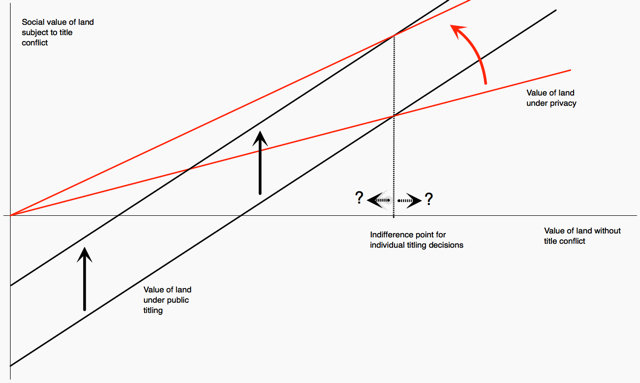
These challenges represent the costs of introducing ICTs in registries. In the book the benefits of ICTs for abating the costs of titling/recording are not discussed at length. Think of them in terms of the costs of gathering, entering, storing, organising and searching the data. I assume it is trivial to say that ICTs decrease the fixed and variable costs of registries even when some issues raised in the book are considered. In terms of the figure below (my elaboration of figure 5.1 on pg 133) this is equivalent to say that, thanks to ICTs, the black line representing the “Value of land under public titling” shifts upwards and therefore the “Indifference point for individual titling decisions” shifts leftward and makes registries more desirable.
However, i think that an important effect of ICTs is neglected in this analysis. In fact ICTs are now pervasive in most transactions. Land is observed with all sorts of satellite technology and the movement of objects and people is traced in many ways. Communications, both formal and informal are also traced and information on companies is just one click away for most individuals. I don’t want to discuss philosophical, sociological or legal aspects of this information bonanza. Neither neglect that more information doesn’t mean better or more trustworthy information. On the other I think we can agree that the quantity of information available to counterparts of a transaction is greatly increased and -more important- that verifiable evidence can be produced more easily should legal intervention in case of conflict arise.
All this information windfall may -this is my hypothesis- decrease the costs of keeping transactions out of registries and therefore improve the value of transactions under privacy. In terms of the figure below, this amounts to rotating the red line upwards and, as a result, shifting the “Indifference point for individual titling decisions” on the right.
In a sense, ICTs both i) decrease the costs of registries and ii) makes registries less relevant. On balance, it is hard for me to say which effect of ICTs may prevail. I think however this could be a very interesting empirical question to research.
Matteo Rizzolli. Assistant Professor of Law and Economics at the Free University of Bozen, Italy. Board member and secretary of the European Law & Economics Association
Click figure for higher resulution:
Arrunada Seminar: Rod Thomas – Developing a Credible Automated System for Agency Registration under a “Registration of Rights” Model
| Rod Thomas |
Developing a Credible Automated System for Agency Registration under a “Registration of Rights” Model
In his book, Arruñada rehearses the debate between mere recordation of deeds versus registration of rights. Under the “registration of rights” model, the registration event may be backed by a State guarantee of ownership, as is the case under a Torrens system. Under such a system, the need for a credible automated system is paramount. This is because the registration event is normally conclusive as to title rights, even in the face of third party ineptness or fraud in undertaking the registration. By way of example, in Torrens systems, the transaction, once completed, can conventionally only be overturned where the transferee is found to have been fraudulent in obtaining the registered title interest even if the dealing is void at law.
Under a registration of rights model there is a heightened sense of vulnerability where the registration even is undertaken by an agent. This is because the agent and not the transferee may have been either fraudulent or inept in undertaking the transaction. An example of such a system in operation is the Landonline System, as it presently exists in New Zealand, where only agency registration is possible.
Arruñada also argues that for a registration system to be successful, it needs to be both cost effective and accessible. Consequently a tension arises under a registration of rights model, operated by agency registration. On the one hand effective measures need to be put in place to protect consumers from inept or fraudulent transactions. On the other hand, a system which is overly complex, or expensive to operate, is unlikely to be successful.
Such concerns may be less pressing in countries where digitalised signatures already play a key role in authorising transactions. In those jurisdictions it appears to be a relatively straightforward procedure to incorporate the need for the existing interest holder’s digitalised signature before a transaction can occur. What however of jurisdictions such as the United Kingdom, Australia or New Zealand where digitalised signatures are not in ready use and agency registration is common?
Various possibilities come to mind for these other jurisdictions. One may be imposing a system where each dealing must first be authorised by a private PIN number known only to the existing land interest holder. This however may be cumbersome to operate and regulate. Also, PIN number may not be securely kept, so abuses could still occur. Another possibility may be to incorporate “flags” into the automated system, so the interest holder is notified of any proposed dealing with his or her interest, and can therefore block the proposed registration before it occurs.
The question therefore needs to be asked; “what possibilities exist under a registration of rights model (in the absence of electronic signatures) for setting up a safe and cost effective automated system, operated by agency registration?”
Rod Thomas. Senior Lecturer in Law, Auckland University of Technology, New Zealand
Arrunada Seminar: Stephen Hansen – Public Institutions and Endogenous Information in Contracting
| Stephen Hansen |
Public Institutions and Endogenous Information in Contracting
Benito Arruñada’s Institutional Foundations of Impersonal Exchange: Theory and Policy of Contractual Registries is an impressive and erudite study of the relationship between legal institutions and impersonal exchange. While clearly valuable for better understanding policies regarding formalization, in my mind it also introduces ideas that are relevant for contract theory more generally and yet hardly treated in the literature.
Since the 1970’s economic theorists have understood that information asymmetries between parties who write contracts are a key source of inefficiencies in exchange. Since then, a vast literature has developed exploring this idea from many different angles. Nevertheless, two key features usually appear. First, the set of parties who write contracts all observe each other, know they are contracting with each other, and (with some exceptions) observe the terms of the contracts agreed. Second, the information asymmetries are assumed to be a fixed, exogenous feature of relationships.
Benito’s book convincingly shows that both of these limit our understanding of trading frictions in the real world. A key insight is that, in addition to his “type” or “action” (to use the language of contract theory), the formal contracts that an economic agent has written with others may be unobservable. After reading the book, it became clear to me that this dimension of non-observability is just as important for generating market failure as others. The second, and intimately related, insight is that the degree of non-observability of contractual rights depends on public institutions, in particular registration systems. Whereas it is unclear how a public body would help contracting parties discover — to take a standard example — each other’s preferences over the good they are proposing to trade, Benito shows that they can affect the amount of information they have about each other’s formal legal rights. And, in line with what one would expect, when institutions can reduce this information asymmetry, the likelihood of efficient trades increases.
Putting these two ideas together provides an original and to me very exciting view on the value of legal systems. Economists often discuss “good” legal systems as those which enforce written agreements transparently at low cost. After reading Benito’s book, I recognized that legal systems also act to endogenously affect the amount of information that parties have available to reach those agreements in the first place. This deserves to be an influential idea in future discussions of law, economics, and contract theory.
Stephen Hansen. Assistant Professor. Economics Department. Universitat Pompeu Fabra. Barcelona, Spain
Arrunada Seminar: Corrado Malberti (2) – An Empirical Test on the Differences between Recordation and Registration
| Corrado Malberti |
An Empirical Test on the Differences between Recordation and Registration
One key point of professor Arruñada is that “[i]t is safe to assume that recordation is less effective than registration in avoiding title uncertainty”. However, the Author acknowledges that it would be essential to perform some empirical analysis to support his conclusions. Importantly he also acknowledges that comparing the performance of titling systems is a daunting task, and that it should be important to consider the specifics of each country.
To start the debate on this point, professor Arruñada compares simple averages for two samples of European Union countries with different titling systems. The Author discovers that, apparently (at least in Europe), registration systems are not only more effective, but also less costly than recordation systems. However, Arruñada also acknowledges that this data is more a starting point for a fruitful discussion than the end of the debate, since it would be ”premature . . . to interpret these empirical differences as causal effects, given the small samples involved”.
I completely agree with this perspective and, I also believe that, starting from this data, it will be important to further investigate the matter.
However, this also poses the question on which is the direction empirical research should take in future. In fact, it is conventional wisdom among legal scholars that registration is superior to recordation. For example, it was also for that reason that, after the end of WWI, Italy decided to preserve in the new provinces the registration system already in place in Austria-Hungary, and that France decided to maintain the livre foncier in Alsace-Moselle.
Since any generalization concerning the classifications of public registers may have little predictive value on how real legal problems are solved, probably, in future, it will be prudent to carry out empirical analyses that consider homogeneous legal frameworks. This would limit the risks of giving the same label to systems that practically adjudicate disputes in completely different ways. Thus, from this perspective, it would probably be more interesting and valuable to focus the attention on those legal systems, like the French and the Italian, where two different public registers coexist.
Corrado Malberti, Professor in Commercial Law. University of Luxembourg. Commissione Studi Consiglio Nazionale del Notariato.
Arrunada Seminar: Corrado Malberti – The Different Dimensions of Recordation and Registration
| Corrado Malberti |
The Different Dimensions of Recordation and Registration
Concerning the characteristics of registration and recordation, I think that the classification made by professor Arruñada should adopt a more nuanced perspective. In fact, the distinction between, on the one hand, recordation systems where deeds are deposited to facilitate their inspection and that rely on what professor Arruñada calls a property rule, and, on the other hand, registration systems that define rights and that give preference to what professor Arruñada calls a property rule, is probably sacrificing important complexities that exist in the public registers falling in each of these two categories.
In fact, legal scholarship highlighted that the dimensions that should be taken into account in classifying public registers are, at least, three:
- the first dimension concerns what is entered in the register, either a deed or a right;
- a second dimension is related to the effects of the entry in the register, either the entry simply regulates the conflicts between two or more acquirers from the same owner, or the entry defines the right;
- finally, the third dimension concerns the role played by bad faith in making a valid entry in the public register.
The combination of these different dimensions makes the dichotomy between registration and recordation more intricate. And it has been argued that, from a legal perspective, it would be impossible to give to these categories anything more than a didactic relevance. In addition, it should also be noted that, even when classified along these three dimensions, in certain cases public registers adopt peculiar principles (e.g. the sometimes radically different rules governing adverse possession could be taken as evidence of how peculiar the practical results of each legal system could be).
Professor Arruñada makes important efforts in trying to include many of these nuances in his analysis. Yet, for many public registers it is difficult to deny the existing contaminations between recordation and registration.
Corrado Malberti, Professor in Commercial Law. University of Luxembourg. Commissione Studi Consiglio Nazionale del Notariato
Arrunada Seminar: Pamela O’Connor – Conflating Contractual and Property Rights
| Pamela O’Connor |
Conflating Contractual and Property Rights
Coming from a property law perspective, I welcome Arruñada’s recognition of the need for economists to acknowledge the nature of property as as rights in rem (rights in things, enforceable against third parties) and their essential difference from contractual rights that bind only the contracting parties. Although legal scholars such as Bernard Rudden, Thomas Merrill and Henry E Smith have been pointing out the inadequacies of traditional economic conceptions of property for some time, economic theorists have been slow to grapple with the implications.
One consequence of conflating contractual and property rights is apparent in recent Australian legislation on resource rights. State legislatures have introduced new types of rights that run with land and bind third parties as rights in rem, but are largely defined by individual agreements. Their relationship to other property rights remains unclear, and their variability makes them costly for other people to assess. Although uptake of the new rights has been slow, they have the potential to burden land titles with proliferating rights that bind all future owners and which nobody really understands.
Pamela O’Connor. Associate Professor, Faculty of Law. Monash University. Australia
Arrunada Seminar: Paul Dower – Centralized vs. Decentralized Allocation
| Paul Dower |
Centralized vs. Decentralized Allocation
In Benito Arruñada’s insightful new book, Institutional Foundations of Impersonal Exchange: Theory and Policy of Contractual Registries, the widespread failure of titling programs in developing countries is used as motivation for a greater appreciation of the role of contractual registries. In many developing countries, immovable assets, especially land, are initially and subsequently allocated using a centralized mechanism as opposed to a decentralized market mechanism implicitly assumed in the book.
The conflict between those holding property and those acquiring property is different under a centralized allocation mechanism. Sara Berry in Chiefs Know Their Boundaries, an interesting work on an agricultural region of Ghana, describes the political process involved in determining the complicated overlapping and competing property claims in a system where land is allocated by a centralized mechanism. Here, the relevant asset is not exactly land but community membership. This asset consists of various rights, one of which entails a kind of social insurance that functions through land allocated based on perceived need. The chief simultaneously serves as the contractual registry, performing public reallocation of rights when necessary, as well as the steward of the community members’ rights in rem, enforceable against all parties. Since need is imperfectly observable, this allocation mechanism suffers from a moral hazard problem, in which the acquiring party has private information putting the holding party at a disadvantage. In this setting, the registry is and can not be independent but it can aim to be impartial.
This example highlights the institutional specialization required for impersonal exchange, a point made well in the book, but it also points to several difficulties not apparent in the analysis. First, the judgment proof problem is more complicated. Power and social status can create a judgment proof problem that is independent or even negatively correlated with the standard one of not having enough wealth to compensate the victim of a violation of rights. The judgment proof problem can create problems for the voluntary registration of property claims. Second, the asset that is transferred or involved in transactions in a centralized system may not easily map into assets exchangeable in a decentralized system. Here, there is a parallel to the informational externality discussed in the book concerning transactions of rights in rem. The lack of institutional specialization leads to significant information costs if rights in rem are transferred. Third, since local legal orders are usually less specialized and serve multiple purposes under a centralized allocation mechanism, they may appear weaker than they actually are. On one hand, the apparent favoritism of a local may merely reflect the fact that an outsider does not have a legitimate claim to rights in rem because the local that transacted with the outsider did not possess rights in rem (even though, as shown above, rights in rem exist and can be transferred). On the other hand, due to the social insurance role of land allocation, the local property holder commonly has a superior claim to land in the abstract than what can be acquired at any moment in time by another local or an outsider. Thus, local legal orders can be in better positions to track the competing or overlapping claims than a public registry based on a state-backed legal order, even though the political process required to adjudicate competing claims under the local legal order restricts trade opportunities.
Paul Dower
Kinross Assistant Professor of Development Economics, New Economic School (NES). Research Economist, Center for Financial and Economic Research (CEFIR).
Arrunada Seminar: Giorgio Zanarone – The Contracts behind Contracting
| Giorgio Zanarone |
The Contracts behind Contracting
Benito Arruñada’s “Institutional Foundations of Impersonal Exchange” is an important book in many ways. It develops a unified theory of property and business registries. It provides the reader with deep historical and institutional analyses that make the theory compelling. And it discusses paths for the reform of business formalization policies that challenge the conventional wisdom.
In my view, however, the most important contribution of Benito Arruñada’s book is broader and more subtle: it shifts the unit of analysis in the theory of the firm from personal to impersonal exchanges. From Coase (1937, 1960) and Williamson (1979) to Grossman and Hart (1986), Holmstrom and Milgrom (1994), and others, the economic theories of the firm have treated contracts as personal exchanges, with little analytic distinction between phyisical and legal persons. This has led to Alchian and Demsetz’s (1972) famous definition of the firm as a “nexus of contracts”.
By focusing on how hidden “originative” contracts make the consequences of present contracts uncertain, and on how registering contracts ex ante can reduce the uncertainty of good-faith acquirers of rights, Benito Arruñada’s book moves an important step towards an economic theory of the firm as a legal person. In that perspective, the nexus of contracts we call “firm” differs from a similar nexus of market contracts because, being the firm registered, external parties can contract with it without fearing that previous “internal” contracts will dilute their rights. In this sense, one could say that ex ante registration marks the boundary between firms and markets.
Beyond the book, these important insights are motivating and will motivate further research, along several lines. In a joint work in progress, Benito Arruñada, Nuno Garoupa and I are developing a formal model to compare “private-ordering” market solutions to the problem of impersonal exchange with regulated solutions, such as the contractual registries discussed in Benito’s book. In a similar vein, it would be interesting to incorporate impersonal exchange and contractual registries in a formal theory of firms’ boundaries. Finally, the book opens promising avenues for empirical research, from the comparative performance of registries and market solutions to the effects of business formalization policies in rich and developing countries. An exciting agenda for XXI-Century institutional and organizational economics!
Giorgio Zanarone
Associate Professor, Colegio Universitario de Estudios Financieros (CUNEF)
Arrunada Seminar: Amnon Lehavi – Economics, Property Rights, and Third Parties
| Amnon Lehavi |
Economics, Property Rights, and Third Parties
Benito Arruñada’s book offers an innovative and intriguing analysis of the crucial role that institutions such as land registries play for securing property rights. A key observation that Benito makes deals with the different focus that economists have vis-à-vis lawyers in their view of property. While “everybody agrees that security of property is essential for development” (p. 24), Benito argues that economists tend to be more concerned with the public order function of property, one which guards against violence and confiscation and which then allows for parties to engage in subsequent efficient bilateral transactions, as modeled by Coase and others. But as Benito aptly notes, lawyers are also concerned with a different aspect of securing property rights, one which has to do with otherwise “routine” property dealings that may fall prey to misuse of transactions. Such conflicts can arise, for example, between a good faith purchaser of an asset and the original owner whose property has been deprived by an intermediate party and then “sold” on the market. Sticking to a contractual paradigm, one that is simply assumed by economists, may thus come short in identifying the true complexity of property rights.
To more fully protect against potential abuse of property rights, or against other cases undermining the security of title, the legal system should be able to award remedies to property owners to protect their interests not only vis-à-vis the direct party to the transaction but also vis-à-vis third parties (in rem protection). This is where land registries come into play. These institutions provide the mechanisms which ensure that private rights would be broadly enforced, “good against the world.” The publicity granted to property rights through such registries and the guarantee of good title, especially in those jurisdictions which follow the registration (Torrens) system, add a key feature of certainty to property rights, one that may be missing from standard economic analysis. Benito’s book offers a unique contribution in identifying the economic and legal foundations of such institutions. His work should be closely studied by scholars across all fields.
Amnon Lehavi
Atara Kaufman Professor of Real Estate, Radzyner School of Law
Academic Director, Gazit-Globe Real Estate Institute Interdisciplinary Center (IDC)
Arrunada Seminar: P.J. Hill – The Importance of Sequential Exchange
| P. J. Hill |
The Importance of Sequential Exchange
Arruñada’s important contribution to the vast literature on institutions and exchange comes from a concept that has been largely ignored by previous contributors (including me), namely the sequential nature of exchange. Most of us have treated the definition and enforcement of property rights as important for exchange, but we have not thought seriously about the ongoing nature of such exchange. If specialization and impersonal exchange are going to occur, the transfer of a property right will be repeated numerous times. Arruñada has integrated well the sequential nature of exchange into his analysis. That integration leads to a host of insights about informality, property registers, and the trade-offs that come from lowering the transaction costs of exchange versus the strength of property rights. How did so many of us miss such an important concept in our work on property rights and the exchange of those rights?
P.J. Hill
Professor Emeritus, Wheaton College and Senior Fellow, Property and Environment Research Center (PERC)
The “Market Power” of Top Journals
| Peter Klein |
When elite academic journals impose stricter submission requirements, authors comply. When lower-ranked journals impose these restrictions, authors submit elsewhere. Key insight for editors: know your place.
Revealed Preferences for Journals: Evidence from Page Limits
David Card, Stefano DellaVigna
NBER Working Paper No. 18663, December 2012Academic journals set a variety of policies that affect the supply of new manuscripts. We study the impact of page limit policies adopted by the American Economic Review (AER) in 2008 and the Journal of the European Economic Association (JEEA) in 2009 in response to a substantial increase in the length of articles in economics. We focus the analysis on the decision by potential authors to either shorten a longer manuscript in response to the page limit, or submit to another journal. For the AER we find little indication of a loss of longer papers – instead, authors responded by shortening the text and reformatting their papers. For JEEA, in contrast, we estimate that the page length policy led to nearly complete loss of longer manuscripts. These findings provide a revealed-preference measure of competition between journals and indicate that a top-5 journal has substantial monopoly power over submissions, unlike a journal one notch below. At both journals we find that longer papers were more likely to receive a revise and resubmit verdict prior to page limits, suggesting that the loss of longer papers may have had a detrimental effect on quality at JEEA. Despite a modest impact of the AER’s policy on the average length of submissions (-5%), the policy had little or no effect on the length of final accepted manuscripts. Our results highlight the importance of evaluating editorial policies.
Complementaries in the Age of the App
| Peter Klein |
Josh Gans asks if “we have yet evolved to the right set of institutions in the app economy,” comparing contracts between app developers and distributors/publishers to those between book authors and publishers. He also notes, correctly I think, that app development may have more to do with signaling programming skill than making money from selling the app. Still, there are important contractual issues to be sorted out in the age of the app.
More generally, Josh’s post highlights the need for organizational scholars to think more broadly about the complementarities between technology, organization, and strategy. Milgrom and Roberts (1990, 1995) are the pioneers here, but there management literatures on modularity and other aspects of fit among organizational attributes are relevant too. (Here’s an example from outside the tech sector.) Milgrom and Roberts put it this way:
[C]hange in a system marked by strong and widespread complementarities may be difficult and . . . centrally directed change may be important for altering systems. Changing only a few of the system elements at a time to their optimal values may not come at all close to achieving all the benefits that are available through a fully coordinated move, and may even have negative payoffs. Of course, if those making the choices fail to recognize all the dimensions across which the complementarities operate, then they may fail to make the full range of necessary adaptations, with unfortunate results. At the same time, coordinating the general direction of a move may substantially ease the coordination problem while still retaining most of the potential benefits of change. Moreover, the systematic errors associated with centrally directed change are less costly than similarly large but uncoordinated errors of independently operating units.
In other words, when a system is characterized by strong complementarities, the diffusion and evolution of business practices requires simultaneous, coordinated changes among all complementary features within the system — technology, organizational form, strategy, and perhaps other elements as well. When simultaneous or coordinated changes occur within strongly complementary systems, business practices like contractual form will also tend to evolve, and to do so rapidly. By contrast, when simultaneous or coordinated changes within systems characterized by strong complementarities do not occur, organizational change will tend to be slow or uneven.
The rapid growth of the app economy might seem an exception to these principles, as the app market has exploded without (it appears) complementary changes in the contractual and organizational aspects of app production. As noted above, this may be because app design performs a signaling role independent of its ability to generate profits. If this becomes less important over time — perhaps because clever programmers find more effective ways to signal ability — then getting the compensation system right will be critical to ensure the success of this particular business model.
Book Seminar: Institutional Foundations of Impersonal Exchange: The Theory and Policy of Contractual Registries
| Lasse Lien |
Very shortly O&M will host a Virtual Seminar on former guest blogger Benito Arruñada’s important new book, Institutional Foundations of Impersonal Exchange: The Theory and Policy of Contractual Registries (University of Chicago Press, 2012). The blurb:
Governments and development agencies spend considerable resources building property and company registries to protect property rights. When these efforts succeed, owners feel secure enough to invest in their property and banks are able use it as collateral for credit. Similarly, firms prosper when entrepreneurs can transform their firms into legal entities and thus contract more safely. Unfortunately, developing registries is harder than it may seem to observers, especially in developed countries, where registries are often taken for granted. As a result, policies in this area usually disappoint.
So stay tuned for this. While we are finalizing the last details of the virtual seminar, you may want to attend one of Benito’s presentations:
- November 26: University of Maryland, Seminar on Trade, Institutions and Politics, November 26, 2012. (Rm. 4103, Tydings Hall; 15:30-17:00). (https://www.econ.umd.edu/about/events/752).
- November 27: Millennium Challenge Corporation, Washington DC, (875 15th St., NW; 12:00-13:00).
- November 28: George Mason University, Fairfax, VA, Public Choice Seminar Series (http://www.gmu.edu/centers/publicchoice/wed%20seminars/wedsem_fall12.html), (Carow Hall, 16:00-15:15).
- November 30: Cato Institute, Washington DC. Lunchtime Discussion (by invitation only). Discussant: Klaus Deininger, World Bank (1000 Massachusetts Ave, NW Washington, DC).
- December 3: Harvard Law School, Private Law Workshop (http://isites.harvard.edu/icb/icb.do?keyword=k84712), (13:00-15:00).
- December 4: Harvard University, Law and Economics Seminar (http://isites.harvard.edu/icb/icb.do?keyword=k84712), 2012 (17:00-19:00).
- December 5: Lincoln Institute of Land Policy, Cambridge, MA, (Lincoln House, 113 Brattle Street, Cambridge, MA; 12:00-14:00). (https://www.lincolninst.edu/education/education-coursedetail.asp?id=867).
Remembering the Ostroms
| Peter Klein |
Indiana University’s Workshop in Political Theory and Policy Analysis has a memorial section for the Elinor and Vincent Ostrom, both of whom passed away this year. Here’s my colleague David O’Brien:
I was a graduate student in Sociology at Indiana University in the late 1960s when I was looking for some courses in Political Science to fulfill the requirements for a minor. I had signed up for a course but the professor left for another university and somehow, by default, I took Lin’s course on “Political Calculus.” Like so many others in my discipline at the time I saw the world from a zero-sum conflict perspective. At the beginning of the semester I felt like I was in intermediate Chinese and had not taken the basic course. Riker’s Theory of Political Coalitions and Buchanan and Tullock’s Calculus of Consent were among the many readings that baffled me. What I remember most about Lin’s teaching was her enthusiasm and the fun she was having in doing her work. There were a lot of serious, somewhat dour, professors around in the late 1960s and not many women in teaching positions in the social sciences. So Lin stood out by her demeanor as well as her intellectual gifts. She had genuine concern for other human beings, including someone like me who did not have a clue as to what was going on and she persistently nudged me to keep an open mind about how I would approach the world as a social scientist. She did something very unusual in those days, which was to suggest that the boundaries between disciplines were artificial.
I did not fully appreciate Lin Ostrom’s influence on my scholarly life until many years after I left IU. Her encouragement to look beyond the disciplinary walls led me to use Mancur Olson’s Logic of Collective Action, one of the books assisgned in the Political Calculus course, as the theoretical foundation of my first work on urban neighborhood organization. Her encouragement for working across disciplines encouraged me to work in partnership with psychologists, political scientists and economists on a variety of research projects find a comfortable home in a Division of Applied Social Sciences.
I thoroughly enjoyed my conversations with Vincent, who became a member of my dissertation committee. He helped me to understand how collective action challenges that we face in our day are analytically similar to those faced centuries ago. I am especially grateful to Vincent for introducing me to the importance of constitutions and federalism, but also to Tocqueville’s observations of the relationship between “association” and “habits of the heart.” Vincent’s insightful observations on the complex relationships between formal and informal institutions have had a significant impact on my approach to household and village adaptations to post-command economy transitions in the former Soviet Union and East Africa.
Most important, Lin and Vincent led by example. They were genuinely kind human beings who were always willing to listen to others and encourage them, engage in spirited debate and thoroughly enjoyed doing applied scholarship.
The Dissertation Defense
| Peter Klein |
Thanks to Pete Boettke for forwarding this thoughtful CHE piece on the dissertation defense. Like the writer, I never had a defense; I was exchanging dissertation drafts with my adviser (via snail mail — this was a long time ago), and one day he simply said, “Send me the title page,” and I was done.
Having participated as a professor in many defenses, both for my own students and for others at home and abroad, I not only appreciate the value of the defense, but recognize the substantial differences in defense formats around the world (fairly casual in the US, much more formal and ceremonial in Europe). I remember touring the University of Salamanca a few years ago and learning how defenses were conducted in the 15th and 16th centuries — multi-day events filled with huge parties and strange rituals, including the candidate spending the night before locked in a room and being stepped on by faculty and other students.
My favorite format is depicted in a 1987 New Yorker cartoon:
Mormons in Management
| Peter Klein |
There’s an old joke about God calling the Pope. “I’ve got good news and bad news. The good news is that I’ve answered your prayer — I’m uniting all the world’s religions under one church and one leader.” Great, the Pope responds, what’s the bad news? “I’m calling from Salt Lake City.”
It’s commonly observed that the academic fields of strategy, organization, and entrepreneurship are over-represented by scholars from the Mormon faith: Christensen, Clark, Barney, Hoskisson, Dyer, Whetten, Zenger, and Felin, to name just a few. Often this is explained by superior social networking and the role of BYU as an anchor entity. But I don’t know any systematic academic research on the phenomenon.
A Wednesday HBR blog entry, “How Mormons Have Shaped Modern Management,” takes a different tack, focusing on the beliefs and practices of the Mormon church. An interesting read. See also a 2011 Business Week piece on the role of the Mormon mission.





 Organizations and Markets
Recent Comments