Posts filed under ‘Institutions’
Henry Manne at Missouri, on the Crisis in Higher Education
| Peter Klein |
Missouri friends, please join us next Tuesday for a lecture by Henry Manne on the governance and organization of US higher education institutions:
The Crisis in Higher Education:
Origins and Problems of University Governance
Henry G. Manne
Dean Emeritus, George Mason University Law School
Tuesday, October 23, 2012, 3:30-4:45pm
MU Student Center, Room 2206
University of Missouri
Sponsored by the Liberty and Justice Colloquium, University of Missouri
Free and Open to the Public
Henry G. Manne is Dean Emeritus of the George Mason School of Law and an expert on insider trading, legal education, university governance, and law and economics. He has also taught at St. Louis University, the University of Wisconsin, George Washington University, the University of Rochester, Stanford University, the University of Miami, Emory University, the University of Chicago, and Northwestern University.
Dean Manne is an Honorary Life Member of the American Law and Economics Association, which honored him as one of the four founders of the field of Law and Economics. He launched the Law and Economics Center at Emory University and the University of Miami before bringing it to George Mason University. His monograph, An Intellectual History of the School of Law, George Mason University, traces the development of the law and economics.
Dean Manne’s other writings include such seminal works as Insider Trading and the Stock Market, Wall Street in Transition (with E. Solomon), and “Mergers and the Market for Corporate Control” Journal of Political Economy, 1965). He is also a frequent contributor to the Wall Street Journal. In 1999, the Case Western Reserve Law Review published the papers from a symposium honoring the many contributions of Dean Manne to the law and economics movement as The Legacy of Henry G. Manne. The Liberty Fund recently published The Collected Works of Henry G. Manne in three volumes.
Dean Manne holds a B.A. from Vanderbilt University (1950), J.D. from the University of Chicago (1952), J.S.D. from Yale University (1966), LL.D. from Seattle University (1987), and LL.D. from the Universidad Francesco Marroquin in Guatemala (1987).
Does Strong Alumni Participation Make US Universities Stronger?
| Peter Klein |
What explains the dominance of the US in elite higher education? Shailendra Mehta offers a novel explanation: the role of alumni. Graduates of US colleges and universities tend to identify strongly with their institutions and care deeply about their school’s reputation and ranking. Only in the US do alumni play such a strong role, not only in financial support (often connected with athletics), but governance.
[N]o group cares more about a university’s prestige than its alumni, who gain or lose esteem as their alma mater’s ranking rises or falls.
Indeed, alumni have the most incentive to donate generously, and to manage the university effectively. Given their intimate knowledge of the university, alumni are also the most effective leaders. Through alumni networks, board members can acquire information quickly and act upon it without delay.
All great universities are nonprofit organizations, created to administer higher education, which benefits society as a whole. But US universities found a way to integrate competition’s benefits into the European concept of nonprofit, or so-called eleemosynary, corporations. The lack of profit does not diminish an alumni-dominated board’s incentive to compete for prestige by, for example, hiring distinguished faculty, accepting meritorious students, and striving for athletic or artistic achievement.
I asked Scott Masten, O&M’s resident higher-education expert, for a reaction:
Interesting, but incomplete. Although boards have formal authority in most universities, in practice they exercise very little, as the recent brouhaha at the University of Virginia serves to illustrate. In fact, the “American model” traces only to the post-Civil War era, when research universities came into being, and effective authority devolved to varying degrees to an administrative bureaucracy and faculty. It was only following that period that U.S. institutions began their dominance. On that alone, one could argue just as convincingly that it was faculty governance that accounted for the success of American higher education. It seems to me there’s a paper on that out there somewhere.
Arruñada’s Institutional Foundations of Impersonal Exchange
| Peter Klein |
Former O&M guest blogger Benito Arruñada has a new book, Institutional Foundations of Impersonal Exchange: Theory and Policy of Contractual Registries (University of Chicago Press, 2012), presenting his influential and important work on the measurement of property rights and transaction costs. Here’s the blurb:
Governments and development agencies spend considerable resources building property and company registries to protect property rights. When these efforts succeed, owners feel secure enough to invest in their property and banks are able use it as collateral for credit. Similarly, firms prosper when entrepreneurs can transform their firms into legal entities and thus contract more safely. Unfortunately, developing registries is harder than it may seem to observers, especially in developed countries, where registries are often taken for granted. As a result, policies in this area usually disappoint.
Benito Arruñada aims to avoid such failures by deepening our understanding of both the value of registries and the organizational requirements for constructing them. Presenting a theory of how registries strengthen property rights and reduce transaction costs, he analyzes the major trade-offs and proposes principles for successfully building registries in countries at different stages of development. Arruñada focuses on land and company registries, explaining the difficulties they face, including current challenges like the subprime mortgage crisis in the United States and the dubious efforts made in developing countries toward universal land titling. Broadening the account, he extends his analytical framework to other registries, including intellectual property and organized exchanges of financial derivatives. With its nuanced presentation of the theoretical and practical implications, Institutional Foundations of Impersonal Exchange significantly expands our understanding of how public registries facilitate economic growth.
My copy is on the way, and I’m eagerly looking forward to reading it!
18 September 2012 at 12:04 pm Peter G. Klein Leave a comment
Management Scholars and the Media
| Peter Klein |
Reporting today from the Academy of Management meetingin Boston. Too many interesting sessions to list them all. Today I attended a very good Professional Development Workshop on the opportunity-discovery perspective in entrepreneurship studies, organized by Henrik Berglund, Steffen Korsgaard, and Kåre Moberg and featuring Bill Gartner, Per Davidsson, and others. Lots of discussion of “discovery opportunities” and “creation opportunities,” and even my own case for dropping the concept of opportunities altogether.
Then, a PDW session called “Engaging the Media: Equipping Management Faculty to Share Their Knowledge More Effectively” featuring me, Jay Barney, Ron Mitchell, Maria Minniti, Mike Lenox, and Scott Kirsner, an ambassador from the world of journalism. I gave the blogger’s perspective, arguing for this medium as an effective way of sharing research results and informed opinion with students, journalists, policymakers, and the lay public. I also shared some practical tips borrowed from Mike Munger.
During the session there was a lot of discussion of economics, and how economists have been much more successful than management scholars at engaging the media. I argued that this has less to do with technique than with substance — economists have a long history of involvement with key social and policy issues of interest to journalists. But there are pitfalls to such a cozy relationship. The desire for relevance and influence can lead to compromise on rigor and and a loss of independence (Exhibit A). Management scholarship is already prone to faddishness and buzzwords, and a closer engagement with the media could exacerbate those unfortunate trends.
But, a question near and dear to our hearts here at O&M: Why are there so few academic blogs devoted to management and organizational scholarship? Economics and law have many influential academic blogs. Management has just a handful (most linked from our sidebar). When I talk to management colleagues about blogging, manyt are reluctant. Will I have something to say? How much time will it take? Will it hurt my academic reputation? Economists don’t seem too worried about these. In part, the difference may be due to core theories and approaches. A little economic theory goes a long way in addressing social and policy issues, and most economists feel comfortable talking about current events without deep knowledge of the specifics. “It involves a price control? Well, let me tell you how that will play out…” Management scholarship is far more eclectic and often calls for deeper knowledge of the concrete phenomena at hand. Is this the most important difference? Or are there other reasons why management scholars don’t blog?
Coase-Theorem Behavior Actually Does Happen
| Dick Langlois |
 I often find it hard to persuade students that the Coase Theorem actually “works” – that one party really will bribe another party to give up a right when transaction costs are low. So I was pleased to find this example on the Atlantic Monthly website. An author called Patrick Wensink ripped off the trademarked Jack Daniel’s label for the cover of a novel called Broken Piano for President, whose principal (perhaps only) interesting characteristic is that it was published by a press called Lazy Fascist. Clearly this is a conflict over the use of a property right, and the author is enjoying uncompensated benefits. One would think that, as Jack Daniel’s clearly owns the property right, the company could force the author to change the cover. Apparently, however, the transaction costs of doing that are high, so the attorney for Jack Daniel’s wrote the author a charming cease-and-desist letter that actually offered to bribe the author to change the cover right away. This is a general point, I suppose, now that I think about it: as the transaction costs rise of using official legal institutions to resolve externality conflicts, the de facto owner of the right can effectively switch, even in a world in which the transaction costs we usually talk about – those of finding and negotiating with the conflicting users of the property – remain small enough to allow Coasean bargaining.
Today’s Mini-Rant
| Peter Klein |
From my colleague John Howe. Here’s the news item:
MarketWatch (June 20, Orol), meanwhile, has learned that “regulatory observers urged policy makers on Wednesday to require companies to make road-show discussions available to the broader public.” Among them was Ann Sherman, associate professor of finance at DePaul University. She spoke at the Senate Banking Committee hearing that was devoted to whether the IPO process was working for ordinary investors and stated: “It is very important that we try to give everyone the same information.” Lise Buyer, founder of Class V Group LLC, a firm that guides IPO-bound companies, agreed with Sherman. She added that one way to improve the flow of information would be to require companies on a road show to hold a scheduled “Ask the Management” Q&A session via the Internet.
John asks:
Do people actually think we can level the information playing field? Not only is that naive (stupid), but it leads small/individual investors to the wrong conclusion — that they are not at a comparative disadvantage in the financial markets. They are, and they’re better off knowing it.
Elinor Ostrom (1933-2012)
| Peter Klein |
A guest post from former guest blogger Joe Mahoney, the Caterpillar Chair in Business and Director of Graduate Studies in the Department of Business Administration, University of Illinois:
As many readers of O&M know by now, Elinor Ostrom of Indiana University (born August 7, 1933) died of pancreatic cancer on Tuesday, June 12th at the age of 78. She shared the Nobel Prize in Economics in 2009 with Professor Oliver Williamson (UC-Berkeley). Elinor along with her husband Vincent Ostrom (now 93) founded Indiana University’s Workshop in Political Theory and Policy in the mid-1960s, in which she remained active until this Spring, only a couple of weeks before her hospitalization. She also donated most of her Nobel Prize money to the Workshop, as Elinor and Vincent had no children and few living relatives. Williamson said in a statement that Ostrom was “a great human being,” an inspiring teacher and colleague and accomplished social scientist. “She had a wonderful sense of joy about the importance of her work that she successfully communicated to others,” he said. A record five women won Nobel prizes in 2009, and Elinor Ostrom is the only woman to have been awarded the prize in Economics.
Elinor Ostrom, who was born and raised in Los Angeles as a child of the Great Depression, and received her education from undergraduate through Ph.D. at UCLA, contributed to our understanding of the evolution of institutions for collective action in common resource contexts such as forests, fisheries, oil fields, and grazing lands. She emphasized citizen involvement, the creativity of local communities, and cutting through sterile dichotomous classifications and ideological “solutions” that are glib and inaccurate. Ostrom states that “neither the State nor the market is uniformly successful in enabling individuals to sustain long-term, productive use of natural resources” (1990: 1). She emphasized the complementarities between public and private mechanisms for solving collective good problems (see Governing the Commons, Cambridge University Press, 1990.) Ostrom conducted field studies of the world’s fisheries, roamed with shepherds in Swiss pastures, and trudged around the Los Angeles water basin (during her dissertation work) to distill the essentials of harnessing cooperation. She writes in the preface to her 1990 book: “It is my conviction that knowledge accrues by the continual process of moving back and forth from empirical observation to serious efforts at theoretical formulation.” From this theoretically informed field case study method Elinor Ostrom concludes that instead of presuming that individuals sharing a common resource are “inevitably caught in a trap from which they cannot escape, . . . the capacity of individuals to extricate themselves from various types of dilemma situations varies from situation to situation” (1990: 14).
Ostrom championed unlocking the spirit of “public entrepreneurship” — a term she coined in her 1965 UCLA dissertation. Her spirit can live on within us, if we decide to “make it so.” Good years.
With the Pols
| Peter Klein |
Two years ago I was in D.C. on Hayek-Klein day and found myself on an elevator with Ben Bernanke, upon which I persuaded him to sing me a few bars of Happy Birthday. True story. This year I was in D.C. again, this time to give an organizational economist’s perspective on the Federal Reserve System to the House Financial Services Committee’s Subcommittee on Domestic Monetary Policy and Technology. You can read my written testimony here and see the oral remarks at C-SPAN which has archived the event.
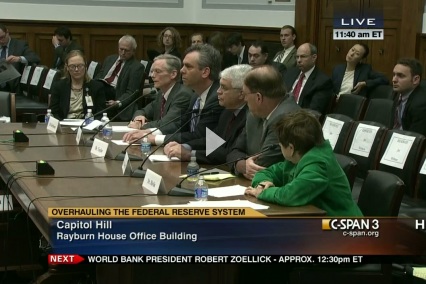
That’s Jeff Herbener to my right and John Taylor to my left, with Jamie Galbraith by Taylor. The one on the end is not Yoda, but Alice Rivlin.
Because the hearing was televised, I can truthfully say, “I’m not a macroeconomist, but I play one on TV.”
Crowdsourcing in Academia
| Peter Klein |
It’s called “fractional scholarship.”
American universities produce far more Ph.D’s than there are faculty positions for them to fill, say the report’s authors, Samuel Arbesman, senior scholar at the Kauffman Foundation, and Jon Wilkins, founder of the Ronin Institute. Thus, the traditional academic path may not be an option for newly minted Ph.D.s. Other post-graduate scientists may eschew academia for careers in positions that don’t take direct advantage of the skills they acquired in graduate school.
Consequently, “America has a glut of talented, highly educated, underemployed individuals who wish to and are quite capable of effectively pursuing scholarship, but are unable to do so,” said Arbesman. “Ideally, groups of these individuals would come together to identify, define and tackle the questions that offer the greatest potential for important scientific results and economic growth.”
Given the level of relationship-specific investment many research projects require, this isn’t likely to work without some kinds of long-term commitments. But the model may be effective for other projects. And it beats the alternative.
Time to Say Goodbye, but Not Really
| Peter Lewin |
After a most enjoyable and productive tour as a guest blogger on this site (at least for me), the time has come to say goodbye.
I do so at an auspicious moment, having just received my copy of Organizing Entrepreneurial Judgment. This book brings together important work by two of the hosts of this site in a very accessible format that promises to spread their message to many who have yet to hear it. To understand the firm one must understand entrepreneurship and vice versa. We live in a dynamic world in which individual judgments concerning the value of resources and the path of future events play a key role and organizational structures develop to give traction to those judgments. For an unrepentant Austrian subjectivist like me it is all very exciting. I look forward to observing further developments as an observer and casual participant on this blog, and elsewhere.
I would like to warmly thank the hosts of this blog Dick, Nicolai, Lasse, and Peter for extending to me the invitation to participate and look forward to ongoing productive associations with all of them.
Review of Allen’s Institutional Revolution
| Peter Klein |
I wrote earlier about Doug Allen’s The Institutional Revolution (University of Chicago Press, 2011). Here’s a new EH.Net review by Mark Koyama.
Institutions in Allen’s view minimize transaction costs, where transaction costs include the costs associated with opportunistic behavior. Transaction costs precluded “first-best” institutions from developing in the pre-industrial world. Instead, apparently inefficient institutions such as tax farming, the sale of offices, and the aristocratic dominance of politics persisted for centuries. Allen argues that these apparently inefficient institutions were, in fact, efficient given the existing configuration of transaction costs. This insight, which builds on the ideas of Yoram Barzel, provides a powerful hypothesis for studying institutional change. Allen places particular emphasis on the importance of measurement. In the high variance pre-modern world, measurement was costly or impossible and consequently bureaucrats, soldiers, sailors, and policemen could not be paid on the basis of observable inputs. Alternative institutions had to emerge to deter opportunism and reward effort. These institutions were often elaborate, and sometimes strange; they involved making the bureaucrats, soldiers, or tax collectors residual claimants of some sort. The story of how these institutions disappeared and were replaced by modern institutions is The Institutional Revolution.
The institutional revolution Allen proposes is linked to the industrial revolution because technological change drove institutional change by reducing measurement costs. Standardization reduced variance. This reduction in variance lessened the possibilities for opportunistic behavior and enabled institutions based around the idea of rewarding individuals for their marginal contribution to emerge.
Perceptions of Opportunities – Part 2
| Peter Lewin |
The second review article in the latest issue of AMR by Venkataraman, Sarasvathy, Dew, and Forster (VSDF) is more ambitious than the first by Shane, discussed in Part 1. In fact one might describe the ambition motivating the article as grandiose. VSDF “seek to recast entrepreneurship as a science of the artificial” an entirely new way of looking at entrepreneurship in the interest of uncovering (what I take to be universal) principles that can serve as the basis of a new empirical and policy-useful science of entrepreneurship. [I see this article as a companion piece to the article by Sarasvathy and Venkataraman (SV) in ET&P January, 2011, in which this grandiose vision is even more apparent.]
The science of the artificial(supposedly a distinct category of science from natural or social science) is derived from the work of Herbert Simon (1996).
As a theory develops it splits into two streams: (1) “basic” research that continues to refine the causal explanations and (2) “applied” research that seeks to alter the variables of explanation. At that point the phenomenon of interest has become an artifact. …
A science of the artificial is interested in phenomena that can be designed [and controlled]. … Design lies is the choice of the boundary values; control lies in the means to change them. (24).
So a useful theory is itself an artifact something that can be used to understand and (importantly) control aspects of the (social) world. And, I suppose, the new science of entrepreneurship will eventually develop such artifacts. [At the end of the article they talk about “recasting opportunities as artifacts” – so I am not sure how this is all connected.]
My lack of expertise regarding the work of Herbert Simon (something which I am now more encouraged to remedy) prevents me from pronouncing with confidence on this part of the article. Suffice it to say that the meaning and contribution of this new “science of the artificial” is far from clear to me. I am left with a feeling that if it is indeed such an important and path-breaking meta-scientific turn, the authors should be able to explain it better. It should be more accessible and transparent. I am left highly skeptical, but I urge readers of this post to read the article and perhaps enlighten me and others. (more…)
Reference Bloat
| Peter Klein |
Nature News (via Bronwyn Hall):
One in five academics in a variety of social science and business fields say they have been asked to pad their papers with superfluous references in order to get published. The figures, from a survey published today in Science, also suggest that journal editors strategically target junior faculty, who in turn were more willing to acquiesce.
I think reference bloat is a problem, particularly in management journals (not so much in economics journals). Too many papers include tedious lists of references supporting even trivial or obvious points. It’s a bit like blog entries that ritually link every technical term or proper noun to its corresponding wikipedia entry. “Firms seek to position themselves and acquire resources to achieve competitive advantage (Porter, 1980; Wernerfelt, 1984; Barney, 1986).” Unless the reference is non-obvious, narrowly linked to a specific argument, etc., why include it? Readers can do their Google Scholar searches if needed.
In management this strikes me as a cultural issue, not necessarily the result of editors or reviewers wanting to build up their own citation counts. But I’d be curious to hear about reader’s experiences, either as authors or (confession time!) editors or reviewers.
Law and Strategy
| Peter Klein |
Over at The Conglomerate, Gordon Smith asks:
Law professors teach and write about topics like public choice, agency capture, rent seeking, etc., but I don’t often hear law professors talking systematically about the use of law for strategic purposes. . . . In simplest terms, the study of law and strategy views the world from the perspective of a business and asks: how can we use law to gain a competitive advantage? This question ought to be of interest to lawyers, but does any law school teach a class on law and strategy?
The context is Richard Shell’s book Make the Rules or Your Rivals Will, which sounds interesting and important. Perhaps the O&M readership can help? The emerging field of non-market strategy (1, 2), led by people like David Baron, Vit Henisz, and the de Figueiredo brothers, studies how firms use not only law but also the regulatory system, bureaucracies, and other non-market features to achieve competitive advantage. The older economics literatures on public choice and rent-seeking of course deal with these issues as well, but typically from “society’s” point of view, rather than the firm’s. As for teaching, I see from a little Googling that John de Figueiredo is teaching law and strategy at Duke, and I suspect other members of the non-market strategy crowd housed at law schools do so as well. Suggestions for Gordon?
Conference on the Law & Economics of Organization: New Challenges and Directions
| Peter Klein |
Via Scott Masten, an important call for papers:
The Walter A. Haas School of Business at the University of California, with support from the Alfred P. Sloan Foundation, is issuing a call for original research papers to be presented at the Conference on the Law & Economics of Organization: New Challenges and Directions. The conference will be held at the Haas School of Business in Berkeley, CA, on Friday, Nov. 30, and Saturday, Dec. 1, 2012. The purpose of the conference is to take stock of recent advances in the analysis of economic organization and institutions inspired by the work of 2009 Nobel Laureate Oliver Williamson and to examine its implications for contemporary problems of organization and regulation. Empirical research and research informed by detailed industry and institutional knowledge is especially welcome. Conference papers will be published in a special issue of the Journal of Law, Economics, & Organization. Submissions are due March 31, 2012. See the Call for Papers for details.
The Science of Design
| Peter Klein |
Rob King’s 2011 AAEA Presidential Address, “The Science of Design,” takes its cue from Herbert Simon.
[M]uch of what we do as economists is akin to what Simon calls natural science. We develop theories about how the economy works, and we conduct empirical studies that test these theories or estimate the parameters of key economic relationships that explain how general results derived from our theories manifest themselves in a particular context.We strive for results that explain what is or that predict what will be. . . .
Economists also design economic artifacts (e.g., markets, contracts, organizational structures, public policies) that reshape economic systems in order to better meet human needs. This work, which I will call economic design, is complementary with but differs fundamentally from economic analysis. While economic analysis is motivated by a question or a puzzle and focuses on explaining what is and predicting what will be, economic design is motivated by a problem or opportunity and focuses on what can be and ought to be or on what will yield a satisfactory outcome. . . .
While we are comfortable in recognizing “good science” in economic analysis, I believe we have devoted less attention to developing a shared understanding of “good science” in economic design.
It is certainly true that economists are increasingly involved in economic design (a trend that accelerated around WWII) though I am less sure this is a good idea. A lot of economic design — specifying “optimal” contracts, for example — might be considered the domain of entrepreneurs, not social scientists. But applied policy work is certainly of this character, so the essay may be read as a call for applied economists to pay closer attention to issues like decomposability, modularity, search, creativity, etc. (See Dick’s work for rich discussions of these issues.)
Kudos to Rob for a thoughtful and intelligent piece. A friend calls it “perhaps the most interesting President’s Address from AAEA in the last 20 years.”
The Economic Organization of Disaster Relief
| Peter Klein |
J. Vernon Henderson and Yong Suk Lee have released a fascinating study of the make-or-buy decision in the provision of disaster relief. “We distinguish four organizational structures by implementation method. . . . (1) donor-implementers who are NGO donors who do their own implementation in villages, (2) international implementers who represent different donors who choose not to do their own implementation, (3) domestic implementers hired by donors which have chosen neither to do their own implementation nor to hire an international implementer, and (4) a country level governmental organization . . . used primarily by domestic and foreign governments.” Henderson and Lee find that donor-implementers offer the highest-quality aid, and the government agency the lowest, with the contract implementers in-between. The framework is agency theory, not transaction cost economics, but there may be a role for asset specificity as well, particularly in cases where a longer-term commitment is required. In any case, this is an interesting and important application of organizational economics to an unconventional setting.
Easterly at the Southerns
| Peter Lewin |
I should also mention that Bill Easterly gave the distinguished guest lecture this year on “Does Development Economics Cause Economic Development?” I thought it was excellent — both entertaining and informative — especially for non-specialists. I hope he publishes it.
Just one instance — a story about controlled random experiments in a development context (perhaps some of you have heard this). An interesting study showed that teacher absenteeism declined when teacher attendance was monitored and rewarded (imagine that). But when the same idea was applied to health-care workers, health-care workers in the treatment group (the monitored group) declined! Apparently, as a result of being monitored, health-care workers started asking for excused absences and found out that their supervisors actually did not care one way or another. As a result excused absences increased dramatically. This illustrates the power of unintended consequences and the importance of local knowledge, and how a seemingly unobtrusive experiment actually ended up providing locals with valuable knowledge that made things worse.
CFP: ISNIE 2012
| Peter Klein |
 The Call for Papers for the 2012 ISNIE conference, 14-16 June 2012 at the University of Southern California, is now posted. Proposals are due 30 January 2012, so start working on those abstracts!
I have been involved with ISNIE for many years and currently serve as the organization’s treasurer. The conferences are terrific, with a variety of papers, panels, and keynotes spanning the broad range of institutional and organizational social science research.
Trivia: I first met the good Professor Foss at the inaugural ISNIE conference in 1997 in St. Louis So if it weren’t for ISNIE, this blog might not exist. . . .
“Poor Economics” Wins FT Best Book Award
| Peter Klein |
The Financial Times has named Abhijit Banerjee and Esther Duflo’s Poor Economics: A Radical Rethinking of the Way to Fight Global Poverty the best business book of 2011. Here’s the book’s webpage. Here are previous O&M posts on the Banerjee-Duflo approach, which is obviously gaining momentum.





 Organizations and Markets
Recent Comments