Posts filed under ‘Institutions’
Economics of Wikipedia
| Peter Klein |
 Wikipedia turns ten today, as you’ve no doubt heard. Most Wikipedia content is recycled, so let me honor the subject by recycling an old O&M post: “Hayek and Wikipedia.” The relationship between the Wikipedia model and Hayek’s concept of dispersed, tacit knowledge, exploited through decentralized decision-making, is perhaps to obvious to note, but consider it noted. See also this Reason piece which emphasizes the Hayek connection. (Of course, in Hayek’s model, information is communicated and actions coordinated through changes in market prices, a feature absent from systems like Wikipedia.) You may also amuse yourself with other old O&M posts about tacit knowledge.
Remediableness Quote* of the Day
| Scott Masten |
In the matter of reforming things, as distinct from deforming them, there is one plain and simple principle; a principle which will probably be called a paradox. There exists in such a case a certain institution or law; let us say, for the sake of simplicity, a fence or gate erected across a road. The more modern type of reformer goes gaily up to it and says, “I don’t see the use of this; let us clear it away.” To which the more intelligent type of reformer will do well to answer: “If you don’t see the use of it, I certainly won’t let you clear it away. Go away and think. Then, when you can come back and tell me that you do see the use of it, I may allow you to destroy it.”
— G.K. Chesterton, The Thing (1929)
*Shouldn’t it be quotation of the day?
New Coase Interview
| Peter Klein |
In conjunction with Ronald Coase’s new book on China, he’s given a new interview to his co-author Ning Wang. (HT: Paul Walker via Mike Giberson.) Excerpt:
WN: You mentioned many times that you do not like the term, “Coasean economics,” and prefer to call it simply the “right economics” or “good economics.” What separates the good from bad, the right from wrong?
RC: The bad or wrong economics is what I called the “blackboard economics.” It does not study the real world economy. Instead, its efforts are on an imaginary world that exists only in the mind of economists, for example, the zero-transaction cost world.
Ideas and imaginations are terribly important in economic research or any pursuit of science. But the subject of study has to be real.
I’m sympathetic to this, but with some methodological reservations, expressed at the end of this post. Anyway, the interview focuses on China, its future economic prospects and likely influence, and the newly formed Coase China Society. Coase is bullish on China: “In the past, economics was once mainly a British subject. Now it is a subject dominated by the Americans. It will be a Chinese subject if the Chinese economists adopt the right attitude.” (more…)
AEA Papers on Organizations, Institutions, and Entrepreneurship
| Peter Klein |
O&M readers attending the American Economic Association annual meeting in Denver may find these papers of particular interest:
Industrial Policy, Entrepreneurship, and Growth
PHILIPPE AGHION (Harvard University)Does Management Matter: Evidence from India
NICHOLAS BLOOM (Stanford University)
BENN EIFERT (University of California-Berkeley)
APRAJIT MAHAJAN (Stanford University)
DAVID MCKENZIE (World Bank)
JOHN ROBERTS (Stanford University)Efficiency and Adaptation in Organizations and Institutions
PETER G. KLEIN (University of Missouri-Columbia)
JOSEPH T. MAHONEY (University of Illinois)
ANITA M. MCGAHAN (University of Toronto)
CHRISTOS N. PITELIS (University of Cambridge)The Coevolution of Culture and Institutions in Seventeenth Century England
PETER MURRELL (University of Maryland) (more…)
Democracy and Credible Commitment in Universities
| Nicolai Foss |
In 2003, Denmark enacted what is the easily the least democratic university legislation in the world (the North Korean one may be less democratic). Essentially, faculty voting rights are now limited to selecting members of an “academic council” which mainly serves as a quality check on candidates for evaluation committees and as a body that offers advice to the university president and the deans. A board of directors (with a majority of external members) appoints the president, the president appoints the dean, and the dean appoints department heads.
This truly major change was partly motivated by the various inefficiencies of the earlier, much more democratic conditions. However, as autocratic systems also have well-known inefficiencies, the question is whether Denmark let the governance pendulum swing too much toward the opposite end. My colleague Henrik Lando directed my attention to a truly excellent paper by O&M guest blogger Scott Masten that is directly relevant to the understanding of this issue. (more…)
Love, Marriage, and Money
| Peter Klein |
Most interesting passage I read today:
Contrary to prevailing interpretations that attribute the [historical] rise in voluntary, romantic unions to an increased sexual division of labor and the domestication of family life, Howell argues that true companionship between husband and wife was necessary to weather the challenges of commercial life. In her words, “love was by no means the antithesis of the market. It was the market’s helpmate” (p. 141).
It’s from Francesca Trivellato’s review of Martha C. Howell, Commerce before Capitalism in Europe, 1300-1600 (Cambridge, 2010). As Howell notes, “the commercialization of society was not just an economic history as we understand the term but a social, legal, and cultural story, and it is incomprehensible if told from the perspective of one of these modern conceptual categories alone.”
Short Course on Network Economics
| Peter Klein |
 I’m teaching a five-week, online course starting in January called “Networks and the Digital Revolution: Economic Myths and Realities.” It’s offered through the Mises Academy, an innovative course-delivery platform that is becoming its own educational ecosystem. A description and course outline is here, signup information is here. I’d love to have you join me!
Ronald Coase’s New Book
| Peter Klein |
 Yes, you read that correctly. Ronald Coase, who turns 100 later this month, has a new book coming out from Palgrave Macmillan and the Institute of Economic Affairs, How China Became Capitalist. It’s coauthored with Ning Wang, Coase’s former research assistant at Chicago and now an assistant professor at Arizona State, and scheduled for publication in June 2011.
Examining the astonishing events that led to China’s transformation from a close socialist economy to an invincible manufacturing powerhouse of the global economy, How China Became Capitalist argues that the impact of events that led China to become capitalist could not have been predicted. From the death of Mao to China’s market reform and move to capitalism under the auspices of the Chinese Communist Party, How China Became Capitalist controversially argues that China’s growth potential will be inhibited in future without a vibrant market in ideas.
Professors Respond to Incentives
| Nicolai Foss |
That’s the overall conclusion of a nice recent study, “Career Incentives and ‘Publish and Perish’ in German and US Universities,” by Uschi Backes-Gellner and Axel Schlinghof. Their theoretical basis is fairly standard personnel economics, but empirically they do something attractive, namely they compae intra-individual productivity differences and monetary incentives over a single researcher’s career. This means that they can avoid the biases introduced by inter-individual ability differences that plague cross-sectional comparisons of research productivity and incentives.
Briefly, Backes-Gellner and Schlinghof hypothesize that increases in research output will obtain prior to tenure in the US system as well as prior to lifetime employment in Germany (and a decline after tenure/lifetime employment). They expect productivity to rise more prior to promotion to full professor in the US than prior to equivalent career changes in Germany (because the wage structure is more compressed in German academia). Finally, for the US (but not for Germany), they expect research productivity to increase in the period before promotion to full professor, but decline afterwards. To test the hypotheses, the authors build a dataset from online CVs of US and German researchers. All hypotheses are borne out in the data.
Mirowski on Backhouse and Fontaine, eds., The History of the Social Sciences since 1945
| Peter Klein |
I enjoyed Philip Mirowski’s first book, though I find his more recent stuff increasingly tendentious and repetitive. Still, a Mirowski review of Backhouse and Fontaine, eds., The History of the Social Sciences since 1945 (Cambridge, 2010) is worth a read. Interesting bit on organizational structure:
The historical generalization overlooked by the editors is that “interdisciplinary” social science units shoehorned into postwar university structures almost uniformly failed, whereas those founded as freestanding think tanks, from RAND to American Enterprise Institute to Cato and the Manhattan Institute, all persevered and succeeded. This is true even for the odd case of Carnegie GSIA, which became the model for other business schools across the nation, but only upon dispensing with the original interdisciplinary structures initially promoted by Herbert Simon (himself then exiled to a Department of Psychology). The lesson may be that the postwar American research university could not sustain true interdisciplinarity in social science inquiry, but that military and corporate sponsors of the think tanks could manage it, but only by yoking it to a format that enforced unquestioned responsiveness to the whims of the funders.
A familiar point of course to students of entrepreneurship and innovation, and yet another reason to suspect that innovation in higher education is more likely to come from outsiders (e.g., the notorious for-profit institutions) than incumbents.
Report on the North Conference
| Peter Klein |
 Responsibilities abroad kept me from attending the recent Douglass North celebration, but the University of Missouri was well represented by a group of energetic and enthusiastic PhD students, who sent me the following report:
The conference on Legacy and Work of Douglass North was an outstanding meeting with discussions on the past, present, and future of the New Institutional Economics. Top scholars discussed the contribution and influence of North (and the New Institutional Economics) in a diverse range of fields, covering everything from the impact of the initial contributions to the outlook for continued research.
It’s hard to summarize the insights and contributions from six paper sessions, Elinor Ostrom’s keynote, and the roundtable on North and the Rise of the New Institutional Economics. One takeaway was the depth and breadth of North’s contributions – many speakers were North coauthors working on a wide variety of topics, from many different perspectives (economics, political science, history, cognition, etc.). North’s influence is huge across the social sciences.
One burning issue: what’s the next step for New Institutional Economics? Besides bridging or integrating Northean institutional analysis with Williamsonian organizational economics, many speakers emphasized the need to be more rigorous, to examine more details, to go farther than the “big picture” studies that are so prominent in the field. There are too many grand, sweeping claims, and not enough mundane, middle-of-the-road analysis. (John Nye, for example, expressed concern that some Northean ideas are very difficult to operationalize, a particular problem since younger scholars are confronted with very high standards for formalization, empirical technique, etc.) (more…)
PENSA 20th Anniversary
| Peter Klein |
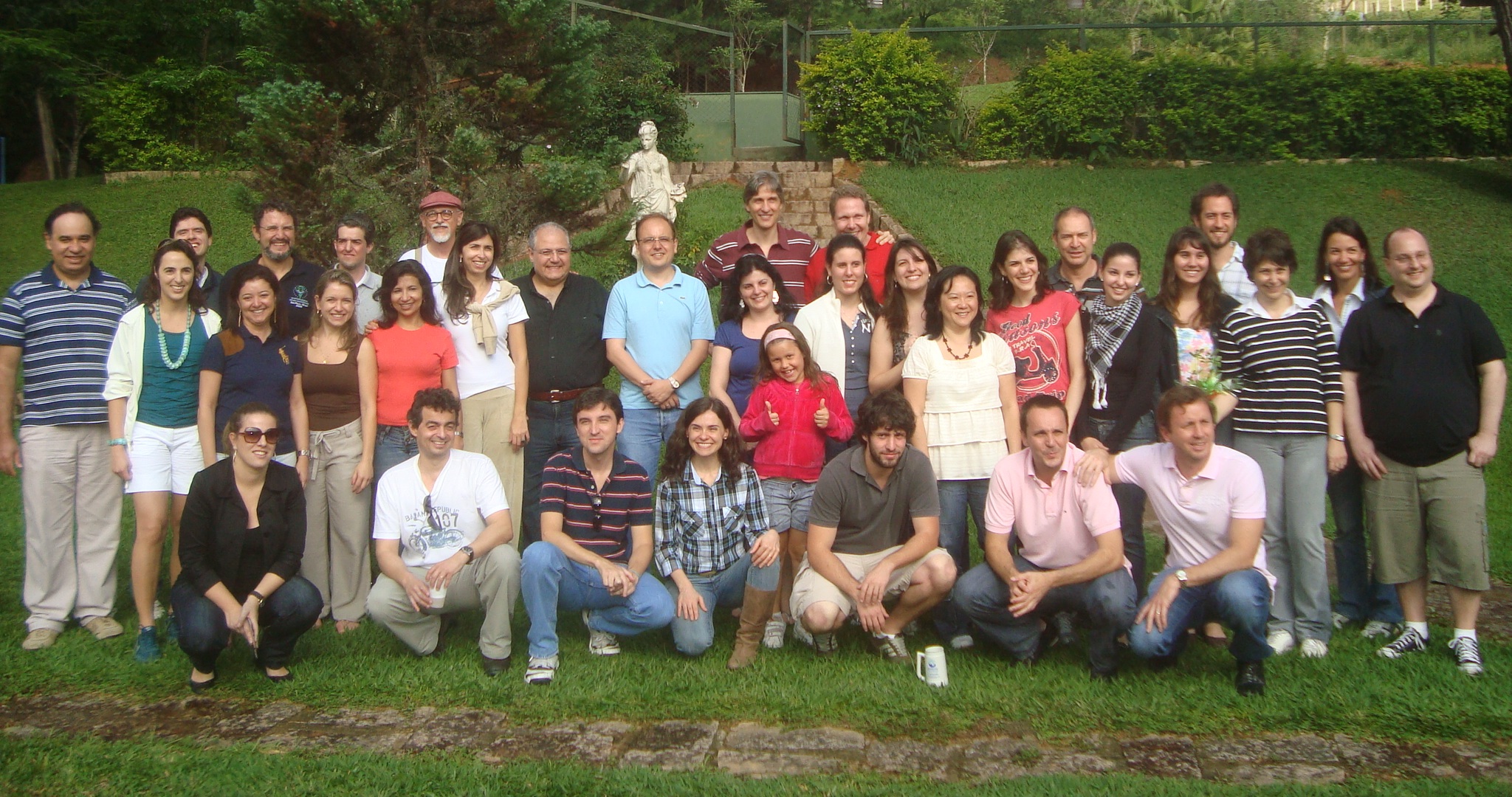
Congratulations to Decio Zylbersztajn and the rest of the group at PENSA on their 20th anniversary. PENSA, a research center within the University of São Paulo, is the home of New Institutional Economics research and teaching in Brazil (and Latin America more generally), producing papers, training graduate students, hosting international conferences, and other activities. The group celebrated its 20th year with a party this past weekend. You can see current and former PENSA personnel in the photo below, including Decio, my Missouri colleague Fabio Chaddad (to Decio’s right), Luciana Florencio de Almeida (just in front of Decio), Paulo Furquim de Azevedo (back row), Sergio Lazzarini (front row), Sylvia Saes (middle row, right side), and other well-known New Institutional Scholars.
The current issue of the Revista de Administração da Universidade de São Paulo has an article on financial constraints and agricultural contracting in Brazil by Decio, Luciana, and me.
CRSP 50th Anniversary
| Peter Klein |
Maybe you knew this already, but the Center for Research on Security Prices (CRSP) — the provider of most of the stock-price data used in academic and practitioner research on financial markets — is celebrating its 50th anniversary this year. The center has put up a fancy website, full of interesting factoids, to commemorate the occasion. Did you know, for example, that the first CRSP computer was a UNIVAC, donated by Sperry-Rand though the intervention of Leslie Groves? That the initial data collection effort came in three years late and 200% over budget? (Makes me feel better about some of my own projects.) That CRSP hasn’t used tapes for years, though people still refer to the master file as the “CRSP tapes”? (HT: Gregg Gordon.)

The Legacy and Work of Douglass North
| Peter Klein |
Washington University, St. Louis is hosting a major international conference, 4-6 November, on the Legacy and Work of Douglass North. The all-star panel includes Lee Alston, Robert Bates, Joel Mokyr, Elinor Ostrom, Ken Shepsle, Barry Weingast, and many others. The conference is organized by Wash U’s Center for New Institutional Social Science.
In other conference news, the CFP for next year’s Atlanta Competitive Advantage Conference, 17-19 May 2011, has been posted. Featured presenters include Jay Barney, Joel Baum, and Rebecca Henderson.
Cui Bono Blues
| Scott Masten |
No, not some long lost Robert Johnson classic. I’m referring to the Justice Department’s suit filed earlier this week against Blue Cross Blue Shield of Michigan, with “hints” from the Justice Department that more health industry suits are in the pipeline. The allegation is that BCBCM used most-favored nation agreements with hospitals to reduce “competition in the sale of health insurance in markets throughout Michigan by inhibiting hospitals from negotiating competitive contracts with Blue Cross’ competitors.”
I don’t know enough about the case to say anything about its merits at this point. But I do find curious the DOJ’s choice of a nonprofit for its demonstration project on controlling healthcare costs through the antitrust laws. It reminds me of [uh-oh, here it comes — Ed.] (more…)
“The Meanest and Most Contemptible Persons in Society”*
| Scott Masten |
*That would be Peter, Dick, Lasse (I think), and me, but not Nicolai. (See below.)
I haven’t posted anything on higher education governance in a couple of weeks, so I guess it is about time. My excuse will be an Instapundit link to an opinion column titled “End Our ‘Multiuniversities’.”
The author, David Warren, complains that the “great majority of the universities — founded since the Second World War to bureaucratically process and credentialize a large part of the general population, as a matter of ‘right’ and regardless of their intellectual capacities — are in effect ‘community colleges’ or trade schools,” a condition that he attributes in the main to public funding. (Warren is writing from Canada but a related piece makes clear his reprobation is catholic.) I am broadly sympathetic with his lament, though I am less confident that public funding is the ultimate culprit. What I want to comment on, however, is his (possibly facetious) solution: (more…)
Two New Books on Economic Growth
| Dick Langlois |
In addition to the review of Doug Puffert’s book that Peter discusses in his most recent post, EH.net has also just issued reviews of two books on economic growth that should be of interest to O&M readers. One is of Michael Heller’s Capitalism, Institutions, and Economic Development. I hope this one gets wide circulation despite being an expensive Routledge title. The other is of Matt Ridley’s The Rational Optimist: How Prosperity Evolves. That one should get a lot of attention.
Lock-In, Path Dependence, and Efficiency: Railway Gauge Edition
| Peter Klein |
 Doug Puffert’s new book on the history of railway gauge standardization apparently takes a middle position between the “lock-in always” position of Paul David and the “lock-in rarely” position of Liebowitz and Margolis. Writes reviewer Dan Bogart:
Puffert’s narrative convincingly dispels the extreme version of the Liebowitz and Margolis critique which argues that market participants had perfect foresight. On the other hand, it does suggest historical actors understood the role of positive feedbacks and tried to manipulate gauge adoption in an effort to lock-in their preferred standard. The degree to which gauge selection was efficient is a lingering question throughout the book. Puffert does not take a stand on the relative efficiency of different gauges, but an argument is made that diversity entailed large costs.
I’m not sure what Bogart means by the “extreme version” of the Liebowitz-Margolis critique; L&M have certainly never used the concept of perfect foresight in their analysis of alleged QWERTY effects. Indeed, their critique of Paul David is based mostly on comparative institutional analysis. As Peter Lewin puts it in his excellent summary of the QWERTY debate:
Somewhat paradoxically both Liebowitz and Margolis and their critics (in varying degrees) are critical of mainstream neoclassical (textbook) economics and its standards of welfare. That is to say, they are both highly critical of the kind of neoclassical economics that assumes perfect knowledge, perfect foresight, many traders, etc., the kind that derives perfect competition as a Pareto optimal efficient standard against which to judge real world outcomes. Both focus (to a greater or lesser extent) on the importance of ignorance and uncertainty (and the importance of institutions) in rendering such a standard problematic. Where they differ decisively, however, is in the policy lessons that they take away from this.
The critics argue that the ideal of perfect competition is an ideal that, for one reason or another, the free market is incapable of attaining, and that, therefore, one should look to the government to obtain by collective action or regulation, what the market, with decentralized actors, cannot. Liebowitz and Margolis have explained clearly why the endorsement of government intervention does not follow from a valid critique of neoclassical welfare economics (and, for that matter, why a defense of neoclassical welfare economics, in itself, is insufficient to establish an argument against intervention).
See here for a previous discussion on path dependence and Williamson’s “remediableness” criterion.
Burning Down the House
| Scott Masten |
Peter posted a Facebook link to a Jeff Tucker post on the Mises Economics Blog commenting on the news report about the Tennessee man who didn’t pay his annual $75 fire protection services fee, and the fire department from the neighboring town let his house burn down. Peter, Jeff, and Clifford Grammich (who commented on Peter’s post) cover the issues pretty well. My guess is that the reason governments rather than private companies generally provide fire services has a lot to do with the difficulty of pricing fire services. (The Tennessee case involved a quasi-market transaction in that residents outside of South Fulton paid the city of South Fulton for fire protection.) It is certainly conceivable that private fire companies could offer homeowners and businesses a choice between (i) prepaid fire service for an annual fee and (ii) on-demand fire service. But how would you determine the price of the latter? I’m pretty sure you wouldn’t want to negotiate the price while your house is burning down. (Talk about temporal specificity!) And you wouldn’t want to negotiate the price after the fact either: Gee, guys, thanks for saving my house; can I buy you all a beer? (more…)
The Peer-Review Fetish
| Peter Klein |
I respect peer review as much as the next person and have done my share of publishing in peer-reviewed outlets. But I question the belief, expressed often in academic, media, and policy circles, that “not peer reviewed” means “worthless” and “peer reviewed” means “should be accepted without question.” (A corollary belief is that “funded by a private foundation or company” means “biased” while “funded by a government grant” means “neutral.”) In practice, the distinctions are not nearly so clean.
My thoughts on this were triggered by a revealing statement from Ronald Coase, quoted by Josh Gans and George Shepherd in their study of famous economics papers that were initially rejected, about his limited experience with peer review: “I have never found any difficulty in getting my articles published. I have either published in house journals (e.g. Economica) or the article was written as a result of a request (e.g. for a conference) and publication was assured.” Certainly no one would discount the importance Coase’s 1937 and 1960 papers because they weren’t rigorously peer reviewed. (Can you imagine the inane referee remarks that “The Problem of Social Cost” would have generated?) More generally, consider the Journal of Law and Economics during Coase’s editorship in the 1960s and 1970s — the high-water mark of the JLE‘s influence. Or, for that matter, Public Choice under Gordon Tullock, the JPE under George Stigler, or the Journal of Libertarian Studies under Murray Rothbard. These were edited somewhat unevenly, led by charismatic and strong-willed editors with idiosyncratic tastes, yet have been vastly influential in their respective fields.
Peer review serves a useful function and probably improves the quality of published output, on average. But let’s not make a fetish of it.





 Organizations and Markets
Recent Comments