Posts filed under ‘– Klein –’
The “Market Power” of Top Journals
| Peter Klein |
When elite academic journals impose stricter submission requirements, authors comply. When lower-ranked journals impose these restrictions, authors submit elsewhere. Key insight for editors: know your place.
Revealed Preferences for Journals: Evidence from Page Limits
David Card, Stefano DellaVigna
NBER Working Paper No. 18663, December 2012Academic journals set a variety of policies that affect the supply of new manuscripts. We study the impact of page limit policies adopted by the American Economic Review (AER) in 2008 and the Journal of the European Economic Association (JEEA) in 2009 in response to a substantial increase in the length of articles in economics. We focus the analysis on the decision by potential authors to either shorten a longer manuscript in response to the page limit, or submit to another journal. For the AER we find little indication of a loss of longer papers – instead, authors responded by shortening the text and reformatting their papers. For JEEA, in contrast, we estimate that the page length policy led to nearly complete loss of longer manuscripts. These findings provide a revealed-preference measure of competition between journals and indicate that a top-5 journal has substantial monopoly power over submissions, unlike a journal one notch below. At both journals we find that longer papers were more likely to receive a revise and resubmit verdict prior to page limits, suggesting that the loss of longer papers may have had a detrimental effect on quality at JEEA. Despite a modest impact of the AER’s policy on the average length of submissions (-5%), the policy had little or no effect on the length of final accepted manuscripts. Our results highlight the importance of evaluating editorial policies.
Top Posts of 2012
| Peter Klein |
It’s been a wild and crazy 2012, with the continued global recession, new developments and trends in strategic management and entrepreneurship research and practice, the resurgence of the Austrian school, and perhaps the most exciting worldwide event of 2012, the publication of the Foss and Klein book. We have an exciting 2013 planned as well.
Here are our most popular posts written in 2012:
- The Sorry State of Economic Journalism
- Life in the Echo Chamber
- What Is a Firm?
- Italian Social Science: Generalized Low Quality?
- Perceptions of Opportunities – Part 1
- Hayek on Schumpeter on Methodological Individualism
- The Bizarro World of Professor Sen
- A Curious Case of Vertical Integration
- “Give Me Money!”
- Handbook of Economic Organization
- Coase-Theorem Behavior Actually Does Happen
- Perceptions of Opportunities – Part 2
- Economists, (Hard) Data, and (Soft) Data
- First, They Ignore You. . . .
- Against Brainstorming
Quickmemes for Academics
| Peter Klein |
True confession: I love quickmemes. Yes, I know, they’re juvenile, most are silly, and more than a few are vulgar. But they make me laugh, sometimes uncontrollably. What about versions for academics? We could have Success Prof, Overly Attached Coauthor, Successful Grad Student, Sheltering Suburban Department Head, and so on. I’ve made a few below; try your hand at the quickmeme site and share the results in the comments.



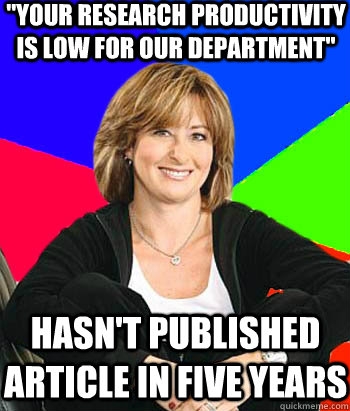


Bonus: Earlier this year I was struggling with a particularly difficult revision and created this Karate Kyle collage as a therapeutic exercise. (It did make me feel better.)
You See the Apocalypse, I See a Profit Opportunity
| Peter Klein |
Game theorists often discuss finitely repeated games by asking, “What if both parties know the world ends in period T?” If the principle of backwards induction holds, then I suppose no Mayans have been able to achieve cooperation in a repeated prisoners’ dilemma game for thousands of years — both parties know the other will defect in T-1, so each defects in T-2, and so on. . . . But where beliefs about the end of the world differ, there are potential gains from trade.

See also this Hummer commercial, one of my favorites in explaining how time preference and discount rates affect behavior.
Review Paper on Prospect Theory
| Peter Klein |
We haven’t been entirely kind to behavioral economics, but we certainly recognize its importance, and have urged our colleagues to keep up with the latest arguments and findings. A new NBER paper by Nicholas Barberis summarizes the literature, focusing on prospect theory, and is worth a read.
Thirty Years of Prospect Theory in Economics: A Review and Assessment
Nicholas C. Barberis
NBER Working Paper No. 18621, December 2012Prospect theory, first described in a 1979 paper by Daniel Kahneman and Amos Tversky, is widely viewed as the best available description of how people evaluate risk in experimental settings. While the theory contains many remarkable insights, economists have found it challenging to apply these insights, and it is only recently that there has been real progress in doing so. In this paper, after first reviewing prospect theory and the difficulties inherent in applying it, I discuss some of this recent work. While it is too early to declare this research effort an unqualified success, the rapid progress of the last decade makes me optimistic that at least some of the insights of prospect theory will eventually find a permanent and significant place in mainstream economic analysis.
TILEC Workshop on “Economic Governance and Organizations”
| Peter Klein |
The Tilburg Law and Economics Center (TILEC) is organizing a very interesting workshop on ” Economic Governance and Organizations,” 6-7 June 2013 in Tilburg. The core themes revolve around governance mechanisms — legal, contractual, social, etc. — that can address social dilemmas (free riding). Keynote speakers are Luis Garicano, Henry Smith, Henry Hansmann, and Guido Tabellini. See the full details here. Sample questions of interest:
- What makes organizations that combine classical incentives with some kind of pro-social mission, e.g. religious organizations or charities, more or less suitable to solve economic governance problems?
- Can firms whose owners are mainly driven by profit incentives mitigate economic governance problems equally good as nonprofit organizations?
- What are the effects on “industry structure” and performance of allowing for-profits to enter into traditional not-for-profit sectors? Are there important differences between sectors?
- There has been a recent trend to run charities as tightly controlled and efficiency-oriented as business firms (e.g. the Gates Foundation). What are the effects of this development on the effectiveness of those organizations (measured by the number of poor people helped, etc.)? What is the risk of crowding out charity workers’ intrinsic motivation by control?
- (How) can organizations help to support political movements in the internet age, where decentralized social online networks seem omnipotent to coordinate citizens’ actions?
- Is there a need to foster new organizational forms, such as “societal enterprises” next to traditional firms and not-for-profit organizations? If so, in which sectors, and what forms?
- Is the decline of formal private organizations providing social capital, such as clubs or many other nonprofits, an inevitable consequence of technological advancements that enable individuals to do many things on their own that required big organizations in earlier times on their own today? If so, is this a problem?
- What is the (a) de facto (b) optimal role of the state in allowing or promoting different types of organizations in order to mitigate economic governance problems? (How) does it differ between countries?
- Is it true that the state has crowded out many private initiatives to support collective action, e.g. in the provision of local public goods such as water and sewage, but less so in contract enforcement? If so, which types of organizations are best suited to mitigate this or that economic governance problem? Why?
- It seems that the number of old for-profit firms is very limited. In contrast, there are quite some religious (nonprofit) organizations which mitigate economic governance problems and are hundreds or even thousands of years old (e.g. Churches, monasteries or religiously affiliated hospitals/nursing homes). Is this impression true? If so, why? What can we learn from the longevity of many religious organizations for the organizational design of other nonprofit organizations?
Web-Savvy Profs
| Peter Klein |
 I’m #57 on a new list of Top 100 Web-Savvy Professors. Teppo smokes me at #19, but I’m right up there with Clay Christensen, Noriel Roubini, Austan Goolsbee, Richard Thaler, and other luminaries. I don’t know the group behind the list or how the ranking was compiled, but it looks good to me. In any case, this will give you more names to follow on blogs or Twitter. Enjoy!
Complementaries in the Age of the App
| Peter Klein |
Josh Gans asks if “we have yet evolved to the right set of institutions in the app economy,” comparing contracts between app developers and distributors/publishers to those between book authors and publishers. He also notes, correctly I think, that app development may have more to do with signaling programming skill than making money from selling the app. Still, there are important contractual issues to be sorted out in the age of the app.
More generally, Josh’s post highlights the need for organizational scholars to think more broadly about the complementarities between technology, organization, and strategy. Milgrom and Roberts (1990, 1995) are the pioneers here, but there management literatures on modularity and other aspects of fit among organizational attributes are relevant too. (Here’s an example from outside the tech sector.) Milgrom and Roberts put it this way:
[C]hange in a system marked by strong and widespread complementarities may be difficult and . . . centrally directed change may be important for altering systems. Changing only a few of the system elements at a time to their optimal values may not come at all close to achieving all the benefits that are available through a fully coordinated move, and may even have negative payoffs. Of course, if those making the choices fail to recognize all the dimensions across which the complementarities operate, then they may fail to make the full range of necessary adaptations, with unfortunate results. At the same time, coordinating the general direction of a move may substantially ease the coordination problem while still retaining most of the potential benefits of change. Moreover, the systematic errors associated with centrally directed change are less costly than similarly large but uncoordinated errors of independently operating units.
In other words, when a system is characterized by strong complementarities, the diffusion and evolution of business practices requires simultaneous, coordinated changes among all complementary features within the system — technology, organizational form, strategy, and perhaps other elements as well. When simultaneous or coordinated changes occur within strongly complementary systems, business practices like contractual form will also tend to evolve, and to do so rapidly. By contrast, when simultaneous or coordinated changes within systems characterized by strong complementarities do not occur, organizational change will tend to be slow or uneven.
The rapid growth of the app economy might seem an exception to these principles, as the app market has exploded without (it appears) complementary changes in the contractual and organizational aspects of app production. As noted above, this may be because app design performs a signaling role independent of its ability to generate profits. If this becomes less important over time — perhaps because clever programmers find more effective ways to signal ability — then getting the compensation system right will be critical to ensure the success of this particular business model.
The Perfect Christmas Tree
| Peter Klein |
Looking for the perfect holiday gift for that special someone? Lots of friends and family on your Nice List? Get them a book from your favorite O&M authors. If you really want to show your love, get the whole bunch! Links and ordering information are on the right-hand sidebar on the O&M home page (you may have to scroll down to see them). Several are available as e-books as well as the traditional versions. Beats the heck out of a lump of coal. (Naughty Listers can be given a complimentary one-year subscription to orgtheory.net.)

Against Scientism
| Peter Klein |
Hayek defined “scientism” or the “scientistic prejudice” as”slavish imitation of the method and language of Science” when applied to the social sciences, history, management, etc. Scientism represents “a mechanical and uncritical application of habits of thought to fields different from those in which they have been formed, and as such is “not an unprejudiced but a very prejudiced approach which, before it has considered its subject, claims to know what is the most appropriate way of investigating it.” (Hayek’s Economica essays on scientism were collected in his 1952 Counter-Revolution of Science and reprinted in volume 13 of the Collected Works.)
Austin L. Hughes has a thoughtful essay on scientism in the current issue of the New Atlantis (HT: Barry Arrington). Hughes thinks “the reach of scientism exceeds its grasp.” The essay is worth a careful read — he misses Hayek but discusses Popper and other important critics. One focus is the “institutional” definition of science, defined with the trite phrase “science is what scientists do.” Here’s Hughes:
The fundamental problem raised by the identification of “good science” with “institutional science” is that it assumes the practitioners of science to be inherently exempt, at least in the long term, from the corrupting influences that affect all other human practices and institutions. Ladyman, Ross, and Spurrett explicitly state that most human institutions, including “governments, political parties, churches, firms, NGOs, ethnic associations, families … are hardly epistemically reliable at all.” However, “our grounding assumption is that the specific institutional processes of science have inductively established peculiar epistemic reliability.” This assumption is at best naïve and at worst dangerous. If any human institution is held to be exempt from the petty, self-serving, and corrupting motivations that plague us all, the result will almost inevitably be the creation of a priestly caste demanding adulation and required to answer to no one but itself.
Creative Destruction Chart of the Day
| Peter Klein |
Via John Hagel, a chart from Mary Meeker showing the percent of personal computing devices (including, today, phones and tablets) accessing the web from various operating systems. Joseph Schumpeter, call your office!

Business and Poetry
| Peter Klein |
Wallace Stevens was one of America’s greatest poets. The author of “The Emperor of Ice-Cream” and “The Idea of Order at Key West” was awarded the Pulitzer Prize for Poetry in 1955 and offered a prestigious faculty position at Harvard University. Stevens turned it down. He didn’t want to give up his position as Vice President of the Hartford Accident and Indemnity Company.
This lyrically inclined insurance executive was far from alone in occupying the intersect of business and poetry. Dana Gioia, a poet, Stanford Business School grad, and former General Foods executive, notes that T.S. Eliot spent a decade at Lloyd’s Bank of London; and many other poets including James Dickey, A.R. Ammons, and Edmund Clarence Stedman navigated stints in business.
Sure, quants rule, but literary types have a role to play in business too. And some of the great literary and artistic figures, such as Dickens, Rubens, and even Shakespeare, were successful business managers. The quoted passage is from John Coleman’s “The Benefits of Poetry for Professionals” in the HBR blog.
Call for Proposals: Austrian Economics Research Conference
| Peter Klein |
Below and here are the details about the 2013 Austrian Economics Research Conference. Submissions are due December 31, 2012. For an example of the high-quality keynotes speeches, see this one from 2012!
Austrian Economics Research Conference
March 21–23, 2013
Ludwig von Mises Institute
Auburn, AlabamaThe Austrian Economics Research Conference (formerly the Austrian Scholars Conference) is the international, interdisciplinary meeting of the Austrian School, bringing together leading scholars doing research in this vibrant and influential intellectual tradition. The conference is hosted by the Ludwig von Mises Institute at its campus in Auburn, Alabama.
Proposals for individual papers, complete paper sessions or symposia, and interactive workshops are encouraged. Papers should be well developed, but at a stage where they can still benefit from the group’s discussion. Preference will be given to recent papers that have not been presented at major conferences. All topics related to Austrian economics, broadly conceived, and related social-science disciplines and business disciplines including management, strategy, and entrepreneurship are appropriate for the conference. Proposals from junior faculty and PhD students are especially encouraged.
This year’s conference features a keynote lecture from Dominick Armentano and a themed symposium on competition theory and policy to celebrate the 30th anniversary of Armentano’s landmark book Antitrust and Monopoly: Anatomy of a Policy Failure. A lecture from Brendan Brown, author of The Global Curse of the Federal Reserve (Palgrave Macmillan, 2011) will celebrate the 50th anniversary of Murray Rothbard’s classic America’s Great Depression. Nikolay Gertchev of the European Commission and Robert Wenzel of Economic Policy Journal will also give keynote speeches. (more…)
Dilbert on Multitasking
| Peter Klein |
Speaking of agency theory, today’s Dilbert deals with multitasking and, as usual, gets the problem exactly right:

Coase on the Economists
| Peter Klein |
Ronald Coase has a short piece in the December 2012 Harvard Business Review, “Saving Economics from the Economists” (thanks to Geoff Manne for the tip). Not bad for a fellow about to turn 102! I always learn from Coase, even when I don’t fully agree. Here Coase decries the irrelevance of contemporary economic theory, condemning economics for “giving up the real-world economy as its subject matter.” He also provides a killer quote: “Economics thus becomes a convenient instrument the state uses to manage the economy, rather than a tool the public turns to for enlightenment about how the economy operates.”
I’m sure that’s true for many economists and for some branches of the field, such as Keynesian macroeconomics. But Coase seems to reject economic theorizing altogether, even the “causal-realist” approach popular in these parts. To be useful, he argues, economics should provide practical guidance for the businessperson. However, “[s]ince economics offers little in the way of practical insight, managers and entrepreneurs depend on their own business acumen, personal judgment, and rules of thumb in making decisions.”
Well, that sounds about right to me. Economics provides general principles, or laws, about human action and interaction, mostly stated as “if-then” propositions. Applying the principles to concrete, historical cases requires Verstehen, and is the task of economic historians (as analysts) and entrepreneurs (as actors), not economic theorists. Deductive theory does not replace judgment. Without deductive theory, however, we’d have no principles to apply, and nothing to contribute to our understanding of the economy except — to quote Coase’s own critique of the Old Institutionalists — “a mass of descriptive material waiting for a theory, or a fire.” To be sure, Coase’s own inductive method has led to several brilliant insights. Coase himself has a knack for intuiting general principles from concrete cases (e.g., theorizing about transaction costs from observing automobile plants, or about property rights from studying the history of spectrum allocation), though not perfectly. But, as I noted before, Coase himself is probably the exception that proves the rule — namely that induction is a mess.
More Genghis Revisionism
| Peter Klein |
 You’ve probably heard the expression, “X is so extreme, he’s to the Right of Genghis Khan.” This basically means, “I don’t like X but have nothing intelligent to say about X or his ideas.” Mostly because we don’t know much about Genghis Khan, and what we do know presents a pretty complex picture. I mentioned before Jack Weatherford’s revisionist portrayal of the Great Khan as a somewhat progressive ruler, by the standards of his time. Now I learn, from Joe Salerno, about a paper by Andrius Valevicius “arguing that Genghis Khan’s successful empire building lay in his introduction of low taxes, stamping out of torture, and promotion of religious toleration and diversity and free scholarly inquiry in the conquered territories. The Great Khan also restricted his plundering to the wealth and property of the vanquished ruling elites while leaving their subjects generally unmolested in their persons and property and even distributing some of the plunder among them.”
Don’t Fear the Reaper
| Peter Klein |
An important contribution to the history of technology and the relationship between technology, organization, and strategy:
Gordon Winder’s The American Reaper is a solid and significant contribution to the history of American grain harvesting implements. Winder offers several revisionist challenges to standard accounts, both those that have treated Cyrus McCormick as a heroic inventor, as well as those that have touted the International Harvester Corporation (IHC, formed in 1902) as a path-breaking model of a vertically integrated and internationally dominant firm. . . . Reaper manufacturers forged licensing agreements, subcontracted with suppliers and branch factories, shared expert personnel and innovations, hired widely dispersed sales agents, and formed alliances to protect patent advantages in order to remain competitive.
Read the rest of the EH.Net review here.
A Response to Reviewer 3
| Peter Klein |
Via Christos Kolympiris, a useful model for dealing with Reviewer 3 — and responding to journal editors and referees more generally. Sample:
We hope you will be pleased with this revision and will ®nally recognize how urgently deserving of publication this work is. If not, then you are an unscrupulous, depraved monster with no shred of human decency. You ought to be in a cage. May whatever heritage you come from be the butt of the next round of ethnic jokes. If you do accept it, however, we wish to thank you for your patience and wisdom throughout this process, and to express our appreciation for your scholarly insights. To repay you, we would be happy to review some manuscripts for you; please send us the next manuscript that any of these reviewers submits to this journal.
Romney and Rent-Seeking
| Peter Klein |
I teased Obama for his “you didn’t build that” gaffe, so it’s only fair that I say something about Romney’s infamous “47%” remark. A friend of mine says that rather than pick on Romney we should “address the very real concern that liberals are using the ‘safety net’ to create a majority underclass that makes our whole system and political class impervious to change or criticism.”
I too was puzzled by the outrage over Romney’s gaffe; wasn’t he just expressing the median voter theorem? But there’s a more substantive point here. My friend is right about welfare bums, just not exactly in the way he thinks. It’s true that many Americans are drinking deeply from the public trough and will resist any attempts at fundamental entitlement reform. These are not the urban poor, however, but the government-connected firms, professionals, bureaucrats, and other rent-seekers who enjoy special privilege at the expense of the rest of us. Try to get US manufacturers to support free trade, farmers to give up crop subsidies, defense contractors to end foreign wars, doctors to relax licensing restrictions, and so on. How many commercial bankers are lining up behind Ron Paul’s call to abolish the Federal Reserve System and subject banks to real competition? Are ADM, Cargill, and Bunge lobbying to reduce taxpayer expenditures on foreign aid? Come to think of it, how many professors at US public universities want to cut subsidies for higher education? (“Hey, don’t touch my research budget, bro!”)
Mencken famously quipped that “every election is a sort of advance auction in stolen goods.” Indeed, given the magnitude of the rents, we should perhaps be surprised that rent-seekers aren’t fighting even harder for a piece of the action.
The Dissertation Defense
| Peter Klein |
Thanks to Pete Boettke for forwarding this thoughtful CHE piece on the dissertation defense. Like the writer, I never had a defense; I was exchanging dissertation drafts with my adviser (via snail mail — this was a long time ago), and one day he simply said, “Send me the title page,” and I was done.
Having participated as a professor in many defenses, both for my own students and for others at home and abroad, I not only appreciate the value of the defense, but recognize the substantial differences in defense formats around the world (fairly casual in the US, much more formal and ceremonial in Europe). I remember touring the University of Salamanca a few years ago and learning how defenses were conducted in the 15th and 16th centuries — multi-day events filled with huge parties and strange rituals, including the candidate spending the night before locked in a room and being stepped on by faculty and other students.
My favorite format is depicted in a 1987 New Yorker cartoon:





 Organizations and Markets

Recent Comments