Posts filed under ‘– Klein –’
With the Pols
| Peter Klein |
Two years ago I was in D.C. on Hayek-Klein day and found myself on an elevator with Ben Bernanke, upon which I persuaded him to sing me a few bars of Happy Birthday. True story. This year I was in D.C. again, this time to give an organizational economist’s perspective on the Federal Reserve System to the House Financial Services Committee’s Subcommittee on Domestic Monetary Policy and Technology. You can read my written testimony here and see the oral remarks at C-SPAN which has archived the event.
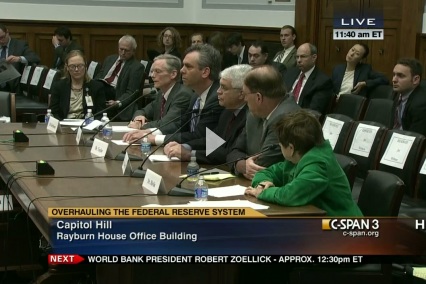
That’s Jeff Herbener to my right and John Taylor to my left, with Jamie Galbraith by Taylor. The one on the end is not Yoda, but Alice Rivlin.
Because the hearing was televised, I can truthfully say, “I’m not a macroeconomist, but I play one on TV.”
Darden Entrepreneurship and Innovation Research Conference
| Peter Klein |
The Darden Entrepreneurship and Innovation Research Conference is now underway in Charlottesville, Virginia. Keynote and roundtable sessions will be streamed on the conference website.
Crowdsourcing in Academia
| Peter Klein |
It’s called “fractional scholarship.”
American universities produce far more Ph.D’s than there are faculty positions for them to fill, say the report’s authors, Samuel Arbesman, senior scholar at the Kauffman Foundation, and Jon Wilkins, founder of the Ronin Institute. Thus, the traditional academic path may not be an option for newly minted Ph.D.s. Other post-graduate scientists may eschew academia for careers in positions that don’t take direct advantage of the skills they acquired in graduate school.
Consequently, “America has a glut of talented, highly educated, underemployed individuals who wish to and are quite capable of effectively pursuing scholarship, but are unable to do so,” said Arbesman. “Ideally, groups of these individuals would come together to identify, define and tackle the questions that offer the greatest potential for important scientific results and economic growth.”
Given the level of relationship-specific investment many research projects require, this isn’t likely to work without some kinds of long-term commitments. But the model may be effective for other projects. And it beats the alternative.
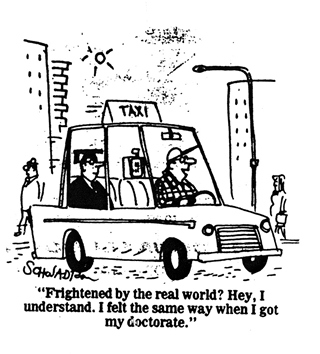
The Bizarro World of Professor Sen
| Peter Klein |
Here is another of those head-scratchers, this one from Amartya Sen, about how neoclassical economics is partly responsible for the financial crisis because neoclassical economists believe that markets work “perfectly”:
Since the crisis broke out the economics profession in general and mainstream economics in particular have been severely criticised. Do you think this is justified?
The criticism of mainstream economics is justified to a limited extent. It is certainly true that the focus of attention in mainstream economics has tended to be on assuming the market to be working perfectly and there being no need for regulation. However, while this view has been a very dominant part of mainstream economics, you have to bear in mind that mainstream economics is not all centered around one unified theme. I don’t think all of mainstream economics should be held responsible.
Do you think that neoclassical macro economists should bear the brunt of the blame?
This would be an oversimplification. Neoclassical economics has many different paths. There are mainstream neoclassical economists who have been very critical of the complete reliance on the markets.
I’ve been around neoclassical economists since my undergraduate days and I can’t think of a single neoclassical economist who says that markets work “perfectly” and favoring “complete reliance on the markets.” David Friedman comes to mind, but even his arguments for anarchism are not based on the belief that markets are somehow “perfect,” but that they are less imperfect than regulation. The truth, of course, is that virtually all neoclassical economists favor a substantial amount of economic regulation — government production of law and order, government control of the monetary system, competition policy, and other government actions to combat purported market failures.
Statements like Sen’s make sense only as a rhetorical ploy to fool the reader. If the mainstream thinks, say, that government should control 25% of the economy, and you think government should control 75%, you describe the mainstream as “extremists” who believe in “no government,” thus making your position seem like a reasonable middle ground. Krugman of course employs the same rhetorical strategy. Sen is obviously too intelligent to mean what he says literally, so I can only assume mendacity. Am I missing something?
Explosive Economists
| Peter Klein |
I’ve always liked the actor John Lithgow, not only because of his smarmy yet likeable weirdness (keep your comments to yourselves, please), but also because he’s married to an economist, the UCLA economic historian Mary Yeager. (The late Fred Bateman told me that when he and Yeager were just starting out, no one in their professional circles could understand why she was hanging out with this struggling actor who was obviously never going to make it big.)
So I was amused by a profile in Thursday’s WSJ about Lithgow’s role in an upcoming Broadway play about cold-war journalist Joseph Alsop. Reporter: “You portray Joe Alsop as an explosive man. Did you model him on someone from your own life?” Lithgow: “I’ve known mercurial people who emotionally completely turn on a dime, and they’re very exciting people. My wife is a little like that.”
OK, most economists are not exciting, but I’ve known plenty of mercurial and explosive ones.
Paradigm Shift
| Peter Klein |
 Did you know this year is the semicentennial of Kuhn’s Structure of Scientific Revolutions? David Kaiser offers some reflections at Nature.
At the heart of Kuhn’s account stood the tricky notion of the paradigm. British philosopher Margaret Masterman famously isolated 21 distinct ways in which Kuhn used the slippery term throughout his slim volume. Even Kuhn himself came to realize that he had saddled the word with too much baggage: in later essays, he separated his intended meanings into two clusters. One sense referred to a scientific community’s reigning theories and methods. The second meaning, which Kuhn argued was both more original and more important, referred to exemplars or model problems, the worked examples on which students and young scientists cut their teeth. As Kuhn appreciated from his own physics training, scientists learned by immersive apprenticeship; they had to hone what Hungarian chemist and philosopher of science Michael Polanyi had called “tacit knowledge” by working through large collections of exemplars rather than by memorizing explicit rules or theorems. More than most scholars of his era, Kuhn taught historians and philosophers to view science as practice rather than syllogism.
Kuhn did not, to my knowledge, say much about the social sciences, though in a later essay he described them in somewhat unflattering terms:
[T]here are many fields — I shall call them proto-sciences — in which practice does not generate testable conclusions but which nonetheless resemble ph9ilosophy and the arts rather than the established sciences in their developmental patters. I think, for example, of fields like chemistry and electricity before the mid-eighteenth century, of the study of heredity and phylogeny before the mid-nineteenth, or many of the social sciences today. In those fields, . . . though they satisfy [Popper’s] demarcation criterion, incessant criticism and continual striving for a fresh start as primary forces, and need to be. No more than in philosophy and the arts, however, do they result in clear-cut progress.
Murray Rothbard took an explicitly Kuhnian approach to his history of economic thought, agreeing with Kuhn that there is no linear, upward progression and condemning what he called the “Whig theory” of intellectual history.
Get Off My Lawn
| Peter Klein |
The boys from orgtheory.net were parking in our maintenance lot, so we had to put up signs. (Spotted in Champaign, IL.)


A Curious Case of Vertical Integration
| Peter Klein |
The WSJ reports that Delta Airlines wants to acquire a Pennsylvania oil refinery. The reporters, quoting the ubiquitous “people familiar with the situation,” says that Delta “could save between $20 and $25 a barrel on some of its jet-fuel costs by acquiring the refinery, a big advantage as industry costs now approach $140 a barrel, up 11% so far this year.” But how? No particular economies of integration are mentioned in the article (apparently the WSJ doesn’t consider this an important point). Jet fuel is a standardized commodity, so asset specificity isn’t an issue. Organizational capabilities don’t seem to be relevant. Market power? Price discrimination? I don’t see it. In short, I can’t imagine where these cost savings would come from. Any ideas?
Stylish Academic Writing
| Peter Klein |
Helen Sword’s recent WSJ piece — “Yes, Even Professors Can Write Stylishly” — takes me back to an early O&M entry on academic writing. Sword offers some great pairwise comparisons:
Stodgy: The human capacity to synthesize linguistic complexity is exemplified by the grammatical phenomenon of verb irregularity.
Stylish: “This book tries to illuminate the nature of language and mind by choosing a single phenomenon and examining it from every angle imaginable. That phenomenon is regular and irregular verbs, the bane of every language student.” (Steven Pinker)
and
Stodgy: A significant variability in nutrient-gathering behaviors has been observed in various insect species.
Stylish: “Insects suck, chew, parasitize, bore, store, and even cultivate their foods to a highly sophisticated degree of specialization.” (Richard Leschen and Thomas Buckley)
Plenty more are in her new book, Stylish Academic Writing. As I noted in the earlier post, economics and management scholarship has been blessed with some terrific prose stylists, but plenty of awful ones too.
And If You Can’t Teach, Teach Gym
| Peter Klein |
Kate Maxwell, writing at Growthology, is concerned about the distance between those who do entrepreneurship and those who teach or research entrepreneurship:
In my reading of the entrepreneurship literature I have been struck by the large gap between entrepreneurs and people who study entrepreneurship. The group of people who self select into entrepreneurship is almost entirely disjoint from the group of people who self select to study it. Such a gap exists in other fields to greater and lesser degrees. Sociologists, for instance, study phenomenon in which they are clearly participants whereas political scientists are rarely career politicians but are often actors in political systems.
But in the case of entrepreneurship the gap is cause for concern. My sense is that all too often those studying entrepreneurship don’t understand, even through exposure, the messy process of creating a business, nor, due to selection effects, are they naturally inclined to think like an entrepreneur might.
I agree entirely with this description, but am not sure I understand the concern. Kate seems to assume a particular concept of entrepreneurship — the day-to-day mechanics of starting and growing a business — that applies only to a fraction of the entrepreneurship literature. Surely one can study the effects of entrepreneurship on economic outcomes like growth and industry structure without “thinking like an entrepreneur.” Same for antecedents to entrepreneurship such as the legal and political environment, social and cultural norms, the behavior of universities, etc. Even more so, if we treat entrepreneurship as an economic function (alertness, innovation, adaptation, or judgment) rather than an employment category or a firm type, then solid training in economics and related disciplines seems the main prerequisite for doing good research.
Of course, this doesn’t mean that entrepreneurship scholars shouldn’t talk to entrepreneurs or study their lives and work. Want to know how if feels to throw the winning Superbowl pass? Ask Tom Brady or Eli Manning. The stat sheet won’t tell you that. But this doesn’t mean that only ex-NFL players can be competent announcers, analysts, sportswriters, etc. Similarly, I like to read about food, and have enjoyed the recent memoirs of great chefs like Jacques Pépin and Julia Child. These first-hand accounts are full of unique insights and colorful observations. But there are plenty of great books on the restaurant industry, on the relationship between food and culture, on culinary innovation, etc. by authors who couldn’t cook their way out of a paper bag.
What do you think?
Why I Avoid Bourdieu: #2,538 in a Series
| Peter Klein |
I have little to add to this press release, summarizing a call by sociologists to treat the individual and social disease of failing to take climate change seriously:
LONDON — (March 26, 2012) — Resistance at individual and societal levels must be recognized and treated before real action can be taken to effectively address threats facing the planet from human-caused contributions to climate change.
That’s the message to this week’s Planet Under Pressure Conference by a group of speakers led by Kari Marie Norgaard, professor of sociology and environmental studies at the University of Oregon. . . .
“We find a profound misfit between dire scientific predictions of ongoing and future climate changes and scientific assessments of needed emissions reductions on the one hand, and weak political, social or policy response on the other,” Norgaard said. Serious discussions about solutions, she added, are mired in cultural inertia “that exists across spheres of the individual, social interaction, culture and institutions.”
“Climate change poses a massive threat to our present social, economic and political order. From a sociological perspective, resistance to change is to be expected,” she said. “People are individually and collectively habituated to the ways we act and think. This habituation must be recognized and simultaneously addressed at the individual, cultural and societal level — how we think the world works and how we think it should work.”
In their paper, Norgaard and co-authors Robert Brulle of Drexel University in Philadelphia and Randolph Haluza-DeLay of The King’s University College in Canada draw from the work of French sociologist Pierre Bourdieu (1930-2002) to describe social mechanisms that maintain social stability or cultural inertia in the face of climate change at the three levels. . . .
I note that the lead author recently published Living in Denial: Climate Change, Emotions, and Everyday Life (MIT Press, 2011), which sounds like a reasonable, balanced, and objective look at the climate-change debate.
CFP: Bricolage in Art and Entrepreneurship
 | Peter Klein |
Bricolage — doing the best you can with the materials on hand, rather than choosing and end and getting the resources you need — is an important concept in the contemporary entrepreneurship literature. Garud and Karnøe’s influential 2003 paper on the Danish wind power industry helped bring bricolage into the mainstream, and it has important parallels with effectuation and other approaches to entrepreneurship that emphasize experimentation and incremental learning.
The University of Missouri’s Department of Romance Languages and Literatures is hosting an interdisciplinary conference, 12-13 November 2012, on bricolage in art and entrepreneurship, focusing on the work of Ediciones Vigía, a unique artists’ collective that produces limited edition handmade books by Cuban and international authors and musicians. Participants will come not only from the humanities, education, and journalism, but also economics, management, and entrepreneurship. Among the featured speakers are Ivo Zander, who recently co-edited a book on Art Entrepeneurship, and Sharon Alvarez.
O&M readers interested in the relationship between business and the arts, the parallels between artistic creativity and entrepreneurial creativity, the economic organization of artist networks, and related issues should check it out. The full call for papers, along with related information, is below the fold.
The Socialist Car
 | Peter Klein |
I blogged previously about Lewis Siegelbaum’s 2008 book Cars for Comrades: The Life of the Soviet Automobile (or, more precisely, Perry Patterson’s EH.Net review). So I need to say something about the follow up, The Socialist Car: Automobility in the Eastern Bloc (Cornell University Press, 2011), an essay collection edited by Siegelbaum. Once again, here’s Patterson:
As was true for Cars for Comrades, this book takes the modern upper-middle-class Western reader far from the contemporary world where drivers need not know what’s “under the hood,” where synthetic oil might not need attention for 15,000 miles or more, and where long-standing institutions for finance, distribution and service of vehicles are seemingly ubiquitous. Rather, this is a world where two-stroke engines are designed for easy (and frequent) self-service, new car owners are required to install windshield wipers, and new automobiles are provided with extensive repair kits and instructions for disassembly. This world is also one where private automobiles – and even socially-owned trucks – represent potential threats to the Soviet-style socialist undertaking by providing opportunities for generating illegal incomes and diverting resources toward consumption. At the core of the rich set of stories contained here are the compromises that everyday citizens, urban planners, and Party officials routinely made as the powerful forces associated with the automobile became more and more apparent throughout the socialist bloc. In addition, the examples presented in this eleven-chapter volume say much about the increasingly complex information flows required and implied by automobiles that became more and more technically complex over time.
Speaking of EH.net, the performativity crowd may get a kick out of another recent review, Bruce Carruthers’s discussion of Carl Wennerlind, Casualties of Credit: The English Financial Revolution, 1620-1720 (Harvard University Press, 2011). Notes Carruthers: “It was not simply that early modern capital markets evolved, that financial systems developed, or that English economic institutions changed. These critical transformations were accompanied and even shaped by the analyses offered by people who witnessed the events of the time.”
Lazear and Spletzer on Creative Destruction
| Peter Klein |
What labor economists call “churn” is an important part of creative destruction, the combining and recombining of productive resources as business entities appear and disappear. New paper:
Hiring, Churn and the Business Cycle
Edward P. Lazear, James R. Spletzer
NBER Working Paper No. 17910
Issued in March 2012Churn, defined as replacing departing workers with new ones as workers move to more productive uses, is an important feature of labor dynamics. The majority of hiring and separation reflects churn rather than hiring for expansion or separation for contraction. Using the JOLTS data, we show that churn decreased significantly during the most recent recession with almost four-fifths of the decline in hiring reflecting decreases in churn. Reductions in churn have costs because they reflect a reduction in labor movement to higher valued uses. We estimate the cost of reduced churn to be $208 billion. On an annual basis, this amounts to about .4% of GDP for a period of 3 1/2 years.
First Copies of the New Book
 | Peter Klein |
Nicolai was in town yesterday to deliver the 2012 Sherlock Hibbs Distinguished Lecture in Economics and Business, and he gave a terrific talk about “open entrepreneurship,” the application of concepts and principles from the open innovation literature to the discovery, evaluation, and exploitation of entrepreneurial opportunities. Upon returning to my office after the lecture, I found a surprise waiting for me: the first hardcopies of our new book, Organizing Entrepreneurial Judgment: A New Approach to the Firm (Cambridge University Press, 2012). As both authors happened to be together, we preserved the moment for posterity.

You can order today on Amazon’s UK site (or pre-order on the US site, which shows a publication date of 30 April). You can order directly from Cambridge (UK or US).
A brief description and some endorsements are below the fold.
NB: Tomorrow Nicolai is giving the Hayek Lecture at the Austrian Scholars Conference, which you can watch live online.
Update: O&M readers can order directly from Cambridge and receive a 20% discount! Use this link.
Hayek on Schumpeter on Methodological Individualism
| Peter Klein |
Our QOTD comes from the 2002 version of Hayek’s “Competition as a Discovery Procedure.” (Thanks to REW for the inspiration.) Hayek delivered two versions of the lecture, both in 1968, one in English and one in German. The former appeared in Hayek’s 1978 collection New Studies in Philosophy, Politics, Economics, and the History of Ideas, and is the version most familiar to English-speaking scholars. In 2002 the QJAE published a new English translation of the German version which includes two sections (II and VII) omitted from the earlier English version. In this passage from section II Hayek distinguishes macroeconomics (“macrotheory”) from microeconomics (“microtheory”):
About many important conditions we have only statistical information rather than data regarding changes in the fine structure. Macrotheory then often affords approximate values or, probably, predictions that we are unable to obtain in any other way. It might often be worthwhile, for example, to base our reasoning on the assumption that an increase of aggregate demand will in general lead to a greater increase in investment, although we know that under certain circumstances the opposite will be the case. These theorems of macrotheory are certainly valuable as rules of thumb for generating predictions in the presence of insufficient information. But they are not only not more scientific than is microtheory; in a strict sense they do not have the character of scientific theories at all.
In this regard I must confess that I still sympathize more with the views of the young Schumpeter than with those of the elder, the latter being responsible to so great an extent for the rise of macrotheory. Exactly 60 years ago, in his brilliant first publication, a few pages after having introduced the concept of “methodological individualism” to designate the method of economic theory, he wrote:
If one erects the edifice of our theory uninfluenced by prejudices and outside demands, one does not encounter these concepts [namely “national income,” “national wealth,” “social capital”] at all. Thus we will not be further concerned with them. If we wanted to do so, however, we would see how greatly they are afflicted with obscurities and difficulties, and how closely they are associated with numerous false notions, without yielding a single truly valuable theorem.
The reference is to Schumpeter’s 1908 book, Das Wesen und der Hauptinhalt der theoretischen Nationalökonomie which, to my knowledge, has never been translated (though an excerpt, and some commentary, are here). For more on the different versions of Hayek’s essay see here and here.
NB: Krugman blogged over the weekend about microfoundations, offering a remarkably (sic) shallow and misguided critique based on what Hayek would call the scientistic fallacy. E.g.: “meteorologists were using concepts like cold and warm fronts long before they had computational weather models, because those concepts seemed to make sense and to work. Why, then, do some economists think that concepts like the IS curve or the multiplier are illegitimate because they aren’t necessarily grounded in optimization from the ground up?” Ugh.
Murray Rothbard Day
| Peter Klein |
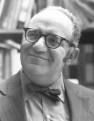 Today would have been Murray Rothbard’s 86th birthday. Rothbard is widely (and rightly) regarded as the father of the modern libertarian movement, and a driving force behind the “Austrian” revival in the US, beginning in the late 1950s. For this occasion I hope I can be forgiven a bit of personal reminiscence, courtesy of a brief excerpt from the introduction to my 2010 book, The Capitalist and the Entrepreneur:
As a college senior, I was thinking about graduate school—possibly in economics. By pure chance, my father saw a poster on a bulletin board advertising graduate-school fellowships from the Ludwig von Mises Institute. (Younger readers: this was an actual, physical bulletin board, with a piece of paper attached; this was in the dark days before the Internet.) I was flabbergasted; someone had named an institute after Mises? I applied for a fellowship, received a nice letter from the president, Lew Rockwell, and eventually had a telephone interview with the fellowship committee, which consisted of Murray Rothbard. You can imagine how nervous I was the day of that phone call! But Rothbard was friendly and engaging, his legendary charisma coming across even over the phone, and he quickly put me at ease. (I also applied for admission to New York University’s graduate program in economics, which got me a phone call from Israel Kirzner. Talk about the proverbial kid in the candy store!) I won the Mises fellowship, and eventually enrolled in the economics PhD program at the University of California, Berkeley, which I started in 1988.
Before my first summer of graduate school, I was privileged to attend the “Mises University,” then called the “Advanced Instructional Program in Austrian Economics,” a week-long program of lectures and discussions held that year at Stanford University and led by Rothbard, Hans-Hermann Hoppe, Roger Garrison, and David Gordon. Meeting Rothbard and his colleagues was a transformational experience. They were brilliant, energetic, enthusiastic, and optimistic. Graduate school was no cake walk—the required core courses in (mathematical) economic theory and statistics drove many students to the brink of despair, and some of them doubtless have nervous twitches to this day—but the knowledge that I was part of a larger movement, a scholarly community devoted to the Austrian approach, kept me going through the darker hours.
I go on to discuss Oliver Williamson’s influence on my research program. Later I include Rothbard among my dedicatees:
Murray Rothbard, the great libertarian polymath whose life and work played such a critical role in the modern Austrian revival, dazzled me with his scholarship, his energy, and his sense of life. Rothbard is widely recognized as a great libertarian theorist, but his technical contributions to Austrian economics are not always appreciated, even in Austrian circles. In my view he is one of the most important contributors to the “mundane” Austrian analysis described above.
Computers in Higher Education, 1960s Edition
| Peter Klein |
An illuminating passage from James Ridgeway’s 1968 book The Closed Corporation: American Universities in Crisis, a scathing critique of the university-military-industrial complex. Note the cameo by Jim March:
[University of California officials Ralph W.] Gerard and [R. Dan] Tschirgi are computer fetishists who insist information is knowledge, and that the function of a university is to provide information.
In 1963 and 1964 Chancellor David G. Aldrich, Jr., at Irvine, and Gerard got IBM interested in setting up programs there. The company agreed to install a 1400 system and to supply staff and engineers. An IBM employee, Dr. J. A. Kearns, came along to head the project and was given a part-time appointment at the Graduate School of Administration. The idea was to see whether the computer could be used as a library, for various administrative functions and for teaching.
Gerard paints a glowing picture. He says that one half of the students on the Irvine campus spend at least one hour a week on the computer, and that computers are used in teaching biology, mathematics, economics, sociology and psychology.
After speaking with Gerard, I went along to see the computer in action, and ran into a senior staff man who told me in a jaundiced manner that it wasn’t operating because they couldn’t make the new IBM 360 system work right. This gentleman was exceedingly glum about the possibilities of very many students learning much of anything on the Irvine computers. So was the dean of Social Sciences, James G. March. When I asked him about the use of the machine to teach sociology, he replied grimly that all the computer did was to print out some basic definitions in an introductory course, which, as he pointed out, one could get just as well from reading a book. He went on to say that a minute portion of any introductory course was on a computer, that students spent little time on them, and that most of the time was taken up programming them. March said the difficulty was to devise a system which could answer questions rather than ask them. The most one could really expect was to have a machine pose a problem to the student, who could then go ahead an answer it on his own.
The tech described here is dated but the book itself still packs a punch. In the late 1906s concerns about the close relationships between the federal government (particularly the Pentagon), public research universities, and industry (particularly defense contractors) were new. Now we take for granted that a primary task of the research university is to produce “applied” research in close cooperation with government and industry sponsors, to commercialize its scientific discoveries, to train students for industry, and so on. But this is a fairly recent — mid-20th century — development, and not an obviously desirable one.
Evil Tw-Lin
| Peter Klein |
 Jeremy Freese to his fellow sociologists:
Jeremy Lin’s favorite course at Harvard was Sociology 128: Methods of Social Science Research. Nevertheless, he majored in economics, so your department cannot staple his face to its “What Can You Do With A Sociology Major?” poster.
(If you don’t get the headline, ask the kittehs.)





 Organizations and Markets
Recent Comments