Posts filed under ‘– Klein –’
A Turkey of a Thanksgiving Post
| Peter Klein |
 Many US bloggers try to post something clever on Thanksgiving about religious freedom, agricultural productivity, colonialism, property rights, immigration, etc. We’ve done it ourselves. But this year I thought I’d share something different: nerdy academic stuff about — what else? — the economic organization of the turkey industry. Tomislav Vukina’s 2001 paper on vertical integration in poultry is instructive. For example:
The pattern of vertical integration is less uniform in the turkey industry than in the broiler industry. A turkey company is less likely to own its own hatchery but is more likely to have company owned production farms (Martin et al. 1993). There is also more variation among production contracts in terms of division of risks and profits from growing turkeys than in the broiler industry. The processing plant is the center for control of placement.
A processor may contract directly with farmers or contract with a feed supplier who in turn contracts with farmers. In the turkey industry, there are still some independent producers with formal marketing contracts with processors. Such marketing contracts do not always provide any price or margin guarantees to producers. (more…)
Intellectual History Making a Comeback
| Peter Klein |
 At this blog we love intellectual history, particularly the history of economic and management thought. Of course, intellectual history has largely disappeared from the curricula of top economics and management programs. In these fields, the trend was driven by positivism — the belief that social science, like natural science, should favor experimental methods, hypothesis testing, and the rest of the usual trappings of Science. For positivists, there is no need to study the history of the discipline, because any truths emerging from prior work have already been incorporated in to the current textbooks and journal articles. (Murray Rothbard called this the “Whig theory” of intellectual history.)
In the field of intellectual history more generally, the challenges came from the late-twentieth-century emphasis on race, gender, and ethnicity, which privileged social, cultural, and material factors over intellectual ones. But apparently intellectual history is making a comeback. The New York Times reports on the newly formed Society for U.S. Intellectual History, which is sparking new interest in the field. The Times article describes
a resurgence in the fortunes of intellectual history — a discipline long dismissed, if not as boring, then as musty, elitist and out of touch. While intellectual historians like Richard Hofstadter and Perry Miller once dominated the profession, they were swept aside in the 1960s by the rise of social and then cultural history, which regarded talk of “the American mind” as code for “the mind of white, male Americans who happened to write books.”
Today, however, a new breed of young intellectual historian is aiming to integrate the spirit of “history from below” with an approach that doesn’t chop American history off at the neck. Young intellectual historians, scholars at the conference were quick to emphasize, have fully absorbed the lessons of the profession’s increased attention to questions of race, class and gender, without losing hold of the premise that ideas matter, even in a culture that still considers “intellectual” a term of abuse.
“We still want to talk about ideas, but we see ideas everywhere,” said Andrew Hartman, a professor at Illinois State University and president of the newly formed Society for U.S. Intellectual History, which sponsored the conference. “Big ideas affect everybody. It’s not elitist to talk about them.”
A Formal Model of Experimentation in Firms
| Peter Klein |
Following Knight, Mises, and Lachmann, we have often characterized entrepreneurship on this blog (and the McQuinn blog, which should be on your reading list) as experimentation with combinations of heterogeneous capital resources. Experimentation itself is relatively understudied in the entrepreneurship and strategy literature — we have general theories about the nature and effects of experimentation, indirect empirical evidence on competition as experimentation (e.g., my relatedness stuff with Lasse), case-study evidence about experimentation and innovation within firms, but don’t fully understand the exact mechanisms.
Here’s a new paper that will not be to everyone’s taste, but tries to get at these issues in a formal model of interaction between experimenting firms:
The Role of Information in Competitive Experimentation
Ufuk Akcigit, Qingmin Liu
NBER Working Paper No. 17602, November 2011Technological progress is typically a result of trial-and-error research by competing firms. While some research paths lead to the innovation sought, others result in dead ends. Because firms benefit from their competitors working in the wrong direction, they do not reveal their dead-end findings. Time and resources are wasted on projects that other firms have already found to be dead ends. Consequently, technological progress is slowed down, and the society benefits from innovations with delay, if ever. To study this prevalent problem, we build a tractable two-arm bandit model with two competing firms. The risky arm could potentially lead to a dead end and the safe arm introduces further competition to make firms keep their dead-end findings private. We characterize the equilibrium in this decentralized environment and show that the equilibrium necessarily entails significant efficiency losses due to wasteful dead-end replication and a flight to safety — an early abandonment of the risky project. Finally, we design a dynamic mechanism where firms are incentivized to disclose their actions and share their private information in a timely manner. This mechanism restores efficiency and suggests a direction for welfare improvement.
Shakespeare and Epistemology
| Peter Klein |
We university types love The Bard — we’ve got bookstores hither and yon, pizza joints, you name it. Not surprisingly, Shakespearean scholars are up in arms at Roland Emmerich’s film Anonymous, which they view as silly entertainment at best, disreputable Oliver Stone style revisionism at worst. I haven’t seen the movie and don’t have a particular dog in the authorship fight (though I once heard a very funny lecture by Joe Sobran based on his 1997 book Alias Shakespeare). But I’m puzzled by the core epistemological issue: what do we really know about Shakespearean authorship?
 An English professor friend told me that belief in a different author for any of Shakespeare’s works is like “belief in the phlogiston theory of fire.” Stephen Marche writes in the NY Times Magazine: “It is impossible that Edward de Vere wrote Shakespeare. Notice that I am not saying improbable; it is impossible.” Again, I don’t know anything about the issue other than what I’ve read in recent commentaries, but Marche’s case, in the piece linked above, is surprisingly weak (some Shakespeare products are dated after de Vere died, which only proves that de Vere couldn’t have written those; the doubters are snobs who don’t believe a poor country boy could have written such beautiful verse, which could be true, but hardly establishes that the country boy did in fact write them; and other circumstantial bits and ex cathedra pronouncements.)
My question, though, is the epistemological one: How can we possibly know with 100% certainty who authored every one of the literary works attributed to Shakespeare? Heck, we don’t know who really writes the stuff published under names like “Doris Kearns Goodwin” and “Stephen Ambrose,” and those appeared in the last few years, not the 17th century. There’s even a lively controversy about what Adam Smith wrote and what he copied. Intellectual historians are frequently reinterpreting and revising, and few cows are sacred. Regarding Shakespearean authorship, then, shouldn’t we expect a little Popperian or Hayekian humility?
Complete Contracts: Roomate Agreement Edition
| Peter Klein |
Contractual completeness is a core issue in organizational economics. A colleague helpfully suggested this illustration of a nearly complete contract. Note the deliberate omission of language dealing with an extreme low-probability event (time for Nicolai and Scott to resume their debate over bounded rationality?).
CFP: ISNIE 2012
| Peter Klein |
 The Call for Papers for the 2012 ISNIE conference, 14-16 June 2012 at the University of Southern California, is now posted. Proposals are due 30 January 2012, so start working on those abstracts!
I have been involved with ISNIE for many years and currently serve as the organization’s treasurer. The conferences are terrific, with a variety of papers, panels, and keynotes spanning the broad range of institutional and organizational social science research.
Trivia: I first met the good Professor Foss at the inaugural ISNIE conference in 1997 in St. Louis So if it weren’t for ISNIE, this blog might not exist. . . .
Causal Identification in Management Research
| Peter Klein |
Mike Ryall writes about the 2011 HBS strategy conference:
Of the empirical papers, almost half incorporated some method aimed at causal identification. My sense is that such identification strategies will soon become a fairly standard requirement for publication in a top management journal (“soon” being measured in academic time, of course).
We’ve discussed this issue several times, including a 2008 post on the potential tradeoffs between choosing problems that are well-identified and choosing problems that are important. I agree with Mike that the management and entrepreneurship literatures — at least the quantitative empirical part of those literatures — are catching up the economists here. But consider the advantages of backwardness: can management research learn to take identification seriously without falling into the Freakonomics trap? (Please, no Freakostrategy or Super-Freakopreneurship!)
Of course, management and entrepreneurship researchers, unlike most economists, tend to sympathize with (or at least tolerate) qualitative methods, and one legitimate means of generating causal inference is careful, detailed, historical investigation, case work, ethnography, analytical narrative, and so on. I suspect, though, that the trend Mike describes will tend to push these approaches to the side as well.

“Poor Economics” Wins FT Best Book Award
| Peter Klein |
The Financial Times has named Abhijit Banerjee and Esther Duflo’s Poor Economics: A Radical Rethinking of the Way to Fight Global Poverty the best business book of 2011. Here’s the book’s webpage. Here are previous O&M posts on the Banerjee-Duflo approach, which is obviously gaining momentum.
The State of the US Economy
| Peter Klein |
According to the latest Kauffman Foundation survey of “top” economics bloggers. (I participate, so it’s not that exclusive a club.)
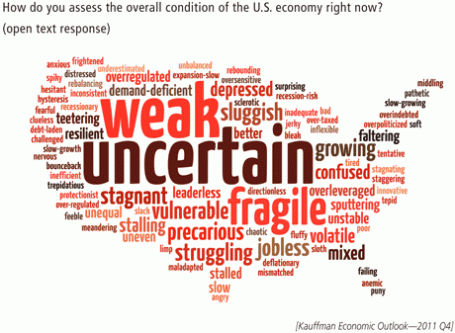
Full report available here. As Kauffman’s Tim Kane notes, “The economics blogging community has proven to be very insightful with rich and diverse viewpoints, but by nature they understand the importance of entrepreneurship because that’s ultimately who they are.” I agree, with the caveat that many of us don’t exactly have a lot of skin in the game. . . .
Moral Culpability of Independent Contractors
| Peter Klein |
Anita McGahan gave two fantastic talks last week on the economics and strategy of health care, including some work on intellectual property and pharmaceutical research and a larger project on public health around the world. At lunch Anita talked about her work with Joel Baum on private military companies. As we discussed, much of the literature on privatization and contracting out takes the focal organization’s objectives as given, then studies the least costly methods of meeting those objectives. But objectives are endogenous to production costs. Predator drones lower the cost of extrajudicial killings, so we get more extrajudicial killings, ceteris paribus. If prison privatization lowers the cost of incarceration, we should expect more incarceration. And so on. For this reason, the desirability of contracting out depends on whether we want more of thing that is being contracting out, a point made eloquently by Bruce Benson.
A related question is the extent to which contractors should be legally liable, not to mention morally culpable, for the outcomes they help facilitate. Most of us reject the Nuremberg defense, but how far are we willing to go? Is Xe partly responsible for US military strategy and tactics in Iraq and Afghanistan? Do private prison operators share some of the blame for the US’s astonishingly high incarceration rate?
See below for the classic discussion of this issue.
CFP: “Managing Wicked Problems: The Role of Multi-Stakeholder Engagements”
| Peter Klein |
O&M friend Brent Ross sends along this CFP for a track session of the 2012 Wageningen International Conference on Chain and Network Management. The session, “Managing Wicked Problems: The Role of Multi-Stakeholder Engagements for Resource and Value Creation,” is linked to a special issue of the International Food and Agribusiness Management Review. Info below the fold: (more…)
Can a Strong Central Government Credibly Commit Not to Intervene?
| Peter Klein |
When the subject is large financial or industrial companies, the answer is clearly no. Government promises not to rescue failing banks or large firms are cheap talk, not credible commitments. A central government strong enough to bail out politically connected organizations will bail them out; the only government that can credibly commit not to intervene is one that is not legally empowered to intervene. And no modern state is willing to give up that discretionary authority. Here is evidence from Korea:
Ending “Too Big To Fail”: Government Promises vs. Investor Perceptions
Todd A. Gormley, Simon Johnson, Changyong Rhee
NBER Working Paper No. 17518, October 2011Can a government credibly promise not to bailout firms whose failure would have major negative systemic consequences? Our analysis of Korea’s 1997-99 crisis, suggests an answer: No. Despite a general “no bailout” policy during the crisis, the largest Korean corporate groups (chaebol) – facing severe financial and governance problems – could still borrow heavily from households through issuing bonds at prices implying very low expected default risk. The evidence suggests “too big to fail” beliefs were not eliminated by government promises, presumably because investors believed that this policy was not time consistent. Subsequent government handling of potential and actual defaults by Daewoo and Hyundai confirmed the market view that creditors would be protected.
Papers of Interest from the NSF’s Call for Long-Term Research Agendas
| Peter Klein |
The NSF recently commissioned a set of papers on long-term research agendas in economics:
This is a compendium of fifty-four papers written by distinguished economists in response to an invitation by the National Science Foundation’s Directorate for the Social, Behavioral and Economic Sciences (NSF/SBE) to economists and relevant research communities in August 2010 to write white papers that describe grand challenge questions in their sciences that transcend near-term funding cycles and are “likely to drive next generation research in the social, behavioral, and economic sciences.” These papers offer a number of exciting and at times provocative ideas about future research agendas in economics. The papers could also generate compelling ideas for infrastructure projects, new methodologies and important research topics.
Here are a few of particular interest for O&Mers:
Challenges for Social Sciences: Institutions and Economic Development
Daron AcemogluMaking the Case for Contract Theory
Oliver HartResearch Opportunities in Social and Economic Networks
Matthew O. JacksonThe Economics of Digitization: An Agenda for NSF
Shane M. Greenstein, Josh Lerner, and Scott SternThe Productivity Grand Challenge: Why Do Organizations Differ so Much?
John Van Reenen
You can find the whole set at SSRN.
Credible Commitment
| Peter Klein | A rather extreme form of the Schelling strategy of tying one’s own hands: 
Courtesy of the indispensable Fail Blog.
Cuba’s First MBA Program
| Peter Klein |
Mises considered the stock market the distinguishing feature of capitalism. “There can be no genuine private ownership of capital without a stock market: there can be no true socialism if such a market is allowed to exist.” But he forgot another capitalist marker: the MBA program. Cuba still lacks a stock market, but the streets of Havana will soon ring with sounds of PowerPointese. The Financial Times has the scoop. Just imagine running some Marxist Revolutionary rhetoric through the MBA Writer!
What Do Boards Really Do?
| Peter Klein |
Coase is fond of telling this story about the economist and the horse:
Economics, over the years, has become more and more abstract and divorced from events in the real world. Economists, by and large, do not study the workings of the actual economic system. They theorize about it. As Ely Devons, an English economist, once said at a meeting, “If economists wished to study the horse, they wouldn’t go and look at horses. They’d sit in their studies and say to themselves, ‘What would I do if I were a horse?’” And they would soon discover that they would maximize their utilities.
Coase, as O&M readers know, prefers direct, hands-on observation to abstract theorizing. As a Misesian [serious, hubba hubba], of course, I can’t endorse this view as a general prescription, though I recognize its value for empirical work. Sometimes it’s best to look at real examples, or to ask real practitioners. Kaplan and Strömberg read through real-world venture-capital contracts to see how control rights were allocated. Genesove and Mullin used the minutes of trade-association meetings, not modeling, to figure out how members of the US sugar cartel maintained compliance.
Here’s another interesting example: “What Do Boards Really Do?” by Miriam Schwartz-Ziv and Michael Weisbach.
We analyze a unique database from a sample of real-world boardrooms – minutes of board meetings and board-committee meetings of eleven business companies for which the Israeli government holds a substantial equity interest. We use these data to evaluate the underlying assumptions and predictions of models of boards of directors. These models generally fall into two categories: “managerial models” assume boards play a direct role in managing the firm, and “supervisory models” assume that boards’ monitor top management but do not make business decisions themselves. Consistent with the supervisory models, our minutes-based data suggest that boards spend most of their time monitoring management: 67% of the issues they discussed were of a supervisory nature, they were presented with only a single option in 99% of the issues discussed, and they disagreed with the CEO only 3.3% of the time. In addition, managerial models describe boards at times as well: Boards requested to receive further information or an update for 8% of the issues discussed, and they took an initiative with respect to 8.1% of them. In 63% of the meetings, boards took at least one of these actions or did not vote in line with the CEO.
I think Ronald would approve.
Business and American Literature
| Peter Klein |
Thanks to Shawn Ritenour for the pointer to Algis Valiunas’s National Affairs piece, “Business and the Literati.”
The business of America may be business, but the business of American literature in the past century has been largely to insist that the nation is, in pursuing business, wasting itself on unworthy objects. In the eyes of most novelists and playwrights who deal with the subject, business is not an honorable vocation, but rather an obsessive scramble for lucre and status. Tycoons are plunderers. Salesmen are poor slobs truckling to their bosses, though most of them aspire to be cormorants and highwaymen, too. The mass desire to strike it rich has launched a forced march to nowhere. In short, American literature hates American business for what it has done to the souls of the rich, the poor, and the middling alike.
Right-thinking people now take it for granted that, in criticizing business, American literature has saved (or at least elevated) the nation’s soul. But after a century of slander, that assumption needs revisiting.
strategyprofs.net
| Peter Klein |
At O&M we’ve long prided ourselves on being one of the top academic group strategy blogs. We believed this with great confidence, mainly because we were the only academic group strategy blog. Other blogs deal with strategic issues — Dick Rumelt’s blog, Knowledge Problem, Managerial Econ, Digitopoly, and of course the Good Twin, among others — but the Herfindahl index for academic group strategy blogs has been pretty close to 1.0.
We’re happy now to introduce a new entrant, strategyprofs.net, brainchild of Freek Vermeulen, Karim Lakhani, Mike Ryall, Russ Coff, Steve Postrel, and Teppo Felin. The first posts are already up, and the discussion is extremely interesting. Welcome to the blogosphere, Strategy Profs!
Strategic Entrepreneurship Conference Starts Today!
| Peter Klein |
 The SMG-McQuinn conference, “Multi- and Micro-Level Issues in Strategic Entrepreneurship,” starts today. Not sure if live-blogging will be feasible (“Nicolai Foss has stepped to the podium. Blue tie, white shirt. Scans the crowd….”) but we’ll post information when we can. The program is here. Some reflections on last year’s conference are here. Naturally Nicolai and I will be in book-promotion mode, hopefully not obnoxiously so.
Update: Per Bylund is doing some live blogging at the McQuinn blog.





 Organizations and Markets
Recent Comments