Posts filed under ‘– Klein –’
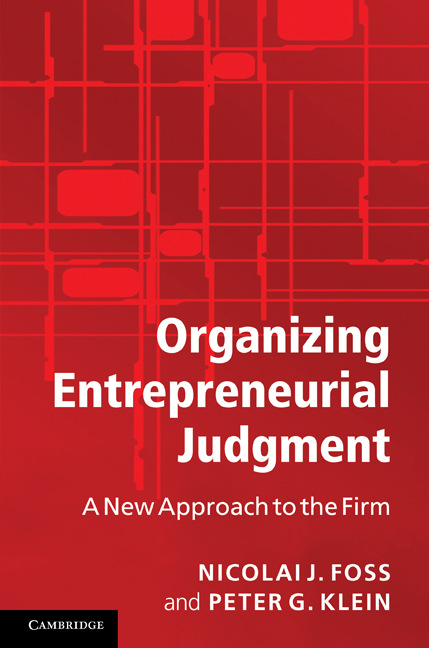
Now Ready for Pre-Order!
| Peter Klein |
This is a placeholder page without much detail, but you can pre-order today! The best news is the price: just £55.00 for the hardback and a mere £19.99 for the paperback — less than a family outing to the cinema, and far more rewarding!
Anita McGahan at Missouri
| Peter Klein |
Friend of O&M and leading management scholar Anita McGahan will present the University of Missouri’s Monroe-Paine Distinguished Lecture in Public Affairs, “The Health of Humanity 2050,” Thursday, 27 October 2011. She’ll also do a faculty-student seminar, “Changing the World,” that morning. Besides her important contributions to industry and competitor analysis Anita has become a leading expert in public health, poverty, and economic growth. Local O&Mers, make plans to attend!
Monroe-Paine Distinguished Lecture in Public Affairs
You’re invited to attend
Dr. Anita McGahan
Associate Dean-Research, Director of the PhD Programs, Professor of Strategic Management and
Rotman Chair in Management, Rotman School of Management,
Munk School of Global Affairs, University of Torontowill present
“The Health of Humanity 2050”
October 27, 2011 — 1:30 pm
2501 Missouri Student Center, Chambers Auditorium
RSVP to McGahan Lecture
For more information on Dr. McGahan, please visit the Truman School website.
Dissing Apple, Loving Steve
 | Peter Klein |
Like so many others, I was deeply saddened to learn today about the passing of Steve Jobs. Jobs was a great entrepreneur, a visionary, a social benefactor. Business leaders like Steve Jobs do more good for humanity than most of the do-gooders put together.
In memory of Steve, Apple fans are sharing their memories of Apple products, listing how many Macs they’ve owned, reminiscing about their first Apple II the way they talk about their first kiss. I’m not one of those. Indeed, I don’t much care for Apple products. I used an Apple II as a teenager, and currently own an iPad, the only Apple product I’ve ever bought. Steve Jobs made a particular kind of device — beautiful, specialized, simple to operate, but expensive, impossible to customize, frustrating to use if you want to use it in a different way than Steve intended. That’s fine — à chacun son goût. Isn’t that the beauty of capitalism? Markets aren’t winner-take all. Neither Steve Jobs nor Bill Gates nor Linus Torvalds nor anyone else decided what products we all should use and made us use them. We didn’t vote for our favorite computer or music player or phone, then all get the one that 51% of the voters preferred. No, we can all have the goods and services we like.
I don’t like Apple products, but I love the fact that other people like them, and that people like Steve Jobs provided them. R.I.P.
Addendum: Steve Horwitz makes the same point.
Schumptoberfest
| Peter Klein |
Kudos to former guest blogger David Gerard for helping organize and host the conference with the über-cool name, Schumptoberfest, 21-23 October at Lawrence University in Appleton, Wisconsin. David Hounshell is giving the keynote address, and the rest looks good too.

Reader Bleg: Transaction Costs and the Boundaries of the State
| Peter Klein |
O&M reader VL asks:
I have noticed an interesting link between transaction cost economics and the explanation of the long-term political units size (as Braudel would have said, on “la longue durée”). For example, it is highly probable that classical Greek poleis were being integrated and desintegrated in response to changes in the nature of military and political contracts. I wish to explore that perspective in my own doctoral thesis and I would like to ask for your help. Do you know about any work that examines that matter? I have read books of Coase, Williamson, and North, and further articles of Alchian, Demsetz, and others. But I don’t know of any work treating organization economics from a political anthropological or political historical perspective.
I suggested privately that he look at David Friedman’s 1977 JPE paper and recent work by Alberto Alesina and coauthors, though none of these works from a transaction cost perspective. Can the rest of you offer some suggestions? If not TCE, then how about resource-based, dynamic capabilities, or property-rights perspectives on the boundaries of the polis?
Terminology
| Peter Klein |
An interesting example of scholars in different fields using the same specialized terms to mean entirely different things:
Creating Capabilities: The Human Development Approach
MARTHA C. NUSSBAUMIn this powerful critique, Martha Nussbaum argues that our dominant theories of [economic] development have given us policies that ignore our most basic human needs for dignity and self-respect. For the past twenty-five years, Nussbaum has been working on an alternate model to assess human development: the Capabilities Approach. She and her colleagues begin with the simplest of questions: What is each person actually able to do and to be? What real opportunities are available to them?
Creating Capabilities . . . affords anyone interested in issues of human development a wonderfully lucid account of the structure and practical implications of an alternate model. It demonstrates a path to justice for both humans and nonhumans, weighs its relevance against other philosophical stances, and reveals the value of its universal guidelines even as it acknowledges cultural difference. In our era of unjustifiable inequity, Nussbaum shows how — by attending to the narratives of individuals and grasping the daily impact of policy — we can enable people everywhere to live full and creative lives.
One reviewer suggests the term “capabilitarianism” to describe this approach. Will we soon see management journal special issues on capabilitarianism and dynamic capabilitarianism? Felin and Foss critiques on the lack of microfoundations in capabilitarianism? Calls to join capabilitarianism and transaction costarianism?
Two Finance Papers of Interest
| Peter Klein |
Two recent review-type papers from NBER:
Behavioral Corporate Finance: An Updated Survey
Malcolm Baker, Jeffrey Wurgler
NBER Working Paper No. 17333
Issued in August 2011We survey the theory and evidence of behavioral corporate finance, which generally takes one of two approaches. The market timing and catering approach views managerial financing and investment decisions as rational managerial responses to securities mispricing. The managerial biases approach studies the direct effects of managers’ biases and nonstandard preferences on their decisions. We review relevant psychology, economic theory and predictions, empirical challenges, empirical evidence, new directions such as behavioral signaling, and open questions.
A Brief History of Regulations Regarding Financial Markets in the United States: 1789 to 2009
Alejandro Komai, Gary Richardson
NBER Working Paper No. 17443
Issued in September 2011In the United States today, the system of financial regulation is complex and fragmented. Responsibility to regulate the financial services industry is split between about a dozen federal agencies, hundreds of state agencies, and numerous industry-sponsored self-governing associations. Regulatory jurisdictions often overlap, so that most financial firms report to multiple regulators; but gaps exist in the supervisory structure, so that some firms report to few, and at times, no regulator. The overlapping jumble of standards; laws; and federal, state, and private jurisdictions can confuse even the most sophisticated student of the system. This article explains how that confusion arose. The story begins with the Constitutional Convention and the foundation of our nation. Our founding fathers fragmented authority over financial markets between federal and state governments. That legacy survives today, complicating efforts to create a financial system that can function effectively during the twenty-first century.
2011 Ig Nobel Laureates
| Peter Klein |
The 2011 Ig Nobel Prizes were announced yesterday. No economics prize this year, but several awards recognize work with profound social-science implications. For instance:
MEDICINE PRIZE: Mirjam Tuk (of THE NETHERLANDS and the UK), Debra Trampe (of THE NETHERLANDS) and Luk Warlop (of BELGIUM). and jointly to Matthew Lewis, Peter Snyder andRobert Feldman (of the USA), Robert Pietrzak, David Darby, and Paul Maruff (of AUSTRALIA) for demonstrating that people make better decisions about some kinds of things — but worse decisions about other kinds of things‚ when they have a strong urge to urinate.
REFERENCE: “Inhibitory Spillover: Increased Urination Urgency Facilitates Impulse Control in Unrelated Domains,” Mirjam A. Tuk, Debra Trampe and Luk Warlop, Psychological Science, vol. 22, no. 5, May 2011, pp. 627-633.
REFERENCE: “The Effect of Acute Increase in Urge to Void on Cognitive Function in Healthy Adults,” Matthew S. Lewis, Peter J. Snyder, Robert H. Pietrzak, David Darby, Robert A. Feldman, Paul T. Maruff, Neurology and Urodynamics, vol. 30, no. 1, January 2011, pp. 183-7.
[ . . . ]
LITERATURE PRIZE: John Perry of Stanford University, USA, for his Theory of Structured Procrastination, which says: To be a high achiever, always work on something important, using it as a way to avoid doing something that’s even more important.
REFERENCE: “How to Procrastinate and Still Get Things Done,” John Perry, Chronicle of Higher Education, February 23, 1996. Later republished elsewhere under the title “Structured Procrastination.”
[ . . . ]
PEACE PRIZE: Arturas Zuokas, the mayor of Vilnius, LITHUANIA, for demonstrating that the problem of illegally parked luxury cars can be solved by running them over with an armored tank.
REFERENCE: VIDEO and OFFICIAL CITY INFO
Digitopoly
| Peter Klein |
A new group blog by Erik Brynjolfsson, Joshua Gans, and Shane Greenstein. Should be interesting and informative. The authors
noticed that there were many blogs devoted to digital developments and consumer products but the selection focussing on economic and business aspects of the digital world was very limited. Digitopoly’s mission is to provide an economic and strategic management perspective on digital opportunities, trends, limits, trade-offs and platforms; expanding commentary in this important space.
The blog’s name — Digitopoly — reflects our broad interests in the impact of digital technology on competition. While, in some cases, our concern is the preservation of competition in the face of pressures toward monopoly, in others we see opportunities for greater competition and welfare benefits.
Our logo is deliberately iconic. The heavy set line in the graph could represent Moore’s Law (for processing power as time progresses) or Metcalfe’s Law (for the value of networks as more join). It overtakes the simple linear trend represented by thin, broken line. This reflects the idea that linear ways of thinking rarely serve us well in the digital economy.
Returning to Our Austrian Roots
| Peter Klein |
Here’s me lecturing last week at the Austrian Academy of Sciences in Vienna, in the very room where Carl Menger and Eugen von Böhm-Bawerk defended their Habilitation theses. It was a pretty amazing experience.

The room is a bit fancier than your average lecture hall:

My co-bloggers couldn’t make it but, on a tour of Austrian economics sites of interest, I snapped this picture of the former Green Anchor restaurant, where Mises and his students repaired after Mises’s university seminar. Notice the street name!

EGOS 2012, “Self-reinforcing Processes in Organizations, Networks and Professions”
| Peter Klein |
The European Group of Organizational Studies (EGOS) is having the 2012 annual conference in Helsinki, July 2-7. The overall theme is design, and one of the subthemes is “Self-reinforcing Processes in Organizations, Networks and Professions,” a subject sure to interest many O&Mers. See the links above for details. Blurb after the fold: (more…)
My First Publication
| Peter Klein |
A colleague recently sent me a copy of his first publication, a letter to the editor in Sports Illustrated magazine. This inspired me to search for my own first publication, which was exactly the same thing. It turns out SI has made its entire archive available online, so here it is:
If it’s nostalgia Fimrite wants, I suggest he pop a few new tubes in his radio, load it into his Model T, ride to Tiger Stadium and listen to a game in the parking lot. Then he can go home, write the game up on his manual typewriter and wire his article in over the telegraph.
Funny how it often turns out that those Luddite whiners who despise large, multipurpose modern stadiums also happen to be the people with the money or the connections to get good seats in the small, cramped “traditional” parks. The rest of us will gladly give up a little tradition just to get tickets.
PETER G. KLEIN
Chapel Hill, N.C.
May 2, 1988
I was writing in reaction to this piece by SI’s Ron Fimrite. I’m still looking for an opportunity to work the term “Luddite whiners” into an academic article.
I was particularly sensitive to this issue because, during my undergraduate days at North Carolina, the school replaced the old Carmichael Auditorium with the new Dean E. Smith Center (better known as the “Dean Dome”). I appreciated the hot, poorly lit, intimate, and idiosyncratic Carmichael as much as anybody, but was tired of the two-day campouts to get student tickets, and welcomed the Dean Dome’s larger student section. Even in those days, I was sensitive to the idea of trade-offs at the margin.
The sad thing is that this letter probably had more readers than all my subsequent publications combined.
And Your Chicks for Free
| Peter Klein |
Fred McChesney, call your office.
Hoping to fend off any antitrust action, Google has hired at least 13 lobbying and communications firms since May, when the Federal Trade Commission ramped up its probe of the Internet giant. Firms led by figures from both parties — including former House Democratic leader Richard Gephardt and the son of Indiana Republican Sen. Richard Lugar — are going to bat for the company.
Gentlemen, don’t forget to close that revolving door on your way out. . . .
BTW for an interesting, if somewhat confused, take on the antitrust industry, see a young Robert Reich.
Upcoming Events
| Peter Klein |
Readers new to O&M may not have noticed the “Events” tab above. Here we maintain an ad hoc list of conferences, seminars, and other activities of likely interest to students and scholars of organizations, strategy, entrepreneurship, institutions, and the like. (Readers are encouraged to forward their suggestions.) Sample:
- VI Research Workshop on Institutions and Organizations
Rio de Janeiro, 3-4 October 2011 - “Multi- and Micro-Level Issues in Strategic Entrepreneurship”
Copenhagen, 13-14 October 2011 - “Achieving Coexistence of Biotech, Conventional & Organic Foods in the Marketplace”
Vancouver, 26-28 October 2011 - International Agribusiness PAA-PENSA Conference
Buenos Aires, 30 November – 2 December 2011
(NB: The “Papers” and “Projects” tabs need some updating, but we’ll get right on it.)
16 September 2011 at 10:03 am Peter G. Klein Leave a comment
New Book on American Institutionalism
| Peter Klein |
It’s by Malcolm Rutherford, titled The Institutionalist Movement in American Economics, 1918-1947: Science and Social Control (Cambridge University Press, 2011). Rutherford reinterpretes the American (or “Old”) Institutional Economics as a much broader and deeper movement than simply the ideas of Veblen, Commons, and Mitchell. Reviewers Robert Van Horn and Richard McIntyre say that “institutional economics should be understood as a ‘movement’ that shared core ideas and beliefs and as a network of people with a self-conscious unity, and Rutherford marvelously shows how the self-conscious unity of this network shaped institutionalist economics and American economics more generally in the first half of the twentieth century.” The reviewers also praise Rutherford for debunking three important “myths” about the Old Institutionalists:
First, he challenges the notion that institutional economics was only a critique of neoclassical economics and that institutional economics disappeared because it did not make any substantial contributions to economics. Second, Rutherford successfully assails the idea that institutional economics was just a set of facts and bereft of theory. Third, Rutherford dispels the notion that institutional economics was Veblenian; he shows that Veblen was an intellectual inspiration to the movement but not central to the networking process.
My previous forays into the writings of the Old Institutionalists have not yielded much fruit, but I will look at Rutherford’s book and try to keep an open mind.
Da Vinci in the Kitchen
| Peter Klein |
More on engineering versus economic perspectives on innovation:
For Leonardo, every food was only as good as the machine that created it, the technique was as important as the taste. Leonardo’s work in the Sforza kitchen strove for efficiency, but often the result of all this time — saving was sheer insanity, reported the humanist courtier Sabba da Castiglione:
“Master Leonardo da Vinci’s kitchen is a bedlam. . . . At one end of the premise, a great waterwheel, driven by a raging waterfall over it, spewed and spattered forth its waters over all who passed beneath and made the floor a lake. Giant bellows, each twelve feet long, were suspended from the ceilings, hissing and roaring with intent to clear the fire smoke, but all they did accomplish was to fan the flames to the detriment of all who needed to negotiate by the fires — so fierce the wandering flames that a constant stream of men with buckets was employed in trying to quell them, even though other waters spouted forth on all from every corner of the ceilings.”
Every kitchen task could be mechanized — crushing garlic, pulling spaghetti, plucking ducks, cutting a pig into cubes — but the machines Leonardo imagined were sometimes far more elaborate than the task required. His invention for a giant whisk twice the size of a man involved an operator from within who was constantly in danger of being wisked into the sauce. . . . Another model involved a team of three horses engaged in the task of crushing a nut.
Michelle Legro has all the details (via Robin Varghese).
Pirrong on Regime Uncertainty
| Peter Klein |
 A nice post from former guest blogger Craig Pirrong on regime uncertainty and its role in hampering economic recovery. As Craig points out, it’s not the level of government intervention per se that delays investment, but uncertainty about anticipated changes in government intervention. Options theory provides a useful way to see this.
Bob Higgs approves. And here are Craig’s old O&M posts.
In the Journals
| Peter Klein |
Three newly published papers of likely interest to O&Mers:
- Jeffrey L. Furman and Scott Stern, “Climbing atop the Shoulders of Giants: The Impact of Institutions on Cumulative Research,” American Economic Review 101, no. 5 (August 2011).
While cumulative knowledge production is central to growth, little empirical research investigates how institutions shape whether existing knowledge can be exploited to create new knowledge. This paper assesses the impact of a specific institution, a biological resource center, whose objective is to certify and disseminate knowledge. We disentangle the marginal impact of this institution on cumulative research from the impact of selection, in which the most important discoveries are endogenously linked to research-enhancing institutions. Exploiting exogenous shifts of biomaterials across institutional settings and employing a difference-in-differences approach, we find that effective institutions amplify the cumulative impact of individual scientific discoveries.
- Antti Kauhanen, “The Perils of Altering Incentive Plans: A Case Study,” Managerial and Decision Economics 32, no. 6 (September 2011).
This paper studies a retail chain that introduced a sales incentive plan that rewarded for exceeding a sales target and subsequently cut the incentive intensity in addition to increasing the target. Utilizing monthly panel data for 54 months for all 53 units of the chain the paper shows that the introduction of the sales incentive plan increased sales and profitability, whereas the changes in the plan lead to a marked drop in sales and profitability. Thus, modifying the incentive plan proved costly for the firm. The results are consistent with the gift-exchange model of labor contracts.
- Oriana Bandiera, Iwan Barankay, and Imran Rasul, “Field Experiments with Firms,” Journal of Economic Perspectives 25, no. 3 (Summer 2011).
We discuss how the use of field experiments sheds light on long-standing research questions relating to firm behavior. We present insights from two classes of experiments—within and across firms—and draw common lessons from both sets. Field experiments within firms generally aim to shed light on the nature of agency problems. Along these lines, we discuss how field experiments have provided new insights on shirking behavior and the provision of monetary and nonmonetary incentives. Field experiments across firms generally aim to uncover firms’ binding constraints by exogenously varying the availability of key inputs such as labor, physical capital, and managerial capital. We conclude by discussing some of the practical issues researchers face when designing experiments and by highlighting areas for further research.
The Institutional Revolution
| Peter Klein |
I’m very excited about Doug Allen’s forthcoming book The Institutional Revolution (University of Chicago Press). Trained by Yoram Barzel (and hence part of the Tree of Zvi), Doug is a leading contemporary scholar on property rights, transaction costs, contracting, and economic history. His work on agricultural contracting with Dean Lueck, including their 2002 book The Nature of the Farm, is a classic contribution to the economics literature on economic organization. He also has a very good introductory textbook. More information is at Doug’s informative (and amusing) website.
Here’s the cover blurb for the new book:
Few events in the history of humanity rival the Industrial Revolution. Following its onset in eighteenth-century Britain, sweeping changes in agriculture, manufacturing, transportation, and technology began to gain unstoppable momentum throughout Europe, North America, and eventually much of the world—with profound effects on socioeconomic and cultural conditions.
In The Institutional Revolution, Douglas W. Allen offers a thought-provoking account of another, quieter revolution that took place at the end of the eighteenth century and allowed for the full exploitation of the many new technological innovations. Fundamental to this shift were dramatic changes in institutions, or the rules that govern society, which reflected significant improvements in the ability to measure performance—whether of government officials, laborers, or naval officers—thereby reducing the role of nature and the hazards of variance in daily affairs. Along the way, Allen provides readers with a fascinating explanation of the critical roles played by seemingly bizarre institutions, from dueling to the purchase of one’s rank in the British Army.
Engagingly written, The Institutional Revolution traces the dramatic shift from premodern institutions based on patronage, purchase, and personal ties toward modern institutions based on standardization, merit, and wage labor—a shift which was crucial to the explosive economic growth of the Industrial Revolution.
Bonus: Here’s the syllabus from Doug’s course on the economics of property rights.
HR News of the Day
| Peter Klein |
A somewhat disheartening report on US workplace safety:
The Bureau of Labor Statistics has its fascinatingly morbid fatality census report out! Are you a manager of some sort? Watch your back, because the study says if you die on the job, there’s a 10% chance it’s murder.
That’s correct. Out of the 4,547 workplace deaths in 2010, 10% of the kaput management was a direct result of homicide. Gulp.
Gizmodo has all the macabre details. If you prefer bureaucratese, head right to the BLS press release. But what about the stock-price reactions?




 Organizations and Markets
Recent Comments