Posts filed under ‘– Klein –’
Miscellaneous Links
| Peter Klein |
- Max Weber versus Rodney Stark. Read the very interesting comment thread at this ThinkMarkets post.
- US firms can expect lower worker productivity starting this week. Duh.
- The Austrian School of Economics: A History of Its Ideas, Ambassadors, and Institutions by Eugen Maria Schulak and Herbert Unterköfler. Newly translated from the 2009 German-language original. (Translator Arlene Oost-Zinner was a production editor on my 2010 book and did a wonderful job — no cracks, please, about the need to have my stilted prose translated into passable English.)
- Do you know what really important US patent was granted on March 14?
Interesting New NBER Papers
| Peter Klein |
Matching Firms, Managers, and Incentives
Oriana Bandiera, Andrea Prat, Luigi Guiso, Raffaella Sadun
January 2011
We exploit a unique combination of administrative sources and survey data to study the match between firms and managers. The data includes manager characteristics, such as risk aversion and talent; firm characteristics, such as ownership; detailed measures of managerial practices relative to incentives, dismissals and promotions; and measurable outcomes, for the firm and for the manager. A parsimonious model of matching and incentive provision generates an array of implications that can be tested with our data. Our contribution is twofold. We disentangle the role of risk-aversion and talent in determining how firms select and motivate managers. In particular, risk-averse managers are matched with firms that offer low-powered contracts. We also show that empirical findings linking governance, incentives, and performance that are typically observed in isolation, can instead be interpreted within a simple unified matching framework.
Business Failures by Industry in the United States, 1895 to 1939: A Statistical History
Gary Richardson, Michael Gou
March 2011
Dun’s Review began publishing monthly data on bankruptcies by branch of business during the 1890s. This essay reconstructs that series, links it to its successors, and discusses how it can be used for economic analysis.
The Consequences of Financial Innovation: A Counterfactual Research Agenda
Josh Lerner, Peter Tufano
February 2011
Financial innovation has been both praised as the engine of growth of society and castigated for being the source of the weakness of the economy. In this paper, we review the literature on financial innovation and highlight the similarities and differences between financial innovation and other forms of innovation. We also propose a research agenda to systematically address the social welfare implications of financial innovation. To complement existing empirical and theoretical methods, we propose that scholars examine case studies of systemic (widely adopted) innovations, explicitly considering counterfactual histories had the innovations never been invented or adopted.
Creative Destruction in Popular Culture
| Peter Klein |
Thanks to Thomas B. for forwarding links to US Sen. Rand Paul’s Monday-night appearance on the Daily Show (part 1, part 2, part 3). At the start of part 3, while discussing government bailouts, Paul uses the words “creative destruction,” and Jon Stewart bursts out laughing, apparently hearing the term for the first time. I guess Schumpeter is not as culturally relevant as I thought!
The show had some interesting moments, but I found the discussions (in the parts I watched) pretty shallow. Stewart was grilling Paul on his “free-market” views, focusing on health, safety, and environmental regulation. Both Paul and Stewart took the milquetoast position that sure, some of this type of regulation is needed, but it shouldn’t be “too much.” They didn’t get into a serious discussion of theory or evidence, however, or explore specific trade-offs. There are huge political economy and public-choice literatures on the FDA, EPA, OSHA, etc., showing that these organizations are easily captured, tend to retard innovation, fail to weigh marginal benefits and costs, and so on. The Journal of Law and Economics under Coase’s leadership made its bones on these kinds of studies in the 1970s. The FDA has been a particular target. The Stewart view also ignores comparative institutional analysis — e.g., the role of private ordering (third-party certification, reputation, etc. ) in the protection of health and safety.
At least Paul didn’t say he intended to become the best Senator, horseman, and lover in all Washington!
Kuhn’s Ashtray
| Peter Klein |
You know about Wittgenstein’s Poker. But have you heard of Kuhn’s ashtray?
We began arguing. Kuhn had attacked my Whiggish use of the term “displacement current.” I had failed, in his view, to put myself in the mindset of Maxwell’s first attempts at creating a theory of electricity and magnetism. I felt that Kuhn had misinterpreted my paper, and that he — not me — had provided a Whiggish interpretation of Maxwell. I said, “You refuse to look through my telescope.” And he said, “It’s not a telescope, Errol. It’s a kaleidoscope.” (In this respect, he was probably right.)
The conversation took a turn for the ugly. Were my problems with him, or were they with his philosophy?
I asked him, “If paradigms are really incommensurable, how is history of science possible? Wouldn’t we be merely interpreting the past in the light of the present? Wouldn’t the past be inaccessible to us? Wouldn’t it be ‘incommensurable?’ ”
He started moaning. He put his head in his hands and was muttering, “He’s trying to kill me. He’s trying to kill me.”
And then I added, “…except for someone who imagines himself to be God.”
It was at this point that Kuhn threw the ashtray at me.
The account comes from filmmaker Errol Morris, then Thomas Kuhn’s graduate student at Princeton, who adds that “I had imagined graduate school as a shining city on a hill, but it turned out to be more like an extended visit with a bear in a cave.” (HT: Pete Boettke). I have not used Kuhn’s particular technique with my own students, though I admit it has a certain visceral appeal. Nor have I been on the receiving end of such behavior, though a conference participant once opened his presentation by saying, “My paper is basically devoted to refuting everything in Klein’s paper.” (Fortunately, I was the moderator, and responded immediately, “Thank you, your time is up.”)
Back to students: I do keep this decorative item by the entrance to my office, placed for all to see:

Chairman Mao and Comparative Institutional Analysis
| Peter Klein |
Coase? Williamson? No, Mao Tse-Tung:
Concrete analysis of concrete conditions, Lenin said, is “the most essential thing in Marxism, the living soul of Marxism.” Lacking an analytical approach, many of our comrades do not want to go deeply into complex matters, to analyse and study them over and over again, but like to draw simple conclusions which are either absolutely affirmative or absolutely negative. The fact that our newspapers are lacking in analytical articles and that the habit of analysis is not yet fully cultivated in the Party shows that there are such shortcomings. From now on we should remedy this state of affairs.
(Thanks to Pablo for the tip.)
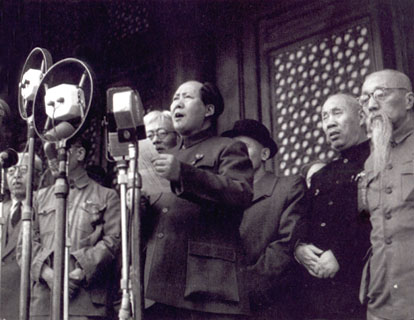
"I say to you, Comrades. . . . No more blackboard economics!"
Oxford Handbook of Human Capital
| Peter Klein |
I just received a copy of the Oxford Handbook of Human Capital, edited by Alan Burton-Jones and J.-C. Spender, and it looks terrific. The concept of “human capital” came from developments in macroeconomics and labor economics (and, it is often forgotten, entrepreneurship) but is increasingly influential in organization and strategy research. (Witness, for example, the new SMS Strategic Human Capital Interest Group.) These Handbook chapters “reveal the importance of human capital for contemporary organizations, exploring its conceptual underpinnings, relevance to theories of the firm, implications for organizational effectiveness, interdependencies with other resources, and role in the future economy,” says the cover blurb. O&M readers may especially like the section on “Human Capital and the Firm,” with chapters on TCE (by Foss), agency theory (Spender), the RBV (Jeroen Kraaijenbrink), entrepreneurship and the theory of the firm (Brian Loasby), and the knowledge-based theory of the firm (Georg von Krogh and Martin Wallin). Check it out!
Joe Mahoney Wins Irwin Award
| Peter Klein |
 Congratulations to O&M friend Joe Mahoney for winning the Irwin Outstanding Educator Award for 2011. The Irwin Award is issued each year by the Business Policy and Strategy Division of the Academy of Management to someone who “(1) has demonstrated outstanding teaching capabilities in business strategy over an extended period of time and the ability to enable future strategy scholars to contribute original research as well as teaching effectively; (2) has had an important impact on strategy pedagogy through demonstrated expertise; and (3) cares deeply about the subject of Strategic Management and the development of his or her students.”
Joe has been my friend and colleague for several years and it’s great to see him join such luminaries as Michael Porter, Mike Hitt, Don Hambrick, Jay Barney, Kathy Eisenhardt, Pankaj Ghemawat, Will Mitchell, and Anita McGahan on the list of Irwin winners.
Is Counterfeiting Good for Business?
| Peter Klein |
Sometimes, according to Yi Qian in a new NBER Working Paper, “Counterfeiters: Foes or Friends?” In some cases, counterfeiting constitutes advertising that increases sales of the original product. It makes sense; how many buyers of faux Rolex watches or Gucci purses would have bought the authentic items if the fakes were banned? I suppose there’s a negative externality (more fakes means less exclusivity means a lower equilibrium price) that must be taken into account as well. An interesting analysis, in any case. Applications to digital media are left as an exercise for the reader.
Counterfeiters: Foes or Friends?
Yi Qian
NBER Working Paper No. 16785
Issued in February 2011This paper combines a natural policy experiment and randomized lab experiments to estimate the differential impacts of counterfeiting on the sales and purchase intent of branded products of various quality levels. I collect new product-line level panel data from Chinese shoe companies from 1993-2004. Exploiting the discontinuity of government enforcement efforts for the footwear sector in 1995 and the differences in authentic companies’ relationships with the government, I identify heterogeneous effects of counterfeit entry on sales of authentic products of three quality tiers. In particular, counterfeits have both advertising effects for the brand and substitution effects for authentic products. The advertising effect dominates substitution effect for high-end authentic product sales, and the substitution effect outweighs advertising effect for low-end product sales. The positive effect of counterfeits is most pronounced for the high-fashion products (such as women’s high-leg boots) and for the high-end shoes of the brands that were not yet well-known at the time of the entry by counterfeiters. I provide a theoretical framework to generalize such impacts due to counterfeits. Analogous heterogeneous effects of counterfeiting on consumer purchase intent for branded products of three quality tiers are also discovered in lab experiments. Responses in the lab allude to the fact that counterfeits could increase brand awareness as well as steal business.
The Forgotten: “Alternative Views of Mengerian Entrepreneurship”
| Peter Klein |
A film blog I follow, the Mubi Daily Notebook (formerly called The Auteurs Notebook) runs a regular feature called “The Forgotten,” showcasing obscure but important older titles. I propose doing the same thing here. Our first entry is a 1979 article by Dolores Tremewan Martin, “Alternative Views of Mengerian Entrepreneurship” (History of Political Economy 11, no. 2). Martin provides an excellent summary and critique of Menger’s subtle approach to the entrepreneur, one largely ignored in the current entrepreneurship literature, even among Austrian economists. Contrasting Schumpeterian and Knightian views on entrepreneurship, Martin argues that Menger’s position is close to Knight’s (and, hence, that Knight is much closer to the Austrian school than is generally recognized).
As Martin points out, Menger’s entrepreneur (Unternehmer) is a resource-owning, information-acquiring coordinator seeking to acquire and combine undervalued assets (using an “input-computing capacity”). Entrepreneurial activity is scarce, in that it is associated with ownership of scarce capital, but also “unique in that, unlike other goods of higher order, it is not intended for exchange and therefore does not command a price.” There are important differences bewteen Menger and Knight concerning types of uncertainty and the effect of uncertainty on profit. Still:
Menger does not treat the entrepreneur as being the “innovator,” “mover,” or “force of change.” Menger places stress on the entrepreneurial function and the role of uncertainty, not innovation, as giving rise to the possibility for rewards. As Schumpeter [the historian of economic thought] suggests, the economic process viewed by Carl Menger is essentially similar to that of Frank Knight. . . . For Menger (as for Knight) the entrepreneurial activity consists of a more correct — “more rational” — evaluation of goods of higher order. This view contrasts with Schumpeter’s personification of the entrepreneur as the hero of the capitalist drama.
Creative Destruction, Music-Industry Edition
| Peter Klein |
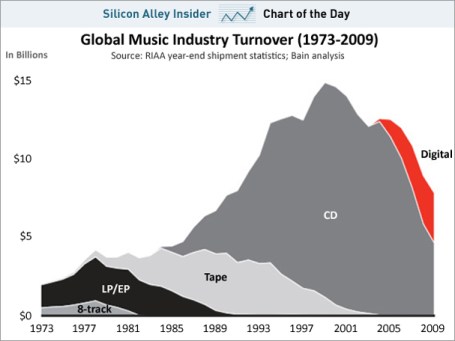
Note that the chart nicely illustrates not only the competition among formats, but the industry’s overall decline. Indeed, “creative destruction” is a good name for the the damage done to the creative arts by the recording industry’s approach to digital media.
Most Interesting Path-Dependence Paper I Saw Today
| Peter Klein |
Just to show that econometric models apply anywhere and everywhere, check out this new Barro paper (via Danny Sokol):
Saints Marching In, 1590-2009
Robert J. Barro, Rachel M. McCleary
NBER Working Paper No. 16769
February 2011The Catholic Church has been making saints for centuries, typically in a two-stage process featuring beatification and canonization. We analyze determinants of rates of beatification and canonization (for non-martyrs) over time and across six world regions. The research uses a recently assembled data set on numbers and characteristics of beatifieds and saints chosen since 1590. We classify these blessed persons regionally in accordance with residence at death. These data are combined with time-series estimates of regional populations of Catholics, broadly-defined Protestants, Orthodox, and Evangelicals (mostly a sub-set of Protestants). Regression estimates indicate that the canonization rate depends strongly on the number of candidates, gauged by a region’s stock of beatifieds who have not yet been canonized. The beatification rate depends positively on the region’s stock of persons previously canonized. The last two popes, John Paul II and Benedict XVI (the only non-Italians in our sample), are outliers, choosing blessed persons at a much higher rate than that of their predecessors. Since around 1900, the naming of blessed persons seems to reflect a response by the Catholic Church to competition from Protestantism or Evangelicalism. We find no evidence, at least since 1590, of competition between the Catholic and Orthodox Churches.
Mario Rizzo’s Graduate Course in Behavioral Economics
| Peter Klein |
Check out the syllabus and join the discussion at ThinkMarkets. I appreciate boat-rocking as much as anyone but am personally in what Mario terms (in his syllabus) the “classical” camp. Still, this is a course I would definitely take. If he’s an easy grader.
New Insight from Old Data
| Peter Klein |
 A few years ago Mike Sykuta and I met with Ronald Coase to discuss ways to add contract documents to the CORI library. Limited contract data from secondary sources, like large-company public filings, are readily available, but how to get a larger variety of contract types, such as the long-term supply agreements of particular interest to Coase? Firms are naturally reluctant to make these available to researchers. Coase’s suggestion was to pursue obsolete contracts from company archives. Old contracts, after all, should be as good as current ones for examining hypotheses about contract design and performance, and firms presumably don’t care if they’re made public.
A recent HBR article implores companies to make use of archived datasets, and the advice applies to academic researchers as well. “For example, a retailer that has kept and labeled its old POS data could now subject it to today’s sophisticated analytical techniques, gaining a valuable understanding of long-term consumer trends.” Likewise, revisiting old data with new and better econometrics, more careful attention to research design (e.g., identification), and sharper hypotheses could generate some interesting findings.
In strategy and entrepreneurship research, everybody wants to study the same stuff: pharma and biotech patenting, R&D alliances, technology IPOs, etc. On the margin, a clever study of an old industry, old data, an old problem, could create a lot of value.
Counterintuitive Research Result of the Day
| Peter Klein |
According to the current issue of Managerial and Decision Economics, women free ride more than men:
An Experimental Test of Behavior under Team Production
Donald Vandegrift and Abdullah YavasThis study reports experiments that examine behavior under team production and a piece rate. In the experiments, participants complete a forecasting task and are rewarded based on the accuracy of their forecasts. In the piece-rate condition, participants are paid based on their own performance, whereas the team-production condition rewards participants based on the average performance of the team. Overall, there is no statistically significant difference in performance between the conditions. However, this result masks important differences in the behavior of men and women across the conditions. Men in the team-production condition increase their performance relative to men in the piece-rate condition. However, this gap in male performances across conditions diminishes over the course of the experiment. In contrast, women in the team-production condition show significantly lower performance than the women in the piece rate. As a consequence of these differences, men in the team-production condition show significantly better performance than women in the team-production condition. We also find evidence that men show stronger performance when they are in teams with a larger variation in skill level.
I’m trying to derive implications for firm performance in light of Alchian and Demsetz (1972). But come on, give me the Go-Gos or Bangles over Backstreet Boys or Jonas Brothers any day.
Anita McGahan at TEDx
| Peter Klein |
Here is my good friend and colleague Anita McGahan, Professor and Rotman Chair in Management and Associate Dean for Research at the University of Toronto’s Rotman School, speaking at a recent TEDx event on the role business schools can play in making the world a better place. Anita is not only a gifted speaker and teacher, and a highly accomplished researcher, but also one of the most thoughtful people in the profession, emphasizing Big Problems as well as the more narrow, technical issues favored by the strategic management literature. Check her out!
Famous Quotations Taken Out of Context
| Peter Klein |
 Kenneth Olsen, former head of computer-industry pioneer Digital Equipment Corporation, died over the weekend. DEC was probably the most important “minicomputer” firm of the 1970s and 1980s, one that failed to make the transition to the PC era and dropped out of sight. (DEC plays a major role in Tracy Kidder’s 1981 Pulitzer-winning book Soul of a New Machine — a book I read just this last year and which, despite the now-obsolete subject matter, feels surprisingly fresh. DEC was the dominant incumbent and foil to Kidder’s protagonist firm, Data General.)
Despite his many accomplishments — a 1986 Fortune article called him “America’s most successful entrepreneur” — Olsen is remembered today mostly for saying, in 1977, “There is no reason for any individual to have a computer in his home.” This is usually taken to show how the leading mainframe and minicomputer firms failed to see the gale of creative destruction on the horizon, or just to illustrate businessperson cluelessness more generally. (Bill Gates’s 1981 remark that “640K ought to be enough for anybody” falls in the same category.)
Olsen consistently maintained that he was quoted out of context, that he wasn’t talking about the ordinary desktop PC, but a sort of master house computer that would run the home, much like HAL in 2001. According to the useful Snopes.com entry on Olsen, “What Olsen was addressing in 1977 was the concept of powerful central computers that controlled every aspect of home life: turning lights on and off, regulating temperature, choosing entertainments, monitoring food supplies and preparing meals, etc. The subject of his remark was not the personal use computer that is now so much a part of the American home, but the environment-regulating behemoth of science fiction.” As Olsen himself put it: “A long time ago when the common knowledge was that PCs would run our lives in every detail, I said that if you stole something from the refrigerator at night you didn’t want to enter this into the computer so that it would mess up the computer plans for coming meals.” I wouldn’t make that sandwich if I were you, Dave.
What are some other examples of famous quotations taken out of context?
São Paulo Workshop on Institutional Analysis
| Peter Klein |
The next Coase Institute workshop for young scholars is 15-21 May 2011 in São Paulo. The application deadline is 15 February, so don’t delay!
Archispeak
| Peter Klein |
Every academic and professional discipline has its own specialized vocabulary. In some cases, this brings clarity and precision; in others, it serves mainly to bamboozle the uninitiated. Even architecture studies is no exception:
Other architects, especially those teaching in universities, reacted to the collapse of Modernism by attempting to reinvent the field as a theoretical discipline. The theories did not come from the evidence of the practice of architecture, as one might expect (that was left to Christopher Alexander), but from arcane historical tracts and the writings of French literary critics in hermeneutics, poetics, and semiology. Thus began a new phase in professional jargon.
Thanks to Witold Rybczynski for giving us an entry for both our jargon watch and Pomo Periscope series. What would Fabio say?
What the Seminar Speaker Really Means
| Peter Klein |
A useful guide. Written primarily for natural scientists, but applies more-or-less across the curriculum. Updates Stigler’s famous “Conference Handbook.” Sample:
When the speaker says: I’m pleased to give you this talk this morning because I always enjoy sharing my research with young scientists.
The speaker really means: I was promised a small honorarium.
When the speaker says: First, a little background.
The speaker really means: I am about to show you the only slide in which I have any confidence.
When the speaker says: This has been an incredibly exciting field for us to research.
The speaker really means: Five or six labs in the world care about this. You don’t.
When the speaker says: To be fair, there has been some debate in the scientific community about this point.
The speaker really means: We have a laboratory of mortal enemies at another institution, and they are so very wrong.
When the speaker says: This led us to ask a different question.
The speaker really means: Our grant ran out.
When the speaker says: I’ll just talk briefly about this.
The speaker really means: I will talk about this for at least an hour. I am unaware that time is finite. I am your overlord.
When the speaker says: This result was completely unexpected.
The speaker really means: This result pissed us off. Two postdocs cried.
When the speaker says: At this point, I went back to the literature.
The speaker means: At this point, I instructed my graduate student to go back to the literature.
Although, actually, the speaker really means: At this point, I instructed my graduate student to go back to the literature, but he just used Wikipedia, so I went back to the literature. (more…)
WSJ on Conglomerates
| Peter Klein |
Industrial conglomerate ITT announced in January a split into three more focused companies, one concentrated in hotels and gaming, one in education (technical training centers), and a slimmed-down ITT Corporation containing the remaining manufacturing businesses. This is the second major restructuring for ITT, once the poster child of the conglomerate movement of the 1960s and early 1970s.
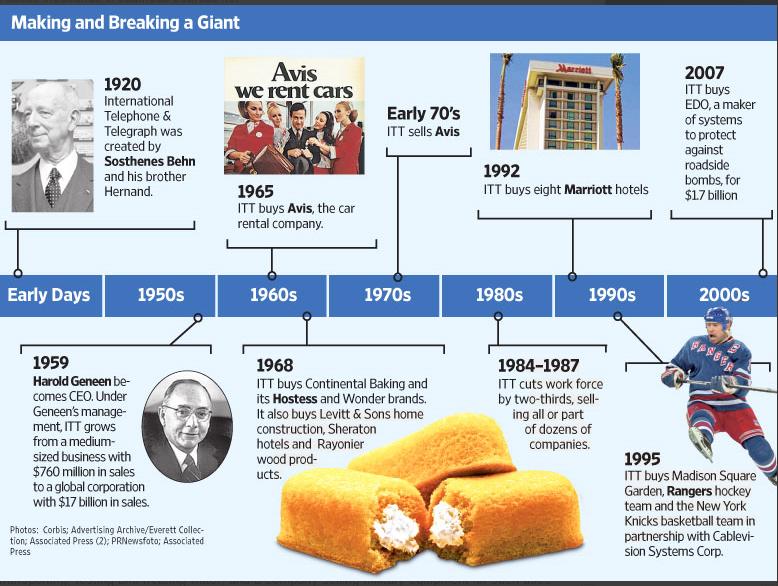 The Wall Street Journal’s article of 13 January contains a nice graphic on the firm’s history, including a picture of Harold Geneen, the quintessential “management by the numbers” CEO (click to enlarge). It also includes ruminations on the conglomerate form more generally, about which I have a continuing research interest. Yale’s Jeffrey Sonnenfeld says conglomerates represented “an unholy mix of opportunistic investment bankers, misguided consultants and the vanities of CEOs.” A companion article puts it this way: “Conglomerates blossomed five decades ago, when favorable interest rates made it relatively easy to boost revenue and stock prices with serial acquisitions. But they fell out of favor when the stock increases slowed and investors began to question whether promised efficiencies would materialize.”
But this is not quite right. In fact, the research literature finds little evidence that conglomerate growth was fueled mainly by cheap credit and rising stock prices. (more…)





 Organizations and Markets
Recent Comments