Posts filed under ‘– Klein –’
Legal and Economic Perspectives on Contracts
| Peter Klein |
Law professor Lewis Kornhauser and economist Bentley MacLeod have teamed up to provide a multidisciplinary perspective on contracts:
Contracts between Legal Persons
Lewis A. Kornhauser, W. Bentley MacLeod
NBER Working Paper No. 16049
Issued in June 2010Contract law and the economics of contract have, for the most part, developed independently of each other. In this essay, we briefly review the notion of a contract from the perspective of lawyer, and then use this framework to organize the economics literature on contract. The review thus provides an overview of the literature for economists who are interested in exploring the economic implications of contract law. The title, Contracts between Legal Persons, limits the review to that part of contract law that is generic to any legal person. A legal person is any individual, firm or government agency with the right to enter into binding agreements. Our goal is to discuss the role of the law in enforcing these agreements under the hypothesis that the legal persons have well defined goals and objectives.
The paper is unfortunately behind the NBER firewall. Note in the comments if you find an ungated version.
Gordon Smith’s chapter in the forthcoming Elgar TCE Handbook, “Legal Precursors of Transaction Cost Economics,” is also worth a look.
Add to: Facebook | Digg | Del.icio.us | Stumbleupon | Reddit | Blinklist | Twitter | Technorati
René Stulz on Asset Bubbles
| Peter Klein |
From the HBR series “Finance: The Way Forward”:
At the same time, however, it is also critical to create conditions that make it more difficult for bubbles to emerge. This means fundamental changes in public policy. The most important change is to do everything possible to make sure that no institution is “too-big-to-fail.” We also have to do away with the Bernanke put. It is not possible for the public sector to guarantee investors against losses without creating more and more instability.
I’d add that policymakers should avoid creating bubbles in the first place, but that’s a subject for another day.
Add to: Facebook | Digg | Del.icio.us | Stumbleupon | Reddit | Blinklist | Twitter | Technorati
Jane Jacobs Festschrift
| Peter Klein |
It’s called What We See and has just been published by New Village Press. Here are the publisher and Amazon links. The website, whatwesee.org, has a blog and lots of useful information about the book, the authors, and Jacobs.
Of particular interest to O&Mers include “Rethinking ‘Jacobs Spillovers,’ or How Diverse Cities Actually Make Individuals More Creative and Economically Successful” by Pierre Desrochers and Samuli Leppälä and “The Mirage of the Efficient City” by Sandy Ikeda.
Add to: Facebook | Digg | Del.icio.us | Stumbleupon | Reddit | Blinklist | Twitter | Technorati
O&M in Paris
| Peter Klein |
I shot the first of these yesterday at Paris Charles De Gaulle Airport, the second near the Panthéon in the 5th Arrondissement (click to enlarge). If the Muppets can take Manhattan, why can’t we take Paris?


More seriously, there are some interesting things happening here in France. Last week was the 9th session of the European School for New Institutional Economics (ESNIE) in Corsica, a week-long summer program for PhD students and junior faculty from around the world. Plenary speakers included Oliver Hart, Francine Lafontaine, John Drobak, Maristella Botticini, me, and several others, and there were research development workshops and student paper sessions as well, along with the all-important networking and socializing. I strongly urge O&M readers to apply or encourage their students to apply next year.
The week after next is a conference on “Contracts, Procurement, and Public-Private Agreements,” 14-15 June in Paris, organized by Stéphane Saussier, one of Europe’s leading specialists in public-private partnerships. It features many great speakers, including keynoter Pablo Spiller (one of my old tennis sparring partners). Anita McGahan, who is doing important work in this area, is presenting a seminar at Paris I this Thursday.
Add to: Facebook | Digg | Del.icio.us | Stumbleupon | Reddit | Blinklist | Twitter | Technorati
Buridan’s Ass
 | Peter Klein |
This week’s A.Word.A.Day features “Words not named after the person they should be,” including McKenzie, orrery, philippic, and guillotine. Thursday’s entry, on Buridan’s ass, reminded me of Murray Rothbard’s insightful discussion of Buridan. Rothbard treats Buridan as an important contributor to the theory of value, price, and exchange, particularly the theory of money. Buridan’s ass makes the daily word list because a) the famous example of an animal who, indifferent between two equidistant bales of hay, can choose neither and hence starves to death, did not originate with Buridan, who merely commented on a familiar story, and b) Buridan referred to a dog, not a donkey — it was Buridan’s critics who changed the animal in the story to an ass, as an insult.
Add to: Facebook | Digg | Del.icio.us | Stumbleupon | Reddit | Blinklist | Twitter | Technorati
Duke LLM in Law and Entrepreneurship
| Peter Klein |
We mentioned before Vanderbilt’s PhD program in law and economics and Arizona’s program in law and entrepreneurship. Now Duke Law School is offering an LLM degree in law and entrepreneurship. “Open to an inaugural class of about 20 JD graduates, the curriculum will blend rigorous academic study relating to the legal, business, institutional, strategic, and public-policy frameworks and considerations that apply to entrepreneurs and innovation, with practice and research opportunities that allow each student to develop skills in representing clients.” Obviously, this is a program for lawyers, not for entrepreneurship scholars or management practitioners, but there may be lessons here for business schools and other academic units seeking to offer interdisciplinary programs in entrepreneurship studies. I particularly appreciate the Duke program’s broad, functional concept of the entrepreneur: “[T]he entrepreneurship LLM will not only be ideal for the entrepreneur, but also for those in large institutions and firms who operate with the spirit of an entrepreneur.”
Add to: Facebook | Digg | Del.icio.us | Stumbleupon | Reddit | Blinklist | Twitter | Technorati
SMS Competitive Strategy Junior Faculty and Paper Development Workshop
| Peter Klein |
Forwarded for Don Hatfield:
Call for Participants
Competitive Strategy Junior Faculty and Paper Development Workshop
Saturday, September 11, 2010
1:00 p.m.-6:00 p.m.Submission deadline: July 15, 2010
The Competitive Strategy Interest Group is offering a research focused junior faculty and paper development workshop at the 2010 Strategic Management Society meetings in Rome, Italy. Although all members of the Competitive Strategy IG are invited to participate, preference will be given to junior faculty who defended their dissertations after September 2005.
This workshop will include panel discussions and breakout sessions. Senior faculty panels will discuss critical aspects of the research and publication process, ways to craft a successful research program and future directions in competitive strategy research. A breakout session will provide opportunities for participants to discuss and receive feedback on their work in an informal setting. (more…)
Economics of Creativity
| Peter Klein |
David Galenson has written a series of papers on the creative arts, including songwriting, architecture, filmmaking, photography, and many kinds of visual art. A new paper, “Understanding Creativity,” summarizes and synthesizes much of this work. A central theme is the distinction between “experimental” and “conceptual” innovators. Experimental innovators focus on perception, proceed incrementally, and tend to make their most important contributions late in their careers. Conceptual innovators emphasize emotions, proceed in bold strokes, and tend to peak early. (A cinematic example: John Ford and Alfred Hitchcock fall in the former category, Orson Welles and Jean-Luc Godard in the latter.)
There are obvious parallels with the study of technological innovation, management, and entrepreneurship. Think of incremental versus systemic innovation, sustaining versus disruptive change, low-key management versus charismatic leadership, Kirznerian coordination versus Schumpeterian innovation. The analogies are inexact, but nonetheless intriguing (particularly the life-cycle aspects). What connections do you see?
The abstract of “Understanding Creativity” is below the fold. (The paper itself is gated, unfortunately). (more…)
Study this Summer with Klein
 | Peter Klein |
I’m participating in a distance-learning experiment this summer — no, not Bootsy Collins’s Funk University, but the Mises Academy, a new Mises Institute service offering short, non-degree courses to university students, management professionals, and the general public. Everything’s online — lectures, readings, discussions, assignments. I’m teaching “Entrepreneurship in the Capitalist Economy,” a course based on my favorite book (as Mankiw would put it). The course runs for 9 weeks from 7 June to 7 August and costs a mere $255 — that’s less than one or two of Nicolai’s books!
The course is pitched at the undergraduate/MBA level, with no formal prerequisites except intellectual curiosity, a good work ethic, and a sense of humor. Perhaps I’ll offer special extra-credit assignments for O&M readers. . . .
Drop me a line if you have any questions. I’d love to have you join me on this journey!
Add to: Facebook | Digg | Del.icio.us | Stumbleupon | Reddit | Blinklist | Twitter | Technorati
CFP: “Law, Economics, and Finance”
| Peter Klein |
Mike Jensen keynotes this September 2010 conference at York University in Toronto on the links between ethics and finance:
As the world economy struggles out of the financially induced recession, the concept of ethical or socially responsible investment, along with corresponding calls for regulation, will play an increasingly important role in the study of finance for both privately held and publicly traded companies. While there has been a growing literature on law and finance, largely through cross-country studies of publicly traded companies, with somewhat less work on the ethics and finance of publicly traded companies, there has been comparatively little work at the intersection of these topics. As well, there has been comparatively little work on the intersection between law and finance and/or between the ethics and finance of privately held companies. We believe this gap needs to be filled.
The submission deadline is 1 June, so get your manuscripts ready. Full details below the fold: (more…)
Handbook of the Economics of Innovation
| Peter Klein |
Elsevier has just released the Handbook of the Economics of Innovation, edited by Bronwyn Hall and Nathan Rosenberg. At USD 250 for the two-volume set (a bit less at Amazon), it’s not exactly cheap, but I expect a high ratio of good ideas to pages. You can read the introduction here, and here’s a draft of one of the chapters.
Add to: Facebook | Digg | Del.icio.us | Stumbleupon | Reddit | Blinklist | Twitter | Technorati
Does Behavioral Economics Offer Anything New and True?
| Peter Klein |
One of my frustrations with behavioral economics is that it often seems to restate common, obvious, well-known ideas as if they are really novel insights (e.g., that preferences aren’t stable and predictable over time). More novel propositions are questionable at best (e.g, the paradox of choice).
Dan Ariely’s column in this month’s HBR is particularly frustrating. He claims as a unique insight of behavioral economics that when people are evaluated according to quantitative measures of performance, they tend to focus on the measures, not the underlying behavior being measured. Well, duh. This is pretty much a staple of introductory lectures on agency theory (and features prominently in Steve Kerr’s classic 1975 article). Ariely goes on to suggest that CEOs should be rewarded not on the basis of a single measure of performance, but multiple measures. Double-duh. Holmström (1979) called this the “informativeness principle” and it’s in all the standard textbooks on contract design and compensation structure (e.g., Milgrom and Roberts, Brickley et al., etc.) (Of course, agency theory also recognizes that gathering information is costly, and that additional metrics are valuable, on the margin, only if the benefits exceed the costs, a point unmentioned by Ariely.)
Ariely says firms should not evaluate CEO’s on stock price, but on a variety of measures. What, for example? Here the story gets a bit murky:
Ideally, they’d vary by industry, situation, and mission, but here are a few obvious choices: How many new jobs have been created at your firm? How strong is your pipeline of new patents? How satisfied are your customers? Your employees? What’s the level of trust in your company and brand? How much carbon dioxide do you emit?
Ariely seems unaware that stock price is the most frequently used measure of firm performance precisely because it is a composite measure that captures all of those things. Stock price reflects the best available information about current and expected future performance — products, jobs, customer satisfaction, etc. Is it a perfect measure? Hardly. But it isn’t obvious how owners or Boards can create their own quantitative, composite measure by by picking their favorite elements, proxies, weighting schemes, and so on, in a way that provides better overall assessments of performance than market valuations. Boards, after all, may be predictably irrational too.
Add to: Facebook | Digg | Del.icio.us | Stumbleupon | Reddit | Blinklist | Twitter | Technorati
Facebook Discussion Threads
| Peter Klein |
Those of you in our Facebook group can click on the “Discussions” tab to access an unmoderated forum for all things organizational and marketish. Let the flamewars begin!
Add to: Facebook | Digg | Del.icio.us | Stumbleupon | Reddit | Blinklist | Twitter | Technorati
Intro to The Capitalist and the Entrepreneur
| Peter Klein |
Here’s a nicely formatted HTML version of the introduction to The Capitalist and the Entrepreneur. I’d apologize for the self-promotion but, well, isn’t that the whole point of blogging?
(PS: Those of you who like to run your transactions through Amazon can get the book here. Not sure about a Kindle edition but I’m told an epub version will be available soon.)
Add to: Facebook | Digg | Del.icio.us | Stumbleupon | Reddit | Blinklist | Twitter | Technorati
Manne on Fama and French
| Peter Klein |
An open letter to Gene Fama and Ken French from Henry Manne (also running today at Truth on the Market):
Dear Gene and Ken:
I must say that I was totally flabbergasted when I read your recent blog posting on insider trading. I know that your usual posts on investments, which I often cite to friends, are well-informed and empirically supported; your work over the years on these topics is important and influential — and rightly so. Unfortunately, in this post, you have deviated from your usual high quality. Anyone current on the topic of insider trading will recognize that you have been careless in your selection of anti-insider-trading arguments and that you omitted from your brief note the major part of the argument about insider trading: whether and how much it contributes to market efficiency. To say this is a strange omission coming from Fama and French would be an understatement.
Your first error is to assume that the insider trading debate is about informed trading only by “top management.” I suspect that this error may flow from my original argument for using insider trading to compensate for entrepreneurial services in a publicly held company, a matter you do not mention and which I will not pursue here except to note that “entrepreneurial services” does not equate to top management. Strangely no one seems to notice that most of the celebrated cases on the subject have not involved corporate personnel at all (a printer, a financial analyst, a lawyer, and Martha Stewart). (more…)
This Makes Me Think of Hayek’s Sensory Order
| Peter Klein |
From Wired:
Karl Popper, the great philosopher of science, once divided the world into two categories: clocks and clouds. Clocks are neat, orderly systems that can be solved through reduction; clouds are an epistemic mess, “highly irregular, disorderly, and more or less unpredictable.” The mistake of modern science is to pretend that everything is a clock, which is why we get seduced again and again by the false promises of brain scanners and gene sequencers. We want to believe we will understand nature if we find the exact right tool to cut its joints. But that approach is doomed to failure. We live in a universe not of clocks but of clouds.
Add to: Facebook | Digg | Del.icio.us | Stumbleupon | Reddit | Blinklist | Twitter | Technorati
Scribd Version of Book
| Peter Klein |
I just learned I can embed the full document right here in a blog entry. Very cool!
Add to: Facebook | Digg | Del.icio.us | Stumbleupon | Reddit | Blinklist | Twitter | Technorati
The Capitalist and The Entrepreneur: Available Now!
| Peter Klein |
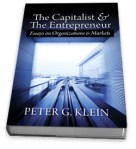 My new book, The Capitalist and the Entrepreneur: Essays on Organizations and Markets (Mises Institute, 2010), is now available. For a limited time, you can get it for just $15 — a bargain at half the price! Actually, the resource-constrained among you can read the Full Monty here, free of charge. A PDF version is also available. A promotional essay appears today on Mises.org.
The editorial and production staff did a terrific job, and I’m thrilled with the volume’s look and feel. The contents aren’t bad either!
Order two or more and I will personally send you a set of Ginsu knives.
Add to: Facebook | Digg | Del.icio.us | Stumbleupon | Reddit | Blinklist | Twitter | Technorati
Personnel Economics Survey
| Peter Klein |
Paul Oyer and Scott Schaefer provide a helpful overview:
Personnel Economics: Hiring and Incentives
Paul Oyer, Scott Schaefer
NBER Working Paper No. 15977We survey the Personnel Economics literature, focusing on how firms establish, maintain, and end employment relationships and on how firms provide incentives to employees. This literature has been very successful in generating models and empirical work about incentive systems. Some of the unanswered questions in this area — for example, the empirical relevance of the risk/incentive tradeoff and the question of whether CEO pay arrangements reflect competitive markets and efficient contracting — are likely to be very difficult to answer due to measurement problems. The literature has been less successful at explaining how firms can find the right employees in the first place. Economists understand the broad economic forces — matching with costly search and bilateral asymmetric information — that firms face in trying to hire. But the main models in this area treat firms as simple black-box production functions. Less work has been done to understand how different firms approach the hiring problem, what determines the firm-level heterogeneity in hiring strategies, and whether these patterns conform to theory. We survey some literature in this area and suggest areas for further research.
Add to: Facebook | Digg | Del.icio.us | Stumbleupon | Reddit | Blinklist | Twitter | Technorati
Transaction Costs and the Virtual Personal Assistant
| Peter Klein |
You can outsource grading, paralegal work, and other services, so why not personal assistance? Some credit cards now feature a concierge service that acts like a crowdsourced, virtual, personal assistant. By exploiting scale economies (a network of specialist assistants that can respond quickly and cheaply to specific client requests) and reducing excess capacity, such ser vices offer dramatically lowered production costs, compared to the conventional model of one dedicated assistant per client (or small group of clients). But the lack of bilateral commitment may make it difficult to encourage relationship-specific investments, so the transaction-cost effects are ambiguous. (Thanks to Chihmao for the pointer.)
If you want to discuss this further, have your people contact my people.
Add to: Facebook | Digg | Del.icio.us | Stumbleupon | Reddit | Blinklist | Twitter | Technorati





 Organizations and Markets
Recent Comments