Posts filed under ‘– Klein –’
Best Acknowledgements Section in an Academic Book
| Peter Klein |
From the preface to James Scott’s The Art of Not Being Governed: An Anarchist History of Upland Southeast Asia (which I heard about from Drake Bennett, via LRC):
There is a large number of colleagues who, having better things to do with their time, nevertheless read part or all of the manuscript and gave me their frank advice. I hope they see, here and there, evidence of their impact as I bobbed and weaved my way to a more nuanced and defensible argument. They include, in no particular order, . . . [a list of 60 names follows]. Wait! I have secreted in this list four colleagues who failed to send their comments. You know who you are. For shame! If, on the other hand, you collapsed trying to carry the manuscript from the printer to your desk, my apologies.
Add to: Facebook | Digg | Del.icio.us | Stumbleupon | Reddit | Blinklist | Twitter | Technorati
A Hayekian Story About Taxis
| Peter Klein |
No, not taxis, but taxis. You know the old story about colleges placing paved footpaths along the paths already worn down by students, relying on “spontaneous order” to select the best routes across campus? Here’s a similar story involving New York City taxicabs. This New York Times infographic tracks taxi traffic and pick-up/drop-off locations across Manhattan throughout a typical week. You can see where traffic clusters during the weekly commute, on Saturday night, and so on. If the city were going to improve certain roads, build taxi stands, re-time traffic signals, and the like, these data could allow for a sort of Hayekian solution. (Via Cliff Kuang, who provides interesting commentary as usual, including this link to a similar San Francisco project.)
Add to: Facebook | Digg | Del.icio.us | Stumbleupon | Reddit | Blinklist | Twitter | Technorati
Outsourcing TAs?
| Peter Klein |
An interesting make-or-buy decision for colleges and universities. Best line, from Roosevelt University B-school dean Terry Friel: “Faculty have this opinion that grading is their job, . . . but then they’ll turn right around and give papers to graduate teaching assistants. . . . What’s the difference in grading work online and grading it online from India?”
Add to: Facebook | Digg | Del.icio.us | Stumbleupon | Reddit | Blinklist | Twitter | Technorati
Westhoff’s The Economics of Food
| Peter Klein |
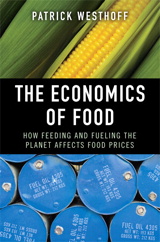 Congratulations to my colleague Pat Westhoff for his new book, The Economics of Food: How Feeding and Fueling the Planet Affects Food Prices (Financial Times Press, 2010). A highly readable account of food markets and food and agricultural policy. Includes some wise words about forecasting:
One thing FAPRI has learned over the years is that people who make and use market projections need a good sense of perspective — and humor. In a rapidly changing world, even the best projections have a very short shelf life. The economic models used to develop the projections necessarily rely on a long series of assumptions, and at least some of these assumptions always prove to be incorrect when viewed with 20-20 hindsight. . . .
For all these reasons, this book uses market projections by FAPRI and other institutions simply to illustrate important points, rather than to predict what will actually happen. If there is one lesson readers should take away from this book, it is that analysts who say they know exactly who food prices will evolve in the future are misleading their audience or fooling themselves.
Update (20 April 2010): While stranded in Germany waiting for a flight home, Pat wrote an item for Freakonomics.
Add to: Facebook | Digg | Del.icio.us | Stumbleupon | Reddit | Blinklist | Twitter | Technorati
Behavioral Corporate Strategy
| Peter Klein |
I’m not a huge fan of behavioral economics, though I obviously recognize its substantial and growing influence in economics, finance, entrepreneurship, and potentially, strategy. Many academics and commentators see the financial crisis as a vindication for behavioral economics research. Behavioral reasoning underlies the New Paternalism. I see the importance and implications of behavioral economics as overstated — the literature typically focuses on straw-man versions of “rationality” and largely ignores the effect of biases and heuristics on political decision-making — but it raises interesting issues in applied psychology.
My old friend Dan Lovallo has a nice piece (with Olivier Sibony) in the new McKinsey Quarterly making “The Case for Behavioral Strategy.” (It’s gated, but registration is free.) They make good arguments for applying behavioral insights into corporate decision making. The basic claim is that “we need new norms for activities such as managing meetings . . . , gathering data, discussing analogies, and stimulating debate that together can diminish the impact of cognitive biases on critical decisions. To support those new norms, we also need a simple language for recognizing and discussing biases, one that is grounded in the reality of corporate life, as opposed to the sometimes-arcane language of academia.” I agree, and urge you to check it out.
Add to: Facebook | Digg | Del.icio.us | Stumbleupon | Reddit | Blinklist | Twitter | Technorati
An Industry Lobbyist’s Definition of “Efficiency”
| Peter Klein |
Gordon Smith, head of the US National Association of Broadcasters (not the good Gordon Smith), explains his understanding of “efficiency”:
In calling for broadcast TV spectrum to be reallocated for mobile broadband use, [Gary] Shapiro falsely suggests that TV broadcasters are “inefficient” users of spectrum. We are not. In fact, when compared with Internet-enabled handheld devices — the primary beneficiaries of Mr. Shapiro’s spectrum plan — TV broadcasters are far more efficient.
Indeed, every single American could turn on his TV set right now without placing any additional capacity strain on the airwaves. You can’t be more efficient than that.
Right. Massive excess capacity, near-zero consumer demand . . . perfect efficiency! (File under economic illiteracy, or maybe public choice.)
Third Searle Center Entrepreneurship Symposium
| Peter Klein |
The schedule is up for the Third Annual Searle Research Symposium on the Economics and Law of the Entrepreneur, 17-18 June 2010 in Chicago. Registration information is here. I participated in the 2008 version and enjoyed it very much.
Top Recruiting Classes
| Peter Klein |
Memphis, Ohio State, and North Carolina have the top-ranked US college basketball recruiting classes for 2010. But how about the Berkeley economics department’s 1963 recruiting class? As I learned this weekend, department head Andreas Papandreou hired five brand-new assistant professors that year: Dan McFadden, Oliver Williamson, Sid Winter, Peter Diamond, and David Laidler. Not a bad haul!
Mundaneum: The Google of 1910
| Peter Klein |
Fascinating article by Molly Springfield in Triple Canopy on the Mundaneum, an effort by two Belgian lawyers to collect and classify all the world’s information, using notecards and an innovative filing system. Information scientist Paul Otlet “was the first to imagine all the world’s knowledge as one vast ‘web,’ connected by ‘links’ and accessed remotely through desktop screens, and because of this he can be seen as the kooky grandfather of the Internet.” Unfortunately, the analog technology of the early twentieth century was not up to the task. (Here’s the wiki on the Mundaneum, which incidentally might make a good title for my next book.)

See also: The Victorian Internet by Tom Standage.
Posner on Institutions and Organizations, Round Two
| Peter Klein |
Remember the infamous Posner-Coase-Williamson exchange from JITE, 1993? Posner dismissed the New Institutional Economics as a derivative form of Posnerian law and economics, prompting unhappy replies from Coase and Williamson. Here’s Coase:
Posner [1993, 79] says that the first part of his paper describes “the conception of the field [the new institutional economics] held by Ronald Coase.” Reading this part of his paper recalled to my mind Horace Walpole’s opening remarks in his book on King Richard the Third: “So incompetent has the generality of historians been for the province that they have undertaken, that it is almost a question, whether, if the dead of past ages could revive, they would be able to reconnoitre the events of their own times, as transmitted to us by ignorance and misrepresentation” (Walpole [1768, 1]). I have only one foot through the door but should the final yank come before this piece is published, Horace Walpole’s words would apply exactly to Posner’s highly inaccurate account of my views.
Adds Williamson, wryly: “Richard Posner is a prolific writer and distinguished jurist. He is frequently asked to speak with wisdom and authority on many issues. Whether he hits the mark or misses varies with his depth of knowledge and understanding of those issues. . . . I content that Posner’s [1993] commentary mainly misses.”
Now Geoff Hodgson has produced a reboot: a long essay by Posner in the Journal of Institutional Economics titled “From the New Institutional Economics to Organization Economics: with Applications to Corporate Governance, Government Agencies, and Legal Institutions,” with replies from Jürgen Backhaus, Bruno Frey, Lin Ostrom, John Roberts, Tom Ulen, and several others (but not Coase or Williamson!). Posner focuses almost exclusively on the principal-agent problem, perhaps unaware that information, delegation, coordination, and adaptation are also important issues in organizational economics. His main conclusion seems to be that both private firms and public agencies are equally inefficient. Interesting reading, to be sure (and much better than Posner’s solipsistic essay on his conversion to Keynesianism, inexplicably published by the New Republic).
Share with First-Year MBA Students
| Peter Klein |
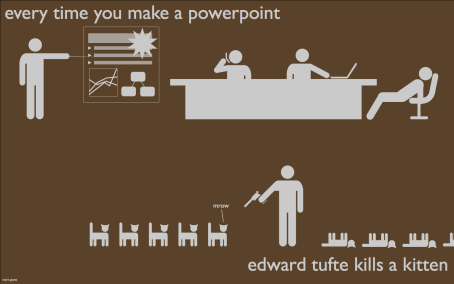
Mark Goetz’s new wallpaper (via Lynne Kiesling). Cory Doctorow translates: “Militant arm of the infoviz movement gets serious about PowerPoint.”
New Issue of EJPE
| Peter Klein |
The new issue of the Erasmus Journal for Philosophy and Economics has several interesting items. Here’s Sen on Adam Smith:
In ethics, Smith’s concept of an impartial spectator who is able to view our situation from a critical distance has much to contribute to a fuller understanding of the requirements of justice, particularly through an understanding of impartiality as going beyond the interests and concerns of a local contracting group. Smith’s open, realization-focussed and comparative approach to evaluation contrasts with what I call the “transcendental institutionalism” popular in contemporary political philosophy and associated particularly with the work of John Rawls.
An essay on Gerard Debreu’s methodology looks promising, along with several of the book reviews. Check it out!
A New Organizational Chart
| Peter Klein |
Fodder for dozens of future PhD dissertations, no doubt! (Click to enlarge.)

Too Blue for You
| Peter Klein |
 I’m partial to Klein Blue, but some of you may prefer Prussian Blue — apparently the first Crayola color to be renamed, as US kids had no idea who or what a “Prussian” could be. See this very cool online essay (via William Bostwick).
Rothbard, Friedman on Health Care
| Peter Klein |
Murray Rothbard and Milton Friedman are no longer with us, unfortunately, but their opinions live on. Lew Rockwell is running a 1994 piece by Rothbard on what was then called Hillarycare, while the Saturday WSJ reprinted a 1996 essay by Friedman on “Soviet-Style Health Care.” My favorite excerpts:
Rothbard on “universal access”:
[T]here is one simple entity, in any sort of free society, that provides “universal access” to every conceivable good or service, and not just to health or education or food. That entity is not a voucher or a Clintonian ID card; it’s called a “dollar.” Dollars not only provide universal access to all goods and services, they provide it to each dollar-holder for each product only to the extent that the dollar-holder desires.
Friedman, quoting a a physician character in Solzhenitsyn’s 1967 novel The Cancer Ward, on Soviet-style “free” health care:
What do you mean by “free”? The doctors don’t work without pay. It’s just that the patient doesn’t pay them, they’re paid out of the public budget. The public budget comes from these same patients. Treatment isn’t free, it’s just depersonalized. If the cost of it were left with the patient, he’d turn the ten rubles over and over in his hands. But when he really needed help he’d come to the doctor five times over. . . .
Is it better the way it is now? You’d pay anything for careful and sympathetic attention from the doctor, but everywhere there’s a schedule, a quota the doctors have to meet; next! . . . And what do patients come for? For a certificate to be absent from work, for sick leave, for certification for invalids’ pensions: and the doctor’s job is to catch the frauds. Doctor and patient as enemies — is that medicine?
Agribusiness Economics and Management
| Peter Klein |
Congratulations to my colleague Mike Cook for his review paper on “Agribusiness Economics and Management” (with Rob King, Mike Boehlje, and Steve Sonka) in the new issue of the American Journal of Agricultural Economics. It’s a special issue commemorating the centennial of the American Agricultural Economics Association. Lots of good stuff here on the history and development of management theory and pedagogy, the evolution of the food sector, and the effects of the institutional environment on firm structure. Here’s the abstract:
Agribusiness scholarship emphasizes an integrated view of the food system that extends from research and input supply through production, processing, and distribution to retail outlets and the consumer. This article traces development of agribusiness scholarship over the past century by describing nine significant areas of contribution by our profession: (1) economics of cooperative marketing and management, (2) design and development of credit market institutions, (3) organizational design, (4) market structure and performance analysis, (5) supply chain management and design, (6) optimization of operational efficiency, (7) development of data and analysis for financial management, (8) strategic management, and (9) agribusiness education.
Kauffman Economics Bloggers Forum
| Peter Klein |
I’ll be in Kansas City tomorrow for the Kauffman Economics Bloggers Forum. Speakers include David Warsh, Paul Romer, Tim Kane, Bob Litan, Donald Marron, and many others. You can watch it live here. Hopefully I’ll get some good ideas for increasing blog revenue, so watch out for our new paid subscription policy. Ha ha ha ha.
Jargon Watch
| Peter Klein |
- Hydrocarbon denier — you know who you are
- YouTube or it didn’t happen — common response from young people to a report of some event
- The G-2 — the US and China, jointly controlling the world economy
- Acluistic — clueless
- Break your crayons — what that last journal reviewer did to me
Bonus material: Andrew Gelman’s urban dictionary for stats
Financial Constraints and Innovation
| Peter Klein |
Why are firms in poor countries less productive than firms in rich countries? Is it lack of technical know-how? Poor infrastructure? Insufficient human capital? Weak intellectual-property protection? Actually, the evidence suggests a more prosaic explanation: financial constraints.
One stylized fact that appears from emerging markets and transition economies . . . is that foreign owned fi rms tend to be more productive than domestically owned firms. . . . To the extent that foreign owned fi rms embody the technological frontier, one can interpret this fact as suggesting that some forces prevent domestically owned firms from emulating the best practices and techniques. . . .
We show that a fi rm’s decision to invest into innovative and exporting activities is sensitive to fi nancial frictions which can prevent fi rms from developing and adopting better technologies. Furthermore, we demonstrate that in a world without financial frictions, innovation and exporting goods are complementary activities. Thus, easing financial frictions can have an ampli ed eff ect on firms’ innovation eff ort and consequently the level of productivity. However, as financial frictions become increasingly severe, these activities become eff ectively substitutes since both exporting and innovation rely on internal funds of fi rms.
That’s from “Financial Constraints and Innovation: Why Poor Countries Don’t Catch Up” by Yuriy Gorodnichenko and Monika Schnitzer. One implication is that diversified firms, whose operating units have access to the firm’s internal capital market, have particular advantages in developing countries, an argument explored in several papers by Khanna and Palepu (e.g., here). In the US, these advantages may not outweigh other drawbacks of unrelated diversification.





 Organizations and Markets

Recent Comments