Posts filed under ‘– Klein –’
Journalists Duped Again
| Peter Klein |
From Walter Duranty to Judith Miller to recent reporting on the financial crisis (1, 2), the mainstream press continues to do what it has always done: print what it wants to be true, rather than investigate what’s actually going on. I got a chuckle out of the latest example: a French magazine that gave its student photojournalism award to a series of dramatic pictures of French youth living in poverty, only to learn the pictures were fakes. Oops! Not quite in the same class as the Sokal affair, but in the same spirit. (HT: Mario Rizzo.)
Slides from Foss-Klein PhD Course
| Peter Klein |
Slides from the PhD course, “The Theory of the Firm and Its Applications in Management Research I,” are now available on the course webpage (scroll down to the bottom).
PS: Did you notice the course title ends with “I,” implying there will be a II and maybe a III? Gotta love that precommitment device. It’s as if Stallone had named his first film “Rocky I.”
Doug North Line of the Day
| Peter Klein |
From Bob Margo’s EH.Net review of North, Wallis, and Weingast’s Violence and Social Orders: A Conceptual Framework for Interpreting Recorded Human History:
In my book people are iconic if I can summarize their life’s work in ten words or less. North takes two: “Institutions matter.”
He adds: “The opposite perspective — viewed in isolation most institutions don’t matter much, being Harberger triangles and small ones at that — has its fans in modern economics. But North has convinced the majority of economic historians, a goodly share of world’s development wonks, and the Nobel Prize Committee that he’s right.”
Update: Art Carden beat me to this.
Austrian Theory of the Firm Bleg
| Peter Klein |
This post is for devotees and fellow-travelers of the Austrian school. As some of you know I maintain an online bibliography of articles and books dealing with applications of Austrian economics to the theory of the firm (and strategic management more generally). Happily, this literature has grown dramatically in the last few years. Sadly, I have not had time to update the bibliography on a consistent basis. So, please send me your suggested additions and corrections (ideally with URLs). Self-nominations are welcome!
Sid Winter on Methodology
| Peter Klein |
Overheard at last week’s DRUID conference, in Sid Winter’s discussion of three papers on technology strategy:
“Our near-exclusive focus on statistical significance has distracted us from the main task of scientific explanation: the determination of cause and effect.”
Three cheers to Sid for standing with Menger over Walras!
Copenhagen Fun
| Peter Klein |
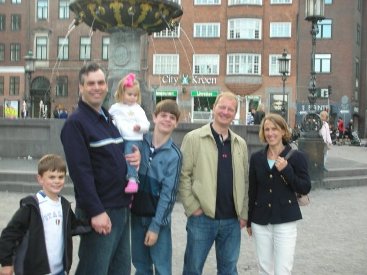
A selection of Kleins and Fosses at Gammel Torv in central Copenhagen (another Foss is in the background, hiding behind a lamppost, and the head of Clan Klein is behind the camera). No real reason to post this except to prove that Nicolai and I both smile occasionally. Note to colleagues at home: This is a business trip, I promise.
Rajshree Agarwal on the US Government’s Response to the Financial Crisis
| Peter Klein |
Nice interview with Rajshree Agarwal on the US government’s response to the financial crisis. “Has It Helped?” Rajshree’s answer in brief: No.
Show Us Some Love
| Peter Klein |
Thanks to Randy for these pictures of science-related tatoos. The phrase “beyond awesome” comes to mind. Who among you will be the first to get an O&M-themed body decoration?
Sameulson on the Crisis
| Peter Klein |
Is it wrong to pick on a 94-year-old? Mario Rizzo doesn’t think so, and neither do I — if it’s Paul Samuelson, perhaps the most influential economist of the twentieth century and bête noire to Austrians, libertarians, and many other types I hold near and dear. Samuelson, champion of “scientific” economics (i.e., the nineteenth-century physics model so effectively skewered by Phil Mirowski), the neo-Keynesian synthesis, and the everything-but-the-kitchen-sink approach to economics textbooks, now says prediction is impossible and deficit spending unsustainable. What’s next, a startling pronouncement that, contrary to what Samuelson wrote in the pre-1991 editions of his textbook, the Soviet Union was not actually more productive than the US?
Bonus Keynesian material (via Ross Emmett): Did Keynes die of a bad tooth?
Events @CBS
| Peter Klein |
I’ve just arrived in Copenhagen, where I’m spending a month as a visiting professor at the SMG. Copenhagen Business School has become one of the most intellectually exciting places in Europe. This week alone the school is hosting the DRUID summer conference which features people like Anita McGahan, Sid Winter, Will Mitchell, Russ Coff, Mike Ryall, and many others, along with a workshop on corporate governance with keynotes by Mark Roe, Randall Morck, Annette Poulsen, and Florencio Lopez-de-Silanes Molina. Of course these are only appetizers for the next week’s main course, the PhD seminar on The Theory of the Firm and Its Applications in Management Research conducted by Professors F. and K. Truly an embarrassment of riches!
Peter L. Bernstein (1919-2009)
| Peter Klein |
I was saddened to learn (from Kenneth Anderson) that Peter L. Bernstein, author of Against the Gods: The Remarkable Story of Risk and other popular works, died June 5. Bernstein was a terrific writer and a clear and provocative thinker with a gift for making difficult concepts accessible. I was greatly influenced by an earlier book, Capital Ideas: The Improbable Origins of Modern Wall Street, which I came across in graduate school while searching for a dissertation topic. Bertstein’s characterization of the brokerage industry in the 1960s and early 1970s, before the deregulation of brokerage fees — an Old Boys Club, lacking competition and innovation — inspired me to examine the role of corporate internal capital markets in replicating the resource-allocation function normally performed by external capital markets, and how the growth and development of financial markets following liberalization contributed to the end of the conglomerate period.
Here are obituaries in the WSJ and NYT and here is Bernstein’s wiki.
Men of Few Words
| Peter Klein |
Those of you into Flesch-Kincaid scores and similar metrics probably appreciate men who can say a lot with a few words. The Bud Light “Dude” guy — whose Fog index, if my calculations are correct, is 1 — may be the best-known modern example:
He’s good, but before him there was Donnie Brasco:
Can your favorite academic writers be that parsimonious?
Fughetaboudit.
De Figueiredo on Political Strategy
| Peter Klein |
We’ve previously mentioned the chapters by Nicolai and Nils Stieglitz and by Lasse and me in the forthcoming Advances in Strategic Management volume titled Economic Institutions of Strategy. John de Figueiredo’s chapter, “Integrated Political Strategy,” is now available as an NBER Working Paper. John is a leader of this emerging field, which studies how firms attempt to influence the legal and political environment to achieve competitive advantage. As he points out:
Legal and acceptable competitive behavior is determined endogenously by legislators, regulators and judges who are influenced, positively and negatively, by the very same firms the regulations are designed to control. By understanding the theories of how firms affect politics, one can better determine how to gain competitive advantage through political institutions. This is a natural extension of the traditional tools of strategic management. Moreover, for young scholars, this is an area in which the lines of investigation are clear and the openings for serious research opportunities available. In this sense, it is robust area for future research and major contributions to understanding firm performance.
2009 SES Boot Camp
| Peter Klein |
Just received the Call for Papers for the 2009 edition of the Society for Entrepreneurship Scholars Manuscript Boot Camp, this year at Johns Hopkins University right before the SMS Conference in October. I participated last year and had a terrific experience (OK, it was at a ski resort, but that has nothing to do with it). Submissions due 4 August 2009. Details below the fold. (more…)
A Reason To Keep Laptops Out of the Classroom
| Peter Klein |
I missed this Doonesbury strip when it came out in 2007 (click to enlarge). Made me cringe. (HT: John Drobak)

Thanks to Mike Sykuta
| Peter Klein |
Thanks to Mike Sykuta for a great series of guest posts on contracting, transaction cost theory, and the crazy political and regulatory world around us. We look forward to Mike’s continued participation in the O&M comment threads and elsewhere in the blogosphere. If you need Mike you can reach him through the usual virtual channels or, if you prefer something meatier, let me know and I’ll walk the 10 feet to his office and bop him over the head.
The MBA Oath
| Peter Klein |
As a manager, my purpose is to serve the greater good by bringing people and resources together to create value that no single individual can create alone. Therefore I will seek a course that enhances the value my enterprise can create for society over the long term. I recognize my decisions can have far-reaching consequences that affect the well-being of individuals inside and outside my enterprise, today and in the future. As I reconcile the interests of different constituencies, I will face choices that are not easy for me and others.
Therefore I promise:
- I will act with utmost integrity and pursue my work in an ethical manner.
- I will safeguard the interests of my shareholders, co-workers, customers and the society in which we operate.
- I will manage my enterprise in good faith, guarding against decisions and behavior that advance my own narrow ambitions but harm the enterprise and the societies it serves.
- I will understand and uphold, both in letter and in spirit, the laws and contracts governing my own conduct and that of my enterprise.
- I will take responsibility for my actions, and I will represent the performance and risks of my enterprise accurately and honestly.
- I will develop both myself and other managers under my supervision so that the profession continues to grow and contribute to the well-being of society.
- I will strive to create sustainable economic, social, and environmental prosperity worldwide.
- I will be accountable to my peers and they will be accountable to me for living by this oath.
This oath I make freely, and upon my honor.
This comes from a group of second-year Harvard MBAs and was featured in last Friday’s New York Times (HT: MGK). Here’s their blog. I eagerly await the analysis of the O&M commentariat.
Seat-of-the-Pants Sports Management
| Peter Klein |
The WSJ recently ran a sort of anti-Moneyball piece on the NBA’s Denver Nuggets that belongs in our “by the numbers” series. Love the title: “Textbook Management? Hardly. — Assembled Largely by Instinct, the Denver Nuggets Keep Winning; Mastering a ‘Curious Business.'” Here’s the central passage:
[The Nuggets] don’t describe their success as the inevitable result of a carefully designed strategy. Rather, in an era when sports executives like to play themselves off as masters of mathematical analysis and risk management — and in a year when most NBA teams chose fiscal prudence over expensive superstars — the Nuggets are an anomaly. They owe their success to a bizarre combination of luck, good health, opportunism and a management strategy that is more six-shooter than Six Sigma.
The story caught my eye partly because it profiles Nuggest owner Stan Kroenke, a real estate developer who lives here in Columbia, Missouri and whose son Josh was Mizzou’s starting shooting guard from 2000 to 2003. (Stan’s wife also happens to be Ann Walton Kroenke, one of Sam Walton’s two nieces; it’s nice to have connections!)
Introducing Guest Blogger Benito Arruñada
| Peter Klein |
We’re delighted to announce Benito Arruñada as our newest guest blogger. Benito is Professor of Business Organization at Pompeu Fabra University in Barcelona, a former President of ISNIE, and a prolific researcher in the areas of organization, law and economics. Most of his work focuses on the organizational conditions that facilitate impersonal exchange, from property titling or business regulation to moral systems. He has published widely in journals such the Journal of Law and Economics, Industrial & Corporate Change, Harvard Business Review, Journal of Law, Economics, and Organization, Journal of Economic Behavior & Organization, Journal of Comparative Economics, and International Review of Law and Economics.
Benito will be blogging about his new book on property and business formalization, Building Market Institutions: Property Rights, Business Formalization, and Economic Development, coming out next year from the University of Chicago Press, and other topics that strike his fancy. Welcome, Benito!
Government-Made Cars
| Peter Klein |
Former Romanian car czar Ion Mihai Pacepa’s confession in today’s WSJ, and Jeff Tucker’s commentary, reminds me of our Trabant series from a while back (the video link is still among our most popular). Look forward to a future video of a GM (i.e., government) worker putting the finishing touches on the next Nova.





 Organizations and Markets

Recent Comments