Posts filed under ‘– Klein –’
My Working Relationship with Lasse
| Peter Klein |
Every coauthoring relationship is unique. Scholars bring different strengths and weaknesses to the table, and there are many opportunities to exploit gains from trade. The best coauthoring relationships are marked by strong complementarities (a theorist and an empiricst, a conceptual thinker and a detail-oriented person, an expert in literature A and an expert in literature B, a “starter” and a “finisher,” etc.). It doesn’t always work, but — as has been frequently noted — sole-authored papers are increasingly rare in business and the social sciences, suggesting that the benefits, on average, outweigh the costs.
Lasse and I have an excellent working relationship resulting in several published and forthcoming papers, numerous works in progress, some joint teaching projects, and more. If there were any doubt that my role in the partnership is basically that of a glorified research assistant, this website, in which one Peter Klein offers “Pre-Lien Services,” should put those doubts to rest.
Tragedy in Athens, Georgia
| Peter Klein |
You may have heard about George Zinkhan, a University of Georgia marketing professor who reportedly shot to death his wife and two others this afternoon before fleeing the scene. As of this writing he remains on the loose and is considered armed and dangerous. A nationwide manhunt is supposedly under way. (Here’s the Google News feed.)
 I was Zinkhan’s colleague at UGA’s Terry College of Business from 1995 to 2002 and knew him casually. We had lunch together on occasion and played basketball together in a faculty/staff league. I didn’t know much about his personal life, only that he had two young children (I think from a second marriage). He was head of the Marketing department when I was there and was, by all accounts, a productive scholar and an effective teacher.
What a surreal experience to see pictures of SWAT teams assembled outside Brooks Hall — apparently staked out in case Zinkhan went there after the shootings, which occurred off campus — where I had my office and taught most of my classes.
One Part of the Financial Sector Is Still Growing
| Peter Klein |
Courtesy of EconomPicData:
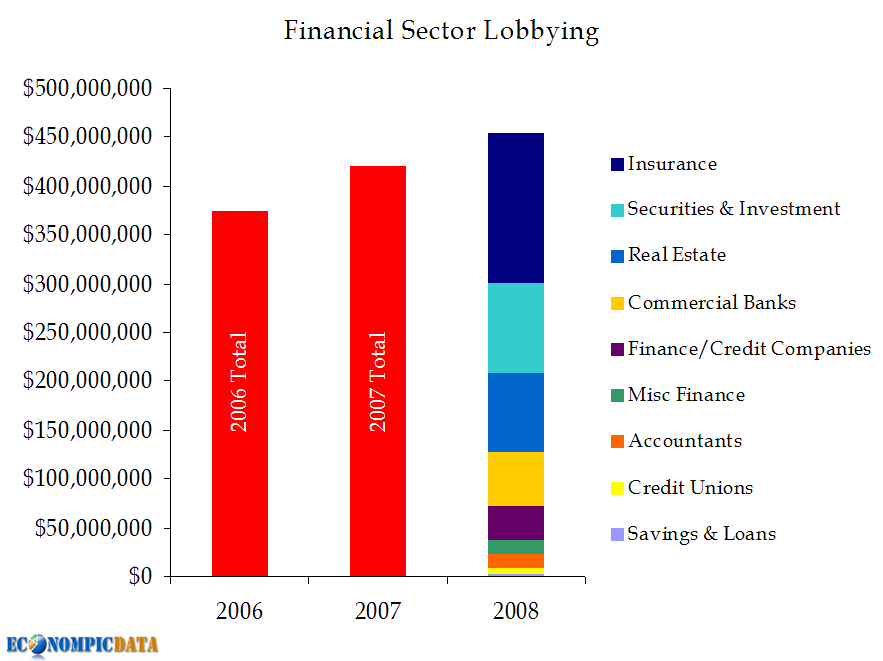
It takes money to make money, you know.
Vive la Révolution!
| Peter Klein |
So says the all-star team of Acemoglu, Cantoni, Johnson, and Robinson in “The Consequences of Radical Reform: The French Revolution.” Check it out:
The French Revolution of 1789 had a momentous impact on neighboring countries. The French Revolutionary armies during the 1790s and later under Napoleon invaded and controlled large parts of Europe. Together with invasion came various radical institutional changes. French invasion removed the legal and economic barriers that had protected the nobility, clergy, guilds, and urban oligarchies and established the principle of equality before the law. The evidence suggests that areas that were occupied by the French and that underwent radical institutional reform experienced more rapid urbanization and economic growth, especially after 1850. There is no evidence of a negative effect of French invasion. Our interpretation is that the Revolution destroyed (the institutional underpinnings of) the power of oligarchies and elites opposed to economic change; combined with the arrival of new economic and industrial opportunities in the second half of the 19th century, this helped pave the way for future economic growth. The evidence does not provide any support for several other views, most notably, that evolved institutions are inherently superior to those ‘designed’; that institutions must be ‘appropriate’ and cannot be ‘transplanted’; and that the civil code and other French institutions have adverse economic effects.
Think of this as a fixed-effects model estimating the within-country effect of legal origin; what happens when a society’s institutional (particularly, legal) environment changes suddenly and unexpectedly? If a common-law country is invaded and occupied by a civil-law country, what happens to financial-market development? An interesting counterpoint to the cross-sectional studies that are the norm in this field.
The Latest Management Bestseller
| Peter Klein |
Followers of the management-guru literature won’t be surprised by this Daily Telegraph report that Mein Kampf is a business bestseller in India. Alas, like Good to Great, the book suffers from the fatal flaws of sampling on the dependent variable and choosing a non-representative sample period. (In a longitudinal sample, the Führer’s managerial performance doesn’t doesn’t look so great, does it?)
As is often the case, the best commentary on this (apparently true) story comes from the Onion: “Well, they sure don’t want to follow Gandhi’s model. All that guy ever did was lose money.”
Peters Against Aggregation
| Peter Klein |
When I saw the title of Brayden’s post, “Don’t Give Up on Aggregation Yet, Peter,” I thought he’d been reading my macroeconomics posts. Alas, Brayden, prefers meatier fare, such as this post by Barnard College sociologist Peter Levin. Levin is worried about the aggregation of knowledge represented by the open-source, wikified, crowdsourcing movement about which people are all, well, atwitter. (We’ve expressed more than a few reservations about this stuff ourselves.) His main concern, if I understand correctly, is the possibility of information cascades. However, much of the cascades literature deals not with the wisdom of crowds, but the wisdom of experts (tulip-bulb traders, mortgage-backed securities underwriters, etc.). The more expertise decision-makers grant to their peers, the more likely they — in the face of uncertainty — will interpret their peers’ (ostensibly expert) opinions as reliable indicators of underlying reality, and hence the greater the likelihood of cascades.
Brayden takes a different tack, arguing that aggregation mechanisms can be designed to mitigate the chance of outliers biasing the results. I think Brayden is right but am not sure his comments address the underlying mechanism — the microfoundations, to use a certain co-blogger’s favorite term — that Levin is worried about.
SecondMarket
| Peter Klein |
Props to Molly Burress for pointing me to this article in today’s NYT on SecondMarket, a website that acts as a market-maker for illiquid assets. According to the Times SecondMarket is developing secondary markets for restricted public equities, bankruptcy claims, mortgage-backed securities, collateralized debt obligations, and other non-marketed financial claims. As the Times points out, the weak IPO market of the last few years has made VCs reluctant to invest in early-stage ventures; by giving VCs an additional exit option, SecondMarket may increase the flow of venture funding.
Not addressed in the article: If SecondMarket succeeds, and grows, and begins to impose disclosure requirements on the companies whose (now-liquid) assets are traded, will private equity lose its purported advantrages over public equity, in the Jensen (1989) sense?
Diversity of Opinion at the University of Missouri
| Peter Klein |
Who says the modern US university doesn’t reflect the full diversity of American social, cultural, and political opinion? Sure, most of the faculty at my university are Birkenstock-wearing, tree-hugging, Prius-driving, union-loving, New-York-Review-of-Books reading ACLU supporters, but they also like to hear from the other side:
Chairperson of U.S. Communist Party to Speak on Campus
Sam Webb, the Chair of the Communist Party, USA, will be speaking on Tuesday April 28th at 7:00pm in Ellis Auditorium. The event is free and open to the public. Sam Webb’s speech will address the current role of/possibilities for the Communist Party, USA and other progressives in the current political climate, confronted as our country is with the economic crisis, environmental crises and two wars. Webb writes extensively on politics, economics, international affairs, and Marxism, and is the author of a number of theoretical pamphlets, including “Reflections on Socialism,” and “The Nature, Role and Work of the Communist Party,” both of which were published in English and Spanish.
Announcement sponsored by ORG — Organization Resource Group
Thanks to Per for noticing.
Macroeconomics Quote of the Day
| Peter Klein |
From Kenneth Boulding’s review essay on Samuelson’s Foundations, published in the JPE in 1948:
[I]t is a question of acute importance for economics as to why the macroeconomics predictions of the mathematical economists have been on the whole less successful than the hunches of the mathematically unwashed. The answer seems to be that when we write, for instance, “let i, Y, and I stand, respectively, for the interest rate, income, and investment,” we stand committed to the assumption that the internal structures of these aggregates or averages are not important for the problem in hand. In fact, of course, they may be very important, and no amount of subsequent mathematical analysis of the variables can overcome the fatal defect of their heterogeneity.
More on heterogeneity in macroeconomics here.
Economic Institutions of Strategy
| Peter Klein |
That’s the title of a forthcoming volume of Advances in Strategic Management edited by Jackson Nickerson and Brian Silverman. You’ll recognize the allusion to a certain classic book. Like that book, this volume maps out an ambitious agenda for new scholarship on institutions and organizations, particularly within the field of strategic management. The chapters provide critical reviews and syntheses of various strands of the strategy literature, intended to support and to challenge new and established scholars starting work in these areas. (They should make excellent readings, for example, for doctoral courses in strategy and the economics of organization.)
Lasse and I contributed a chapter, “Diversification, Industry Structure, and Firm Strategy: An Organizational Economics Perspective,” that you can download on SSRN. Here’s the abstract:
We review theory and evidence on corporate diversification, industry structure, and firm strategy from an organizational economics perspective. First, we examine the implications of transaction cost economics (TCE) for diversification decisions. TCE is essentially a theory about the costs of contracting, and TCE sheds light on the firm’s choice to diversify into a new industry rather than contract out any assets that are valuable in that industry. While TCE does not predict much about the specific industries into which a firm will diversify, it can be combined with other approaches, such as the resource-based and capabilities views, that describe which assets are useful where. We also discuss the transaction-cost rationale for unrelated diversification, which focuses on the potential efficiencies from exploiting internal capital markets. We review this argument as it emerged in the transaction cost literature in the 1970s and 1980s and, more recently, theoretical and empirical literature in industrial organization and corporate finance. We then discuss how diversification decisions, both related and unrelated, affect industry structure and industry evolution. Here, the stylized facts suggest that diversifying firms have a crucial impact on industry evolution because they are larger than average at entry, grow faster than average, and exit less often than the average firm. We conclude with thoughts on unresolved theoretical, methodological, and empirical issues and problems and provide suggestions for future research.
Information Encountering
| Peter Klein |
I recently attended an interesting workshop by my colleague Sanda Erdelez from the School of Information Science and Learning Technologies (what used to be called library science, back when we had libraries). Sanda has developed the concept of information encountering, defined as
a memorable experience of an unexpected discovery of useful or interesting information. Information encountering occurs when one is looking for information relating to one topic and finds information relating to another one. However, it also occurs upon bumping into information while carrying on a routine activity.
During the workshop we discussed the parallels between information encountering and Kirzner’s notion of entrepreneurial discovery. Both are different from systematic search, yet more than pure accident. (As Sanda reminded us, “serendipity,” often used today as a synonym for luck, originally meant the discovery of one thing while searching systematically for another.) More generally, we agreed that the entrepreneurship and information-science literatures can learn from each other. We also discussed Nicholas Carr’s recent Atlantic Monthly piece, “Is Google Making Us Stupid?” which argues, in part, that the ability to find specific information quickly makes us less likely to discover useful information accidentally.
Here is more of Sanda’s research. The terms “accidental discovery of information” and “incidental information acquisition” are also used in the information-science literature.
Antitrust and the Theory of the Firm
| Peter Klein |
Josh has a nice post at Truth on the Market on the place of antitrust research and practice within the legal academy. “[C]ontrary to the conventional wisdom I hear from the legal academy, it is an incredibly exciting time to practice, think about, and write about antitrust issues. . . . I suspect that right now is one of the most intellectually active antitrust eras in history.” Josh proposes several hypotheses on the increasingly popularity of antitrust analysis in law schools and within the law-and-economics movement.
Josh’s post got me thinking about the economic theory of the firm. The pioneers in this field — Coase, Williamson, Klein, Alchian, Demsetz, Teece, Masten — were actively interest in antitrust issues. The subtitle of Williamson’s Markets and Hierarchies (1975), after all, is “Analysis and Antitrust Implications.” In the more recent literature, however, antitrust doesn’t make much of an appearance. None of the leading scholars, such as Oliver Hart, Bengt Holmström, Jean Tirole, John Moore, Bob Gibbons, George Baker, Kevin Murphy, Tom Hubbard, or Steve Tadelis works juch on antitrust (please correct me if I’m wrong). Even giants like Foss, Klein, Langlois, and Lien are not active in this area.
One might respond that antitrust is an economic policy issue, not a firm-strategy issue, and note that transaction cost economics (TCE) has migrated from economics departments to business schools, where it joins the resource-based view (RBV) as a leading theoretical perspective on the the firm. Indeed, while the people mentioned above are economists, mostly teaching in economics departments, Williamsonian TCE has largely been supplanted by the Grossman-Hart-Moore model among mainstream economists, while it remains highly influential within the fields of strategic management, organization theory, and marketing.
This leaves us with two questions: (1) Why isn’t the property-rights or Grossman-Hart-Moore approach to the firm more influential in antitrust economics? (2) Why isn’t antitrust a bigger topic within strategic management (e.g., as part of a firm’s legal and political strategy)?
Law and Economics of Innovation
| Peter Klein |
I’m speaking at this year’s edition of the Law and Economics of Innovation, organized by Geoff Manne and Josh Wright and co-sponsored by GMU Law and Microsoft. It’s May 7 in Arlington. Check out the slick conference website (and Geoff’s post at ToTM). If you don’t want to hear me, at least come for Susan Athey’s keynote. Tom Hazlett has the best paper subtitle: “Of Newtons, Blackberries, iPhones & G-Phones.” How many of you youngsters have heard of the Newton?
Down with Strunk and White
| Peter Klein |
Geoffrey Pullum does’t think much of the ubiquitous grammar guide, celebrating its 50th anniversary this week. The Elements of Style “does not deserve the enormous esteem in which it is held by American college graduates. Its advice ranges from limp platitudes to inconsistent nonsense. Its enormous influence has not improved American students’ grasp of English grammar; it has significantly degraded it.” (Thanks to Gary Peters for this link to a free version, available for just a few days.)
Missouri’s View of Charter Schools
| Peter Klein |
Missouri Democrat Chris Kelly, who represents my district in the state legislature, has introduced a bill rescinding a 2007 Missouri state board of education rule restricting the sale of public school buildings to charter schools. The 2007 rule prevents public school buildings from being sold to “charter schools, liquor stores, adult entertainment venues, distilleries, and landfills.”
Follow O&M on Twitter!
| Peter Klein |
Twitterers or Tweetheads or whatever the correct term is can now receive O&M updates by following orgsandmarkets. This works through TwitterFeed, which I learned about from Lynne. Kool!
Keynesian Economics in a Nutshell
| Peter Klein |
An earlier post on Keynesian economics in four paragraphs has proven extremely popular. Here’s Keynesian economics in just one-and-a-half paragraphs, courtesy of Mario Rizzo:
Clearly, DeLong is a rigid aggregate demand theorist. He talks about output and employment as if it were some homogeneous thing. In his mind, macroeconomics is just about spending to increase the production of stuff. Yes, there is lip service to the idea that the stuff should have economic value. But that is easy when you assume that the only alternative is value-less idleness. . . .
The sectoral problems generated, not only by exogenous shocks but by the low interest rate policy of the Fed, are of critical importance. The aggregate demanders are blind to this.
Here at O&M we take the opposite perspective, namely that heterogeneity matters. Actually, as Mario has pointed out in a series of posts (1, 2, 3), Keynes himself was much better than his latter-day followers. Keynes may have been wrong — deeply, deeply wrong, in my view — but he was no fool. As for today’s Keynesians. . . .
Update (14 April): See also Mario’s fine essay in the April Freeman, “A Microeconomist’s Protest.”
René Stulz on Derivatives
| Peter Klein |
In case you missed it, Tuesday’s WSJ ran an op-ed by René Stulz, one of the world’s elite researchers in empirical corporate finance, “In Defense of Derivatives and How to Regulate Them.” Highlights:
That derivatives benefit our financial system and our national economy is well established. Twenty-nine of the 30 companies that make up the Dow Jones Industrial Average use derivatives. According to data from Greenwich Associates, two-thirds of large companies (those that have sales of more than $2 billion) use over-the-counter derivatives and more than half of all mid-size companies (those that have sales between $500 million and $2 billion) are very active in derivatives markets. Derivatives are necessary and helpful tools for companies seeking to manage financial risk.
The most important benefit of derivatives is that they allow businesses to hedge risks that otherwise could not be hedged. This does a number of positive things. It transfers risk, allowing firms to guard against being forced into financial distress. It also frees lenders to offer credit on better terms, giving companies access to funds that they can use to keep their doors open, lights on and, even, invest in new technologies, build new plants, or hire new employees. (more…)
Program for Searle Center Conference, “The Economics and Law of the Entrepreneur”
| Peter Klein |
Here. I participated in last year’s conference and thought it was terrific. Old friend Henry Butler is doing a fine job making the Searle Center a major player in the entrepreneurship field.
IRBs Gone Wild
| Peter Klein |
We’ve noted before the strange behavior of university Institutional Review Boards. My own campus has a particularly prickly IRB, the result of an unpleasant incident a few years back involving the medical school. So, even social-science researchers must receive IRB training and have individual research projects — yes, every research project that involves “human subjects,” which includes research using secondary data — approved by the campus IRB.
My certification expired recently and I took an online test today to be re-certified. Some of you may find the questions interesting. Here is a selection. Keep in mind these are questions for an economist wishing to do research in economics and management, not for a pharmacologist or epidemiologist. (more…)





 Organizations and Markets
Recent Comments