Posts filed under ‘– Klein –’
Waugh’s House of Wittgenstein
| Peter Klein |
The Saturday Wall Street Journal features Janes Penrose’s review of Alexander Waugh’s House of Wittgenstein, a profile of the prominent Viennese family that produced not only the philosopher Ludwig, considered by many the greatest of the twentieth century, but also pianist Paul. Their father, Karl, was an important Austrian industrialist, and their home, nicknamed Palais Wittgenstein, a Viennese landmark. The WSJ also offers a sample chapter.
Hayek enthusiasts will of course remember that Hayek and Wittgenstein were second cousins, though they did not appear to know each other well (see Hayek’s “Remembering My Cousin Ludwig Wittgenstein” in Hayek, Collected Works, vol. 4, pp. 176-81). My old boss Bill Bartley, founding editor of Hayek’s Collected Works, wrote a controversial Wittgenstein biography in 1973 (Bartley’s book was the first to discuss Wittgenstein’s homosexuality publicly, for which Bartley was condemned by Wittgenstein’s literary executors and outcast by the Wittgenstein establishment). Hayek is also mentioned briefly in the popular book Wittgenstein’s Poker, which we discussed before.
John Gray argues that Hayek’s theory of language, as presented especially in The Sensory Order, was strongly influenced by Wittgenstein (even the numbering system copies that of the Tractatus). There are, writes Gray, “many evidences that Wittgenstein’s work reinforced Hayek’s conviction that the study of language is a necessary precondition of the study of human thought, and an indispensable prophylactic to the principal disorders of the intellect. Examples which may be adduced are Hayek’s studies of the confusion of language in political thought and, most obviously, perhaps, of his emphasis on the role of social rules in the transmission of practical knowledge.”
Archived Version of Hitt Presentation on Strategic Management
| Peter Klein |
Here’s an archived version of Mike Hitt’s presentation, “New Theoretical Developments in Strategic Management,” that Mike Sykuta described before. You can also download the slides.
I watched the presentation yesterday and strongly recommend it, particularly the first part, as a good introduction to the resource-based view of the firm and an overview of some of Mike’s recent work on the institutional environment. It was nice of the AEM folks to set this up.
Skidelsky on Keynes and Hayek
| Peter Klein |
Keynes biographer Robert Skidelsky delivered the Manhattan Institute’s 2006 Hayek Lecture on Keynes and Hayek. The lecture will be broadcast this Sunday, 1 March 2009, 3:00 EST, on C-Span 2’s Book TV series. It will presumably appear later on C-Span’s YouTube channel. (Thanks to Warren for the pointer.)
Top Earners at Private US Colleges and Universities
| Peter Klein |
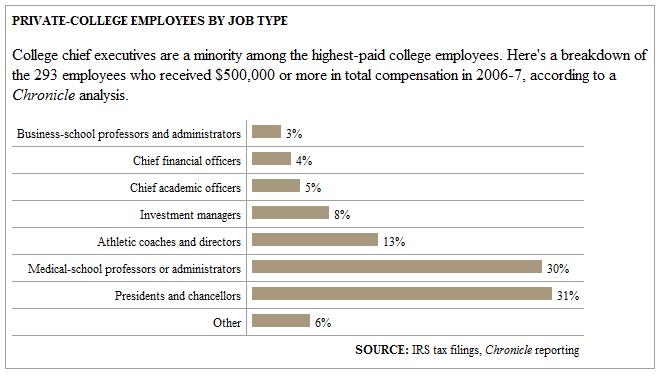
Some interesting factoids in this Chronicle of Higher Ed. story on compensation at 600 private US colleges and universities (via Gary Peters):
- Of the 88 employees earning more than $1 million in 2006-07, only 11 were chief executives. Most were coaches or medical school faculty.
- Median salary for full professors with MDs in the clinical sciences: $238,000
- Median salary for full professors in all other disciplines: $122,159
- Highest-paid employee: USC football coach Pete Carroll ($4.4 million)
- Second highest-paid employee: Columbia University dermatologist David Silvers ($4.3-million)
- Highest-paid economist: Columbia’s Henry Levin ($302,053)
- Highest-paid film-studies professor: Wesleyan’s Jeanine Basinger ($250,854)
No information given on marginal revenue products. I imagine Pete Carroll’s is at least $4.4 million. Don’t know about the rest.
See also the graphic below (click to enlarge):
Risk, Uncertainty, and Financial Markets
| Peter Klein |
A quick follow-up to Nicolai’s post on the copula function: See also this item on Gary Gorton’s role in the financial crisis, which includes Warren Buffett’s great line: “Beware of geeks . . . bearing formulas.” And items on Knightian uncertainty here and here.
And there’s this passage from Darren Aronofsky’s cult classic Pi:
Restate my assumptions: One, Mathematics is the language of nature. Two, Everything around us can be represented and understood through numbers. Three: If you graph the numbers of any system, patterns emerge. Therefore, there are patterns everywhere in nature. Evidence: The cycling of disease epidemics;the wax and wane of caribou populations; sun spot cycles; the rise and fall of the Nile. So, what about the stock market? The universe of numbers that represents the global economy. Millions of hands at work, billions of minds. A vast network, screaming with life. An organism. A natural organism. My hypothesis: Within the stock market, there is a pattern as well. . . . Right in front of me . . . hiding behind the numbers. Always has been.
This is before the speaker, the mathematician protagonist Max Cohen, goes literally insane. That’s what quantitative financial modeling can do to you.
More on the Evolution of Accounting
| Peter Klein |
For some reason posts dealing with accounting are among our most popular. Perhaps this says something about the Nerd Quotient of the typical O&M reader. Anyway, if you liked the recent post about the evolution of accounting rules, you may enjoy this paper that looks at the problem more systematically.
Accounting is an Evolved Economic Institution
Gregory B. Waymire and Sudipta Basu
We consider accounting from an evolutionary perspective. Accounting encompasses the creation of transactional records, the summarization of records in t-accounts, and the preparation of audited financial statements. Accounting’s history spans at least 10,000 years dating back to the first human settlements in ancient Mesopotamia. Our focus is on the study of accounting history in three ways: providing useful thoughts experiments valuable to researchers interested in the development of modern practices, the use of historical data to test formal hypotheses about the origins of accounting practices, and the development of theories and related empirical evidence that explain accounting based on evolution and ecological rationality. Within this third area, we describe the basis for hypotheses and empirical analyses concerning six issues: (1) the emergence of recordkeeping, (2) the effect of double-entry bookkeeping on the scale and scope of economic organization, (3) the spontaneous emergence of norms of practice in accounting, (4) the impact of law, regulation, and taxation on accounting, (5) the demand for broad principles in evaluating accounting method choices, and (6) the relation between economic crises and major discontinuities in accounting practice.
Slides on “Putting Entrepreneurship into Strategy and Organization”
| Peter Klein |
You’ve read the book. You’ve seen the movie. You attended the seminar. Now download the slides. Or something like that. Anyway, Lasse begged me to post the slides from this morning’s talk at NHH — or maybe he begged me not to post them, I forget which — so here they are. Some of the slides may not make much sense without the animation (and accompanying patter), but sadly the event was not captured on video, where it could have won next year’s Oscar in the “Best Obscure Academic Talk” category.
An Obamanable Housing Plan
| Peter Klein |
So, let me get this straight. We’re in a major recession triggered by a collapse in the housing market, itself the inevitable result of government policies, led by Fannie Mae and Freddie Mac, to get the wrong loans to the wrong people so they could buy the wrong houses. The Obama Administration’s remedy is not to let Fannie and Freddie die a long-overdue and merciful death, but to prop them up, to give them additional powers, and to subsidize private mortgage lenders who extend yet more credit to more borrowers who can’t pay it back, thus making what might have been a temporary misallocation of the housing stock into a permanent one. Brilliant!
I am bewildered. But, more than that, I am angry. I can’t count how many news accounts I’ve seen about the poor, struggling homeowners who can’t make the monthly mortgage payment, are about to be foreclosed, and risk losing the family home, yard, white picket fence, and piece of the American Dream. But I haven’t heard one word about the poor, struggling renters, the ones who scrimped and saved and put money away each month towards a down payment, who kept the credit cards paid off, stayed out of trouble, and lived modestly, and thought that maybe, just maybe, the fall in housing prices meant that they, finally, could afford a house — maybe one of those foreclosed units down the street. These people are Bastiat’s unseen. For them, Obama’s housing plan is a giant slap in the face. To hell with the prudent. Party on, profligate! Now that’s what I call moral hazard.
Update: Here it is in pictures (from EconomiPicData via Wayne Marr).
Tribal Ritual Among the Ag-Econ
| Peter Klein |
Henry Bahn and George McDowell’s spin-off of the Leijonhufvud classic. I wonder how many other sub- and sister disciplines have their own versions? Sample:
Almost all tribe members adhere to a fundamental belief system and set of basic tenets called Neoclassic Econ. However, different groups in the tribe, sometimes formalized into castes called “fields,” are more or less strict in their adherence to different parts of these tribal teachings. . . .
One group, the Quant-jocques, thinks the tribe should ascribe to a special language and method of communication and analysis. Others, known as Institoots, think the Quant-jocques are introverts, inclined to want to know more and more about less and less, and thus miss important issues along the way. The Quant-jocques reply that the Institoots have more than their fair share of the “mists” about their work as Agg-econ-ni-mists. One of the revered elders of a related tribe decided to resolve some of the philosophical issues among tribe members about who they were and what they believed by pronouncing that the belief system is simply “what the tribe does.”
Like other academic disciplines, agricultural economics has its share of adjuncts, consultants, and other semi-professorial types:
There are also landless tribe members — some of those perhaps more disposed to vagrancy — scattered throughout the land doing what Ag-econs do. Indeed, one group in the tribe has members who live apart from the Depts and are therefore obliged to do honest work for a living. This group is known by its hard work and industry and are called “industry types” or, in an apparent slight, “nonacademics.” Yet another view of this group is that many of them are akin to wandering minstrels who dash in and out of the protected communities, donning the protective robes of the Depts when it serves them well, and when more is to be gained from singing their minstrel song for more than the honor of the Depts, they sing for the highest bidder.
Also lots of insider references on journals and annual meetings. A related discipline, rural sociology, is described in the classic “Village Idiot” Python sketch.
Pixar’s HR Strategy
| Peter Klein |
Mostly, it’s about hiring ultra-nerds with good communication skills. To wit: You want people who have become exceptional at a tiny discipline, no matter how obscure or dorky, since it’s that compulsion to truly master something that predicts how they’ll handle a new task. (Wannabe Pixar employees: Don’t bury your unicycle or juggling skills on your resume.) Another idea is looking for people who have failed and overcome — as [HR chief Randy] Nelson puts it, “The core skill of innovators is error recovery not failure avoidance,” which is key if you’re asking someone to solve a never-before-solved problem. But perhaps the squishiest trait is the ability to make others around you better, through communication and camaraderie.
From Kottke via Fast Company. See also “How Pixar Fosters Collective Creativity” from last September’s HBR.
Economist Quote of the Day
| Peter Klein |
John Nye gets the honor, quoted in a St. Louis Post-Dispatch story on the newfound popularity of economists (via Travis):
For economist John Nye, the financial crisis has meant new questions at dinner parties and children’s birthday parties.
But Nye, a former Washington University professor who now teaches at George Mason University in Virginia, noted an irony in his profession’s new-found popularity. He said most people — including government officials — seemed to ignore economists during the good times, but they are turning to economists now, even though there is little consensus among economists about what to do.
“We’re confused,” said Nye, “and yet folks want to listen to us even more.”
I sometimes think that being an economist today is like being an epidemiologist during the Black Plague. Everybody has questions, but nobody likes the answers.
Accounting Rules and Spontaneous Order
| Peter Klein |
David Albrecht thinks the US should not replace its accounting rules (GAAP) with the new, international standard (IFRS).
A language evolves to fit its culture. Language is not static. Moreover, there is no one best way for a language to be. . . .
If Americans wish to speak to a person from Peking, they can get their communication translated. The translation comes at a cost. The benefit from avoiding this cost by switching [to Chinese] would be much less than the huge opportunity costs of educating everyone in the U.S. to speak another language. If we continued using English, the translation to Chinese would (and is) a trivial expense, and a minor inconvenience.
Similarly, there is no good reason for anyone to have the U.S. discontinue using its accounting language (GAAP) and switch over to IFRS. Having multiple accounting languages in the world is a minor inconvenience and translation expenses are, in the grand scheme of things, trivial. Moreover, GAAP seems to fit our culture, economy and system of financial markets. . . .
Who would benefit if the U.S. switched to IFRS? Certainly not investors, for the same reason that they would not benefit if the country moved immediately to Chinese. The beneficiaries would be the accounting firms that would teach us the new IFRS, and company executives. (more…)
The Onion or Reality: Marketing Edition
| Peter Klein |
 Check out the 27-page marketing proposal
(6MB PDF) for Pepsi’s recent logo redesign, which references Euclid, Feng Shui, Da Vinci, the Möbius strip, Le Corbusier, perimeter oscillations, the Earth’s magnetic field and gravitational pull, the speed of light, and space-time relativity. I kid you not. (Gawker via Fast Company.)
Remember, this is the proposal Pepsi liked.
An Empirical Test of Williamson’s Adaptation Theory
| Peter Klein |
We’ve noted before, following Bob Gibbons, how Williamson’s transaction-cost approach can be called an adaptation theory of the firm. Vertical integration, in this context, is seen as an efficient means of adjusting a production process to unanticipated changes in market conditions, regulation, or technology.
Most of the empirical TCE literature focuses on the equilibrium rent-seeking version of the story, however (perhaps more influenced by Klein, Crawford, and Alchian’s interpretation). Vertical integration is viewed as an efficient means of mitigating holdup in the presence of asset specificity — and, in equilibrium, holdups don’t occur, so there is nothing to mitigate. Hence the typical TCE empirical paper which compares observed organizational forms to observed transactional characteristics (e.g., the degree of asset specificity). Newer studies attempt to test the relationship between efficient alignment, in the sense above, and long-term performance or survival, but few study the process of adaptation itself. (Exceptions include Mayer and Argyres, 2004 and Argyres and Mayer, 2007.)
Arnaud Costinot, Lindsay Oldenski, and James Rauch have written what I think is the first large-N empirical paper on the adaptation theory, “Adaptation and the Boundary of Multinational Firms.”They construct an occupation-level measure of “routineness” — whether a job involves mainly routine tasks or more creative, problem-solving activities — and show that routineness and vertical integration are negatively correlated. An interesting operationalization of the theory. Abstract:
What determines the boundary of multinational firms? According to Williamson (1975), a potential rationale for vertical integration is to facilitate adaptation in a world where uncertainty is resolved over time. This paper offers the first empirical analysis of the impact of adaptation on the boundary of multinational firms. To do so, we first develop a ranking of sectors in terms of their “routineness” by merging two sets of data: (i) ratings of occupations by their intensities in “problem solving” from the U.S. Department of Labor’s Occupational Information Network; and (ii) U.S. employment shares of occupations by sectors from the Bureau of Labor Statistics Occupational Employment Statistics. Using U.S. Census trade data, we then demonstrate that, in line with adaptation theories of the firm, the share of intrafirm trade tends to be higher in less routine sectors. This result is robust to inclusion of other variables known to influence the U.S. intrafirm import share such as capital intensity, R&D intensity, relationship specificity, intermediation and productivity dispersion. Our most conservative estimate suggests that a one standard deviation decrease in average routineness raises the share of intrafirm imports by 0.26 standard deviations, or an additional 7% of import value that is intrafirm.
Extreme Decentralization at Walmart
| Peter Klein |
A fascinating NY Post story on Walmart by a reporter who went undercover and got hired as an entry-level worker. The story reveals a surprising amount of decentralization for a firm sometimes regarded as some kind of Taylorite dinosaur. (Thanks to Rafe Champion for the pointer.) Excerpt:
Having pledged ourselves, we encountered the aspect of Wal-Mart employment that impressed me most: The Telxon, pronounced “Telzon,” a hand-held bar-code scanner with a wireless connection to the store’s computer. When pointed at any product, the Telxon would reveal astonishing amounts of information: the quantity that should be on the shelf, the availability from the nearest warehouse, the retail price, and (most amazing of all) the markup.
All of us were given access to this information, because — in theory, at least — anyone in the store could order a couple extra pallets of anything, and could discount it heavily as a Volume Producing Item (known as a VPI), competing with other departments to rack up the most profitable sales each month. Floor clerks even had portable equipment to print their own price stickers. This was how Wal-Mart detected demand and responded to it: by distributing decision-making power to grass-roots level. It was as simple yet as radical as that.
We received an inspirational talk on this subject, from an employee who reacted after the store test-marketed tents that could protect cars for people who didn’t have enough garage space. They sold out quickly, and several customers came in asking for more. Clearly this was a singular, exceptional case of word-of-mouth, so he ordered literally a truckload of tent-garages, “Which I shouldn’t have done really without asking someone,” he said with a shrug, “because I hadn’t been working at the store for long.” But the item was a huge success. His VPI was the biggest in store history — and that kind of thing doesn’t go unnoticed in Arkansas.
Markets in Everything, Valentine’s Revenge Edition
| Peter Klein |
A local bar is hosting a “Valentine’s Day Massacre” party this weekend. The centerpiece is a commercial tree shredder. Patrons can bring mementos or personal effects from old boyfriends and girlfriends (and, I guess, former spouses) and have them pulverized into tiny bits. “We’ve even had a wedding dress!” says the radio ad. Presumably more extreme scenarios, like that depicted in the famous wood-chipper scene in Fargo, are prohibited.
Demand for Commodities Is Not Demand for Labor
| Peter Klein |
Minnesota engineering professor David Levinson (via Mankiw), on the “shovel-ready” criterion for stimulus spending:
In the 1930s, when you were literally building with shovels, that might have made sense. That was largely unskilled labor. Today, it’s blue collar, but it’s not unskilled. . . . The guy brushing the asphalt back and forth is unskilled, but the guy operating the steamroller isn’t. And there’s an assumption out there that construction workers are interchangeable between residential and highway projects. But a carpenter isn’t a whole lot of help in building a road.
Modern Keynesian economics, which retains the Master’s belief in homogeneous labor and capital and his focus on macroeconomic aggregates, treats a worker as a worker as a worker. Lending and spending — on anything, it doesn’t matter what — brings idle resources into gainful use. Notes Hayek:
John Stuart Mill’s profound insight that demand for commodities is not demand for labor, which Leslie Stephen could in 1878 still describe as the doctrine whose “complete apprehension is, perhaps, the best test of a sound economist,” remained for Keynes an incomprehensible absurdity (Collected Works, vol. 9., p. 249).
And here’s Craig Pirrong:
There is no such thing as “aggregate output.” There are many industries, many goods, many sectors, all of which rely on specialized resources that are not readily redeployable among them. Directing — via coercion — spending to one sector or another is likely to worsen resource misallocations, rather than mitigate them. I find it particularly bizarre that some of the stimulus appears to be directed at supporting industries and sectors that resources should leave (e.g., construction, automobiles). We almost certainly built too many houses (due to perverse monetary policy, as John Taylor explains it), so resources should leave that business. Why stimulate it?
Alex Rodriguez Admits to Personal Stimulus Package
| Peter Klein |
NEW YORK — Yankees’ star third baseman Alex Rodriguez admitted to receiving a series of personal stimulus packages from 2001 to 2003. “My trainer said my actual output was well below my potential output so we needed to pursue an expansionary nutritional policy.” Now suffering from a debilitating disease caused by prolonged exposure to stimulus, Rodriguez said he had “little choice” but to ask the trainer for even more stimulus, as well as putting every aspect of his personal and professional life under the trainer’s control. “Bold action is needed,” said a spokesperson for Major League Baseball. “We cannot depend on stimulus alone to create home runs or long-term athletic growth, but at this particular moment, only stimulus can provide the short-term boost necessary to lift Alex from a recession this deep and severe.”
Rodriguez’s trainer said he was pleased with his new authority and blamed the player’s health problems on “lack of oversight” by baseball officials. “We didn’t have enough regulation,” he complained. Baseball analyst Paul Krugman said he supported additional stimulus and the trainer’s new powers but worried that the plan “doesn’t go far enough.”
The Future of the Textbook
| Peter Klein |
Cliff Kuang at Fast Company points us to smARThistory, which looks very nice, and asks:
Why the hell are we still teaching kids from textbooks? Granted, the system works. But you’d at least expect more experiments in the genre, along the lines of smARThistory. For one, textbooks for each student routinely cost hundreds, even thousands per year — and a massive chunk of those costs aren’t in the production of the material, but rather its printing and distribution. Better to give kids laptops, and dynamic textbooks with high production values (like smARThistory). You could arrange them with assigned lessons that require modules to be checked off. A system of clicks or periodic questions could ensure that the kids are engaged. And what about flash animations that illustrate physics or math concepts? The list goes on. If done right, a virtual textbook would far outshine any print textbook we’ve ever cracked.
In economics and management we sometimes use online simulations, experiments, and other interactive learning tools, but the traditional textbook (or set of journal articles) reigns supreme. Do the newer tools work? Which are most effective? And, most important, what clever names can we give them? huMANresources? pricECONnections?
Regime Uncertainty
| Peter Klein |
Much wisdom in John Taylor’s piece in today’s WSJ. The housing boom and crash were caused primarily by monetary policy and a government-induced relaxation of borrowing standards. Policymakers mistakenly diagnosed the problem as a lack of liquidity and tried to increase loan volume as early as 2007. Further “stimulus” and even lower federal-funds rates came in 2008, followed by a set of arbitrary interventions (selective bank bailouts, the inexplicable TARP). Taylor places special blame on Bernanke and Paulson for creating regime uncertainty:
On Friday, Sept. 19, the Treasury announced a rescue package, though not its size or the details. Over the weekend the package was put together, and on Tuesday, Sept. 23, Fed Chairman Ben Bernanke and Treasury Secretary Henry Paulson testified before the Senate Banking Committee. They introduced the Troubled Asset Relief Program (TARP), saying that it would be $700 billion in size. A short draft of legislation was provided, with no mention of oversight and few restrictions on the use of the funds. . . .
The realization by the public that the government’s intervention plan had not been fully thought through, and the official story that the economy was tanking, likely led to the panic seen in the next few weeks. And this was likely amplified by the ad hoc decisions to support some financial institutions and not others and unclear, seemingly fear-based explanations of programs to address the crisis. What was the rationale for intervening with Bear Stearns, then not with Lehman, and then again with AIG? What would guide the operations of the TARP?
I argued before that the whole “credit crunch” may be a kind of self-fulfilling prophecy. Taylor suggests that more generally, the government, having created the crisis, is now deepening and prolonging it by trying to “fix” the problem is made, a classic example of Mises’s theory of interventionism.





 Organizations and Markets

Recent Comments