Posts filed under ‘– Klein –’
The Heath Brothers on Incentives
| Peter Klein |
Dan and Chip Heath worry that incentive plans backfire because of focusing illusion — managers place too much weight on a single variable in the incentive contract, ignoring the likely side effects. I don’t disagree that this is possible but Chip and Dan seem to be knocking down a pretty feeble straw man. The drawbacks of single-variable, quantitative incentive schemes are well known in the organizational design literature, spawning oodles of studies of multi-tasking, the use of multiple performance measures, the benefits and costs of subjective evaluation criteria, and the like. (There’s a nice overview in BSZ chapter 16.)
The Economics and Sociology of Stonehenge
| Peter Klein |
 Recent research on Stonehenge recognizes that its construction was not just a massive technological undertaking, but a huge organizational challenge as well. Here’s a recent item from American Scientist (via 3quarks):
Although many people might straightforwardly conclude that an undertaking on the scale of Stonehenge must have been an expression of concentrated power within Neolithic society, the claim cannot be conceded without thinking about the long processes of inspiration, discussion, mobilization of labor and periodic reenergizing of all those involved that must have accompanied such enterprises and indeed made them possible. The challenge for archaeologists can slide from simple detection of the presence of power to analysis of the ways in which social preeminence could be asserted and maintained for what was all too often just a brief interval.
So research into the ways in which monuments “worked” is crucial. How did people approach and move around these great assemblies of earth, timber and stone? Did they do so freely, or were they directed? What did interventions in nature on this scale signify, and what meanings could be projected by the materials used in their construction? How were tradition and innovation respectively regarded? Leaders or would-be leaders must have had tricky paths to negotiate.
I’m waiting for the pop-management book, Leadership Lessons from the Stonehenge Builders.
Introducing Guest Blogger Mike Sykuta
| Peter Klein |
I’m delighted to introduce my friend and colleague Mike Sykuta as our newest guest blogger. Mike is Director of the Contracting and Organizations Research Institute (CORI) here at the University of Missouri. Mike and CORI played a big role in attracting me to Missouri in 2002 and we’ve worked closely together on many projects since then.
Mike got his Ph.D. in economics at Washington University in St. Louis and identifies with the Coase and North branch of the new institutional economics. (He is sympathetic to Williamsonian TCE but has not yet drunk the Kool-Aid.) Mike is co-editor of SSRN’s NIE Abstracting Journals, along with Mary Shirley, and is involved with ISNIE and ESNIE. He works on contracting, corporate governance, and the political economy of regulation. He teaches an MBA/MS-level course on the economics of transactions and contracting, doctoral seminars on firm and industry organization, and the capstone undergraduate strategy course in the agribusiness management program. Mike is almost as much a Luddite as Nicolai — he acquired his first mobile phone just a short while ago — and I’m glad he’s finally decided to give some 21st-century technology a try. Welcome, Mike!
Sociology Beats Economics — Again!
| Peter Klein |
This was only the beginning. Now I learn from this paper, summarized by Henry Farrell (who supplies the graph below), that economists rank dead last among social scientists in RateMyProfessors.com’s “hot or not” ranking system. Sociologists are right up there near the top. How can this be?
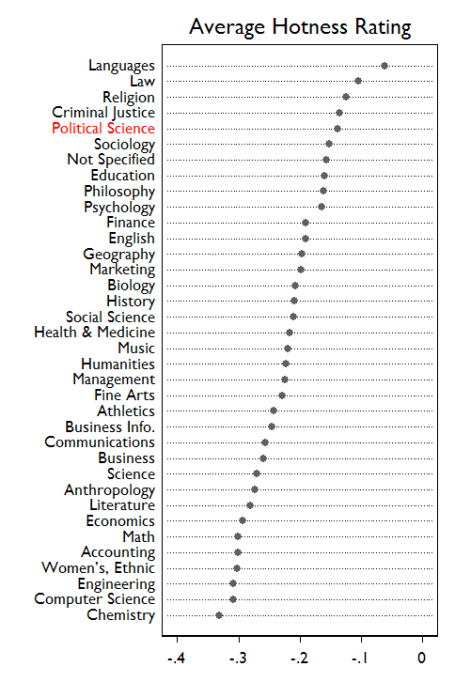
As Henry points out, all the academic disciplines have “hotness quotients” below zero, meaning more likely “not” than “hot.” I’m tempted to ask commentators to supply their favorite counter-examples, but would prefer not to encourage lawsuits.
Technological Change
| Peter Klein |
 You Macophiles may get a kick out of Larry Magid’s 1984 LA Times review of the original Mac (now celebrating its 25th anniversary). Packed with 128K RAM, a 400K floppy drive, a 9-inch monitor, and something called a “mouse,” it wowed the critics from the get-go. Magid was particularly impressed with the MacWrite software, which “can vary the size and style of your type on the screen and on paper. . . . You can vary the type size from 9 point (about the size used in most newspapers) to 72 point headlines. You can also change your type style, selecting an Old English font or one of the more common type styles. Your type can be in bold, italic, underline or even shadow print.” Wow!
Magid doesn’t say anything about speed, which concerned me the first time I saw one in person (yes, back in 1984; I’m that old). The old IBM-compatible PCs running command-line MS-DOS were much faster for basic word processing, database, and spreadsheet applications than the pretty WYSIWYG design popularized on the Mac.
Keynesian Economics in Four Paragraphs
Courtesy of Robert Barro:
[A]ssume that the multiplier was 1.0. In this case, an increase by one unit in government purchases and, thereby, in the aggregate demand for goods would lead to an increase by one unit in real gross domestic product (GDP). Thus, the added public goods are essentially free to society. If the government buys another airplane or bridge, the economy’s total output expands by enough to create the airplane or bridge without requiring a cut in anyone’s consumption or investment.
The explanation for this magic is that idle resources — unemployed labor and capital — are put to work to produce the added goods and services.
If the multiplier is greater than 1.0, as is apparently assumed by Team Obama, the process is even more wonderful. In this case, real GDP rises by more than the increase in government purchases. Thus, in addition to the free airplane or bridge, we also have more goods and services left over to raise private consumption or investment. In this scenario, the added government spending is a good idea even if the bridge goes to nowhere, or if public employees are just filling useless holes. Of course, if this mechanism is genuine, one might ask why the government should stop with only $1 trillion of added purchases.
What’s the flaw? The theory (a simple Keynesian macroeconomic model) implicitly assumes that the government is better than the private market at marshaling idle resources to produce useful stuff. Unemployed labor and capital can be utilized at essentially zero social cost, but the private market is somehow unable to figure any of this out. In other words, there is something wrong with the price system.
Barro thinks a multipler of zero is a more plausible baseline assumption. Of course, if GDP is adjusted for quality, the multipler is most likely negative, as resource allocation is directed by government officials, not consumer demands. In prior work Barro has estimated wartime multiplers of 0.8, but this seems high based on Robert Higgs’s important work [1, 2]. More important, there the Austrian point that resources are heterogeneous, and the additional goods and services financed by government spending will tend to be in the “wrong” place in the economy’s intertemporal structure of production. Keynes rejected the idea of capital heterogeneity, so this problem was lost on him.
That Great Klein (1996) Paper
| Peter Klein |
No, not this one. I’m talking about Ben Klein’s 1996 Economic Inquiry paper, “Why Would Hold-Ups Occur: The Self-Enforcing Range of Contractual Relationships.” It’s from a special issue honoring Armen Alchian, the entire contents of which are worth reading. Klein’s paper extends the Klein, Crawford, and Alchian (1978) model by explaining why, in equilibrium, holdups can occur, even if parties are farsighted. The basic story — that parties deliberately leave “gaps” in their contracts because the marginal costs of filling in the gaps exceed the marginal benefits — is closer in spirit to neoclassical economics than is Williamson’s Carnegie-style appeal to bounded rationality. Writes Klein:
[In an uncertain world where complete contractual specification is costly, transactors use incomplete contracts that deliberately do not take account of every contingency. As a result, transactors knowingly leave themselves open to the possibility of hold-ups.
The costs associated with contractual specification that lead transactors to use incomplete and imperfect contracts involve much more than the narrow transaction costs of writing down responses to additional contingencies. In addition to these extra “ink costs,” complete contractual specification entails wasteful search and negotiation costs associated with discovering and negotiating prespecified contractual responses to all potential contingencies. Because most future events can be accommodated at lower cost after the relevant information is revealed, much of this activity involves largely redistributive rent dissipation with little or no allocative benefit. Transactors are merely attempting to obtain an informational advantage over their transacting partners, hoping to place themselves in a position where they will be more likely to collect on (and less likely to pay for) hold-ups. Therefore, rather than attempting to determine all of the many events that might occur during the life of a contractual relationship and writing a prespecified response to each, the gains from exchange are increased by the use of incomplete contracts.
Transactors also use incomplete contracts because writing something down to be enforced by the court creates rigidity. Since contract terms are necessarily imperfect, once something is written down transactors can engage in a hold-up by rigidly enforcing these imperfect contract terms, even if the literal terms are contrary to the intent of the contracting parties (p. 447). (more…)
Robert Burns and Adam Smith
 | Peter Klein |
I’m sure you’re all busy this week preparing your Burns Supper. I’ll be celebrating on Sunday, of course, the 250th anniversary of Burns’s birth (this Burns, not this one). To honor the occasion Gavin Kennedy has written about the influence on Burns of Adam Smith, whose Theory of Moral Sentiments Burns knew well. Reflecting on the famous lines from Burns’s “Poem About a Louse” — O wad some Pow’r the giftie gie us / To see oursels as ithers see us! — Gavin notes that
Burns’s poem is a way into Smith’s “impartial spectator.” Both men would have agreed that “to see oursels as ithers see us” expresses their different perspectives; Burns, pessimistically, reminding us of human frailty and its consequences, and Smith, optimistically, mapping how humans develop and maintain their moral senses. Smith, contrary to the poet’s assertion, says we do have the power “to see oursels as ithers see us” and he explains how. We have this power, if we wish to use it, from what we may crudely describe as akin to a conscience (though it was much more) in a weak resistance to self-deceit.
Smith is explicit and his stance inspired Burns’s verse:
. . . self-deceit, this fatal weakness of mankind, is the source of half the disorders of human life. If we saw ourselves in the light in which others see us, or in which they would see us if they knew all, a reformation would generally be unavoidable. We could not otherwise endure the sight. (TMS III.4.6)
More Evidence Against the QWERTY Effect
| Peter Klein |
Via MR, an experimental study on path dependence finds that subjects do not get stuck using second-best technologies, even in the presence of network effects:
In this paper, we offer new evidence regarding the economic importance of QWERTY type outcomes. We use laboratory experiments to study platform competition. Experiments have several advantages in studying platform competition: the identity of the inferior platform is clearly defined; the degree to which a platform has a “head start” is controlled; and the “life cycle” of platform competition is reproducible. So far as we are aware, we are the first to study QWERTY in the lab.
We can easily summarize our results: Somehow, the market always manages to solve the QWERTY problem. In sixty iterations of dynamic platform competition, our subjects never got stuck on the inferior platform — even when it enjoyed a substantial first-mover advantage.
For more on path dependence, network effects, and QWERTY see this, this, and this. The more I learn about so-called QWERTY effects the more I’m convinced that they have no economic significance (and even less policy signficance).
How To Write a Term Paper and Get an F
| Peter Klein |
While Googling for some entrepreneurship references I stumbled upon this entry from one of those term-paper download sites. The site is called how-to-write-a-term-paper.net. Unfortunately, whoever created the site neglected to check the content of the papers because this one, which happens to be in one of my research areas of interest, is pretty bad. Sample passage: “We must first debunk the idea, advocated by Knight and Mises, of the entrepreneur as risk-bearer (Peter Swoboda, 1984). Aside from making every stock market participant an entrepreneur, this definition simply does not describe actual entrepreneurs and must be discredited.” Um, OK. Aside from misunderstanding the distinction between risk and uncertainty — which, after all, is supposed to be Knight’s main contribution — and arguing by begging the question, this reads like, well, a high-school term paper. But maybe that’s the point — when you plagiarize, it should look authentic.
More on Open-Source Peer Review
| Peter Klein |
 I’ve thought about setting up an academic version of the Fail Blog where scholars could post copies of rejected manuscripts, nasty referee reports and editor’s letters, and — of course — favorite student papers. But some current experiments in open-source peer review (a topic we’ve covered before) may do the trick. For example, this biology journal is making all submitted manuscripts and referee reports visible to the public:
Publication of research findings is very important to scientists. But scientists tend only to know about how things work at a scientific journal through personal experience and hearsay. By making the evaluation of manuscripts visible to everyone, The EMBO Journal aims to encourage constructive referee and author argumentation. Younger scientists will gain valuable insight into how to publish their research findings as well as how to deal with critique.
I’m not sure how anonymity will be preserved, and some potential authors and reviewers will likely shy away from participating. A very interesting experiment, to be sure. Here’s a wikipedia entry on the open-source peer-review movement more generally.
Kirzner on Kirzner
| Peter Klein |
In a recent paper I wrote that much of the contemporary entrepreneurship literature on opportunity identification
misses . . . the point of Kirzner’s metaphor of entrepreneurial alertness: namely that it is only a metaphor. Kirzner’s aim is not to characterize entrepreneurship per se, but to explain the tendency for markets to clear. In the Kirznerian system, opportunities are (exogenous) arbitrage opportunities and nothing more. Entrepreneurship itself serves a purely instrumental function; it is the means by which Kirzner explains market clearing.
Some readers have challenged me on this point. In my defense, I call upon none other than Israel Kirzner, whose newest paper, “The Alert and Creative Entrepreneur: A Clarification,” appears in the February 2009 issue of Small Business Economics (working-paper version here). Kirzner seeks to clarify the nature of his classic contribution, concerned that he has been misinterpreted by friend and foe alike. Writes Kirzner:
[M]y own work has nothing to say about the secrets of successful entrepreneurship. My work has explored, not the nature of the talents needed for entrepreneurial success, not any guidelines to be followed by would-be successful entrepreneurs, but, instead, the nature of the market process set in motion by the entrepreneurial decisions (both successful and unsuccessful ones!). . . . This paper seeks (a) to identify more carefully the sense in which my work on entrepreneurial theory does not throw light on the substantive sources of successful entrepreneurship, (b) to argue that a number of (sympathetic) reviewers of my work have somehow failed to recognize this limitation in the scope of my work (and that these scholars have therefore misunderstood certain aspects of my theoretical system), (c) to show that, despite all of the above, my understanding of the market process (as set in motion by entrepreneurial decisions) can, in a significant sense, provide a theoretical underpinning for public policy in regard to entrepreneurship.
Kirzner devotes the bulk of his attention to the contrast between Kirznerian and Schumpeterian entrerpreneurship, while my paper focuses on the differences between Kirzner and Knight. Still, I’m gratified that Kirzner appears to view today’s applied entrepreneurship literature, in relation to his own work, the same way I do.
Getting Serious about Economic Stimulus
| Peter Klein |
WASHINGTON – President-Elect Barack Obama called on Congress to quickly pass a new fiscal stimulus package that would provide nearly $100,000 trazillion gaquillion frijillion in an effort to revive the U.S. economy, which some experts believe has entered a recession.
Sadly, some ethics-free Republican hacks fail to see the wisdom of the plan, which also includes:
- $43 nurpillion for job training
- $89 bibblydefrillion for community reinvestment
- $505 frappakrillion for infrastructure and public works
- $732 hominavillion for health care and education
- $986 giggitysquillion for Goldman Sachs
Majority Leader Harry Reid is said to be optimistic about the bill’s chances, as the Senate “has already adopted legislation increasing the national debt ceiling to $4,000 pigglywigglyjibbityjabbityfrippityfroppitybadaboomillion.” Nobel Laureate Paul Krugman approves but worries the plan “doesn’t go far enough.”
The DeLong Hall of Honor
| Peter Klein |
Brad DeLong continues to be one of the stupidest smart people around. When the House failed to pass the $700 billion bailout the first time back in September, and the stock market fell by $1.3 trillion, Brad estimated the true cost of the bailout at $100 billion (ha!), added $2 trillion in lost wages from its failure to pass, and accused House Republicans of having a required benefit-cost ratio of 30-to-1. Of course, the bailout bill passed a week later, and the stock market fell by another $1.2 trillion. Oops! In general, there’s no economic policy issue that Brad can’t spin into a childlike morality play pitting noble, enlightened Democrats against vile, stupid Republicans.
His latest post in this vein, characterizes all economists who publicly oppose Obama’s proposed stimulus plan “ethics-free Republican hacks.” Most of the individuals quoted aren’t actually Republicans, but never mind. You Go, Girl! When I saw that my colleague Mike Sykuta made the list, I was jealous, and upset that I hadn’t written anything specifically opposing the stimulus. So, Brad, I want you to know that I reject the stimulus plan, and the sophomoric Keynesian reasoning behind it, lock, stock, and barrel. Will you please include me in your next Hall of Shame? (BTW I am not now, and have never been, a Republican.)
Update: See also Boudreaux and Horwitz and their commentators.
Students: Consider Renting, not Buying, Your Books
| Peter Klein |
Chegg is the Netflix of college textbooks. Get your book in the mail, along with a prepaid return address label, don’t write in it too much, and send it back once the semester is over. I took a quick look and the savings appear to be substantial for brand-new books, modest otherwise (because there are robust secondary markets for used textbooks). The newest edition of a book I assigned last semester is $127 new from Amazon, $72 for a one-semester rental from Chegg. I wonder if the books come in those cute little red mailing sleeves? (Via cnet).
Hart and Holmström on Firm Scope
| Peter Klein |
One drawback of the Grossman-Hart-Moore “property rights approach” to the firm is that it isn’t really a theory of the firm per se, but a theory of which individuals should own which assets. Key organizational issues such as firm scope, delegation, monitoring, information sharing, and other coordination problems do not figure prominently in this approach (though there are plenty of formal theory papers dealing with internal organization by people like Radner, Tirole, Gibbons, Garicano, and Hart himself).
A new paper by Hart and Bengt Holmström extends the GHM model by incorporating intra-firm coordination. In this approach the value of the firm depends not only on the allocation of residual rights of control, but also on operating decisions of the firm’s subunits, decisions that may or may not be in synch. The central office of an integrated firm can internalize these externalities, but at the cost of reducing division managers’ private benefits. Here’s the abstract:
The existing literature on firms, based on incomplete contracts and property rights, emphasizes that the ownership of assets — and thereby firm boundaries — is determined in such a way as to encourage relationship-specific investments by the appropriate parties. It is generally accepted that this approach applies to owner-managed firms better than to large companies. In this paper, we attempt to broaden the scope of the property rights approach by developing a simple model with three key ingredients: (a) decision rights can be transferred ex ante through ownership, (b) managers (and possibly workers) enjoy private benefits that are non-transferable, and (c) owners can divert a firm’s profit. In our basic model decisions are ex post non-contractible; in an extension we use the idea that contracts are reference points to relax this assumption. We show that firm boundaries matter. Nonintegrated firms fail to account for the external effects that their decisions have on other firms. An integrated firm can internalize such externalities, but it does not put enough weight on the private benefits of managers and workers. We explore this tradeoff in a model that focuses on the difficulties companies face in cooperating through the market if the benefits from cooperation are unevenly divided; therefore, they may sometimes end up merging. We show that the assumption that contracts are reference points introduces a friction that permits an analysis of delegation.
You can comment here or at the Harvard Corporate Governance Blog.
Philosophy Bites
| Peter Klein |
Philosophy Bites is a philosophy podcast site run by David Edmunds (co-author of Wittgenstein’s Poker) and Nigel Warburton. The political philosophy section is quite good (and features our friend Chandran Kukathas a couple of times). Via 3quarks.
Geek Article of the Day
 | Peter Klein |
The NY Times profiles R, the open-source stat programming language that’s increasingly popular among quants.
Sociology Finally Beats Economics!
| Peter Klein |
A new study by Les Krantz ranks 200 U.S. occupations by environment, income, employment outlook, physical demands and stress. Sociologist comes in at #8, while economist ranks only #11. (The top five are mathematician, actuary, statistician, biologist, and software engineer, while the five worst are lumberjack, dairy farmer, taxi driver, seaman, and EMT.) Yes, I’m sure within-job heterogeneity is an issue. My colleague Mike Cook, who sent me the link, suggests that sociology must be a low-stress profession.
Darth Vader on Leadership
| Peter Klein |
The Dark Lord’s leadership secrets, sure to become a staple of future MBA courses:
- Use fear.
- Don’t tolerate dissent.
- Punish incompetence.
- Deal exclusively on your terms.
- Use loyalty judiciously.
- Always look for talent.
- Know that power is what matters.
- Get out there and lead. [Remember the end of Episode IV: Vader ended up better than Grand Moff Tarkin.]
- Finally, always remember that an elaborate, far-reaching plan, which relies on people reacting exactly how you plan for them to react, is always better than a simple plan.
Full story here (via Art). Can’t wait for the book.





 Organizations and Markets
Recent Comments