Posts filed under ‘– Klein –’
Skidelsky on Ferguson
| Peter Klein |
Thanks to Humberto Barreto for forwarding Robert Skidelsky’s review of Niall Ferguson’s The Ascent of Money: A Financial History of the World from the New York Review of Books. Here’s Ferguson talking about the book on NPR. There are plenty of reviews by journalists as well. I haven’t read the book but this review by former O&M guest blogger David Gordon makes me wonder if it’s worth the effort.
Interview with Richard Rumelt
 | Peter Klein |
This interview with UCLA strategy giant Dick Rumelt appeared in the McKinsey Quarterly in November 2007 (free registration required). My old classmate Dan Lovallo is one of the interviewers. I’m sure Steve Postrel, David Hoopes, and others from the UCLA crowd can provide some Rumelt stories.
Schumpeter on Methodological Individualism
| Peter Klein |
Via Lani Elliott, here’s a PDF excerpt from Joseph Schumpeter’s first book, Das Wesen und Hauptinhalt der theoretischen Nationalokonomie (The Nature and Essence of Theoretical Economics), published in 1908. The book made quite a splash in the German-speaking world and Schumpeter received many requests for an English translation, but he wouldn’t allow it, or to have the book reprinted in German. In 1980 a single chapter, “Methodological Individualism,” was translated and published in pamphlet form, with a short introduction by Hayek (which I included here). The pamphlet has been very difficult to get until now. Thanks to Lani for tracking it down and Jeff Tucker for hosting a copy.
Hayek remarked:
Many of [Schumpeter’s] students will be surprised to learn that the enthusiast for macroeconomics and co-founder of the econometrics movement had once given one of the most explicit expositions of the Austrian school’s “methodological individualism.” He even appears to have named the principle and condemned the use of statistical aggregates as not belonging to economic theory.
That this first book of his was never translated is, I believe, due to his understandable reluctance to see a work distributed which, in part, expounded views in which he no longer believed.
On Schumpeter’s changing views see also Thorbjørn Knudsen and Markus C. Becker’s “The Entrepreneur at a Crucial Juncture in Schumpeter’s Work: Schumpeter’s 1928 Handbook Entry Entrepreneur,” Advances in Austrian Economics 6 (2003): 199–234.
Sentences to Ponder
| Peter Klein |
[A] firm’s internal organization is not fully reducible to routines, norms, and firm-specific customs. The element of command — emphasized rightly by Coase and Williamson — is of great importance as well. A firm is neither reducible to custom and norms, nor to hierarchy and command. All elements interact strongly, and monetary incentives play a role as well.
That’s from Ekkehart Schlicht’s “Consistency in Organization,” in the December 2008 issue of JITE (not yet online; SSRN version here). Schlicht argues that the exercise of authority in organizations establishes precedent — commands to do this or that become routines or customs that are embedded into the organization’s culture — and that authority must be used consistently within the organization, suggesting limits to firm size and scope. Interesting read. Some similarities to Nickerson and Zenger’s envy theory.
Top Posts of 2008
| Peter Klein |
These posts got the most page views in 2008:
- Agency Theory in Management
- Porter’s Five Forces, Updated
- PhD Candidate Shortage in Accounting
- In Praise of the US Auto Industry
- Agency Theory and Intrinsic Motivation
- The University of Phoenix and the Economic Organization of Higher Education
- What Would Hayek Say?
- Accounting: A Brief History
- Bailout Bingo
- The SWOT Model May Be Wrong
- Method versus Methodology
- Why Study the Humanities?
- Taxes al Carbon
- Management Journal Impact Factors 2005
- Is Entrepreneurship a Factor of Production?
2008 was a good year for O&M, with 501 posts over 35 categories and 1,339 comments from interested readers like you. Total page views rose by 17% over the previous year, and our number of unique visitors increased by 25%. The ratio of thoughtful and intelligent comments to snarky or dopey ones remained remarkably high (though not quite 100%). Thanks to all our readers for your continued encouragement and support, and happy 2009 to all!
Krugman’s Got the Disease
| Peter Klein |
Paul Krugman suffers increasingly from what might be called Stiglitz’s Disease, the inability to read (or cite) anyone but oneself. Some years ago Krugman wrote a rather silly and superficial piece on the Austrian theory of the business cycle, which he called the “hangover theory” of recessions. Krugman’s essay provoked strong reactions from Roger Garrison, John Cochran, David Gordon, and Bob Murphy, all of whom have considerable expertise regarding this particular theory. Naturally, Krugman didn’t read any of these responses because they weren’t written by, well, Paul Krugman. So, a couple of days ago, Krugman again trots out his “hangover” metahpor, oblivious to the fact that his original essay got the Austrian theory completely wrong. Ah, the joys of being a full-time dilettante!
Introducing Guest Blogger David Gerard
| Peter Klein |
I’m pleased to introduce David Gerard as our newest guest blogger. David is Executive Director of the Center for the Study and Improvement of Regulation (CSIR) at Carnegie-Mellon University. He works on the development, implementation and enforcement of regulations and the effect of regulatory institutions on economic behavior, the environment, and public safety. David teaches the core course in managerial economics and a course on innovation in the master’s program in Engineering and Technology Innovation Management. He also teaches several courses in the Department of Social and Decision Sciences including entrepreneurship, regulation, and technological change (with David Hounshell). I’ve known David since his student days at the University of Illinois, where he received a PhD in economics in 1997. Welcome, David!
What First-Year Economic Theory Courses Are Like
| Peter Klein |
Bob Higgs sends this clip, adding: “Those of you who were unable to obtain admission to the Ph.D. program at MIT or UC Berkeley may go here for a quick look at what you missed.” He’s right, it was a lot like that.
It Was Only a Matter of Time . . .
| Peter Klein |
. . . before someone blamed the financial crisis on agency theory. Sure enough, Raymond Fisman and Rakesh Khurana trace the source of the current mess not to expansionary monetary policy, or lax underwriting standards, or implicit (now explicit) government guarantees against market discipline, or the Basel Committee, or a host of other policy and institutional failures, but to business schools, and the critics’ favorite bête noire, the concept of shareholder wealth maximization.
[B]usiness schools [promote] a particular brand of free-market ideology — squarely focused on shareholder maximization theories — that forms the staple fare of MBA and executive education courses today. . . .
In the world views that underlie modern business education, the market always “gets prices right” and “managers” are merely agents for shareholders. An individual’s worth can be reduced to one’s worth in the market.
If I get $100 million in compensation, the thinking goes, it is because ‘I deserve it.’ There is no discussion of the role of circumstance, luck or market failure. It is the type of thinking that has resulted in literally hundreds of billions of dollars being transferred away from organizational resources and into the personal bank accounts of CEOs, and is now bringing capitalism to its knees.
So, teaching future managers how the price system works, how managerial behavior effects shareholder wealth, how marginal productivity affects wages, and the like is equivalent to encouraging managers to lie, cheat, and steal! I suppose it would be better to teach that water runs uphill, that central planning is more efficient than free markets, and that men are angels. Perhaps we should cover socially responsible statistics and accounting too.
Sumantra Ghoshal famously blamed transaction cost economics and agency theory for much of the world’s ills, including the Enron affair. At least Ghoshal offered some arguments. Fisman and Khurana can’t be bothered. (HT: Ben Asa Rast.)
My New Office Poster
| Peter Klein |
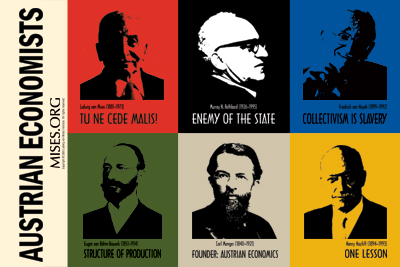
Cool, very cool. With these guys staring down at me I am sure to increase my productivity. That’s Mises, Rothbard, Hayek, Böhm-Bawerk, Menger, and Hazlitt, in case you can’t make out the captions (or, embarrassingly, don’t recognize the mug shots.) Sadly it doesn’t include Nicolai Foss, but you can’t have everything. Thank you, Santa! You can get yours here.
More New Blogs of Interest
| Peter Klein |
- Experiential Knowledge, by Alexandre Padilla
- Economic Policy Review, by a group of Harvard MBA students
- A Financial Economist’s Ramblings, by Wayne Marr
Christmas Links
 | Peter Klein |
Rotman’s Roger Martin explains the challenges faced by Santa in the Knowledge Economy:
While he may have an indisputable track record of effectiveness, Santa is clearly an industrial-age leader. He is going to need to change his leadership style dramatically to prosper in the knowledge economy. His focus on the physical characteristics of his workers — e.g. Rudolph’s red nose — is “old world.” He just has to learn how to value and reward the brains and accumulated knowledge of his elves and reindeers for his enterprise to prosper in the new economy.
The problem with satire, however, is that some people don’t quite get the joke. Consider, for example, this book on leadership, the contents of which can be summarized thusly:
1. Build a wonderful workshop!
- Make the MISSION the MAIN THING
- Focus on your PEOPLE as well as your purpose
- Let VALUES be your guide
2. Choose your reindeer wisely!
- Hire TOUGH so you can manage EASY
- PROMOTE the right ones….for the right reasons
- Go for the DIVERSITY advantage
3. Make a list and check it twice!
- PLAN your work
- WORK your plan
- Make the MOST of what you have
4. Listen to the Elves!
- OPEN your ears to participation
- PAY ATTENTION to how you’re perceived
- Walk awhile in THEIR shoes (more…)
Pomo Alert: New Management Journal Special Issues
| Peter Klein |
We haven’t raised the pomo periscope for a while, but two recent management journal special issues call for its return. The June 2008 issue of the Scandinavian Journal of Management contains a symposium on “Recreating/Recontextualising Entrepreneurship,” which includes such articles as “Accidental Ventures — A Materialist Reading of Opportunity and Entrepreneurial Potential” and “Transduction and Entrepreneurship: A Biophilosophical Image of the Entrepreneur.” Then there’s the new issue of ephemera, with the theme “University, Failed” and articles like “Institutionalizing Critique: A Problem of Critical Management Studies,” “Epistemic Convenience,” “I Wanted to Be an Academic, Not a ‘Creative’: Notes on Universities and the New Capitalism, and “We Are All Workers: A Class Analysis of University Labour Strikes.” Hoo-boy.
Guilds and Innovation
| Peter Klein |
Most economic and management historians see the guild system as partly responsible for the stagnation of the medieval European economy. A new book, Guilds, Innovation and the European Economy, 1400-1800 (S. R. Epstein and Maarten Prak, eds., Cambridge, 2008) offers a revisionist view, challenging the stereotype of guilds as “moribund rent-seekers whose habitual reaction to technical innovation was resistance and rejection.” The reality is more complex, says reviewer Christine MacLeod:
What emerges from this exceptionally coherent volume is not only the complexity of this institution, whose history spans more than half a millennium and a myriad of particular trades and local circumstances, but also the persistent tensions to which it was subjected, both internally from individualistic and capitalist challenges to its collective ethos and externally from the exigencies of nation states. Moreover, it adds another spur to the demanding search for innovation in the workshop and on the construction site, rather than in the too easily accessed and counted records of the patent office.
The Failure of the Journalists, Part II
| Peter Klein |
Another aspect of journalists’ remarkably credulous and fatuous attitude towards policymakers is their view that rhetoric, not substance, is what matters. Hence the constant references to the Bush Administration’s “dedication to free-market principles,” its “aversion to regulation,” its “belief in letting markets work by themselves.” This is of course sheer balderdash and piffle, virtually the reverse of the truth. Bush and Paulson and Greenspan and their clique are “free marketeers” in the same way (to borrow from A. J. Jacobs) that Olive Garden is an Italian restaurant. They adopt the language, and some of the form, of market advocacy without any of the content. The Bush Administration was already, before the “financial crisis,” the most economically interventionist since LBJ; it now ranks with Hoover and FDR as the most aggressively anti-market in US history. Greenspan and Bernanke expanded the money supply like none before; Bush and Cheney borrowed and spent trillions to finance overseas adventures; the Federal Register added pages at a record-setting pace; now the banking and automobile industries have become GSEs. Lassiez-faire, indeed! (BTW can anyone name a specific act of “deregulation” that contributed to the financial crisis? Gramm-Leach-Bliley? No way. And GLB was under Clinton, as was the infamous WGFM. What specific regulations, e.g. on hedge funds or mortgage-backed securities or executive compensation, did the Bush Administration oppose?)
And yet, there was Juan Williams on yesterday’s Diane Rehm show explaining, matter-of-factly, how Bush and Paulson had allowed their “free-market ideology” and “resistance to regulation” to “commitment to the idea that the market works itself” to lead the nation into ruin. Williams may be a good news reporter, but he has the political-economy understanding of a fifth-grader. Does it ever occur to these “watchdogs” to investigate what government officials actually do, rather than simply repeat what they say?
Indigenous Entrepreneurship in Rural China
| Peter Klein |
A very interesting article in the McKinsey Quarterly by MIT’s Yasheng Huang: “Private Ownership: The Real Source of China’s Economic Miracle.” The key to China’s recent economic is not state-led capitalism (call it “Bush-Bernanke-Paulson capitalism”) but private property and financial-market liberalization, leading to a burst of indigenous rural entrepreneurship. Writes Huang:
Big cities like Beijing, Shanghai, and Shenzhen are routinely extolled in the Western press as vibrant growth centers. China’s rural areas, if mentioned at all, typically figure as impoverished backwaters. But a close analysis of the economic data reveals that these breathless descriptions of China’s modern city skylines have it exactly backward: in fact, the economy was most dynamic in rural China, while heavy-handed government intervention has stifled entrepreneurialism and ownership in the urban centers.
Particularly interesting is Huang’s account of why so many Western economists fail to understand this. (more…)
Good to Great: Neither Good nor Great
| Peter Klein |
I’m not a fan of “guru” books like In Search of Excellence, Built to Last, and Good to Great, for reasons well documented by Phil Rosenzweig in his excellent Halo Effect. These books suffer from ad hoc generalization, sampling on the dependent variable, and a host of related methodological and expository flaws. If Rosenszweig’s critique is startling, then two articles from the November 2008 Academy of Management Perspectives on Jim Collins’s Good to Great — perhaps the leading guru book of our time — are devastating. Here is Bruce Resnick and Timothy Smunt:
With sales of more than 4.5 million copies, Good to Great by Jim Collins provides an inspiring message about how a few major companies became great. His simple but powerful framework for creating a strategy any organization can use to go from goodness to greatness is certainly compelling. However, was Collins truly able to identify 11 great companies? Or was the list of great companies he generated merely the result of applying an arbitrary screening filter to the list of Fortune 500 companies? To test the durability of his greatness filter, we conducted a financial analysis on each of the 11 companies over subsequent periods. We found that only one of the 11 companies continues to exhibit superior stock market performance according to Collins’ measure, and that none do so when measured according to a metric based on modern portfolio theory. We conclude that Collins did not find 11 great companies as defined by the set of parameters he claimed are associated with greatness, or, at least, that greatness is not sustainable. (more…)
EJPE Now Available
| Peter Klein |
The Erasmus Journal for Philosophy and Economics has put out its first issue, which you can read online here. Highlights include several articles and reviews about methodology, an interview with Uskali Mäki, and a review of Donald MacKenzie’s An Engine, Not a Camera, much beloved in certain circles. (Via Dan D’Amico.)
Mainstream Journalism, RIP
| Peter Klein |
Last week’s WSJ carried an op-ed from SEC Chair Christopher Cox, “We Need a Bailout Exit Strategy.” The op-ed was nothing special (mostly defending the SEC, of course, though there was a nice Hayekian line about “decentralized decision-making, in which millions of independent economic actors make judgments using their own money, [resulting] in the wisest allocation of scarce resources across our complex society”). What caught my eye was the headline, which suggests a connection between the bailout and the Iraq war, a connection I’ve been meaning to write about.
Remember how journalists felt deceived by the Bush Administration about the war? President Bush said that Saddam Hussein was a “grave and growing threat,” and the media repeated this line. Colin Powell showed pictures of the mobile weapons trailers and the New York Times reprinted them with enthusiasm. When the Administration’s claims proved false, the mea culpas began. Judith Miller resigned in disgrace. Never again, the media cried, will we be used as house propaganda organs. And yet, once the financial crisis began, the exact pattern was repeated. Bernanke and Paulson say there’s a “credit freeze,” that the financial sector is on the verge of collapse, that they alone know what to do — so that’s what the newspapers print. No time to investigate, to interview anyone outside the government, to hold these claims up to any critical scrutiny. If high officials say credit markets are frozen, that only “bold action” from the Treasury, the Fed, and Congress can prevent total meltdown, then that’s the way it is. Virtually every news report on the crisis followed the official script. It’s as if the financial reporters from the Times, the WSJ, the Washington Post, CNN, etc. were embedded with the Treasury. News reports have been little more than government press conferences. Shame, journalists, shame!
Why Oh Why, as Brad DeLong would say, can’t we have a press corps that investigates, rather than simply repeating what the government asserts?
Bygrave on the State of Entrepreneurship Research
| Peter Klein |
William Bygrave surveys the field and concludes that it’s “dominated by quantitative research driven almost exclusively by statistical analysis with SPSS and that qualitative research is seldom published in the leading entrepreneurship journals. He regrets that it is almost impossible to get purely empirical paper published in the leading journal. He pleads with journal editors and their review boards to become less narrow minded and much more pluralistic.”
Bygrave’s assessment is valuable but I think limited by its focus on the “traditional” entrepreneurship journals (e.g., JBV, ETP, SBE). Newer journals such as the SEJ and, more important, the entrepreneurship research that increasingly appears in the top mainstream strategy, organization, and economics journals tends to have a different, and more varied, character.





 Organizations and Markets
Recent Comments