Posts filed under ‘– Klein –’
The Onion or Reality: Today’s Quiz
| Peter Klein |
Which is more ridiculous? Hard to tell.
Praising the vehicle’s 25 years of experience, its proven dependability, and its 2.2-liter internal combustion engine, Chrysler announced Monday that it has appointed a 1983 four-door LeBaron sedan as the company’s new CEO. “We believe that the LeBaron’s expertise in dealing with customers, combined with its 100.3-inch wheelbase, makes it the right automobile for the job,” Chrysler CFO Ron Kolka said. The Chrysler Town and Country, passed over for the position for the second time in four years, will return to its post as the company’s regional finance manager. When asked how Chrysler plans to shift toward more energy-efficient models in order to compete in a changing marketplace, the LeBaron honked its horn for 35 seconds.
The Big Three Detroit automakers have begun lobbying Congress for up to $50 billion in loans that would help them adjust to a market that demands more fuel-efficient vehicles. But the automakers insist the loans would not amount to a government bailout of the struggling auto industry.
How Well Does the Market Handle Network Effects?
| Peter Klein |
Quite well, according to Dan Spulber’s paper “Consumer Coordination in the Small and in the Large: Implications for Antitrust in Markets with Network Effects,” out recently in the Journal of Competition Law and Economics (June 2008). Dan distinguishes between network effects in small- and large-numbers bargaining situations; Coasean bargaining can solve the problem in the former while Hayekian “spontaneous order” can emerge in the latter. The paper also contains a useful, up-to-date summary of the network effects literature. Highly recommended!
Westgren to Missouri
| Peter Klein |
I’m delighted to announce that Randy Westgren, organizational scholar, academic entrepreneur, bon vivant, and all-around great guy — and, most important, former O&M guest blogger — has been named McQuinn Professor of Entrepreneurial Leadership at the University of Missouri. I’ve greatly enjoyed interacting with Randy over the years from his perch in Urbana-Champaign and am looking forward to having him just down the hallway.
As McQuinn Professor Randy will also direct the McQuinn Center, which was launched in 2004 under the leadership of Bruce Bullock. The Center is creating an innovative and unusual program to research and teach the “functional” aspects of entrepreneurship, with particular emphasis on firm organization and strategy and applications to food, agriculture, biotechnology, natural resources, and rural development.
Please join me in congratulating Randy on his new post!
Messin’ With Entrepreneurship Data
| Peter Klein |
OK, it’s not as much fun as Messin’ with Sasquatch. But what happens if you mess with the two leading sources of global entrepreneurship data, the Global Entrepreneurship Monitor, which tracks startups, and the World Bank Entrepreneurship Survey dataset, which measures formal business registrations? One could explain the differences in terms of coverage, the sensitivity of the measurement instrument, and various forms of error. Or, like Zoltan Acs, Sameeksha Desai, and Leora Klapper, use the differences to measure the stages of entrepreneurial development. For commensurate data, that is, the ratio of registrations to startups provides information on the rate at which entrepreneurial ideas are transformed into feasible ventures. The abstract, from SSRN:
This paper compares two datasets designed to measure entrepreneurship. The Global Entrepreneurship Monitor dataset captures early-stage entrepreneurial activity; the World Bank Group Entrepreneurship Survey dataset captures formal business registration. There are a number of important differences when the data are compared. First, GEM data tend to report significantly greater levels of early-stage entrepreneurship in developing economies than do the World Bank data. The World Bank data tend to be greater than GEM data for developed countries. Second, the magnitude of the difference between the datasets across countries is related to the local institutional and environmental conditions for entrepreneurs, after controlling for levels of economic development. A possible explanation for this is that the World Bank data measure rates of entry in the formal economy, whereas GEM data are reflective of entrepreneurial intent and capture informality of entrepreneurship. This is particularly true for developing countries. Therefore, this discrepancy can be interpreted as the spread between individuals who could potentially operate businesses in the formal sector – and those that actually do so: In other words, GEM data may represent the potential supply of entrepreneurs, whereas the World Bank data may represent the actual rate of entrepreneurship. The findings suggest that entrepreneurs in developed countries have greater ease and incentives to incorporate, both for the benefits of greater access to formal financing and labor contracts, as well as for tax and other purposes not directly related to business activities.
The Downside of (Quasi-)Academic Blogging
| Peter Klein |
It goes like this: Blogger A, a writer or grad student or some other non-specialist commentator, takes on Big Issue X with a few glib sentences dismissing decades, or even centuries, of research by specialists on some important topic. A recent example involved a blogger, who apparently is some kind of grad student, opining on the minimum wage. The blogger quotes Kevin Murphy’s statement that economic theory predicts that a wage floor above the market-clearing wage will, ceteris paribus, reduce the demand for labor. But no, says our blogger — labor and commodities are different economic goods, so that the law of demand does not apply to the former! Well, gosh, economists have been thinking about the demand for factors of production for, I don’t know, about two hundred years, and have had a pretty sophisticated understanding of marginal productivity since the late nineteenth century. My guess is that our blogger has read a textbook or two, and maybe even a few recent journal articles on the minimum-wage controversy, but thinks this discovery that factor markets are different from commodity markets is a brilliant new insight. (Note to blogger: factor-market demand curves are also downward sloping.) If I were this blogger’s academic adviser, I would suggest that she consult a labor economist, or perhaps skim Lazear’s Personnel Economics, before writing this sort of drivel.
As they used to say about the internet: The good thing about blogging is that anyone can share his opinion with the world. The bad thing about blogging is that anyone can share his opinion with the world.
Reading List for My Entrepreneurship Course
| Peter Klein |
This semester I’m teaching a new PhD seminar, “Economics of Entrepreneurship: Theory, Applications, Debate.” Here’s an excerpt from the course description. The reading list is below the fold. Comments and suggestions are welcome.
Entrepreneurship is one of the fastest-growing fields within economics, management, organization theory, finance, and even law. Surprisingly, however, while the entrepreneur is fundamentally an economic agent — the “driving force of the market,” in Mises’s (1949, p. 249) phrase — modern theories of economic organization and strategy maintain an ambivalent relationship with entrepreneurship. It is widely recognized that entrepreneurship is somehow important, but there is little consensus about how the entrepreneurial role should be modeled and incorporated into economics and strategy. Indeed, the most important works in the economic literature on entrepreneurship — Schumpeter’s account of innovation, Knight’s theory of profit, and Kirzner’s analysis of entrepreneurial discovery — are viewed as interesting, but idiosyncratic insights that do not easily generalize to other contexts and problems. . . .
This course presents a wide-ranging overview of the place of entrepreneurship in economic theory, with a special focus on applications to institutions, organizations, strategy, economic development, and related fields. It is intended for PhD students trained in economics, sociology, business administration, or a similar field (subject to instructor permission). Students are expected to be in at least their second year of their PhD program and to be working on a dissertation, or looking for a suitable dissertation topic. This is a research-oriented class in which students take an active role identifying suitable articles and topics for analysis, leading course discussions, and evaluating themselves and their peers. (more…)
A Clever Classroom Exercise
| Peter Klein |
J. W. Verret, guest blogging at the Conglomerate:
I thought that I would talk about an exercise I conducted on my first day teaching Securities Regulation.
We ran an auction for a “gift certificate for dinner for two, plus drinks, at a local restaurant,” the proceeds of which would be donated to the American Cancer Society. I informed them, by way of a disclosure statement via email, that I informally asked some friends on the faculty what they would bid based on the same limited information that the students received. I told the students that the result of that informal survey was an average bid of $93.50, and I mentioned that if the students obtained the item for lower than its value they might even sell it for a profit. My disclosure email was riddled with the sort of dry and equivocal statements one might find in a registration statement, and my first day sales pitch was a little more puffed up.
The result: The winning bid was $85 for a $10 gift certificate to McDonald’s. I think it got their attention, which was a good intro to my overview of what we’ll cover in the class.
Who else wants to share an effective classroom experiment or exercise? (Russ Coff has also suggested some here.)
Order Yours Today!
| Peter Klein |
It’s great having graduate students with a sense of humor (and a knowledge of German):
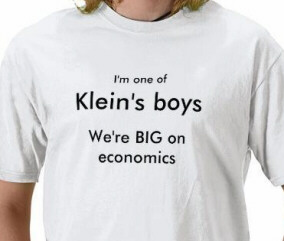
Now, if only they would spend as much time on their dissertations as they spend on their jokes. . . .
Hoselitz’s “Early History of Entrepreneurial Theory”
| Peter Klein |
Thanks to my dedicated assistants Per Bylund and Mario Mondelli we now have an electronic copy of Bert Hoselitz’s hard-to-find 1951 essay, “The Early History of Entrepreneurial Theory” (Explorations in Entrepreneurial History, volme 3, pp. 193-220) and are happy to share it. This is one of the best surveys of the concept of entrepreneurship in pre-classical economics (but also including J. B. Say). (Hébert and Link (1988) think Hoselitz draws too sharp a line between Cantillon and Say.)
Influence of E. A. G. Robinson on Coase
| Peter Klein |
The March 2008 issue of the Journal of the History of Economic Thought features “On Robinson, Coase, and ‘The Nature of the Firm'” by Lowell Jacobsen. Robinson is E. A. G. Robinson, the Cambridge economist and longtime editor of the Economic Journal, now known mainly as the husband of Joan Robinson. Coase was trained by Arnold Plant and has written much about Plant’s influence. Jacobsen argues that Coase was also influenced significantly by Robinson, an influence that has not been widely appreciated. Here’s a bit from the conclusion:
Robinson’s influence on Coase’s writing of ‘‘The Nature of the Firm’’ through his The Structure of Competitive Industry is both obvious and significant. This is understandable, as Robinson and Coase both embraced and looked to extend the Marshallian tradition with these noted works.19 They sought to directly engage the real world of business as they were keenly interested in how firms actually behave, and why. They pursued answers to very fundamental questions: Why do firms exist? and, To what size? In addition, the study of firms and their industries requires a variety of considerations if effective decision-making by the firms’ managers is to be properly understood. In Cairncross’ fine biography of Robinson, he noted the brilliance of Robinson was his ability ‘‘to look at problems from different angles, against an historical background, taking in technology, organisational considerations, political feasibility’’ (Cairncross 1993, p. 164). Much the same could be said about Coase. . . .
[Robinson and Coase] were both interested in applying simple, yet compelling, economic concepts and theory such as scale economies, substitution at the margin and, of course, transaction costs. Further, it was important for them that economic analysis be grounded on realistic assumptions; theory that depended on fabricated assumptions to ensure tractability and even elegance should be largely avoided. Moreover, mathematics should not be the sine qua non of economic theory. Unfortunately, formalism and a priori theorizing emerged in the 1930s (given such influences as Robbins, Pigou, and even Joan Robinson) to dominate, if not define, mainstream economics, including the treatment of the firm. As a result, Coase and Robinson arguably became ‘‘outsiders’’ as Medema (1994), in his equally fine biography, concludes about Coase.
The paper is free, for now at least, on the Cambridge Journals site, so grab it while you can.
Barry Smith Online
| Peter Klein |
I just learned that Barry Smith’s influential book, Austrian Philosophy: The Legacy of Franz Brentano (Open Court, 1994), is available online in its entirety. This is not a book on the Vienna School or logical positivism or Wittgenstein, but on the general philosophical climate in Austria during the late nineteenth and early twentieth centuries, with special emphasis on the influence of this climate on Carl Menger’s economics. Menger, Smith has argued, was steeped in the Catholic, Aristotelian tradition of classical Austrian philosophy and this helps explain how his “causal-realist” approach differs from its Walrasian and Jevonsian counterparts.
Understanding Professors: Graphical Expositions
| Peter Klein |
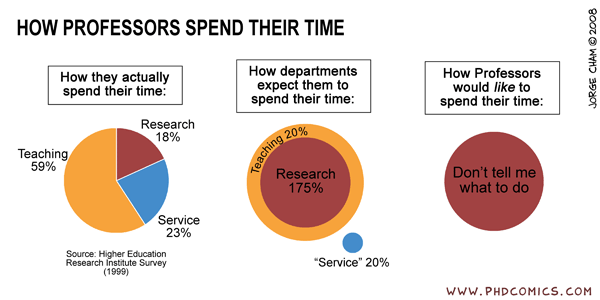
Here are some diagrams to help you understand how professors think. First, how they spend their time, from PhD Comics (via Art Carden). Click to enlarge.
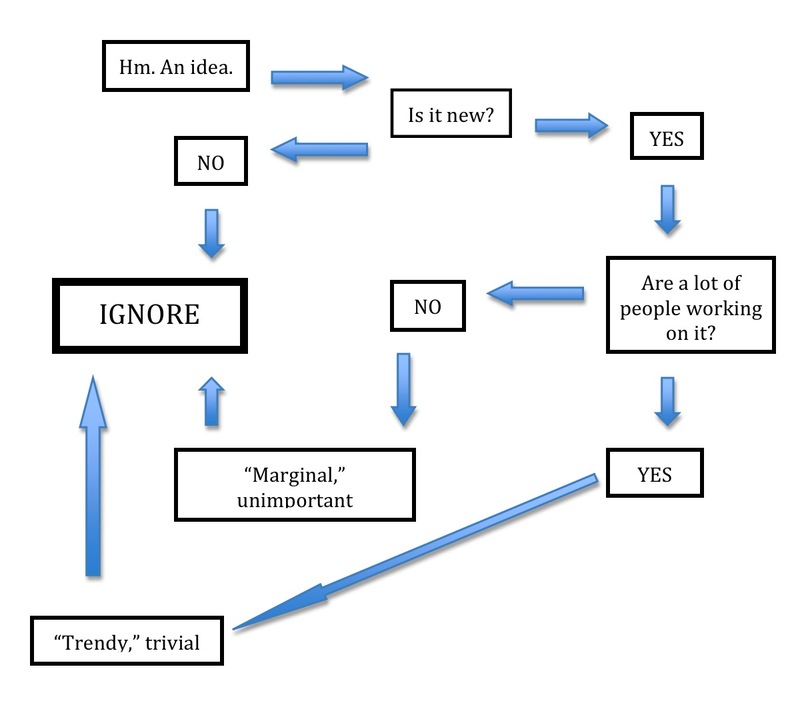
Second, how they choose research topics, from Marc Liberman (via Newmark):
Tullock on the Corporation
| Peter Klein |
Gordon Tullock is retiring this year from George Mason Law School. In the coming weeks you’ll probably be reading a lot of Tullock tributes and Tullock anecdotes (for example, about his famous put-downs). I don’t have much to add on the personal side, but I thought I’d share a remark or two about one of my favorite, and little-known, Tullock articles, “The New Theory of Corporations,” in Erich Streissler, ed., Roads to Freedom: Essays in Honor of Friedrich A. von Hayek (Routledge and Kegan Paul, 1969).
Tullock offers a number of insights into the corporate form and, in particular, the Berle-Means problem, that are well ahead of their time. As Tullock notes in the essay, he draws heavily here on Henry Manne’s work (and, he tells us, many conversations with Manne about these issues). In 1969 the consensus view was that corporations were almost exclusively controlled by salaried managers, running firms in their own interests and largely ignoring the wishes of shareholders. However, Tullock notes:
The theory of management control of corporations, of course, is subject to one very obvious difficulty. It offers no explanation of how managements are changed, and changes of management are an everyday occurrence as any reader of the Wall Street Journal can appreciate. It is true that presidents of large corporations frequently stay in office rather longer than the president of the United States, but they don’t stay in office as long as congressmen and senators, and we would hardly argue that the long tenure of congressmen and senators indicates that we do not have democracy in the United States. Thus, the current orthodoxy that the management actually runs the corporation cannot explain how the management got there or how the everyday occurrence of a change in management occurs. For some reason, this does not seem to disturb the partisans of the . . . Berle and Means theory. (more…)
Save Grandma, Don’t Give Makeup Exams
| Peter Klein |
I quit giving makeup exams years ago because they were Granger-causing the deaths of too many grandmothers. I believe the relationship between makeup exams and grandma mortality is well known among college professors, but I only recently discovered Lee Jussim’s analysis (via Teppo). (He suggests giving only really difficult makeup exams, which has a similar effect.)
Hayek, Read, Mises in the Classroom
| Peter Klein |
Today the University of Missouri welcomes its largest freshman class in history, with 5,680 student expected at their desks for the first day of the semester. (Could the increased enrollment be the result of Mizzou football’s surprising 10-2 record, and Big Twelve North Championship, last season? Not as crazy as you might think.) I am teaching an undergraduate class, “Economics of Managerial Decision Making,” that focuses on organizational and managerial issues. Finding good readings is often a challenge, though the textbook options are much better than a generation ago (Brickley, Besanko, Froeb, Hendrikse, and more.) Here are a couple of classroom resources I discovered today:
- A short paper by Russ Roberts summarizing the (somewhat difficult) argument in Hayek’s “Use of Knowledge in Society” (1945)
- Roger Meiners’s PowerPoint version of Leonard Read’s classic “I, Pencil”
Mises is not usually considered “classroom friendly” but I have found that “Profit and Loss” (1958) works well with undergraduates. And of course Mises emphasizes the entrepreneur as the driving force behind price adjustment, an aspect missing from Hayek’s treatment (in which agents are modeled as responders, not initiators). Section I of Bureaucracy, on “Profit Management,” is also quite good, and only 20 pages.
Best Three Sentences I Read Today
| Peter Klein |
Chris Dillow, wondering why doctors have such a good reputation, and economists such a poor one:
A man who’s been cured by a doctor lives to tell everyone. A man who’s been killed by one stays quiet. Economists’ “victims” — those stupid enough to believe forecasts — don’t keep schtum.
The rest of his reasons are interesting too. I think he focuses too much on economic forecasting, which is not in my view the same as economic analysis. The economy is not, after all, a “patient” to be taken care of and “cured” by the economist.
Don’t Ask Me What This Means
| Peter Klein |
In 1999, a group of researchers including [endocrinologist Erma] Drobnis were working on a study comparing semen quality across major metropolitan areas, suspecting that sperm counts were dropping worldwide. They selected New York, Minneapolis and Los Angeles for their study. But reviewers of the grant application recommended adding add another, more rural town. They selected Columbia [Missouri].
Researchers believed that including Columbia would serve as a baseline by which to judge the other cities. More rural settings, so the theory goes, tend to have fewer toxic pollutants such as smog in the air that impact reproductive health.
So researchers were caught off-guard when the Columbia sperm samples turned out to be significantly lower than samples from three other cities.
Here’s the story from the local paper. I’m eagerly awaiting the witty comments.
Reflections on Cyert and March
| Peter Klein |
The April 2008 issue of JEBO features a symposium on Cyert and March’s 1963 classic, A Behavioral Theory of the Firm (an O&M favorite). The book has been highly influential in organization theory, somewhat influential in behavioral economics, but mostly ignored in the contemporary economics literature on the firm (see here). As Mie Augier and March note in their introduction to the special issue:
As long as the primary focus of the theory of the firm was on the aggregate outcomes of interaction among rational actors, the book’s role in economics was limited. As Cyert and March noted, “Ultimately, a new theory of firm decision making behavior might be used as a basis for a theory of markets, but at least in the short run we should distinguish between a theory of microbehavior, on the one hand, and the micro-assumptions appropriate to a theory of aggregate economic behavior on the other. In the present volume we will argue that we have developed the rudiments of a reasonable theory of firm decision making” (1963, 16).
As interest in economics moved slowly toward greater concern with behavioral micro-assumptions, ideas consistent with Cyert and March (1963) became more prominent ([Kay, 1979], [Day and Sunder, 1996] and [Day, 2002]), although with hesitations and qualifications ([Baumol and Stewart, 1971] and [Williamson and Winter, 1991]). Elements of a behavioral view of the firm can now be found in many modern developments in economics, but especially in transaction cost economics ([Williamson, 1996] and [Williamson, 2002]), evolutionary theory ([Nelson and Winter, 1982], [Nelson and Winter, 2002], [Winter, 1986] and [Dosi, 2004]), and organizational economics (Gibbons, 2003). Behavioral ideas have been elaborated not only in theories of the firm but also in collateral areas of economics, such as strategic management (Rumelt et al., 1991), organization theory (Argote and Greve, 2007), and the psychological foundations of economic choice ([Tversky and Kahneman, 1974], [Kahneman and Tversky, 1979] and [Camerer et al., 2004]). Ideas of bounded rationality, conflict, learning, and routines are now commonplace, as is the general idea that economic behavior is guided by principles of human behavior. Although those ideas have many ancestors, A Behavioral Theory of the Firm probably contributed some modest amount of DNA.
Of particular interest to the O&M crowd are “Outlines of a Behavioral Theory of the Entrepreneurial Firm” by Dew, Read, Sarasvathy, and Wiltbank; “Realism and Comprehension in Economics: A Footnote to an Exchange Between Oliver E. Williamson and Herbert A. Simon” by Augier and March; and “Unpacking Strategic Alliances: The Structure and Purpose of Alliance versus Supplier Relationships” by Mayer and Teece.
Best Sentence I Read Today
| Peter Klein |
Justin Wolfers, on methodological conformity among mainstream economists:
Feel free to insert joke here about two-handed economists; although recognize that even an octopus couldn’t summarize the consensus within, say, sociology.
He’s mainly criticizing economists, however, adding: “Is it really the case that economics has advanced so little that 30 years later we are still having the same old debates?”
An Orthodox Response to Max Weber
| Peter Klein |
“Orthodox” with a capital O, that is. The current issue of the Acton Institute’s flagship journal, the Journal of Markets and Morality, features the first English translation of Sergey Bulgakov’s 1909 essay “The National Economy and the Religious Personality,” described by translator Krassen Stanchev as “the first Orthodox Christian response to Max Weber’s The Protestant Ethic and the Spirit of Capitalism.” Bulgakov, widely regarded as the greatest 20th-century Orthodox theologian, has been attracting increasing interest in recent decades, in both East and West. Writes Stanchev:
Only in the 1906s did scholars turn their attention to business in the Orthodox medieval world. Professors in theological academies in Communist countries carefully avoided the topic while economic historians, at best, studied the relations between religion and business for closed audiences, but most often they pretended the phenomenon did not exist.
Just a few years after Weber, Bulgakov managed to put together similar theoretical arguments and a set of historical evidence that allowed claiming origins of the capitalist spirit from Orthodox Christianity as well. For those who are familiar with the later Russian “scientific” philosophers’ disregard for facts and documents, it will be a surprise as to how rich Russian historiography in the nineteenth century has been.
The article is currently gated but should be available to non-subscribers later this year. Or you can subscribe now and avoid the wait.





 Organizations and Markets
Recent Comments