Posts filed under ‘– Klein –’
On Academic Writing
| Peter Klein |
The Strategic Management Society’s annual conference wrapped up yesterday. It was an excellent event with many fine papers, panels, workshops, and entertainments. We’ll be posting more about the substance of the conference in the coming days. However, I want to mention today a small gripe, not about the conference, but about the strategic management literature more generally. This is something that struck me in particular during the conference. Specifically, there is too much bad writing. The strategic management field is becoming as bad as some of the humanities — maybe even sociology — in its use of pretentious, clumsy, and awkward words and phrases. You can see this most easily in the paper titles: “An Analysis of the Effects of Intra-Firm Group Identity and Power Imbalance on the Deployment of Collaborative Teams in the North Waziristani Ball-Bearing Industry, 1992-2005.” OK, I made that one up, but it gives you the flavor. I’m reminded of Orwell’s example:
Here is a well-known verse from Ecclesiastes:
I returned and saw under the sun, that the race is not to the swift, nor the battle to the strong, neither yet bread to the wise, nor yet riches to men of understanding, nor yet favour to men of skill; but time and chance happeneth to them all.
Here it is in modern [1946] English:
Objective considerations of contemporary phenomena compel the conclusion that success or failure in competitive activities exhibits no tendency to be commensurate with innate capacity, but that a considerable element of the unpredictable must invariably be taken into account.
This is a parody, but not a very gross one.
I’m pretty sure the latter version appeared in the abstract of a recent SMJ paper!
Happy Mises Day
| Peter Klein |
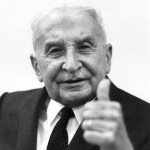 I never miss Hayek’s birthday but sometimes forget to celebrate September 29 as the birthday of Ludwig von Mises (1881-1973), Hayek’s senior colleague and mentor, whose writings are very influential here at O&M. To learn about Mises you should read Guido Hülsmann’s biography but, if you prefer shorter treatments, you can find biographical essays by Mises’s students Murray Rothbard and Israel Kirzner. Organization theorists should pay particular attention to Mises’s 1922 book Socialism as well as his (unfortunately neglected) 1944 book on Bureaucracy.
How Much Has Changed, Really?
| Peter Klein |
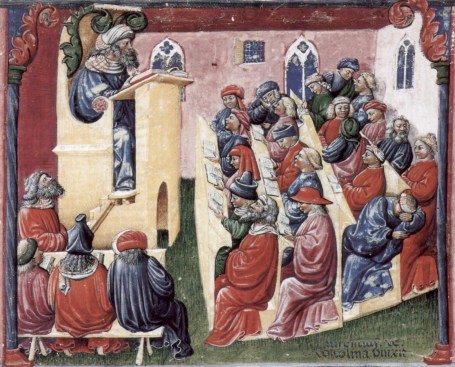
University of Bologna, 14th century
Come to the CSIG Teaching Workshop this Saturday in Atlanta and find out!
NBER Papers of Interest
| Peter Klein |
Three recent NBER papers on compensation, performance, and productivity:
Ann Bartel, Brianna Cardiff-Hicks, Kathryn Shaw
NBER Working Paper No. 19412, September 2013
Due to the limited availability of firm-level compensation data, there is little empirical evidence on the impact of compensation plans on personal productivity. We study an international law firm that moves from high-powered individual incentives towards incentives for “leadership” activities that contribute to the firm’s long run profitability. The effect of this change on the task allocation of the firm’s team leaders is large and robust; team leaders increase their non-billable hours and shift billable hours to team members. Although the motivation for the change in the compensation plan was the multitasking problem, this change also impacted the way tasks were allocated within each team, resulting in greater teamwork.
William Mullins, Antoinette Schoar
NBER Working Paper No. 19395, September 2013
Using a survey of 800 CEOs in 22 emerging economies we show that CEOs’ management styles and philosophy vary with the control rights and involvement of the owning family and founder: CEOs of firms with greater family involvement have more hierarchical management, and feel more accountable to stakeholders such as employees and banks than they do to shareholders. They also see their role as maintaining the status quo rather than bringing about change. In contrast, professional CEOs of non-family firms display a more textbook approach of shareholder-value-maximization. Finally, we find a continuum of leadership arrangements in how intensively family members are involved in management.
George J. Borjas, Kirk B. Doran
NBER Working Paper No. 19445, September 2013
Knowledge generation is key to economic growth, and scientific prizes are designed to encourage it. But how does winning a prestigious prize affect future output? We compare the productivity of Fields medalists (winners of the top mathematics prize) to that of similarly brilliant contenders. The two groups have similar publication rates until the award year, after which the winners’ productivity declines. The medalists begin to “play the field,” studying unfamiliar topics at the expense of writing papers. It appears that tournaments can have large post-prize effects on the effort allocation of knowledge producers.
Thank goodness I haven’t won the Clark Medal, Nobel Prize, or a MacArthur Award. I want to keep my productivity high!
Do Markets “React” to Economic News?
| Peter Klein |
 One doesn’t have to be a strict methodological individualist to appreciate that collectives don’t think, act, and choose. Yet one of the standard tropes of financial journalism is the idea that the stock market, like your broker or your Aunt Sally, “reacts” to this or that bit of economic news. “Stocks Soar on Summers Withdrawal,” screams this morning’s Reuters headline. This reporter has some serious powers of discernment: trading Friday “was subdued ahead of the Federal Reserve’s expected reduction of stimulus measures next week.” “In reaction to the withdrawal of Mr. Summers, the dollar slipped to a near four-week low against a basket of currencies.” And: “Further whetting risk appetite were signs of progress in Syria following a Russian-brokered deal aimed at averting United States military action.”
Of course, this is all pure invention on the part of the reporter. Nobody knows for certain why a stock-price average goes up or down. Think about it. The prices of individual stocks reflect expectations of future dividends and future price movements, and they go up and down as new information is revealed about the firm and its competitors. We can never know for certain what makes people buy and sell particular shares but, in the case of an individual firm, we can reasonably infer that shareholders as a group are reacting to new information about the firm. The firm announces quarterly earnings below analysts’ expectations, the share price tends to fall. A competitor announces bankruptcy, the share price tends to rise. Event studies are a popular technique for quantifying investor reactions to news and events related to particular firms.
But the stock market as a whole doesn’t work this way. Stock prices go up and down, and indexes like the S&P 500 and DJIA go up and down according to the performance of their member stocks. Sometimes the average rises, sometimes it falls. Duh. The idea that movements in the index necessarily embody the reaction of the market as a whole to some piece of aggregate economic news reflects a failure to grasp the concept of an average. Of course, it’s always possible that investors’ beliefs about the prospects for particular stocks reflect shared concerns about the economy as a whole. If the government announces an increase in the corporate income tax rate, the prices of many stocks will likely fall. But this applies only to the most obvious cases. Did lots of investors care about Larry Summers’s withdrawal from the Fed race, enough to make them start buying stocks? Who knows? Clearly financial journalists — who are paid to write about such things — care a lot about the next Fed chair. But we have absolutely no idea how much investors care, and no way at all to attribute this morning’s rise in US equity prices to the Summers announcement or any other piece of economic news.
So please, can we stop taking such pronouncements seriously? The stock market is a social institution, an aggregate of individual trades and traders. Let’s stop anthropomorphizing it.
SMS Teaching Workshop on Technology and the Future of Higher Education
| Peter Klein |
 Tunji Adebesan and I are organizing the second annual teaching workshop for the Strategic Management Society’s Competitive Strategy Interest Group. The workshop is Saturday, September 28, 2:00-5:00pm, part of the upcoming SMS Conference in Atlanta. It’s open to emerging and established scholars in strategic management, organization, and entrepreneurship, or a related field.
This year’s theme is technological innovation and its impact on teaching strategy. The higher-education industry is abuzz with talk about MOOCs, distance learning, computer-based instruction, and other pedagogical innovations. Many of you are already using online exercises and assessments, simulations, and other activities in the classroom. How are these innovations best incorporated into the strategy curriculum? What can strategy scholars say about the impact of these technologies on higher education more generally? Are they sustaining or disruptive innovations, and what do they imply for the structure of the business school, and the university itself?
The interactive, participatory workshop begins with a panel session featuring experts on distance learning, online assessments, simulations, electronic textbooks, social media, and more. Panelists include Michael Leiblein (Ohio State), Jackson Nickerson (Washington University, St. Louis), Frank Rothaermel (Georgia Tech), and Bob Wiseman (Michigan State), along with Tunji and myself. Sample questions: Are MOOCs the future of higher education? Do they work? Can What are best practices for distance learning, and for incorporating online activities into the traditional classroom? Do improved distance-learning and collaboration tools facilitate new models for executive education and corporate training programs? How should strategy teachers make best use of social media, TED talks and other media, iPads, and other tools and apps, especially for younger students? Following the panel session, participants will break into small groups for in-depth discussion and practice using new tools. After regrouping, participants will discuss about what these innovations mean for the higher-education industry, and business schools in particular.
Pre-registration is encouraged but not required. If you’re planning to attend, please let us know by sending an email to csig.teaching2013@gmail.com so we can plan accordingly. Feel free to email me with questions or comments.
A Haiku for Coase
| Peter Klein |
From Jill Bradbury:
The herd strays; crops die.
Who pays? Gain and harm are weighed.
Not Pigou’s frayed nerves.
Feel free to try your hand in the comments.
Ronald Coase (1910-2013)
| Peter Klein |
Ronald Coase passed away today at the age of 102. One of the most influential economists of the 20th century, perhaps of all time. His “Problem of Social Cost” (1960) has 21,692 Google Scholar cites, and “The Nature of the Firm” has 24,501. Adam Smith’s Wealth of Nations, summed across editions, has about 30,000. Coase changed the way economists think about the business firm and the way they think about property rights and liability. He largely introduced the concepts of transaction costs, comparative institutional analysis, and government failure. Not all economist have agreed with his arguments and conceptual frameworks, but they radically changed the terms of debate in the economics of law, welfare, industry, and more. He is the key figure in the “new institutional economics” (and co-founder, and first president, of the International Society for New Institutional Economics).
Coase did all these things despite — or because of? — not holding a PhD in economics, not doing any math or statistics, and not, for much of his career, working in an economics department.
We’ve written so much on Coase already, on these pages and in our published work, that it’s hard to know what else to say in a blog post. Perhaps we should just invite you to browse old O&M posts mentioning Coase (including this one, posted last week).
The blogosphere will be filled in the coming days with analyses, reminiscences, and tributes. You can find your favorites easily enough (try searching Twitter, for example). I’ll just share two of my favorite memories. The first comes from the inaugural meeting of the International Society for New Institutional Economics in 1997. After a discussion about the best empirical strategy for that emerging discipline. Harold Demsetz stood up and said “Please, no more papers about Fisher Body and GM!” Coase, who was then at the podium, surprised the crowd by replying, “I’m sorry, Harold, that is exactly the subject of my next paper!” (That turned out to be his 2005 JEMS paper, described here.) A few years later, I helped entertain Coase during his visit to the University of Missouri for the CORI Distinguished Lecture. At lunch we talked about his disagreement with Ben Klein on asset specificity. After the lunch he got up, shook my hand, and announced, with evident satisfaction: “I see all Kleins are not alike.”
The Journalists and Syria
| Peter Klein |
Looks like we need a new subject category for the demise of the journalism sector. As discussed frequently on this blog, most journalists are little more than press agents for government officials (1, 2, 3). US news outlets typically take the perspective of the Washington insider, repeating solemn pronouncements from their confidential sources as if these were verifiable facts without questioning, challenging, even investigating. It’s a simple bargain: report what the official sources say in exchange for access to those sources, without which you lose status.
Conor Friedersdorf, writing in the Atlantic, provides this week’s illustration. [See also the Addendum below.] While the US public and the US Congress overwhelmingly oppose US military intervention in Syria, the mainstream news outlets write only about the “pressure” on President Obama to act — never bothering to describe this pressure or explore its source:
The citizenry wants us to stay out of this conflict. And there is no legislative majority pushing for intervention. A declaration of war against Syria would almost certainly fail in Congress. Yet the consensus in the press is that President Obama faces tremendous pressure to intervene. . . .
Where is this pressure coming from? Strangely, that question doesn’t even occur to a lot of news organizations. Take this CBS story. The very first sentence says, “The Obama administration faced new pressure Thursday to take action on Syria.” New pressure from whom? The story proceeds as if it doesn’t matter. How can readers judge how much weight the pressure should carry? Pressure from hundreds of thousands of citizens in the streets confers a certain degree of legitimacy. So does pressure from a just-passed House bill urging a certain course of action, or even unanimous pressure from all of the experts on a given subject.
What I’d like is if news accounts on pressure to intervene in Syria made it clear that the “growing calls … for forceful action” aren’t coming from the people, or Congressional majorities, or an expert consensus. The pressure is being applied by a tiny, insular elite that mostly lives in Washington, D.C., and isn’t bothered by the idea of committing America to military action that most Americans oppose.
Some reporters suffer from what Thomas Sowell called the vision of the anointed, and most live in a bubble surrounded by insiders and elites who share their outlook. But I suspect the main reason for this style of writing is the quid pro quo described above.
I can’t resist quoting a little more: (more…)
Pindyck on Climate Science
| Peter Klein |
Further to my previous post on misplaced confidence, here is Robert Pindyck on one of the critical tools used by climate scientists.
Climate Change Policy: What Do the Models Tell Us?
Robert S. Pindyck
NBER Working Paper No. 19244, July 2013Very little. A plethora of integrated assessment models (IAMs) have been constructed and used to estimate the social cost of carbon (SCC) and evaluate alternative abatement policies. These models have crucial flaws that make them close to useless as tools for policy analysis: certain inputs (e.g. the discount rate) are arbitrary, but have huge effects on the SCC estimates the models produce; the models’ descriptions of the impact of climate change are completely ad hoc, with no theoretical or empirical foundation; and the models can tell us nothing about the most important driver of the SCC, the possibility of a catastrophic climate outcome. IAM-based analyses of climate policy create a perception of knowledge and precision, but that perception is illusory and misleading.
Thanks to Bob Murphy for the pointer.
Young Ronald
| Peter Klein |
Here’s a picture of Ronald Coase you may not have seen, from his student days at LSE.

From Hayek: A Commemorative Album (London: Adam Smith Institute, 1998), and courtesy of Bettina Greaves.
ContractsProf Blog Symposium on Stuart Macaulay
| Peter Klein |
Economists and management scholars know Stuart Macaulay’s landmark 1963 article, “Non-Contractual Relations in Business: A Preliminary Study,” as the foundation for modern work in relational contracting. As Williamson (1985, p. 10) put it, “Macaulay’s studies of contractual practices support the view that contractual disputes and ambiguities are more often settled by private ordering than by appeal to the courts — which is in sharp contrast with the neoclassical presumptions of both law and economics.” A new book on Macaulay has promoted a symposium over at the ContractsProf Blog. I’m particularly looking forward to this week’s contributions, especially the one from Gillian Hadfield.
More on Collaboration and Innovation
| Peter Klein |
Following up my earlier post on artistic collaboration, and its relationship to entrepreneurial collaboration, here’s a quote from Paul Cantor on his new book, The Invisible Hand in Popular Culture: Liberty vs. Authority in American Film and TV:
Many people who condemn pop culture and dismiss it as artistically worthless dwell on the fact that films and television shows are almost never the products of a single artist working on his own. It is therefore important to show that many of the great works of high culture grew out of a collaborative process too. There is nothing about cooperation in artistic creation that precludes high quality. Too many cooks may spoil the broth, but they may also each add a distinctive flavor and work together to bring the recipe to perfection. The processes of synergy and feedback work in popular culture just the way they do in other areas of human endeavor. This is all part of my defense of popular culture — to demonstrate that the conditions of production in film and television are not necessarily incompatible with artistic as well as commercial success.
Likewise, entrepreneurship and innovation are collaborative media — which is easy to see once you realize that entrepreneurship is not about recognizing “opportunities,” but acquiring and controlling resources that are used in production.
AoM Miscellany
| Peter Klein |
This week’s Academy of Management conference was fun and interesting, if overwhelming (over 12,000 nerds graced the Disney World resort hotels with their presence). A few post-conference links, thoughts, etc.
- Twitter was a big deal. Check out the #AOM2013 hashtag for the stream. There was even an officially sponsored Tweet Up. I enjoyed playing along (as @petergklein) but am not totally clear how such a tool is best used during a conference.
- I really enjoyed a Saturday morning session on “Opportunities: The State of the Debate” with me, Sharon Alvarez, Jay Barney, Dimo Dimov, Mike Wright, Devereaux Jennings, and Roy Suddaby. I was the odd man out, giving my usual shtick about how the concept of “opportunities” should be eliminated altogether — perhaps a bit cheeky given the session title, but YOLO, right? (My slides are here, though they make less sense without the accompanying patter.) Jay Barney started the session by stating that all the panelists, except me, agree that opportunities should be the unit of analysis in entrepreneurship research but that opportunities should not (necessarily) be regarded as “discovered,” but also created. By the end of the session, it seemed that all but one panelist rejected the discovery concept altogether, and most grudgingly admitted that maybe we could talk about entrepreneurs creating products and services, rather than creating “opportunities.” Anyway, a good time was had by all.
- There were lots of other interesting sessions, too many to mention. Some have already been described below. The session on “Myths and Realities of Capitalism” was particularly, well, controversial.
- Here’s a report on a session (that I missed) on translating research results into practice by engaging the media (via Dave Ketchen).
More AoM PDWs
| Peter Klein |
There are too many good AoM sessions to mention them all — there’s even a Tweet Up for social-media freaks (hey, where’s the Insta-Slam?) — but I’ll mention two more Professional Development Workshops of interest:
Myths and Realities of Capitalism: Micro and Macro Perspectives
Session #609, Sunday, Aug 11 2013 4:30PM – 7:30PM at WDW Dolphin Resort in Asia 3Organizer: Rajshree Agarwal, U. of Maryland
Speaker: John Allison, Cato Institute
Speaker: Yaron Brook, Ayn Rand Institute
Speaker: Paul Green, Morning Star
Speaker: Jay B Barney, Eccles School, U. of Utah
Speaker: Doug Kirkpatrick, Morning Star Institute
Speaker: Peter G Klein, U. of Missouri
Speaker: Edwin A. Locke, U. of Maryland, College Park
Speaker: John Sullivan, Center for International Private Enterprise
Organizer: Hildy Teegen, U. of South Carolina
Speaker: Paul E. Tesluk, U. of BuffaloThe theme of the 2013 Academy of Management Meetings is based on a call into question of the efficacy and merits of capitalism—and the free enterprise system that it entails. However, all of the economic systems in the world today represent varying degrees of free enterprise and government intervention. This PDW addresses the call of examining micro and macro perspectives on some of the myths and realities of capitalism. A critical and informed examination of perhaps the most foundational underpinning of business and management —voluntary trade among producers based on the premise of human rights to life, liberty and pursuit of happiness—is urgently called for. The PDW brings together micro and macro scholars within the Academy, along with leading businessmen and spokespersons from policy institutes. The format of the PDW allows for an articulation of premises that guide both micro individual behavior and macro institutional factors that are required for value creation under a capitalist system, and a discussion of the alleged virtues and vices of capitalism. The workshop is designed in four parts and is structured to provide workshop participants with the opportunity to learn from experts and each other and to co-develop relevant implications for management faculty around the world.
Entrepreneurial Opportunity—The State of the Debate and The Linkages to Management
Session #258, Saturday, Aug 10 2013 10:00AM – 12:00PM at WDW Swan Resort in Mockingbird 1Chair: Robert Joseph Wuebker, U. of Utah
Discussant: Roy R Suddaby, U. of Alberta
Presenter: Jay B Barney, Eccles School, U. of Utah
Participant: David Audretsch, Indiana U., Bloomington
Presenter: Dimo Dimov, U. of Bath
Presenter: Sharon Alvarez, The Ohio State U.
Presenter: Peter G Klein, U. of Missouri
Presenter: Mike Wright, Imperial College London
Presenter: P. Devereaux Jennings, U. of AlbertaFor more than two decades, the field of entrepreneurship has struggled to converge on a definition of a core distinction in the field—entrepreneurial opportunity. The recent publication of a series of reflection papers in the Academy of Management—along with the published reactions, comments on the reactions, and meta-commentary—highlight both the importance of this dialogue to the field and illuminate the competing and mutually exclusive perspectives on (1) the nature of entrepreneurial opportunity and (2) the importance of the debate itself. This workshop offers a structured discussion about the status of entrepreneurial opportunity with the individuals who are at the “sharp end” of the debate, and framed by the journal editors that are directly involved in promoting, framing, and shaping it. We accomplish this through a panel format in which we curate representative positions on the question of entrepreneurial opportunity. Each panelist will reflect on the historical and theoretical roots of their position; note key assumptions and important priors; and elucidate the consequences of each position on the research and teaching program for the field. Following our panel, editors from Academy of Management Journal and Organization Science will offer their perspective and lead a Q&A session between panelists and participants.
Climate Science and the Scientific Method
| Peter Klein |
This article on climate science skeptics is making the rounds, and drawing the expected denouncements in the usual quarters. It actually makes some reasonable, and quite mild, statements, namely that climate science, like astronomy or evolutionary biology, is a different kind of “science” than physics or chemistry or geology or other mundane sciences. In the former fields, the fundamental assumptions and key mechanisms are usually not falsifiable, the data are often fuzzier than usual, and there is frequently a lot of hand-waiving to fill in gaps.
Many climate sceptics worry climate science cannot be dubbed scientific as it is not falsifiable (as in Popper’s demarcation criterion). They claim that while elements of climate science may be testable in the lab, the complexity of interactions and feedback loops, as well as the levels of uncertainty in climate models, are too high to be a useful basis for public policy. The relationship of observations to these models are also a worry for climate sceptics. In particular, the role of climate sensitivity.
As well as their use of models, the quality of observations themselves have been open to criticism; some of which have been attempts to clean up issues deriving from the messiness of data collection in the real world (eg the positioning of weather stations), while others have focused on perceived weaknesses in the proxy methods required to calculate historic temperature data such as cross-sections of polar ice sheets and fossilised tree rings.
Such claims are of variable quality, but what unites them is a conviction that data quality in various branches of climate science are below those required by “real science”.
What strikes me the most about these “big” sciences is the language and tone typically used to communicate the results to the public. Where scientists in mundane fields express their conclusions cautiously, emphasizing that results and conclusions are tentative and always subject to challenge and revision, climate scientists seem to view themselves as Brave Crusaders for Truth, striking down “Deniers” (who must be funded by the oil industry or some other evil group). They shout that we “know” this or that about climate change, what the planet will be like in 5,000 years, etc. You hardly ever hear other scientists talk like this, or act as if skeptics are necessarily prejudiced and irrational.
“Trapped” in Rental Contracts
| Peter Klein |
In today’s feature on the US housing market, an NPR correspondent sadly notes that foreclosure victims are “trapped” in rentals. Why, those poor, unlevered souls, choosing to purchase a flow of housing services over time, rather than buying a huge, illiquid housing asset outright, using borrowed funds. Tragic!
It made me think of similar tragedies:
- Mercedes and BMW drivers trapped in lease contracts, rather than buying their cars with cash or credit
- Individuals trapped in wage and salary contracts, rather than raising the capital, arranging the inputs, and bearing the uncertainties to be sole proprietors
- Companies trapped in outsourcing agreements, rather than owning all upstream and downstream production processes directly, as vertically integrated firms
- Vacationers trapped in resort hotels, rather than owning their own vacation condos or timeshares
- Readers trapped by downloading and reading books on their Kindles, essentially “renting” them from Amazon, rather than buying physical books
- Movie fans trapped in DVD rental agreements with Netflix, rather than owning massive DVD libraries
Don’t these suckers know that goods and services should always be purchased outright, rather than rented or borrowed?
More Orson
| Peter Klein |
A useful management tip from the great director:
Orson Welles: Did I ever tell you the story of [Franz Joseph’s] visit to the provinces? It’s a great movie story. You can use it on set almost any day with an assistant director.
Henry Jaglom: What is it?
OW: Franz Joseph is riding in his carriage through this tiny provincial town, plumes and all. The trembling mayor is sitting next to him. He says, “Your Imperial Highness, I have to apologize to you in the profoundest terms for the fact that the bells are not ringing in the steeple. There are three reasons. First, there are no bells in the steeple — ” And Franz Joesph interrupts him and says, “Please don’t’ tell me the other two reasons.” Now, that’s a good answer for every assistant director, everyone in the world that you’ve had working for you in any capacity.
HJ: Where you just want to get a straight answer. . . .
OW: I tell that story when I make a movie, always. When somebody starts with the excuses, I say, “Bells in the steeple.” It stops them every time.
Student: “I didn’t finish the assignment because, well, um. . . .” Professor: “Bells in the steeple!” I’m putting that one on my syllabus.
Two AoM PDWs of Interest
| Peter Klein |
O&Mers attending the AoM conference may find these Professional Development Workshops, sponsored by the Academy of Management Perspectives and based on recent AMP symposia, of particular interest:
The first PDW is on “Private Equity” and features presentations on the managerial, strategic, and public policy implications of private equity transactions. Presenters include Robert Hoskisson (Rice University), Nick Bacon (City University London), Mike Wright (Imperial College London), and Peter Klein (University of Missouri). The private equity session takes place Saturday, Aug 10, 2013 from 11:30AM – 12:30PM at WDW Dolphin Resort in Oceanic 5.
The second is on “Microfoundations of Management,” and features presentations from Nicolai Foss (Copenhagen Business School), Henrich Greve (INSEAD), Sidney Winter (Wharton), Jay Barney (Utah), Teppo Felin (Oxford), Andrew Van de Ven (Minnesota), and Arik Lifschitz (Minnesota). The microfoundations session takes place Monday, Aug 12, 2013 from 9:00AM
– 10:30AM at WDW Dolphin Resort in Oceanic 5
Preregistration isn’t required but please let Don Siegel or Tim Devinney know if you plan to attend, as space is limited.
Orson Welles on Organizational Structure
| Peter Klein |
Welles was perhaps the greatest auteur of cinema and modern theater, so it’s no surprise that he comes out in favor of flatter hierarchies:
OW: [Irving] Thalberg was the biggest single villain in the history of Hollywood. Before him, an producer made the least contribution, by necessity. The producer didn’t direct, he didn’t act, he didn’t write — so, therefore, all he could do was either (A) mess it up, which he didn’t do very often, or (B) tenderly caress it. Support it. Producers would only go to the set to see that you were on budget, and that you didn’t burn down the scenery. But [Louis B.] Mayer made way for the producer system. He created the fellow who decides, who makes the directors’ decisions, which had never existed before.
HJ: Didn’t the other studio heads interfere with their directors?
OW: None of the old hustlers did that much harm. If they saw somebody good, they hired him. They tried to screw it up afterwards, but there was still a kind of dialogue between talent and the fellow up there in the front office. They had that old Russian-Jewish respect for the artist. All they did was say what they liked, and what they didn’t like, and argue with you. That’s easy to deal with. And sometimes the talent won. But once you got the educated producers, he has a desk, he’s gotta have a function, he’s gotta do something. He’s not running the studio and counting the money — he’s gotta be creative. That was Thalberg. The director became the fellow whose only job was to day, “Action” and “Cut.” Suddenly, you were “just a director” on a “Thalberg production.” Don’t you see? A role had been created in the world. Just as there used to be no conductor of symphonies.
HJ: There was no conductor?
OW: No. The konzertmeister, first violinist, gave the beat. The conductor’s job was invented. Like the theater director, a role that is only 150, 200 years old. Nobody directed plays before then. The stage manager said, “Walk left on that line.” The German, what’s his name, Saxe-Meiningen, invented directing in the theater. And Thalberg invented producing in movies. He persuaded all the writers that they couldn’t write without him, because he as he great man.
Clearly Orson would not agree with my take on entrepreneurship and ultimate responsibility, as applied to the arts. Or do well in a restaurant kitchen. I have to admit, though, that Welles has a certain credibility on the subject of creativity.





 Organizations and Markets
Recent Comments