Posts filed under ‘– Klein –’
Fun With Words
| Peter Klein |
You know the game where you take a common word, add or change one letter, and create a new definition? Our good friend Randy W. sends these examples, including some economics and management terms:
1. Cashtration: The act of buying a house, which renders the subject financially impotent for an indefinite period of time.
2. Ignoranus: A person who’s both stupid and an asshole.
3. Intaxication: Euphoria at getting a tax refund, which lasts until you realize it was your money to start with.
4. Reintarnation: Coming back to life as a hillbilly.
5. Bozone: The substance surrounding stupid people that stops bright ideas from penetrating.
I tried but all I could come up with is
6. Jive-forces analysis: a model analyzing the effect of intra- and
inter-industry rivalry on the truthfulness of corporate disclosures.
Dear readers, give it your best shot!
UPDATE: I thought of a few more:
7. Basset specificity: relationship specific investments dog-lovers make in their hounds.
8. Strategic compliments: what you give your significant other on Valentine’s Day.
9. Perennial gale of creative distraction: the blogosphere. (OK I changed two letters on that one.)
Impact of B-School Research
| Peter Klein |
The AACSB has released its Impact of Research Task Force Report. Key excerpt:
The Task Force believes that it is critical for business schools to find ways to continuously enhance the value and visibility of scholarship and research of all types — basic, applied, and pedagogical. Through its analysis, the Task Force has uncovered five issues that, if addressed by AACSB International, its member schools, and other organizations, could assist business schools to achieve their fullest potential from scholarship and research. First, current measures of intellectual contributions focus on inputs rather than outcomes. That is, the focus is on how faculty spend time (engagement in scholarship) and not on the value of outcomes produced (impact of scholarship on intended audiences). Second, business school and individual faculty incentives tend to create an overwhelming emphasis on discipline-based scholarship at the expense of contributions to practice and to pedagogical development. Third, the relationship between management research and teaching and the
mechanisms to support their interaction, especially when these functions are not always performed by the same people, are not well-understood. Fourth, there are inadequate channels for translating academic research to impact practice. Fifth, opportunities to support deeper, more continuous interaction between faculty and practicing managers on questions of relevance have not been fully developed.
The recommendations are fairly generic — require accredited schools to demonstrate the impact of faculty research, find ways to reward faculty for producing high-impact work, study more closely the links between scholarship, education, and practice, and so on. There’s less detail on exactly how impact should be measured, however. A few examples are given:
- number of practitioners or firms adopting new approach or developed practice
- awards by industry or professional associations
- adoptions and integration in curricula of schools
- sales of book
- number of regional/national/international presentations
- reviews in magazines (e.g., BusinessWeek, Forbes)
These are all fine, but it’s difficult to imagine criteria that can be applied consistently across disciplines, across types of research (basic versus applied), and so on.
Here is some commentary from Inside Higher Ed.
Economists with Verve
| Peter Klein |
Jim Heckman is one. Steve Sailer, whom I enjoy reading despite many disagreements, recently shared this Heckman nugget. Referring to Heckman’s angry 1995 review of Herrnstein and Murray’s The Bell Curve, Sailer notes:
What people didn’t realize . . . is that Heckman is almost always upset. That’s his personality. In a Medieval Big Four Humours model, he’d be The Man of Choler.
Years ago, I was participating in an email discussion with Heckman, who made all of his contributions to the conversation IN ALL CAPS.
As I recall, I privately emailed him to suggest — diplomatically, I hoped — that if he didn’t find the shift key convenient, he could just eschew upper case altogether and type using only lower case, like e.e. cummings. You see, I explained, using all caps gives other readers the impression that you are shouting.
“I AM SHOUTING!” he emailed back.
Heckman’s distinctive personality is one of the things that helps make him a great scientist.
Incidentally, this story helps place the thin-skinned scholar episode in perspective.
Henry Manne, Academic Entrepreneur
| Peter Klein |
Henry Manne did as much as anyone to create the modern discipline of law and economics. I refer here not only to his scholarly contributions, particularly his work on the market for corporate control and on insider trading, but also his creation of institutions (such as the original Law and Economics Center at the University of Miami) to support the emerging field. So it’s nice to see this essay by Larry Ribstein, “Henry Manne: Intellectual Entrepreneur,” coming out in Pioneers of Law and Economics edited by LLoyd Cohen and Josh Wright. (Via Josh.)
Writing when there was a theory vacuum in legal academia, Manne breathed life into corporate law by using economic principles to formulate a sweeping new theory of the corporation. Then he took his show on the road with seminars, programs and ultimately a law school to create a market for his ideas. The Chapter shows that Manne was an entrepreneur not only in bringing people and ideas together, but also in the Schumpeterian sense Manne discussed in his work on insider trading — an active participant in the creative destruction of the existing paradigm rather than merely a manager of existing ideas. Manne’s career demonstrates that, under the right conditions, a single scholar can leave noticeable ripples in the stream of intellectual history. By demonstrating that corporations, and by inference other important institutions, are best analyzed in market terms, and by creating an intellectual market for these and other economic ideas, Manne changed the way scholars, judges, regulators and others think about the role of law in society.
See also this Manne essay on the emergence of the field. And these papers by my former student Alex Padilla on insider trading. (And these cool gowns worn by the examiners at Alex’s dissertation defense at l’Université d’Aix en Provence.)
The Nicest Thing Anyone’s Ever Said About Us
| Peter Klein |
Alf Rehn directs his readers to
my favorite gang of theorists I do not agree with at all over at Organizations and Markets (fun blog, and I have a great deal of respect for them, even though we are as far apart in thinking as people in the kinda-the-same-field-although-you-could-be-forgiven-for-thinking-otherwise can be — I even like reading Nicolai Foss’s rants, bless his little hardliner heart).
But why does he think Nicolai has a heart?
Medieval Business Schools
| Peter Klein |
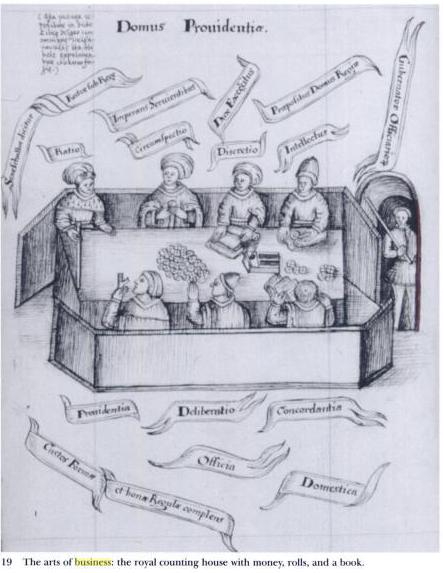
Contrary to popular belief, formal education in medieval times was not restricted to the clergy and the very wealthy. Nor was theology the most popular subject. Independent schools, unaffiliated with any particular religious body or royal institution and staffed by lay people, were common, and even taught business administration (writing letters, drafting contracts, keeping the books).
So says Nicholas Orme in Medieval Schools: From Roman Britain to Renaissance England (Yale, 2006). (Thanks to Tom Woods for the pointer.) In Britain, grammar schools were often supported by wealthy patrons and were open to students of modest means. Notes Orme:
Most [English] schoolmasters were probably broad rather than specialized teachers, catering for a wide range of needs, so it is not surprising that a brand of practical teacher emerged by the fourteenth century (at latest), offering more focused instruction for careers in trade and administration. Such instruction might include “dictamen” (the art of writing letters), the methods of drafting deeds and charters, the composition of court rolls and other legal record, and the keeping of financial accounts. Since documents of these kinds were often written in French between 1200 and 1400, the practical teachers came to teach French too.
This illustration, from p. 69 of the book, depicts such a class. How did they do it without PowerPoint?
Essay Contest on Property Rights
| Peter Klein |
My co-blogger, an enthusiast for the Coase-Alchian-Demsetz-Cheung-Barzel property-rights approach, will appreciate the topic for this year’s Sir John M. Templeton Fellowships Essay Contest, sponsored by the Independent Institute:
For decades social critics in the United States and throughout the Western world have complained that “property” rights too often take precedence over “human” rights, with the result that people are treated unequally and have unequal opportunities. Inequality exists in any society. But the purported conflict between property rights and human rights is a mirage — property rights are human rights.
— Armen Alchian, “Property Rights,” in The Concise Encyclopedia of Economics
Are property rights human rights? How are they related? What are their similarities and differences? If property rights are human rights, why have they enjoyed fewer legal protections and intellectual champions than other human rights?
The contest is for college students and “young” college professors (sorry Nicolai).
Nietzsche and Contemporary Philosophy
| Peter Klein |
“Nietzsche is peachy,” according to a bumper-sticker I once saw. Nietzsche is sometimes cited in management research as an authority on power, complexity, time, or relativism (e.g., Singer, 1994; Kilduff and Mehra, 1997; Mainemelis, 2001). But what did Nietzsche really say about these things? What are his main contributions to philosophy? Professional philosophers can’t seem to agree, as witnessed in this roundtable conversation with Peter Bergmann, Teodor Münz, Frantisek Novosád, Paul Patton, Richard Rorty, Jan Sokol, and Leslie Paul Thiele. Bergmann calls Nietzsche “the culture hero of modernism, a cultural revolution comparable to the Reformation or the Enlightenment. His critique of herd values is reflected in the posture of the avant-garde: elitist to the present, democratic to the future.” But Nietzsche was no nihilist, says Sokol; he was rather “an excessively sensitive person horrified by a world where nothing has rules and stands for nothing.”
All agree that Nietzsche bears no personal responsibility by the appropriation of his ideas by German nationalists, but Schrift notes that Nietzsche “chose to write in a style that invites misunderstanding — his use of metaphor, dissimulation, and hyperbole in particular, all make it easier for his words to be taken to mean something other than what he might have intended.” A warning to those of us who like jargon and are guilty of bad academic writing. (HT: 3quarks)
A Sociology Class I Might Actually Take
| Peter Klein |
SOC 121-015: “Introduction to Sociology: The Sociology of George Lucas and Steven Spielberg’s Films”
This class introduces students to the science of sociology utilizing examples from the real world of society, and the reel worlds of George Lucas and Steven Spielberg’s films. Sociological theories and research, and their application to culture, socialization, religion, technology, inequality, and media are the themes of the class. Films such as THX-1138, American Graffiti, Star Wars, Indiana Jones, Schindler’s List, Amistad, and E.T. will be used as examples oft he these themes, and the fans of Star Wars and Indiana Jones will be discussed. Students will present a paper about the sociological themes of the films and the movies illuminate about the 1970s to 2000s zeitgeist.
For more information about the class, contact Professor Tenuto at jtenuto@clcillinois.edu or at the college website www.clcillinois.edu.
Link via a Star Wars fan site.
If Einstein Wrote a Management Book
| Peter Klein |
It might look like this (via Newmark). Einsteinisms like “imagination is more important than knowledge,” “not everything that can be counted counts, and not everything that counts can be counted,” and “whoever is careless with the truth in small matters cannot be trusted with important matter” are pithy, to be sure, but not very operational. And Einstein did not seem to understand economics very well.
CEOs as University Presidents
| Peter Klein |
I could have titled this post “University Presidents as CEOs,” focusing on the characteristics and responsibilities of university administrators. But I’m interested here in universities hiring former corporate CEOs, rather than career educators, as presidents. Gary Forsee, Sprint-Nextel CEO from 2005 to 2007, became my boss yesterday when he began his term as President of the University of Missouri System. Forsee’s selection last year raised hackles among some faculty because he holds only a bachelor’s degree and has no faculty or university administrator experience. (A greater concern, among some faculty, was the eagerness with which Sprint, under Forsee’s leadership, participated in the Bush Administration’s warrantless wiretapping program.) The University of Colorado is apparently in a similar situation, though with far greater controversy.
Does a university president need a PhD? Under the university-as-guild model, hiring a leader from outside the guild is unthinkable, akin to bringing in Richard Dawkins to head the Catholic Church, or hiring a guy who never played in the NBA to coach an NBA team (actually, that happened). On the other hand, if the university is just another service organization, then hiring leaders from outside makes perfect sense. (more…)
Economics of Higher Education: Sophism versus Virtue
| Peter Klein |
Donald R. Stabile’s new book Economics, Competition And Academia: An Intellectual History of Sophism versus Virtue (Elgar, 2007) contrasts the customer-oriented, for-profit model of education (which Stabile calls “sophism”) with the patronage-supported, non-market model (“virtue”). Stabile reminds us that the notion of higher education as a commercial enterprise was invented not by the University of Phoenix, but by the ancient Greeks. The Sophists believed in teaching practical subjects that students wanted to know, while Plato and Aristotle, wealthy aristocrats whose schools didn’t depend on student fees, favored the teaching of timeless truths independent of student demand. Reviewer Donald Frey thinks Stabile’s framework lacks precision; still, the book sounds like an interesting read.
Tyler Cowen’s In Praise of Commercial Culture, which traces the history of patronage (and, its modern-day equivalent, state funding) and market-based approaches in art, music, and literature, is worth consulting in this context. And don’t miss Paul Cantor’s lectures on commerce and culture, which you can listen to here.
The Stabile dust-jacket blurb is below the fold. (more…)
Bruno Leoni Institute Seminar for Young Scholars
| Peter Klein |
The Institute Bruno Leoni, named for the great classical liberal legal scholar, announces a seminar for young scholars (under 35 years old) on competition, regulation, and antitrust. It’s 3-5 October, 2008, in Sestri Levante (Italy). Economists, sociologists, philosophers, legal scholars, and historians are encouraged to apply. Here is the call for papers. Bill Niskanen and Steve Littlechild are the keynoters. Other than the blatant ageism, it looks like a great event.
Langlois Economics of Organization Course
| Peter Klein |
Don’t you wish you could sign up? Fortunately the reading list and slides are available to all. And check out this great homework assignment.
The Role of Economic Analysis in Public Policy
| Peter Klein |
Here are two views on the role of economic analysis in public policy, from a passage in Robert Dodge’s biography of Thomas Schelling recounting the early days of Harvard’s Kennedy School of Government:
A tension [among the faculty] began to develop over an ideological difference between two groups. The question that brought about the division concerned the proper role of the policy analyst. Schelling’s view was the same as it had been since the Cold War, and there were other economists in the school who generally agreed. They believed that the approach to policy analysis was to begin by rationally analyzing situations, seeking to understand how things work and what outcomes would be. His idea had been to “solve the puzzle first.” Policy was something that came after understanding. Throughout his career Schelling had fought against the idea of beginning with outcomes, what he saw as looking at problems backward, and had believed that strategic analysis was required in advance to understand situations before developing public policy.
A group headed by Steve Kelman and future Secretary of Labor, Robert Reich, held a different view. This group cared about policy management as well as public policy analysis. Their main argument was that values couldn’t be separated from public policy, and the antiseptic and purely analytical approach of Schelling’s group was incomplete. Policy analysis, the Reich group felt, was to be used in determining a successful path to the goal one hoped to achieve. They believed it was necessary to acknowledge and identify openly what one was trying to achieve or affirm when carrying out a policy. . . . (more…)
Dress for Success
| Peter Klein |
 The professorial dress code has long been an object of (gentle) ridicule. “This diagram explains why I’m an expert on money yet I dress like a flood victim,” says an economics professor in a recent Dilbert strip. I remember one from years back in which an older professor says to the younger, “Congratulations on making tenure! Here are your elbow patches.”
Erik Jensen argues that professors should, instead, conduct themselves in a professional manner, which includes professional dress. For men that means jackets and ties; for women, suits or modest, professional dresses. His proposed Uniform Uniform Code: “Faculty members shall, when on college grounds or on college business, dress in a way that would not embarrass their mothers, unless their mothers are under age 50 and are therefore likely to be immune to embarrassment from scruffy dressing, in which case faculty members shall dress in a way that would not embarrass my mother.”
When I started my career I wore a tie every day in class, but eventually quit. This semester I’m teaching a class at Olin, where ties are the norm (except among the economists, apparently), and am wearing one again. I’d really prefer a gown, however. And when did students quit bowing?
The Early History of Silicon Valley
| Peter Klein |
Most historical accounts of Silicon Valley start in the 1970s or later. Christophe Lecuyer’s Making Silicon Valley: Innovation and the Growth of High Tech, 1930-1970, reminds us that the seeds of the first modern high-tech cluster were planted much earlier. Fairchild is central to the story, of course, but so is Eitel-McCullough (Eimac) in the 1930s and 1940s, Litton in the 1940s and 1950s, and Varian in the 1960s (them, not him). Lecuyer, writes reviewer Glenn Bugos,
seeks to define Silicon Valley as an industrial district, akin to the Marshallian industrial districts that economic historians have begun to explore. Also, he integrates into his story the many extant, divergent strands of Silicon Valley historiography. Into his manufacturing-driven narrative, we see the trends other historians have emphasized — military funding, the shake-out following the McNamara consolidation, the role of Stanford University in generating expertise, and the importance of workplace culture.
Inputs and Outputs
| Peter Klein |
In academia we measure outputs, not inputs. Promotion, tenure, and other rewards are based on publications, grants, teaching evaluations, and so on, not effort. So why do we talk so much about inputs? He’s in his office all the time! I get emails from her at 3:00am! Whenever I see him he’s typing at the computer! Even economists, who rightly reject the labor theory of value, talk this way. What gives?
I like the way Kieran puts it:
You have time to blog? I work so hard I couldn’t possibly fit that sort of frivolous nonsense into my day. You have time to watch television? I don’t even own a TV. (I am happy to see this one is now very nearly a cliché.) You go jogging in the morning? How do you find the time? You have time to shower afterward? Personal grooming distracts from the research effort. You walk to the other end of the building to use the bathroom? I specifically requested that my office have the toilet seat model of the Aeron chair installed. A real time saver, that one. You have small children? Actually, why am I even wasting my time talking to you right now? Goodbye.
It seems to me that very nearly all of this sort of guff is pure posturing, net of a very small kernel of obvious truth about not whiling away the weeks playing gin rummy or watching movies to the exclusion of all else. (more…)
Austrian Economics Study Guides
| Peter Klein |
Jérémie Rostan has produced a study guide for Menger’s Principles of Economics, a nice complement to Bob Murphy’s study guides for Man, Economy, and State and Human Action (see the study guide links after each chapter title). And there’s always Percy Greaves’s Mises Made Easier.
When will someone write Foss Made Easier? I would buy a Foss Companion.
Schumpeter and Knight on Democracy
| Peter Klein |
With the US primaries in full swing, and “democracy fever” sweeping the land, it’s perhaps a good time to share a couple of my favorite quotes on democratic governance:
Thus the typical citizen drops down to a lower level of mental performance as soon as he enters the political field. He argues and analyzes in a way which he would readily recognize as infantile within the sphere of his real interests. He becomes a primitive again. (Joseph A. Schumpeter, Capitalism, Socialism, and Democracy, 3rd edition, pp. 262-63.)
The probability of the people in power being individuals who would dislike the possession and exercise of power is on a level with the probability that an extremely tender-hearted person would get the job of whipping master in a slave plantation. (Frank H. Knight (1938), quoted in F. A. Hayek, The Road to Serfdom, p. 152.)





 Organizations and Markets

Recent Comments