Posts filed under ‘– Klein –’
Two Papers on Entrepreneurship
| Peter Klein |
Joe Salerno, “The Entrepreneur: Real and Imagined.” Contrasts Kirzner’s concept of the pure entrepreneur, an agent who possesses superior alertness to profit opportunities but himself owns no resources, with an alternative concept of the entrepreneur as property owner, a concept with equally strong roots in the Austrian tradition. Complements the Knightian approach emphasized in several of these papers.
Steve Phelan, “Entrepreneurship as Expectations Management.” Starting from the resource-based view of the firm, explores how firms can influence market participants’ beliefs about the value of resources it possesses. An interesting attempt to integrate entrepreneurship into the RBV.
Management by the Really Big Numbers
| Peter Klein |
Management by the numbers may work after all. But what about management by the really big numbers?
Paul Slovic, writing in Foreign Policy about genocide, says we are “numbed by numbers” — really big numbers, that is.
Why do good people ignore mass murder and genocide?
The answer may lie in human psychology. Specifically, it is our inability to comprehend numbers and relate them to mass human tragedy that stifles our ability to act. It’s not that we are insensitive to the suffering of our fellow human beings. In fact, the opposite is true. . . .
The psychological mechanism that may play a role in many, if not all, episodes in which mass murder is neglected involves what’s known as the “dance of affect and reason” in decision-making. Affect is our ability to sense immediately whether something is good or bad. But the problem of numbing arises when these positive and negative feelings combine with reasoned analysis to guide our judgments, decisions, and actions. Psychologists have found that the statistics of mass murder or genocide — no matter how large the numbers — do not convey the true meaning of such atrocities. The numbers fail to trigger the affective emotion or feeling required to motivate action. In other words, we know that genocide in Darfur is real, but we do not “feel” that reality. In fact, not only do we fail to grasp the gravity of the statistics, but the numbers themselves may actually hinder the psychological processes required to prompt action.
Here is a longer version of Slovic’s piece, with references.
Are managers, likewise, unable to extract meaningful information from really big numbers? Is this a cost of centralized decision-making, or a limit to firm size or scope for a given degree of centralization? What would Harold say?
Pomo Periscope X: Foucault Deconstructed
| Peter Klein |
This week’s Times Literary Supplement includes Andrew Scull’s review of a new translation of Foucault’s History of Madness, the book that launched the French philospher’s public career. (HT: A&L Daily.) The first English edition, Scull notes, had the great merit of brevity, if not accuracy.
Madness and Civilization was not just short: it was unhampered by any of the apparatus of modern scholarship. What appeared in 1965 was a truncated text, stripped of several chapters, but also of the thousand and more footnotes that decorated the first French edition. Foucault himself had abbreviated the lengthy volume that constituted his doctoral thesis to produce a small French pocket edition, and it was this version (which contented itself with a small handful of references and a few extra pages from the original text) that appeared in translation. This could be read in a few hours, and if extraordinarily large claims rested on a shaky empirical foundation, this was perhaps not immediately evident. The pleasures of a radical reinterpretation of the place of psychiatry in the modern world (and, by implication, of the whole Enlightenment project to glorify reason) could be absorbed in very little time. Any doubts that might surface about the book’s claims could always be dismissed by gestures towards a French edition far weightier and more solemn — a massive tome that monoglot English readers were highly unlikely, indeed unable, to consult for themselves, even supposing that they could have laid their hands on a copy.
From the extended edition, published now in English for the first time, we learn that Foucault’s primary sources were narrow, outdated, and superficial. (more…)
Measuring the Institutional Environment
| Peter Klein |
An central problem in empirical research on institutions is the difficulty of measuring key attributes of the institutional environment. Secure property rights, respect for the rule of law, transparency, free markets, norms of fairness and reciprocity, and similar characteristics are held to be critical for economic development. But how do you know them when you see them?
Most of the literature has used indicators derived from secondary data, such as the economic freedom measures produced by the Fraser Institute and Heritage Foundation, Witold Henisz’s polcon database, the World Bank’s database of political institutions, various indexes of shareholder and creditor rights compiled by the La Porta gang, and the like. These measures have much to recommend them, but may proxy only indirectly for the real institutional constraints of interest.
This paper by Jan Svejnar and Simon John Commander takes a different approach: it asks. The authors use primary data from the Business Environment and Enterprise Performance Survey (BEEPS), in which managers of several thousand firms in 26 transition countries are asked for their subjective perceptions about tax and regulatory policy, uncertainty about regulatory change, macroeconomic stability, the effectiveness of the judiciary, corruption, crime, infrastructure, and other institutional characteristics. (The authors conclude that most of the variation in firm performance is explained by time-invariant country fixed effects, and that individual institutional variables have little explanatory power, suggesting that existing studies using secondary measures of institutional characteristics may overstate their effects.)
Galileo in Popular Culture
| Peter Klein |
Brief follow-up to our earlier post on the Galileo Legend. Happened to catch on the radio today “Galileo” by the Indigo Girls, from their 1992 album Rites of Passage. The song opens thusly:
Galileo’s head was on the block
the crime was looking up for truth
and as the bombshells of my daily fears explode
I try to trace them to my youth
The chorus, a fortiori, makes Galileo into a sort of secular saint:
How long till my soul gets it right
can any human being ever reach that kind of light
I call on the resting soul of Galileo
king of night vision, king of insight
I’ll buy the “king of night vision” part — Galileo’s greatest achievement, after all, was his improvements to the telescope — but “king of insight” seems a little extreme. (It’s a catchy tune, however.)
Socrates’s Teaching Evaluations
| Peter Klein |
Thomas Cushman finds them in Socrates’s private papers. Where’s that hemlock when you really need it? (Via A&L Daily.)
The Danger of Under-Management
| Peter Klein |
As we’ve noted before, the hype about flatter hierarchies, modular organizational architectures, worker-managed teams, and the like tends to obscure the costs of decentralization or, conversely, the benefits of hierarchy. Sure, we can worry along with Bob Sutton about abusive bosses. But what about bosses who exercise too little authority?
WebWorkerDaily is running an open thread on under-management. Notes Anne Zelenka:
Books like The Starfish and The Spider: The Unstoppable Power of Leaderless Organizations promote the idea that decentralized loosely-managed organizations can be more successful than hierarchical traditionally managed organizations. Starfish organizations, so the claim goes, work mainly via flat and collaborative peer networks, not by the practice of top-down leadership or management. This might make you think that management isn’t necessary in the new world of work and business enabled by the web. Yet even so-called starfish organizations like Wikipedia and Craigslist rely on some sort of governance structure and effective leadership to succeed.
CORI’s Contracts Database: More Documents, Faster
| Peter Klein |
Researchers in organizational economics and strategy who rely on CORI’s online contracts database — and c’mon, who doesn’t? — will be happy to know that the collection is growing faster than ever before:
SEATTLE — (BUSINESS WIRE) — QL2 Software today announced that the Contracting and Organizations Research Institute (CORI), one of the world’s leading research organizations on contracts, has deployed QL2’s flagship product, WebQL. CORI will leverage the on-demand power of WebQL to automate the Web data extraction process from the Securities and Exchange Commission’s (SEC) database, EDGAR, to enhance the Institute’s knowledge base of contract information (K-Base). As a result of the implementation, CORI has been able reduce the document upload process to CORI’s K-Base from 15 hours to two hours; a productivity increase of 750% per day.
Based at the University of Missouri-Columbia, CORI’s goal is to build upon its collection of more than 250,000 contracts and other documents of interest to support studies conducted by academic researchers and professional clients focused on best practices as well as economic enterprise structure. Prior to QL2, document search and collection was being performed manually by students at the University, a process of copying and pasting new filings which often took more than 15 hours per EDGAR-filing day. Students also served as taxonomists, responsible for assigning each document to a particular category or associating it with certain search terms.
“WebQL allowed us to replace a slow, tedious and costly process with an automated solution that dramatically improves the speed, quality and consistency of the data extracted from EDGAR,” said Dr. Michael Sykuta, Associate Professor of Agribusiness and Director of CORI. “The solution has also helped reduce the drain on our network bandwidth, processing capacity and archival storage, and allowed the students to focus on processing and categorizing the documents downloaded by the WebQL-enhanced system. With nearly 50,000 documents waiting to be reviewed, we are certainly ahead in our data extraction and downloading.”
We hope users will enjoy the increasing breadth of the collection (and appreciate our contribution to the Marxist process of labor displacement). And if you haven’t seen CORI’s new search interface, you’re in for a treat.
Syllabus Exchange II
| Peter Klein |
More material for our syllabus exchange:
- Steve Bainbridge’s Business Organizations (UCLA)
- Dick Langlois’s Economics of Organization and Controversial Social Issues (Connecticut)
- Anne Miner’s Entrepreneurship Theory and Research (Wisconsin)
- Peter Lewin’s Social and Political Environment of Business (UT-Dallas)
If you have a syllabus to share, let us know.
Brayden King, Fabio Rojas at Missouri
| Peter Klein |
If you’re within driving distance of the University of Missouri campus in Columbia please join us for two upcoming seminars. Brayden King of BYU and orgtheory.net will present his paper with Gordon Smith, “Contracts as Organizations,” in the CORI seminar series April 11. Indiana University’s Fabio Rojas (also blogging at orgtheory.net) will present work on social movements and networks in an April 16 seminar jointly sponsored by McCEL and the Division of Applied Social Sciences. Visitors are welcome. (Contact me for details.)
John McMillan (1951-2007)
| Peter Klein |
For several years I used John McMillan’s book Games, Strategies, and Managers as a supplemental text in my managerial economics courses. I was saddened to learn that McMillan died last Tuesday at the age of 56 after losing a battle with cancer. Here is an obituary. McMillan taught at Stanford’s Graduate School of Business, edited the Journal of Economic Literature, and wrote many articles and books, including Reinventing the Bazaar: A Natural History of Markets.
David Warsh says “Give him a couple of paragraphs — on the evolution of folk football into rugby, soccer, and American football; or the various ways to rig an auction; or the reasons China and Vietnam grew so successfully out of their planned economies while Russia did not — and he could make economics jump right off the page and into the mind of his reader.”
Secondary Markets
| Peter Klein |
Bet these guys prefer cap-and-trade to Pigouvian taxes:
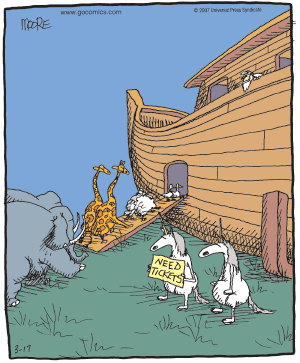
I think this was a case of command and control, however.
Speaking of secondary markets, my longtime associate Dwight Lee proposes setting up a market for citizenships. “America’s homeless and panhandlers . . . are actually quite wealthy. Almost all own an asset — their United States citizenship — that is worth several hundred thousand dollars. The problem is that they are denied the right to sell that asset.” Dwight has a unique talent for spotting potential gains from trade where others fear to tread. . . .
Political Economy of the Internet
| Peter Klein |
Some time ago I wrote a short, popular piece on the political economy of the internet, focusing on its origins as a set of federal government projects. For a more comprehensive, scholarly take, see this paper by Massimiliano Neri, presented at this past weekend’s Austrian Scholars Conference.
Thanks to Cliff Grammich
| Peter Klein |
Many thanks to Cliff Grammich for joining us as a guest blogger over the last several weeks. We look forward to his continued participation as a regular reader and commentator. Also, Cliff has promised to share the results of work he’s doing on global attitudes toward markets and other research projects of interest to the O&M crowd.
Comment Spam
| Peter Klein |
Like most blogs we filter our comments for spam, and lately the spam filter has been picking up a number of false positives. If you leave a comment on the site (and are not pushing Cia!lis or re.fin.ancing) and it does not appear right away, please let us know.
The Long Tail: Extreme Dining Edition
| Peter Klein |
The great thing about the long tail is that every taste, no matter how idiosyncratic, can be accommodated. Literally. Thanks to the web, no one need do without alligator, antelope, bison/buffalo, caribou/reindeer, elk, frog, kangaroo, kobe beef, lamb, llama, rabbit, rattlesnake, snapping turtle, venison, wild boar, yak, duck, goose, guinea fowl, ostrich, pheasant, quail, squab, or wild turkey. All are available from exoticmeats.com. Next best thing to the Gourmet Club! (HT: Jeff Tucker)
Reminds me of one of my favorite billboards:

The Elusive Concept of Corporate Culture
| Peter Klein |
Corporate culture, like pornography, is difficult to define, but perhaps easy to recognize. Attitudes, beliefs, ways of solving problems — “cognitive frames,” if you prefer a fancy term — seem to differ among organizations, and to affect performance and characteristics. But a scientific explanation of corporate culture has proved elusive. Economists, in particular, have not gotten much past the analysis in Kreps’s 1986 paper “Corporate Culture and Economic Theory,” despite important contributions from Crémer (1993), Lazear (1995), and Hermalin (1998). (Ben Hermalin provides a nice summary of the literature here, and George Akerlof and Rachael Kranton provide some related discussion here.) Certainly there has been little empirical work on the economics of corporate culture.
So I was pleased to see this paper by Henrik Cronqvist, Angie Low, and Mattias Nilsson, “Does Corporate Culture Matter for Firm Policies?” The paper takes the Forrest Gump approach (which I’ve advocated elsewhere) that “corporate culture is what corporate culture does.” In other words, rather than try to define it, treat it as a latent concept and look for its effects. From the abstract:
We construct a parent-spinoff firm panel dataset that allows us to identify culture effects in firm policies from behavior that is inherited by a spinoff firm from its parent after the firms split up. We find positive and significant relations between spinoff firms’ and their parents’ choices of investment, financial, and operational policies. Consistent with predictions from economic theories of corporate culture, we find that the culture effects are long-term and stronger for internally grown business units and older firms. Our evidence also suggests that firms preserve their cultures by selecting managers who fit into their cultures. Finally, we find a strong relation between spinoff firms’ and their parents’ profitability, suggesting that corporate culture ultimately also affects economic performance. These results are robust to a series of robustness checks, and cannot be explained by alternatives such as governance or product market links.
This strikes me as a fruitful approach. Culture is treated as a residual, like Solow’s (1957) treatment of technological change. Of course, the drawback is that culture itself remains a black box. But perhaps this is the best economic analysis can do.
The History of Economic Thought is Alive and Well (Outside Economics Departments)
| Peter Klein |
Jeffrey Young, reviewing Leonidas Montes and Eric Schliesser’s New Voices on Adam Smith (Routledge, 2006) for EH.Net, opens with the following observation:
George Stigler began his banquet speech at the Glasgow University bicentennial of the publication of the Wealth of Nations with the now frequently quoted salutation, “I bring you greetings from Adam Smith, who is alive and well and living in Chicago.” (quoted in Meek, p. 3) Thirty odd years later the remark remains true, though ironically not in the Economics Department. Of the fourteen young scholars whose work is published in this book, five earned their Ph.D.s at the University of Chicago, none in economics. Indeed of the fifteen only four are economists, despite the book’s placement in Routledge’s Studies in the History of Economics series. This is reflective of the fact that Smith scholarship has largely moved away from seeing WN and its seminal role in the nineteenth century development of economics as a discipline as Smith’s crowning achievement. The focus today is largely on seeing Smith’s system as a whole, of which The Theory of Moral Sentiments is the foundational work.
This is undoubtedly true, but surely reflects not only this particular trend in Smith scholarship, but also the lack of interest in the history of economic thought more generally among economists, a theme we’ve touched on before.
Preserving Anonymity, Electronically
| Peter Klein |
Heard the one about the sign in the Buddhist public park: “Stay on path”?
Here’s a case where the path can get you in trouble. Nicolai and I were recently discussing the problem of preserving author anonymity when sending electronic referee reports or other documents. As many of you know, word processing programs typically preserve the author’s name and (often) affiliation as part of the document header. When submitting a manuscript or referee report in Word you should click File, Properties, Summary and delete your name and other identifying information before sending. If you convert your file to PDF, however, there is another danger. Acrobat saves the full path of the source file (e.g., the Word document used to create the PDF) under File, Document Properties, Description, Location. So even if the source file contains no identifying information, the PDF file may include something like “C:\Documents and Settings\Peter Klein\My Documents\Referee Reports\Really Bad Papers\” under Document Properties. Windows users should make sure their documents are stored in a generic location like c:\ or c:\temp before converting to PDF. If they want to preserve their anonymity, that is.
Ben Klein’s Reply to Coase
| Peter Klein |
Ben Klein’s new paper, “The Economic Lessons of Fisher Body – General Motors,” appears in the February 2007 issue of the International Journal of the Economics of Business. He is not about to give Ronald Coase the last word. Indeed, Klein writes, the newest evidence on the history of the relationship between Fisher and GM confirms his earlier claim that GM’s acquisition of Fisher in 1926 was a response to opportunistic behavior by Fisher. This evidence
sheds new light on the conduct underlying these events, most importantly on how Fisher Body accomplished its holdup of General Motors in 1922. . . . The analysis presented in this paper reconciles [my] previous evidence of Fisher Body’s reluctance to locate its body plants adjacent to GM assembly facilities and Fisher Body’s reduction in its capital to sales ratio with [Coase’s] new evidence regarding contract restrictions on the use of inefficient production technology and the lack of mis-located plants. In the process we not only more fully explain what happened in the Fisher Body-General Motors relationship but also provide significant insights into the economics of holdup behaviour. The conclusion that Fisher Body held up General Motors not only stands, but is substantially strengthened by the analysis because Fisher’s conduct is shown to be consistent with what we would expect from economics.
What of Coase’s contention that there was no holdup, and that the entire case illustrates economists’ tendency to disregard the facts? (more…)





 Organizations and Markets
Recent Comments