Posts filed under ‘Law and Economics’
Mario Rizzo’s Graduate Course in Behavioral Economics
| Peter Klein |
Check out the syllabus and join the discussion at ThinkMarkets. I appreciate boat-rocking as much as anyone but am personally in what Mario terms (in his syllabus) the “classical” camp. Still, this is a course I would definitely take. If he’s an easy grader.
ISNIE Annual Conference, Stanford University, June 16–18
| Scott Masten |
The 15th Annual Conference of the International Society for New Institutional Economics will be held this year at Stanford University on June 16-18. The conference is being organized by President-Elect Barry Weingast, and my inside, not-yet-public information is that the conference will have two very interesting keynotes. The ISNIE website has the just-released Call for Papers.


New Coase Interview
| Peter Klein |
In conjunction with Ronald Coase’s new book on China, he’s given a new interview to his co-author Ning Wang. (HT: Paul Walker via Mike Giberson.) Excerpt:
WN: You mentioned many times that you do not like the term, “Coasean economics,” and prefer to call it simply the “right economics” or “good economics.” What separates the good from bad, the right from wrong?
RC: The bad or wrong economics is what I called the “blackboard economics.” It does not study the real world economy. Instead, its efforts are on an imaginary world that exists only in the mind of economists, for example, the zero-transaction cost world.
Ideas and imaginations are terribly important in economic research or any pursuit of science. But the subject of study has to be real.
I’m sympathetic to this, but with some methodological reservations, expressed at the end of this post. Anyway, the interview focuses on China, its future economic prospects and likely influence, and the newly formed Coase China Society. Coase is bullish on China: “In the past, economics was once mainly a British subject. Now it is a subject dominated by the Americans. It will be a Chinese subject if the Chinese economists adopt the right attitude.” (more…)
Ronald Coase’s New Book
| Peter Klein |
 Yes, you read that correctly. Ronald Coase, who turns 100 later this month, has a new book coming out from Palgrave Macmillan and the Institute of Economic Affairs, How China Became Capitalist. It’s coauthored with Ning Wang, Coase’s former research assistant at Chicago and now an assistant professor at Arizona State, and scheduled for publication in June 2011.
Examining the astonishing events that led to China’s transformation from a close socialist economy to an invincible manufacturing powerhouse of the global economy, How China Became Capitalist argues that the impact of events that led China to become capitalist could not have been predicted. From the death of Mao to China’s market reform and move to capitalism under the auspices of the Chinese Communist Party, How China Became Capitalist controversially argues that China’s growth potential will be inhibited in future without a vibrant market in ideas.
The Legacy and Work of Douglass North
| Peter Klein |
Washington University, St. Louis is hosting a major international conference, 4-6 November, on the Legacy and Work of Douglass North. The all-star panel includes Lee Alston, Robert Bates, Joel Mokyr, Elinor Ostrom, Ken Shepsle, Barry Weingast, and many others. The conference is organized by Wash U’s Center for New Institutional Social Science.
In other conference news, the CFP for next year’s Atlanta Competitive Advantage Conference, 17-19 May 2011, has been posted. Featured presenters include Jay Barney, Joel Baum, and Rebecca Henderson.
Assorted Links
| Peter Klein |
- A new paper by Randall Morck and Bernard Yeung, “Agency Problems and the Fate of Capitalism.” A very good comparative-institutional analysis of shareholder democracy and its benefits and costs relative to “stakeholder” models.
- A Washington Post story on “moral licensing” (via Sheen Levine) — suggesting that some people view ethical behavior, like goods and services, in terms of trade-offs at the margin!
- A call for contributions to The Ethics and Economics of Agrifood Competition, a Springer volume in preparation by my colleague Harvey James.
- Videos and papers from the Coase centenary conference held last year at the University of Chicago Law School.
Suing in America
| Lasse Lien |
As a temporary resident of the US I find much to enjoy and admire. What I find slightly less admirable is the American litigiousness and the transaction costs it creates (for example the endless number of forms and paperwork needed to get simple services ). Here are some “random” examples of lawsuits (via Clean Laughs):
An inmate filed a $5 million lawsuit against himself (he claimed that he violated his own civil rights by getting arrested) — then asked the state to pay because he has no income in jail. He said, “I want to pay myself 5 million dollars, but ask the state to pay it on my behalf since I can’t work and am a ward of the state.” The judge was not impressed by his ingenuity, and dismissed the suit as frivolous. (Source: CALA)
A convicted bank robber on parole robbed a California Savings and Loan Branch. The bank robber placed the money roll containing the hidden Security Pac in his front pants pocket. The Security Pac released tear gas and red dye resulting in second and third degree burns requiring treatment at a hospital. The bank robber sued the bank, the Security Pac manufacturer, the city the police and the hospital. (Source: ATRA)
A writer was sued for $60 million dollars after writing a book about a convicted Orange County serial killer. Although the inmate is on death row, he claimed that he was innocent in all 16 murders, so the characterization of him as a serial killer was false, misleading and “defamed his good name”. In addition, he claimed those falsehoods would cause him to be “shunned by society and unable to find decent employment” once he returned to private life. The case was thrown out in a record 46 seconds, but only after $30,000 in legal fees were incurred by the writer’s publisher. (Source: CALA)
A minister and his wife sued a guide-dog school for $160,000 after a blind man learning to use a seeing-eye dog trod on the woman’s toes in a shopping mall. South-eastern Guide Dogs Inc., a 13-year old guide-dog school and the only one of its kind in the Southeast, raises and trains seeing-eye dogs at no cost to the visually impaired. The school is located about 35 miles south of Tampa. The lawsuit was brought by Carolyn Christian and her husband, the Rev. William Christian. Each sought $80,000. The couple filed suit 13 months after Ms Christian’s toe was stepped on and reportedly broken by a blind man who was learning to use his new guide dog, Freddy, under the supervision of an instructor. They were practicing at a shopping mall. According to witnesses, Ms Christian made no effort to get out of the blind man’s way because she “wanted to see if the dog would walk around me”. (Source: ATRA and Houston Chronicle, 95-10-27) (more…)
Misbehavioral Antitrust
| Peter Klein |
I suggested earlier that behavioral economics could use a dose of comparative institutional analysis. The New Paternalists are very worried about various biases and forms of “irrationality” on the part of consumers, managers, entrepreneurs, investors, etc. but have little or nothing to say about the rationality of regulators, legislators, judges, and other non-market actors. Josh Wright and Judd Stone offer a parallel critique of behavioral economics applied to antitrust law: the behavioralists focus on presumed bias and irrationality on the part of incumbents, while largely ignoring the cognitive attributes of rivals and potential entrants. Josh and Judd propose an “irrelevance theorem”: “If one assumes a given behavioral bias applies to all firms — both incumbents and entrants — behavioral antitrust policy implications do not differ from those generated by the rational choice models of mainstream antitrust analysis.”
Addendum: Steve Horwitz made the comparative institutional argument in an earlier post that I unfortunately missed.
Tilburg Conference on Private Ordering
| Scott Masten |
O&M readers might be interested in a conference held this week (Sept. 30 – Oct. 1) at the Tilburg Law and Economics Center on the topic “Economic Governance and Competition: The Pros and Cons of Private Ordering in the Shadow of the Law.” The conference was organized by Jens Prüfer and featured keynote presentations by Lisa Bernstein, Avinash Dixit, Robert Gibbons, and Bentley MacLeod. Many interesting papers, several of the authors of which will be familiar to the O&M/ISNIE crowd. The full program, including downloadable papers, can be found here. (Would have liked to attended but classes interfered.)
Elgar Companion to TCE
 | Peter Klein |
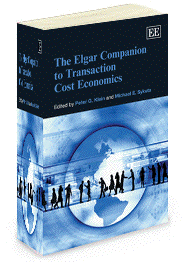
The Elgar Companion to Transaction Cost Economics, edited by Mike Sykuta and me, has just been published. Twenty-nine chapters cover the basic structure of TCE, its precursors and influences, fundamental concepts, applications and evidence, along with alternatives and critiques. Oliver Williamson was kind enough to contribute an introduction and overview. Co-blogger Foss is in there as well.
O&M readers can get it here 10 percent off the list price! (Actually, anybody can get the deal.) Mike beat me to the punch with an announcement and description, so I’ll just add that we’re really pleased with the final product and grateful to all the distinguished contributors and the production staff.
Here are previous O&M posts on transaction cost economics.
Introducing Guest Blogger Scott Masten
| Peter Klein |
It’s a real pleasure to introduce Scott Masten as our newest guest blogger. Scott is Professor of Business Economics and Public Policy at the University of Michigan’s Ross School of Business and a leading figure in the transaction cost approach. Trained by Oliver Williamson at Penn, Scott was one of the first (along with David Teece and a few others) to do systematic empirical work on alternative institutions of governance. Scott’s 1984 paper on procurement in aerospace, his 1985 paper (with Keith Crocker) on characteristics of natural gas contracts, and his 1991 paper (with James Meehan and Ted Snyder) on the costs of internal organization are classics in the transaction cost literature. Scott has also made important contributions to law and economics, antitrust, contract theory, and many other areas. He’s a past president of ISNIE, co-editor of JEMS, and, as I learned a few years ago at a conference for Williamson’s 70th birthday, a wickedly funny after-dinner speaker.
We’re delighted to have Scott on the team and look forward to his insights. Welcome, Scott!
24 September 2010 at 11:40 pm Peter G. Klein Leave a comment
The Myth of the Razors-and-Blades Strategy
 | Peter Klein |
Not quite as exciting as the GM-Fisher contretemps, but in the same revisionist vein: Randy Picker’s new paper, “The Razors-and-Blades Myth(s).”
From 1904-1921, Gillette could have played razors-and-blades — low-price or free handles and expensive blades — but it did not do so. Gillette set a high price for its handle — high as measured by the price of competing razors and the prices of other contemporaneous goods — and fought to maintain those high prices during the life of the patents. For whatever it is worth, the firm understood to have invented razors-and-blades as a business strategy did not play that strategy at the point that it was best situated to do so.
Here’s a PPT version.
Well, as Bogey might have said to Bergman: “We’ll always have printer ink.”
Law School for Economists
| Peter Klein |
Via Josh Wright, here’s an announcement for the Levy Fellowship at George Mason University School of Law. It’s a program to support PhD economists (and ABDs) pursuing law degrees. These days, a JD and a PhD are pretty much required for an academic post at a good law school, so check it out if you’re interested in teaching. After all, the world clearly needs more economists and more lawyers. . . .
Department of “Duh”
| Peter Klein |
It must be acknowledged, however, that a researcher’s political ideology or vested interest in a particular theory can still enter even ostensibly descriptive analysis by the data set chosen for the research; the mathematical transformations of raw data and the exclusion of so-called outlier data; the specific form of the mathematical equations posited for estimation; the estimation method used; the number of retrials in estimation to get what strikes the researcher as “plausible” results, and the manner in which final research findings are presented.
That’s Uwe Reinhardt, writing a NY Times op-ed that could have been titled “A Mainstream Economist Tries to Come to Grips with Kaldor-Hicks Efficiency.” It’s actually a pretty thoughtful and informative discussion that exposes some of the fatal — to my mind, anyway — flaws of the Kaldor-Hicks concept. But Reinhardt implies, unfortunately, that virtually every economist accepts the Kaldor-Hicks principle as a normative standard. There is actually a fair amount of dissent, not only from Austrians but also from people like Jon Elster and John Roemer. As Gary Lawson notes in an excellent survey of welfare economics concepts, the Kaldor-Hicks criterion, in practice, is
as useless as Pareto superiority. Kaldor-Hicks efficiency purchases its coherence by requiring that compensation be hypothetically possible in such a way as to guarantee that each person, by her own standards, does not come away a loser, just as strict Paretianism requires that each person judge herself to be as well off or better off than before. All it takes to make the universe of Kaldor-Hicks-efficient transactions an empty set is one person who sincerely cannot be bought-that is, a person who values autonomy, either his own or that of others, so highly that no amount of after-the-fact compensation could possibly leave him as well off as he would have been had the loss never been inflicted. (without consent) in the first place. In a large population, no legal rule [or other reallocation of resources] will ever satisfy the Kaldor-Hicks efficiency criterion.
Regulatory Capture
| Dick Langlois |
I seem to be on the “communitarianism” mailing list of Amitai Etzioni, missives from which are usually good for a cold frisson of annoyance. The most recent one seemed promising, however, as it touted a paper revisiting the capture theory of regulation. Many people have rightly criticized the Dodd-Frank Act for piling on unnecessary administrative regulation despite the fact that (A) regulation was already extensive and provided all the powers that would have been needed to avert the crisis and (B) much of the new regulation is aimed at activities that have nothing to do with the financial crisis. Etzioni points out that the potential for regulatory capture is an additional reason for concern. Quite so. Dependably, however, Etzioni comes to the wrong conclusion about the nature of the problem and how to fix it. To Etzioni, the problem is not the inherent liabilities of administrative regulation but the specter of private money corrupting the system. (Notably, his examples do not include the money of labor unions, which have captured, at the very least, vast swaths of the Labor and Education Departments.) As political speech is a topic on which I have already fulminated at some length, I will just add that, even in a world in which regulators were somehow insulated from financial temptation, there would still be capture: the operation of regulatory agencies depends on the possession of large amounts of specialized knowledge in whose generation the subjects of regulation have considerable, and oftentimes overwhelming, advantage.
Add to: Facebook | Digg | Del.icio.us | Stumbleupon | Reddit | Blinklist | Twitter | Technorati
The Organizational Economics of the BP Oil Spill
 | Peter Klein |
Now that passions are cooling regarding the BP disaster, it’s time to bring organizational issues into the discussion.
1. Everyone knows about the liability caps and the role they may have played in encouraging moral hazard. Just as bank deposits are guaranteed by government deposit insurance, and large banks themselves are probably Too Big to Fail, liability for property damage from oil spills off US waters is limited to $75 million (plus cleanup costs), based on a 1990 law passed after the Exxon Valdiz spill. This presumably mitigates drillers’ incentives to manage environmental risk. Indeed, oil companies enjoy a very cozy relationship with their ostensible guardians; as the NY Times noted, “[d]ecades of law and custom have joined government and the oil industry in the pursuit of petroleum and profit.” The federal agency that oversees drilling, the Minerals Management Service, rakes $13 billion a year in fees in what amounts to a public-private partnership. And does anyone really think the British government would “stand idly by” if BP’s status as an ongoing concern were threatened by criminal or civil penalties?
2. As Bill Shughart points out, BP did not own the Deepwater Horizon platform, but leased it from a company called Transocean. To Bill this suggests “a classic principal-agent problem in which the duties and responsibilities of lessor and lessee undoubtedly were not spelled out fully, especially with respect to maintenance and testing of the rig’s blowout preventer as well as to the advisability of installing a second ‘blind sheer ram,’ which may have been able to plug the well after the first (and only one then in service) failed to do so.” Would BP have paid more attention to safety if it owned, rather than leased, the platform? (more…)
Hayek Interviews
| Peter Klein |
 In 1983 the Earhart Foundation sponsored a lengthy set of interviews with F. A. Hayek in Los Angeles. The transcripts have long been available (and form the basis of the interview parts of Hayek on Hayek), but the complete set of videos has just now been put online, courtesy of the Universidad Francisco Marroquín. The interviewers are an impressive lot as well: James Buchanan, Armen Alchian, Axel Leijonhufvud, Robert Bork, Tom Hazlett, Jack High, Bob Chitester, Leo Rosten, and Earlene Craver. (I hardly recognized the youthful Hazlett!) You can also get the transcripts, if you prefer plain text.
Add to: Facebook | Digg | Del.icio.us | Stumbleupon | Reddit | Blinklist | Twitter | Technorati
Property Rights and Modularity
| Dick Langlois |
The Schumpeter Society conference in Aalborg has just ended, and I’m on the train to Copenhagen before heading home tomorrow. Like Peter, I was also at the ISNIE conference in Stirling. Of the three conferences I attended on this trip, ISNIE gets the award for best substance, something I judge by whether I learned something interesting that I hadn’t known. Great plenaries with Ostrom and Williamson, as well as Bruno Frey on the economics of happiness and Pablo Spiller on regulation. I hadn’t been familiar with Spiller’s concept of third-party opportunism in government contracting. Some of the parallel sessions were also good, including sessions involving always-reliable people like Lee Alston and Gary Libecap. But perhaps the most interesting papers I heard were by Henry Smith of Harvard Law School, whom I had never met before.
Smith has a modularity theory of property rights, one very much in line with my own thinking on the issue. As Smith writes in one of his papers given at the conference,
property sets up modular structures that manage the complexity of the interactions of actors with respect to resources. A starting point for property is to use an exclusion strategy to define the “thing” and then to delineate rights wholesale as a first cut through the interface between the bubble defined by the exclusion strategy and the rest of the world. Thus, . . . the interface between the basic package of rights to a car and the rest of the world is a simple one behind which much information is hidden. In this way, the structure of rights is modular. As a method of managing complexity modularity relies on a system’s being nearly decomposable, that is, one in which there are clusters of elements that interact relatively intensely with each other but which interact more sparsely with elements of other clusters.
This is a version of what lawyers call the in rem view. What I learned that I hadn’t known is that this is the polar opposite of Coase’s theory of property rights. It turns out that Coase is an extreme legal realist. That is, like legal realists, Coase thinks of property as a bundle of rights to do specific things — emit sparks, make noise, etc. The trouble with this view is that it is non-modular (more technically: non-decomposable) and creates a spaghetti-tangle of interactions among rights holders that raises transaction costs. The in rem view is perfectly consistent with Coasean bargaining, of course, since it is just a starting point from which people can slice off specific pieces if they choose. (Side note: I had been wanting to post something about a paper by Tom Hazlett and Vernon Smith that credits Coase with $17 billion in welfare losses foregone because of his influence on how spectrum now gets allocated.)
At the same session, Gillian Hadfield of USC had a paper arguing that the market for legal services has not kept pace with the needs of the new economy. I saw this a paradigmatic dynamic-transaction-costs story. Google is internalizing legal services for the same reason Chandlerian corporations in the nineteenth century internalized complementary production processes the market was not yet well enough developed to provide. As Hadfield pointed out, the inability of market institutions to supply these new kinds of legal services has a lot to do with the tight regulation the government exercises over the supply of such services.
Add to: Facebook | Digg | Del.icio.us | Stumbleupon | Reddit | Blinklist | Twitter | Technorati
Legal and Economic Perspectives on Contracts
| Peter Klein |
Law professor Lewis Kornhauser and economist Bentley MacLeod have teamed up to provide a multidisciplinary perspective on contracts:
Contracts between Legal Persons
Lewis A. Kornhauser, W. Bentley MacLeod
NBER Working Paper No. 16049
Issued in June 2010Contract law and the economics of contract have, for the most part, developed independently of each other. In this essay, we briefly review the notion of a contract from the perspective of lawyer, and then use this framework to organize the economics literature on contract. The review thus provides an overview of the literature for economists who are interested in exploring the economic implications of contract law. The title, Contracts between Legal Persons, limits the review to that part of contract law that is generic to any legal person. A legal person is any individual, firm or government agency with the right to enter into binding agreements. Our goal is to discuss the role of the law in enforcing these agreements under the hypothesis that the legal persons have well defined goals and objectives.
The paper is unfortunately behind the NBER firewall. Note in the comments if you find an ungated version.
Gordon Smith’s chapter in the forthcoming Elgar TCE Handbook, “Legal Precursors of Transaction Cost Economics,” is also worth a look.
Add to: Facebook | Digg | Del.icio.us | Stumbleupon | Reddit | Blinklist | Twitter | Technorati
Duke LLM in Law and Entrepreneurship
| Peter Klein |
We mentioned before Vanderbilt’s PhD program in law and economics and Arizona’s program in law and entrepreneurship. Now Duke Law School is offering an LLM degree in law and entrepreneurship. “Open to an inaugural class of about 20 JD graduates, the curriculum will blend rigorous academic study relating to the legal, business, institutional, strategic, and public-policy frameworks and considerations that apply to entrepreneurs and innovation, with practice and research opportunities that allow each student to develop skills in representing clients.” Obviously, this is a program for lawyers, not for entrepreneurship scholars or management practitioners, but there may be lessons here for business schools and other academic units seeking to offer interdisciplinary programs in entrepreneurship studies. I particularly appreciate the Duke program’s broad, functional concept of the entrepreneur: “[T]he entrepreneurship LLM will not only be ideal for the entrepreneur, but also for those in large institutions and firms who operate with the spirit of an entrepreneur.”
Add to: Facebook | Digg | Del.icio.us | Stumbleupon | Reddit | Blinklist | Twitter | Technorati





 Organizations and Markets
Recent Comments