Posts filed under ‘Law and Economics’
Program for Searle Center Conference, “The Economics and Law of the Entrepreneur”
| Peter Klein |
Here. I participated in last year’s conference and thought it was terrific. Old friend Henry Butler is doing a fine job making the Searle Center a major player in the entrepreneurship field.
Public Entrepreneurship
| Peter Klein |
A surprising aspect of the recent growth in the entrepreneurship literature is the number of papers, projects, courses, centers, etc. studying entrepreneurship in non-market settings: “social entrepreneurship,” “cultural entrepreneurship,” “environmental entrepreneurship,” and so on. At my own university students can take entrepreneurship courses not only in the Colleges of Business or Engineering but in the College of Agriculture, the School of Natural Resources, the College of Journalism, and even the School of Social Work. (One of my colleagues organized a conference last year aimed at cattle ranchers seeking to market their, um, byproducts as fertilizer, with the classic title: “Manure Entrepreneurship: Turning Brown into Green.”
Translating concepts, theories, and research methods from the entrepreneurship literature to non-market settings raises challenging issue, however. How is entrepreneurship defined? What corresponds to entrepreneurial profit and loss? What is the entrepreneur’s objective function? Are there competitive processes that select for the better entrepreneurs? None of the classic writers on entrepreneurship — Cantillon, Say, Schumpeter, Knight, Mises, Kirzner — wrote explicitly on entrepreneurship in non-market settings, as far as I am aware. Mises, in fact, distinguishes sharply between “profit management” (or entrepreneurial management) and “bureaucratic management,” identifying the former with initiative, responsibility, creativity, and novelty and the latter with rule-following within strict guidelines (see Bureaucracy, 1944, and chapter 15, section 10 of Human Action, 1949). (more…)
Conference on Law and New Institutional Economics
| Peter Klein |
Vic Fleischer and Phil Weiser have organized a conference on Law and New Institutional Economics at the University of Colorado, 4-5 June 2009. Along with Lee Fennel, Mark Ramseyer, Henry Smith, and Eric Talley, Vic and Phil will facilitate discussion of classic (Demsetz 1967, Klein, Crawford, and Alchian, 1978) and contemporary papers dealing with property rights, contract design, behavioral finance, the teaching of NIE, and more. See the link for details.
Reducing Transaction Costs in Government Procurement
| Mike Sykuta |
Lest anyone think I (or, by association, O&M) am just a disgruntled Obama-basher, let me applaud the Administration’s announcement today of its intent to overhaul the ways in which the government contracts for goods and services, particularly in the Department of Defense. I suspect the collective “we” are all in favor of identifying methods and processes that will reduce transaction costs (and overall costs) in government procurement programs.
On this point, there is economic research that should help guide the Administration’s deliberations. To wit, William Rogerson provides a pretty thorough assessment of the economic incentives in defense procurement (JEP, 1994) and has a follow-up article on the optimal structure of fixed-priced cost reimbursement contracts (AER, 2003). Bajari and Tadelis (RAND J., 2001) provide a study of incentives versus transaction costs in procurement contracts. Although focused on private-sector construction, their findings are likely relevant to government procurement as well. Important lesson: cost-plus is not necessarily bad.
Yet More “Shameful” Interventionist Rhetoric
| Mike Sykuta |
It’s obviously not enough for regulators from the Obama administration to march down Wall Street and mandate changes in the incentive systems of rank-and-file workers or even mandating that these “bonus” payments be rescinded (see here and here). Now banks that received bailout money are being chastised and brow-beaten from the bully pulpit of the White House for honoring long-term contracts signed years before the current “crisis.”
Today’s Wall Street Journal reports Citigroup is considering reneging on its 20-year stadium naming rights deal with the New York Mets to appease the White House and the populist press. Citi has already caved on its commitment to purchase a new corporate jet to replace two aging planes (a move that would likely have enhanced both fuel and environmental efficiency, ironically enough). Although Citi and the Mets claim the deal is still on, the attitude from Washington is remarkable in its complete disregard for the complexity of business deals, if not for the very essence of the institutional structures that support exchange (and contracting).
First, despite all the clamoring about Citi spending $400 million on naming rights while receiving $350 million in TARP funds, the reality is Citi is obligated to pay $20 million a year for 20 years. So while taxpayers are being told they are paying to name the new Mets stadium Citi Field, only a relatively small amount — certainly by bailout standards — is being spent this year. If the purpose of the bailout is to get firms through these troubled times and into a more stable future, we’re not talking about taxpayers taking on a 20-year commitment. (more…)
New Leoni Collection: Law, Liberty, and the Competitive Market
| Peter Klein |
Transaction Publishers and the Instituto Bruno Leoni have just published a new collection of essays by Bruno Leoni, Law, Liberty, and the Competitive Market, edited by Carlo Lottieri. The essays elaborate on Leoni’s distinction between law and legislation, and the analogy between the latter and centralized economic planning, themes introduced in his best-known book, Freedom and the Law. Richard Epstein provides an informative introduction.
That Great Klein (1996) Paper
| Peter Klein |
No, not this one. I’m talking about Ben Klein’s 1996 Economic Inquiry paper, “Why Would Hold-Ups Occur: The Self-Enforcing Range of Contractual Relationships.” It’s from a special issue honoring Armen Alchian, the entire contents of which are worth reading. Klein’s paper extends the Klein, Crawford, and Alchian (1978) model by explaining why, in equilibrium, holdups can occur, even if parties are farsighted. The basic story — that parties deliberately leave “gaps” in their contracts because the marginal costs of filling in the gaps exceed the marginal benefits — is closer in spirit to neoclassical economics than is Williamson’s Carnegie-style appeal to bounded rationality. Writes Klein:
[In an uncertain world where complete contractual specification is costly, transactors use incomplete contracts that deliberately do not take account of every contingency. As a result, transactors knowingly leave themselves open to the possibility of hold-ups.
The costs associated with contractual specification that lead transactors to use incomplete and imperfect contracts involve much more than the narrow transaction costs of writing down responses to additional contingencies. In addition to these extra “ink costs,” complete contractual specification entails wasteful search and negotiation costs associated with discovering and negotiating prespecified contractual responses to all potential contingencies. Because most future events can be accommodated at lower cost after the relevant information is revealed, much of this activity involves largely redistributive rent dissipation with little or no allocative benefit. Transactors are merely attempting to obtain an informational advantage over their transacting partners, hoping to place themselves in a position where they will be more likely to collect on (and less likely to pay for) hold-ups. Therefore, rather than attempting to determine all of the many events that might occur during the life of a contractual relationship and writing a prespecified response to each, the gains from exchange are increased by the use of incomplete contracts.
Transactors also use incomplete contracts because writing something down to be enforced by the court creates rigidity. Since contract terms are necessarily imperfect, once something is written down transactors can engage in a hold-up by rigidly enforcing these imperfect contract terms, even if the literal terms are contrary to the intent of the contracting parties (p. 447). (more…)
Some Interesting Working Papers
| Peter Klein |
- Jennifer Arlen and Eric Talley, “Experimental Law and Economics”
This chapter provides a framework for assessing the contributions of experiments in Law and Economics. We identify criteria for determining the validity of an experiment and find that these criteria depend upon both the purpose of the experiment and the theory of behavior implicated by the experiment. While all experiments must satisfy the standard experimental desiderata of control, falsifiability of theory, internal consistency, external consistency and replicability, the question of whether an experiment also must be “contextually attentive” — in the sense of matching the real world choice being studied — depends on the underlying theory of decision-making being tested or implicated by the experiment.
- Matthew J. Holian, “Optimal Decentralization in Corporations and Federations”
Oates’ Theorem and the M-form Hypothesis are both organizational theories of decentralization, though they deal with different types of organizations. This brief note describes how the two theories complement one another, through both verbal description and mathematical models. The result is a simple but comprehensive account of the delegation problem.
- Abhijit V. Banerjee, Esther Duflo, “The Experimental Approach to Development Economics”
Randomized experiments have become a popular tool in development economics research, and have been the subject of a number of criticisms. This paper reviews the recent literature, and discusses the strengths and limitations of this approach in theory and in practice. We argue that the main virtue of randomized experiments is that, due to the close collaboration between researchers and implementers, they allow the estimation of parameters that it would not otherwise be possible to evaluate. We discuss the concerns that have been raised regarding experiments, and generally conclude that while they are real, they are often not specific to experiments. We conclude by discussing the relationship between theory and experiments.
The Emergence of English Commercial Law
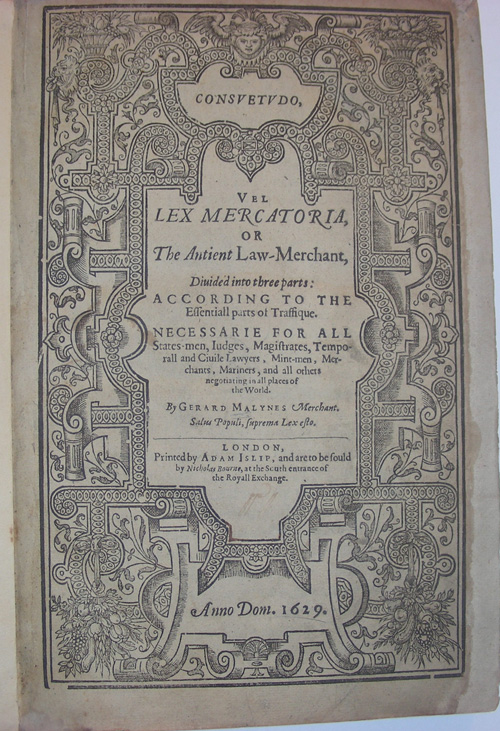
 The English system of commercial law or the lex mercatoria has been described as an example of “spontaneous order,” a set of rules that emerged without central direction and yet provided remarkable stability and favorable institutional environment for trade. Harold Berman and Bruce Benson, among others, have written extensively on this. Here’s an interesting paper by Daniel Klerman on the early history of English commercial law, framed as a comparison of the English and Ottoman systems:
Thirteenth-century England was a commercial backwater whose trade was dominated by foreigners. To accommodate and encourage foreign merchants, England modified its legal system by creating legal institutions which were available to both domestic and foreign traders. Among the most important of these institutions were streamlined debt collection procedures and mixed juries composed of both Englishmen and foreigners. By introducing institutions which treated locals and foreigners equally, England created a level playing field which enabled English merchants to become increasingly prominent in the later Middle Ages. England’s ability to modernize its law was facilitated by the secular nature of English law, the representation of merchants in Parliament, and legal pluralism. Medieval England contrasts sharply with the early modern Ottoman Empire. The latter created special institutions for foreign merchants, which eventually put Ottoman Muslims at a competitive disadvantage.
Interviews with Alchian, Coase, Kirzner, Manne
| Peter Klein |
 The Liberty Fund has put online several interviews from its Intellectual Portrait Series. Of particular interest to O&M readers:
- Armen Alchian, interviewed by Dan Benjamin
- Ronald Coase, interviewed by Richard Epstein
- Israel Kirzner, interviewed by Tibor Machan
- Henry Manne, interviewed by Fred McChesney
Update (Nov. 2): Manne link fixed.
Today’s Bailout Links
| Peter Klein |
Ok, so let me get this straight. Credit got all constipated from banks’ misguided feast on crappy assets. My thought (see, especially, the most recent posts in this archive) was that maybe bank managers need better incentives.
I guess I must have been wrong, because the government is now putting a quarter trillion in non-voting stock. Well, that’s one way to fix the misalignment of manager-shareholder incentives — undermine the shareholders’ incentives too.
The Banks get below cost capital grants. Loans would cost 11 to 12 percent. The government gives them cash at 5 percent for five years and 10 percent thereafter with optional repayment; it is senior preferred stock. Large banks cumulate foregone dividends on the preferred; small banks do not. Existing shareholders still get dividends at past levels (no increases) and the government cannot vote any of its stock. Why ever pay it back? . . .
Lehman, J.P. Morgan and AIG look like AAA suckers. They paid dearly for their capital infusions. Greenberg, the ex-CEO of AIG and a major shareholder, is, sensibly, asking the government to renegotiate the AIG bailout package. The lesson for future crises? Stall, stall, stall.
Peter Schiff (via Karen):
After supposedly bailing out the fat cats on Wall Street, no politician wants to be accused of evicting struggling families. Once you understand this, all of your anxiety should melt away. Why pay your mortgage if foreclosure is off the table, and if you know that lower payments, and possibly a reduced loan amount, would result? A tarnished a credit rating is a small price to pay for such a benefit.
Unfortunately, this boon will not extend to those foolish individuals who either made large down payments or resisted the temptation of cashing out equity. The large amount of home equity built up by these suckers, I mean homeowners, means that in the case of default foreclosure remains a financially attractive option. As a result, these loans will be much less likely to be turned over to the government.
Searle Center Symposium on Property Rights and Innovation
| Peter Klein |
It’s next month in Chicago. The high-powered lineup includes Joel Mokyr, Avner Greif, Robert Merges, Lynne Kiesling, Stan Liebowitz, Scott Stern, my old classmates Emerson Tiller and Rich Brooks, and many more. Harold Demsetz gives the keynote. Wish I were going.
Political Origins of the Financial Crisis
| Dick Langlois |
Okay, so maybe I’ll write about the financial crisis after all.
Stan Liebowitz has been pointing for a long time to the political origins of lowered lending standards — pressure on Fannie Mae to increase “affordable housing” — and to the role of those lowered standards in the mortgage bubble. “[I]n an attempt to increase homeownership, particularly by minorities and the less affluent, an attack on underwriting standards was undertaken by virtually every branch of the government since the early 1990s. The decline in mortgage underwriting standards was universally praised as an ‘innovation’ in mortgage lending by regulators, academic specialists, GSEs, and housing activists. This weakening of underwriting standards succeeded in increasing home ownership and also the price of housing, helping to lead to a housing price bubble.”
Today the AEI has posted a nice piece by Peter Wallison and Charles Calomiris saying much the same thing. Even more interesting, however, is a long article in Saturday’s New York Times that chronicles the process in great detail.
Capitol Hill bore down on Mr. Mudd as well. The same year he took the top position, regulators sharply increased Fannie’s affordable-housing goals. Democratic lawmakers demanded that the company buy more loans that had been made to low-income and minority homebuyers.
“When homes are doubling in price in every six years and incomes are increasing by a mere one percent per year, Fannie’s mission is of paramount importance,” Senator Jack Reed, a Rhode Island Democrat, lectured Mr. Mudd at a Congressional hearing in 2006. “In fact, Fannie and Freddie can do more, a lot more.” (more…)
Amethyst and Public Choice
| Dick Langlois |
Many of you have heard of the Amethyst Initiative, a petition signed (at this writing) by 130 American college and university presidents in favor of lowering the drinking age from 21 back down to 18. As the website puts it, prohibition is not working. The college presidents are hoping that, by removing the black-market character of college drinking in the U.S., lowering the drinking age might be part of a solution to the problem of binge drinking on campus. (Although American 18-year-olds may not buy alcohol because such an activity is unsafe and unhealthy, it is quite alright for the same 18-year-olds to join the military and be posted to Iraq or Afghanistan.) Needless to say, this proposal has generated an enormous amount of controversy, and is vociferously opposed by politically powerful groups like Mothers Against Drunk Driving. The authoritarian response, typified by this column in Slate, is to point to the many studies that show that a higher drinking age reduces driving fatalities, although the Slate article does come around at the very end to the point that economists would make: taxes are more efficient at regulating behavior than is prohibition. (This would also include binge drinking. A student of mine, recently returned from a semester abroad, reports that there is no binge drinking at the National University of Singapore despite a drinking age of 18 — not because of that government’s well-known authoritarianism but because alcohol is highly taxed.) Not, of course, that I would personally like to see higher taxes on my pinot grigio.
My point here is not to engage the debate but to raise a Public Choice point I haven’t seen raised elsewhere. A quick reading of the list of university presidents who have signed suggests that many of them are from private schools. Among the most prominent of these are Dartmouth, Duke, and Johns Hopkins. Public Choice theory might suggest that presidents of state universities are much less likely to sign, since they depend on politicians for funding, and are much less willing to take positions that groups like MADD would oppose. The president of my university is certainly not about to sign it. The six Connecticut schools that have signed are all private, including Trinity College but not including Connecticut College, Wesleyan, or Yale. (Of course, Rick Levin at Yale may be just as reluctant to take unpopular positions given the hungry eye the government has been casting at his endowment.) On the other hand, there are a number of public colleges among the signatories, notably Maryland, UMass, and Ohio State. Are the signatories really biased in favor of private schools? Or are people actually taking moral positions despite possible consequences? That would be interesting. Do we have enough data to tell? Might be an good project for someone talented in the relevant econometrics.
I hesitated at first to post this, since I didn’t see its relevance to the current financial crisis. On reflection, however, it occurred to me that there is an important connection, since the best possible response to the financial crisis might well be binge drinking.
A Critique of Modern Law and Economics Research
| Peter Klein |
From Eric Engle. How can I not link to a paper with “Theoretical Puffery” in the title? (Thanks to Mark Thornton for the pointer.)
Law and Economics: Theoretical Puffery, Exaggerated Claims and Counterfactual Models
Eric Engle
Universität Bremen; Harvard University – Berkman Center for Internet & SocietySeptember 15, 2008
Economic analyses of law predominate in the United States because they can claim to be objective and scientific thus verifiable and the basis of predictions and reproducible experiments. However, several of the claims of economic analysis of law go too far and are entirely unrealistic. This explains why economic analysis of law has not been taken up outside of the U.S. to the extent it has in the U.S. This article points out the unrealistic presumptions within law and economics theory (homo economicus and efficient markets, mostly) and the unrealistic claims of law and economics (that the law is and should be a mirror of the economy). Economic analysis of law cannot and should not serve as a general basis of legal decision making. However, as a special theory applicable as a method for determining certain issues economic methods can well inform legal decision making helping judges to shape justice correctly. This article exposes the competing schools within law and economics and presents a defensible version of economic methodology applied within legal discourse.
Call for Papers: International Entrepreneurship
| Peter Klein |
The new Strategic Entrepreneurship Journal is rapidly becoming one of my favorite reads. (And not just because I’m the SEJ’s #1 author — it’s true, when my colleagues and I submitted this paper, we were assigned manuscript number SEJ-0001.) Here’s a call for papers for a special issue on international entrepreneurship edited by Douglas Cumming, Don Siegel, and Mike Wright. The call lists several potential research questions::
- How do government policies impact incentives to form strategic alliances among entrepreneurial firms in domestic versus foreign settings?
- What is the role of laws and public policy in stimulating transnational and returning entrepreneurs?
- What is the role of social networks in international entrepreneurship?
- What factors lead to the success of immigrant entrepreneurs in different countries?
- What is the interaction between public policy and foreign investment in entrepreneurial ventures?
- What explains international differences in governmental policies regarding intellectual property, entrepreneurship, and entrepreneurial finance?
- How does international entrepreneurship affect firm performance?
- How important is product and geographic focus for entrepreneurial success within different public policy settings?
- What are the implications of corporate entrepreneurship for multinational companies?
- How do corporate governance regulations impact international entrepreneurship?
- How do venture capitalists and private equity firms make decisions in an international context, including the decision to make cross-border investments and how to enter international markets?
- What is the role of academic entrepreneurship in various nations? Is their convergence or divergence in policies to stimulate academic entrepreneurship?
- How do universities stimulate international technology transfer and commercialization?
- What is the relative importance of patenting, licensing, and property-based institutions, such as science parks and incubators in stimulating entrepreneurship in various nations?
Submissions are due 31 December. Accepted papers will be presented at a conference at York University in April.
How Well Does the Market Handle Network Effects?
| Peter Klein |
Quite well, according to Dan Spulber’s paper “Consumer Coordination in the Small and in the Large: Implications for Antitrust in Markets with Network Effects,” out recently in the Journal of Competition Law and Economics (June 2008). Dan distinguishes between network effects in small- and large-numbers bargaining situations; Coasean bargaining can solve the problem in the former while Hayekian “spontaneous order” can emerge in the latter. The paper also contains a useful, up-to-date summary of the network effects literature. Highly recommended!
Tullock on the Corporation
| Peter Klein |
Gordon Tullock is retiring this year from George Mason Law School. In the coming weeks you’ll probably be reading a lot of Tullock tributes and Tullock anecdotes (for example, about his famous put-downs). I don’t have much to add on the personal side, but I thought I’d share a remark or two about one of my favorite, and little-known, Tullock articles, “The New Theory of Corporations,” in Erich Streissler, ed., Roads to Freedom: Essays in Honor of Friedrich A. von Hayek (Routledge and Kegan Paul, 1969).
Tullock offers a number of insights into the corporate form and, in particular, the Berle-Means problem, that are well ahead of their time. As Tullock notes in the essay, he draws heavily here on Henry Manne’s work (and, he tells us, many conversations with Manne about these issues). In 1969 the consensus view was that corporations were almost exclusively controlled by salaried managers, running firms in their own interests and largely ignoring the wishes of shareholders. However, Tullock notes:
The theory of management control of corporations, of course, is subject to one very obvious difficulty. It offers no explanation of how managements are changed, and changes of management are an everyday occurrence as any reader of the Wall Street Journal can appreciate. It is true that presidents of large corporations frequently stay in office rather longer than the president of the United States, but they don’t stay in office as long as congressmen and senators, and we would hardly argue that the long tenure of congressmen and senators indicates that we do not have democracy in the United States. Thus, the current orthodoxy that the management actually runs the corporation cannot explain how the management got there or how the everyday occurrence of a change in management occurs. For some reason, this does not seem to disturb the partisans of the . . . Berle and Means theory. (more…)
CSI: Reform
| Dick Langlois |
My old friend Roger Koppl has an interesting article in Slate on reforming the system of forensic analysis and testimony. He and his coauthor argue for such measures a forensic counsel for the indigent; greater independence of experts from the prosecutorial team; more competition among labs; more statistical analysis to uncover anomalous findings; and the masking of evidence from analysts to reduce cognitive bias.
Roger has started something called the Institute for Forensic Science Administration. Check out his website for links to papers and others materials. (The website also declares that Roger’s Erdös number is 6. As Roger and I have written a couple of papers together, my Erdös number must be no greater than 7.)
São Paulo Workshop on Institutions and Organizations
| Peter Klein |
See below for information on the Third Research Workshop on Institutions and Organizations, 13-14 October 2008 at Fundação Getúlio Vargas in Brazil. Session topics include “Organizations, law and corruption,” “Institutions and development,” “Institutions and environment,” “Psychological issues and organization strategies,” and “Industrial and competition policy.”
I participated in last year’s conference and enjoyed it tremendously. There is a growing network of Brazilian researchers working on various topics in the New Institutional Economics. It is a good group to be involved with. (more…)





 Organizations and Markets
Recent Comments