Posts filed under ‘Management Theory’
“Illusions in Regression Analysis”
| Peter Klein |
Apropos Lasse’s post, check out Scott Armstrong’s “Illusions in Regression Analysis,” via Craig Newmark, who highlights passages like this:
This illusion [that correlation implies causality] has led people to make poor decisions about such things as what to eat (e.g., coffee, once bad,is now good for health), what medical procedures to use (e.g., the frequently recommended PSA test for prostate cancer has now been shown to be harmful), and what economic policies the government should adopt in recessions (e.g., trusting the government to be more efficient than the market).
And this:
Do not use regression to search for causal relationships. And do not try to predict by using variables that were not specified in the a priori analysis. Thus, avoid data mining, stepwise regression, and related methods.
Job Openings of Interest to O&M Readers
| Nicolai Foss |
It is not yet online, but the University of Paris-Sorbonne is looking for a Full Professor in the Economics of Organization (see the ad text below). Importantly, proficiency in French is not a requirement … “upfront,” at least.
Very apropos (if I may) the Department of Strategic Management and Globalization will be hiring one assistant professor and three associate professors in “strategic and international management” over the next few months. Proficiency in French, or Danish for that matter, is not required at all. The job ads are here. Or, contact me directly on njf.smg@cbs.dk (more…)
Is Jim Collins Reading O&M?
| Peter Klein |
 Über-guru Jim Collins has taken more than his share of hits here at O&M, mainly for lack of attention to experimental design (1, 2, 3). It appears that his new book, Great by Choice: Uncertainty, Chaos, and Luck: Why Some Thrive Despite Them All (Harper, 2011), finally tries to address this issue with an attempt at causal identification. If the dust-jacket blurb is to be believed, Great by Choice introduces to the Collins project the concept of treatment and control:
With a team of more than twenty researchers, Collins and Hansen studied companies that rose to greatness — beating their industry indexes by a minimum of ten times over fifteen years — in environments characterized by big forces and rapid shifts that leaders could not predict or control. The research team then contrasted these “10X companies” to a carefully selected set of comparison companies that failed to achieve greatness in similarly extreme environments.
This looks like a step in the right direction, but Collins is still selecting on the dependent variable — in a quasi-experimental design one normally chooses the treatment and control groups based on behaviors, not outcomes. (You don’t compare 100 healthy people to 100 sick people, you compare 100 smokers to 100 otherwise similar nonsmokers or 100 people on a medication to 100 similar people on a placebo to see which get healthy or sick.
For more, see Collins in the NYT or this interview from Knowledge@Wharton. I don’t have the actual book but I tried searching keywords from the Amazon “Look Inside,” and didn’t get any hits for “Knight,” “Schumpeter,” “dynamic capabilities,” or other appropriate key words, so I’m not expecting much theory here.
Are We Quacks?
| Lasse Lien |
Rich Bettis makes an important point in a forthcoming issue of SMJ. Bettis points out how two unfortunate practices interact with each other to create a very serious and fundamental problem for knowledge accumulation in (strategic) management.
One is the widespread practice of running numerous regressions on a given dataset and subsequently adapting (or in milder cases “tuning”) hypotheses or theory to fit the data. By itself this practice is quite unfortunate, since data patterns can and will occur by chance, and the more regression models one tries the more likely that one will “find” something. We obviously do not want such random patterns to influence either theory building or our catalog of empirical findings. However, this problem would be a great deal less serious if replication studies were common and we gladly published non-findings. Random correlations in the data would not survive replication tests, and would be eliminated fairly quickly.
As we all know, in management, replication studies cannot get published and are basically just not done. To make matters worse, we don’t publish non-findings either. This is the second unfortunate practice. Taken together these two practices may in the worst case indicate that much of what we think we know in management are just random data patterns, discovered through data mining, and protected by our lack of replication studies and refusal to publish non-findings. This is a sobering thought. As Bettis points out, we should all be very thankful that replication studies are more common in medical research than in management.
What is the solution? Well, a first step might be to launch the Journal of Managerial Replication Studies and give it the prestige it deserves. Either SMS or AOM should see the launch of such a journal as a crucial responsibility. I mean, we really don’t want to be quacks, do we?
HT: Helge Thorbjørnsen
Causal Identification in Management Research
| Peter Klein |
Mike Ryall writes about the 2011 HBS strategy conference:
Of the empirical papers, almost half incorporated some method aimed at causal identification. My sense is that such identification strategies will soon become a fairly standard requirement for publication in a top management journal (“soon” being measured in academic time, of course).
We’ve discussed this issue several times, including a 2008 post on the potential tradeoffs between choosing problems that are well-identified and choosing problems that are important. I agree with Mike that the management and entrepreneurship literatures — at least the quantitative empirical part of those literatures — are catching up the economists here. But consider the advantages of backwardness: can management research learn to take identification seriously without falling into the Freakonomics trap? (Please, no Freakostrategy or Super-Freakopreneurship!)
Of course, management and entrepreneurship researchers, unlike most economists, tend to sympathize with (or at least tolerate) qualitative methods, and one legitimate means of generating causal inference is careful, detailed, historical investigation, case work, ethnography, analytical narrative, and so on. I suspect, though, that the trend Mike describes will tend to push these approaches to the side as well.
CFP: “Managing Wicked Problems: The Role of Multi-Stakeholder Engagements”
| Peter Klein |
O&M friend Brent Ross sends along this CFP for a track session of the 2012 Wageningen International Conference on Chain and Network Management. The session, “Managing Wicked Problems: The Role of Multi-Stakeholder Engagements for Resource and Value Creation,” is linked to a special issue of the International Food and Agribusiness Management Review. Info below the fold: (more…)
Self Employment, Entrepreneurship and Economic Growth
| Peter Lewin|
Interesting new monograph from the IEA (Institute of Economic Affairs) in the UK on: Self Employment, Small Firms and Enterprise. A pdf is available for free here. And here is the executive summary.
Summary
- Self-employment is a form of contractual relationship which, in certain circumstances, will have greater benefits to the parties involved than an employer–employee relationship. Government intervention, however, may make selfemployment artificially more attractive by raising the costs of employment relationships.
- Certain ethnic minority groups, older people and those without English as a first language tend to be overrepresented among the self-employed. This is partly because of the flexibility the arrangement provides but also because self-employment offers a ‘safety valve’ for those who find it difficult to find employment in the formal labour market.
- It is vital that businesses are not impeded from moving from a situation where the owner is self-employed without employees to a situation where the business has employees. There is evidence that businesses are impeded in this way. In just nine years to 2009, the proportion of micro-businesses with employees fell by almost one fifth. At the same time the proportion of self-employed with no employees rose rapidly.
- Women, individuals from certain ethnic groups, those with young dependants, those with low or no qualifications, those for whom English is not a first language and those who have recently experienced unemployment make up a much greater proportion of the workforce of small firms. For example, whereas 11 per cent of employees of small firms had no qualifications, only 4 per cent of employees of large firms had no qualifications.
- Some workers will prefer to work for small firms because of the greater flexibility they offer in their working practices. In many cases, however, small firms will employ people who are talented but who are not able to negotiate the more formal recruitment processes of larger firms. Micro-businesses therefore perform an important economic and social function – employing people who might be overlooked by larger employers.
- Genuine entrepreneurial insight and discovery tends to come from small firms. Entrepreneurship is crucial for economic growth. The nature of entrepreneurial insight is such, however, that we have no idea where it will come from – not even in the most general terms. Probably only one in every thousand ‘start-up’ firms will become one of the large businesses of the future.
- Policies to promote entrepreneurship must come in the form of removing impediments to business and should not involve the promotion of particular business activities. It is simply not possible for government intervention to pick this tiny number of winners. All government can do is create a climate in which entrepreneurship can thrive.
- The smallest firms are a key driver of job creation. Businesses do not start big. One quarter of employees working in firms that were established ten years earlier are working for firms that started from a position of employing only one person.
- The cost of regulation has grown enormously over the last fifteen years. This particularly affects small firms with employees because regulatory costs act like a ‘poll tax’. Wide ranging exemptions from employment regulation and the minimum wage would be appropriate for small firms. Such exemptions would have the additional advantage of allowing the government to ‘experiment’ with deregulation. Standard terms and conditions of employment could be drawn up which would ensure that employees clearly understood the exemptions. Radical reforms of the tax system would also assist small firms which experience much greater compliance costs than large firms.
- Moves by the government to promote entrepreneurship through the state education system or provide specific tax exemptions and reliefs for particular forms of business activity are wasteful or counterproductive.
strategyprofs.net
| Peter Klein |
At O&M we’ve long prided ourselves on being one of the top academic group strategy blogs. We believed this with great confidence, mainly because we were the only academic group strategy blog. Other blogs deal with strategic issues — Dick Rumelt’s blog, Knowledge Problem, Managerial Econ, Digitopoly, and of course the Good Twin, among others — but the Herfindahl index for academic group strategy blogs has been pretty close to 1.0.
We’re happy now to introduce a new entrant, strategyprofs.net, brainchild of Freek Vermeulen, Karim Lakhani, Mike Ryall, Russ Coff, Steve Postrel, and Teppo Felin. The first posts are already up, and the discussion is extremely interesting. Welcome to the blogosphere, Strategy Profs!
Strategic Entrepreneurship Conference Starts Today!
| Peter Klein |
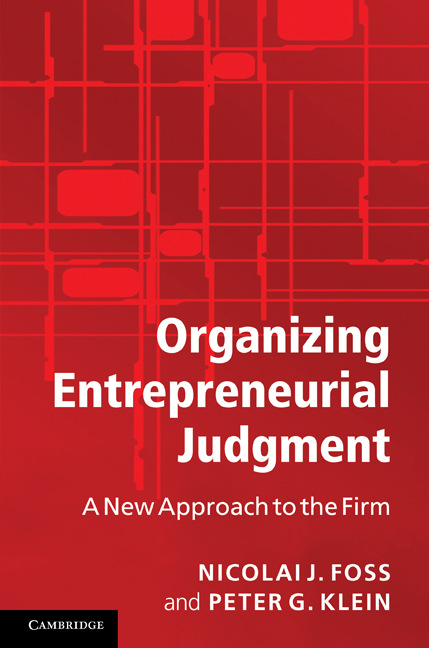
 The SMG-McQuinn conference, “Multi- and Micro-Level Issues in Strategic Entrepreneurship,” starts today. Not sure if live-blogging will be feasible (“Nicolai Foss has stepped to the podium. Blue tie, white shirt. Scans the crowd….”) but we’ll post information when we can. The program is here. Some reflections on last year’s conference are here. Naturally Nicolai and I will be in book-promotion mode, hopefully not obnoxiously so.
Update: Per Bylund is doing some live blogging at the McQuinn blog.
Now Ready for Pre-Order!
| Peter Klein |
This is a placeholder page without much detail, but you can pre-order today! The best news is the price: just £55.00 for the hardback and a mere £19.99 for the paperback — less than a family outing to the cinema, and far more rewarding!
Terminology
| Peter Klein |
An interesting example of scholars in different fields using the same specialized terms to mean entirely different things:
Creating Capabilities: The Human Development Approach
MARTHA C. NUSSBAUMIn this powerful critique, Martha Nussbaum argues that our dominant theories of [economic] development have given us policies that ignore our most basic human needs for dignity and self-respect. For the past twenty-five years, Nussbaum has been working on an alternate model to assess human development: the Capabilities Approach. She and her colleagues begin with the simplest of questions: What is each person actually able to do and to be? What real opportunities are available to them?
Creating Capabilities . . . affords anyone interested in issues of human development a wonderfully lucid account of the structure and practical implications of an alternate model. It demonstrates a path to justice for both humans and nonhumans, weighs its relevance against other philosophical stances, and reveals the value of its universal guidelines even as it acknowledges cultural difference. In our era of unjustifiable inequity, Nussbaum shows how — by attending to the narratives of individuals and grasping the daily impact of policy — we can enable people everywhere to live full and creative lives.
One reviewer suggests the term “capabilitarianism” to describe this approach. Will we soon see management journal special issues on capabilitarianism and dynamic capabilitarianism? Felin and Foss critiques on the lack of microfoundations in capabilitarianism? Calls to join capabilitarianism and transaction costarianism?
EGOS 2012, “Self-reinforcing Processes in Organizations, Networks and Professions”
| Peter Klein |
The European Group of Organizational Studies (EGOS) is having the 2012 annual conference in Helsinki, July 2-7. The overall theme is design, and one of the subthemes is “Self-reinforcing Processes in Organizations, Networks and Professions,” a subject sure to interest many O&Mers. See the links above for details. Blurb after the fold: (more…)
Of Categories and Killers
| Peter Lewin |
A recent issue of the Review of Austrian Economics (edited by Virgil Storr) honors the contributions of Don Lavoie who died at a very young age in 2001. It contains contributions by Storr, Boettke and Prychitko, Klamer, Chamlee-Wright, Horwitz, Lewis, and High. In addition, published for the first time is a seminal article by Lavoie on the interpretive turn in economics.
Lavoie was an audacious pioneer. Like many such pioneers he was ahead of his time. The newly re-emergent Austrian school was not ready for him — did not understand what he was about. Most of them either ignored Lavoie’s products (and those of his collaborators at the Program on Social and Organizational Learning — a center he co-founded with Jack High), or else marginalized him. To the latter his preoccupation with late Continental Philosophy and hermeneutics was seen as a real threat to doing social science. His young, loyal and creative collaborators were caught in the crossfire. After his death the furor simply died down.
With the publication of this issue it is possible to gain a fresh perspective (something Lavoie’s hermeneutics might have predicted). For me it is a case of “distance lends enchantment to the view.” I confess I was in the group who neglected his work for lack of sufficient understanding of its significance.
For management and industrial organization types Lavoie’s work is highly relevant. There is a growing appreciation of the connection between language, communication, meaning, action, purpose and organization — about which Lavoie’s approach has much to say, not to mention his prescient contributions on culture, modularity, and computer science. For those wishing to benefit from his work, unless you have an interest in the epistemology of Continental philosophers, I would suggest concentrating on the contributions that have to do with information, knowledge, computing, and organization. (more…)
Da Vinci in the Kitchen
| Peter Klein |
More on engineering versus economic perspectives on innovation:
For Leonardo, every food was only as good as the machine that created it, the technique was as important as the taste. Leonardo’s work in the Sforza kitchen strove for efficiency, but often the result of all this time — saving was sheer insanity, reported the humanist courtier Sabba da Castiglione:
“Master Leonardo da Vinci’s kitchen is a bedlam. . . . At one end of the premise, a great waterwheel, driven by a raging waterfall over it, spewed and spattered forth its waters over all who passed beneath and made the floor a lake. Giant bellows, each twelve feet long, were suspended from the ceilings, hissing and roaring with intent to clear the fire smoke, but all they did accomplish was to fan the flames to the detriment of all who needed to negotiate by the fires — so fierce the wandering flames that a constant stream of men with buckets was employed in trying to quell them, even though other waters spouted forth on all from every corner of the ceilings.”
Every kitchen task could be mechanized — crushing garlic, pulling spaghetti, plucking ducks, cutting a pig into cubes — but the machines Leonardo imagined were sometimes far more elaborate than the task required. His invention for a giant whisk twice the size of a man involved an operator from within who was constantly in danger of being wisked into the sauce. . . . Another model involved a team of three horses engaged in the task of crushing a nut.
Michelle Legro has all the details (via Robin Varghese).
HR News of the Day
| Peter Klein |
A somewhat disheartening report on US workplace safety:
The Bureau of Labor Statistics has its fascinatingly morbid fatality census report out! Are you a manager of some sort? Watch your back, because the study says if you die on the job, there’s a 10% chance it’s murder.
That’s correct. Out of the 4,547 workplace deaths in 2010, 10% of the kaput management was a direct result of homicide. Gulp.
Gizmodo has all the macabre details. If you prefer bureaucratese, head right to the BLS press release. But what about the stock-price reactions?
User-Driven Innovation, India Edition
| Peter Klein |
[E]very now and again one encounters an article in the American business press about jugaad, the uniquely Indian capacity to join broken things, and make them work, using country fixes. In on-going debates about innovation in India, it seems inevitable that one returns to the ‘ingenious fixes’ of those days, to ask how that talent and human inventiveness can be better harnessed towards the future.
The classic theory of innovation is provided in economic terms by Joseph Schumpeter, who listed several different kinds of changes that could be brought about through entrepreneurial action. These included the discovery and creation of new markets, the development of new methods of production and transportation, as well as new forms of industrial organization, and — this is critical — new kinds of consumer goods and the new experiences of value that they afford. It is striking to me that even though the country-mechanics and other jugaad specialists of India are capable of achieving none of these aims, they are still held up as somehow occupying a place or showing a kind of direction for innovation, that is not otherwise visible to us. It is as if we know, somehow, that all the abstract jargon of business thinking and economic reasoning has its place, but that it cannot replace that hands-on messing about with tools and things that artisans, craftspeople, and repairmen share. Jugaad seems to serve as a figure for design-thinking and problem-solving in the real world, capabilities which are scarce to the point of being unknown and unheard in many corners of Indian industry and public life.
Navi Radjou, Jaideep Prabhu, and Simone Ahuja, writing last year in HBR, call jugaad “the art of creative improvisation,” the Indian version of the long-standing tradition of user-driven innovation associated with Cyrus McCormick, the Danish windmill industry, and open-source software.
Common MBA Problem-Solving Mistakes
| Peter Klein |
From Luke Froeb, author of the excellent Managerial Economics: A Problem-Solving Approach, shares his most common comments on MBA student assignments. Excerpt:
“What about the organizational design?” Figure out what is causing the problem, and then think about how to avoid the problem. A lot of papers identified a bad decision, and then suggested reversing it. But they neglected to address the issue of why the bad decision was made, and how to make sure the same mistakes wouldn’t be made in the future.
“Don’t define the problem as the lack of your solution.” For example, if the problem is “the lack of centralized purchasing,” then you are locked into a solution of “centralized purchasing.” Instead, define the problem as “high acquisition cost” and then examine “centralized purchasing” vs. “decentralized purchasing” (or some other alternative) as two solutions to the problem.
“What is the trade-off?” Every solution has costs as well as benefits. If you list only the benefits, it makes your analysis seem like an ex post rationalization of a foregone decision, rather than a careful weighing of the benefits and costs. If you spent some time thinking through the tradeoffs, show it. If not, then you should.
These are excellent suggestions. For example, students want us to teach them solutions, but usually the best we can do as instructors is help them understand the relevant tradeoffs.
AOM 2011
| Peter Klein |
The Academy of Management conference in San Antonio is in full swing, with lots of interesting activities for O&Mers. Friday I co-facilitated the theory workshop for the Entrepreneurship Division Doctoral Consortium (slides here), and Peter Lewin and I participated yesterday in a great Professional Development Workshop on the role of Austrian economics in entrepreneurship research. Today O&M friend Joe Mahoney will receive the Irwin Outstanding Educator Award. And there are paper sessions, roundtables, keynotes, and other events dealing with organizational design, entrepreneurship, strategy, innovation, regulation, and other topics near and dear to our collective hearts. A good time is being had by all!
The Downside of Case Studies
| Peter Klein |
As Herbert Simon once noted, while a case study is only a sample of one, a sample of one is infinitely more informative than a sample of none. This is surely true, but cases must be used with caution, particularly when more systematic evidence is available.
A couple months back I saw a Huffington Post piece claiming that, because Lincoln Electric retains workers even during recessions, and Lincoln Electric is a profitable company, firms should not fire workers when the demand for their products declines. QED. The author laments that business schools don’t teach the virtues of a “no-layoffs” policy more generally. As evidence that business schools are corrupt or incompetent, the author shows that management experts do not, in fact, believe that such a policy is desirable.
A more troubling reason is that many professors at Harvard and other MBA schools are deeply skeptical of offering workers such a bargain.
“It’s a terribly non-optimal and inefficient policy,” says George P. Baker, the co-chair of the HBS doctoral program. “Lincoln Electric is a special case. Unless there is some other reason for having it, as part of an incentive system, you would be wrong to recommend it.”
“I’m not unsympathetic to guaranteed employment and the long-term social strengths it builds,” says James Rebitzer, Chair of the Business Policy Department at Boston University’ School of Management, “But I think there are only a very few special circumstances where a commitment to no-layoffs actually improves operating efficiency.”
Harvard students such as Corey Crowell (MBA 2009), who read the [Lincoln Electric] case just days before we met, got the message: “I just worry that the sense of a guaranteed job would create complacency . . . look at the auto industry.”
There you have it. Despite a wealth of theory and evidence that guaranteed lifetime employment is generally harmful to firm performance, if one firm follows such a policy and prospers, then all firms should do so. That business schools don’t embrace the non sequitur is “troubling.” Okey dokey.
Another Benefit of Globalization
| Peter Klein |
Better management practice:
The Land that Lean Manufacturing Forgot? Management Practices in Transition Countries
Nicholas Bloom, Helena Schweiger, John Van Reenen
NBER Working Paper No. 17231, July 2011We have conducted the first survey on management practices in transition countries. We found that Central Asian transition countries, such as Uzbekistan and Kazakhstan, have on average very poor management practices. Their average scores are below emerging countries such as Brazil, China and India. In contrast, the central European transition countries such as Poland and Lithuania operate with management practices that are only moderately worse than those of western European countries such as Germany. Since we find these practices are strongly linked to firm performance, this suggests poor management practices may be impeding the development of Central Asian transition countries. We find that competition, multinational ownership, private ownership and human capital are all strongly correlated with better management. This implies that the continued opening of markets to domestic and foreign competition, privatisation of state-owned firms and increased levels of workforce education should promote better management, and ultimately faster economic growth.





 Organizations and Markets
Recent Comments