Posts filed under ‘Methods/Methodology/Theory of Science’
Analyzing the WikiLeaks Data
| Peter Klein |
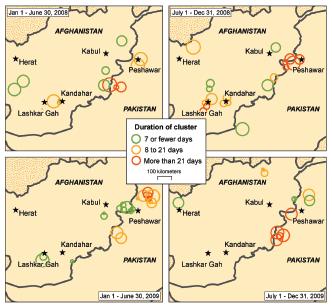
Once more on WikiLeaks: A team of University of Colorado researchers has already produced a geospatial analysis of the incident reports contained in the dataset. “By mapping the violence and examining its temporal dimensions, the authors explain its diffusion from traditional foci along the border between the two countries. While violence is still overwhelmingly concentrated in the Pashtun regions in both countries, recent policy shifts by the American and Pakistani governments in the conduct of the war are reflected in a sizeable increase in overall violence and its geographic spread to key cities. . . .” This is exactly the kind of analysis the military intelligence agencies are not doing, or at least not sharing.
Economists, geographers, entrepreneurship and innovation researchers, and other social scientists have a lot of expertise in network and cluster analysis. Why not turn them loose on these kinds of raw data? It’s also cheap: as Karen Kwiatkowski notes, “[t]he study was honestly, scientifically, and nimbly completed and published at no direct cost to the intelligence community. It was made possible by the decentralization, fluidity, and constant sharing and shifting of roles and responsibilities that comprise the Internet.”
Department of “Duh”
| Peter Klein |
It must be acknowledged, however, that a researcher’s political ideology or vested interest in a particular theory can still enter even ostensibly descriptive analysis by the data set chosen for the research; the mathematical transformations of raw data and the exclusion of so-called outlier data; the specific form of the mathematical equations posited for estimation; the estimation method used; the number of retrials in estimation to get what strikes the researcher as “plausible” results, and the manner in which final research findings are presented.
That’s Uwe Reinhardt, writing a NY Times op-ed that could have been titled “A Mainstream Economist Tries to Come to Grips with Kaldor-Hicks Efficiency.” It’s actually a pretty thoughtful and informative discussion that exposes some of the fatal — to my mind, anyway — flaws of the Kaldor-Hicks concept. But Reinhardt implies, unfortunately, that virtually every economist accepts the Kaldor-Hicks principle as a normative standard. There is actually a fair amount of dissent, not only from Austrians but also from people like Jon Elster and John Roemer. As Gary Lawson notes in an excellent survey of welfare economics concepts, the Kaldor-Hicks criterion, in practice, is
as useless as Pareto superiority. Kaldor-Hicks efficiency purchases its coherence by requiring that compensation be hypothetically possible in such a way as to guarantee that each person, by her own standards, does not come away a loser, just as strict Paretianism requires that each person judge herself to be as well off or better off than before. All it takes to make the universe of Kaldor-Hicks-efficient transactions an empty set is one person who sincerely cannot be bought-that is, a person who values autonomy, either his own or that of others, so highly that no amount of after-the-fact compensation could possibly leave him as well off as he would have been had the loss never been inflicted. (without consent) in the first place. In a large population, no legal rule [or other reallocation of resources] will ever satisfy the Kaldor-Hicks efficiency criterion.
Austrian Economics PhD Course
| Peter Klein |
This semester I am teaching a PhD course in the Austrian school of economics. Here’s a preview. Visitors to Columbia, Missouri are welcome to sit in!
Excerpt from the syllabus:
It is difficult to cover an entire school of thought in one semester. Austrian economics, after all, is not an applied field like development economics or international trade policy or biotechnology but an alternative approach to all fields of economics. The course objective is not to provide a comprehensive review and critique of the entire Austrian tradition, but to give students a sampler of high-quality Austrian writings, classic and modern, on a variety of issues and topics. One goal is to show that while Austrian economists share a common conceptual framework, theoretical core, and historical context, the Austrian literature contains tremendous variety, both stylistic and substantive. Like any living, breathing tradition the Austrian literature continues to expand and diversify, often at a dizzying pace.
Add to: Facebook | Digg | Del.icio.us | Stumbleupon | Reddit | Blinklist | Twitter | Technorati
Experimental Philosophy
| Peter Klein |
 Experimental economics is mainstream, and is increasingly popular in management (as well as sociology, political science, criminology, etc.). Laboratory and natural experiments seem to fill more journal pages every year. Esther Duflo took home this year’s Clark Medal for her work on randomized controlled trials. Identification is all the rage in empirical social science, and who needs instrumental variables or fixed effects if you can force ceteris to be paribus through experimental design?
But wait a minute: philosophy? Apparently philosophers are getting into the game, via a new experimental philosophy movement (“X-Phi,” to the cool kids). The NYT Magazine surveyed the field a few years back, and this week’s this week’s “Room for Debate” asks important philosophers what they think. Note the wide range of opinions. My initial reaction was similar to Brian Leiter’s, namely that X-Phi is about being trendy, attracting funding, and keeping philosophy departments from being shredded by budget-conscious administrators. Academia, after all, is among the most faddish of the professions. But who knows. (Thanks to MLC for the link.)
Add to: Facebook | Digg | Del.icio.us | Stumbleupon | Reddit | Blinklist | Twitter | Technorati
The (Very) Early History of Financial Economics
| Peter Klein |
The latest issue of the History of Economics Review contains Geoffrey Poitras and Jovanovic’s interesting paper, “Pioneers of Financial Economics: Das Adam Smith Irrelevanzproblem?” (published version not available online; working-paper version here, presentation slides here). Despite the subtitle the paper isn’t about Adam Smith, but the (very) early history of financial economics. Here’s an excerpt:
In the case of financial economics, the roots of this field stretch back to antiquity, involving the valuation of financial transactions, such as determining payment on a loan or distributing profits from a partnership. Poitras (2000) uses the late fifteenth century as a starting point for the early or pre-classical history of financial economics, more than three centuries prior to the publication of the [Wealth of Nations]. As early as Fibonacci (1170?-1250?), elements of financial economics were being disseminated among the merchant classes in the commercial arithmetics that, by the fifteenth century, formed the core of the reckoning school curriculum, e.g., Swetz (1987). A fundamental historical demarcation point appears with Christian Huygens’s (1629-1695) seminal introduction of the modern theory of expectations.
From this point, until the appearance of the WN, the founding work of classical political economy, financial economics underwent a dramatic transformation. By the time the Theory of Moral Sentiments appeared, sophisticated methods for pricing contingent claims, such as the life annuities sold by various individuals, municipalities and national governments in western Europe, had been developed and were being applied to the establishment of actuarially sound life insurance plans and pension funds. Hald (1990), Poitras (2006), Lewin (2003) and Rubinstein (2003) among others identify the earliest pioneers of modern financial economics, the beginning of classical financial economics, from the contributors that developed these pricing methods. As such, there is a close connection between the classical histories of financial economics, statistics, and actuarial science.
In other words, this is a field in which theory and practice appear to have co-evolved quite closely, which raises interesting questions for the performativity crowd. Modern financial economics is in many ways similar: theories of market efficiency were both shaped by, and helped to shape (e.g., through options-pricing formulas) actual market behavior.
Add to: Facebook | Digg | Del.icio.us | Stumbleupon | Reddit | Blinklist | Twitter | Technorati
Before They Were Famous
| Peter Klein |
Joe Morgenstern’s recent rant about the horrible year in movies included a sidebar (scroll down) about cinema classics that appeared ordinary when they came out. Casablanca, for example, was considered just another patriotic war movie, which the studios were putting out by the dozen, and a syrupy one at that.
The sidebar reminded me of Josh Gans and George Shepherd’s essay on classic social-science papers that struggled to find a publisher. Akerlof’s “Market for Lemons” was rejected by the AER, JPE, and REStat before QJE finally picked it up in 1970. Williamson’s manuscript for Markets and Hierarchies was rejected by Brookings. Robert Lucas’s 1972 paper, “Expectations and the Neutrality of Money” was rejected by the AER on the grounds that it was too mathematical. William Sharpe’s 1964 paper that introduced the capital asset pricing model was initially rejected by the Journal of Finance because, wrote the editor, the assumption that all investors make the same predictions was “preposterous.”
Jim March, as often, gets the best line: “I recall on one occasion a referee filing a two paragraph commentary on a paper I co-authored suggesting (in the first paragraph) that the key theorem involved was trivially obvious and (in the second) that it was wrong. I thought on the whole that he ought to
choose.”
Add to: Facebook | Digg | Del.icio.us | Stumbleupon | Reddit | Blinklist | Twitter | Technorati
Uncertainty and Human Action in Fiction
| Peter Klein |
 From Ursula Le Guin’s 1969 novel The Left Hand of Darkness:
“The unknown,” said Faxe’s soft voice in the forest, “the unforetold, the unproven, that is what life is based on. Ignorance is the ground of thought. Unproof is the ground of action. If it were proven that there is no God there would be no religion. No Handdara, no Yomesh, no hearthgods, nothing. But also if it were proven that there is a God, there would be no religion. . . . Tell me, Genry, what is known? What is sure, predictable, inevitable — the one certain thing you know concerning your future, and mine?”
“That we shall die.”
“Yes. There’s really only one question that can be answered, Genry, and we already know the answer. . . . The only thing that makes life possible is permanent, intolerable uncertainty: not knowing what comes next.”
The phrase “permanent, intolerable uncertainty” brings to mind Knight’s famous remark in Risk, Uncertainty, and Profit about the “the sheer brute fact that the results of human activity cannot be anticipated.”
Add to: Facebook | Digg | Del.icio.us | Stumbleupon | Reddit | Blinklist | Twitter | Technorati
Rothbard Quote of the Day: Theory and History
| Peter Klein |
 I stumbled recently upon this passage from Murray Rothbard’s review of Unemployment in History by the distinguished historian John A. Garraty. Rothbard’s review, published in 1978, raised an issue that has come up in previous discussions of the Freakonomics phenomenon (1, 2, 3, 4): Can a little theory, without accompanying real-world knowledge, be a dangerous thing?
After chiding Garraty for writing about unemployment without knowing the basics of business-cycle theory, Rothbard adds:
My strictures against history which lacks any sound theoretical base are not meant to be an act of intellectual imperialism on behalf of economics and against history or other disciplines. Quite the contrary; the economist who ventures into the historical arena armed only with a few equations and mathematical razzle-dazzle has wreaked far more damage than the uninspired and slightly bumbling historian. For the economist, particularly the latter-day “cliometrician,” aims to flaunt his arrogant “scientific” pretensions of encompassing and explaining all of world history by means of a few mathematical symbols. The economist who knows no history understands far less than his opposite number in the historical profession; but his claims are far greater. Therefore, he is much wider off the mark.
Add to: Facebook | Digg | Del.icio.us | Stumbleupon | Reddit | Blinklist | Twitter | Technorati
The Wikileaks Data Dump
| Peter Klein |
I’ve been fascinated by the reaction to the Wikileaks release of 90,000+ classified documents related Afghanistan war. US and British (and Pakistani) authorities are predictably outraged, while critics of the war are encouraged that the disclosures could help turn the tide, as did the Pentagon Papers three decades prior. What interests me the most, however, is the massive size of the Wikileaks archive. As the Guardian’s Roy Greenslade remarked, this is “data journalism.” Wikileaks doesn’t analyze, synthesize, attempt to corroborate, seek alternative points of view, write up the inverted-pyramid lead, or do the other things respectable journalists are supposed to do; it just dumps the data and lets others sort it out.
Some find this approach distasteful. A Pakistani official said “these reports betray a lack of understanding of the complexities of the nations involved.” Well, sure. They’re raw data, nothing more. But isn’t sharing data, and not just analysis, a quintessential New Economy phenomenon? Don’t we have search and analysis tools, data-mining algorithms, page rankings, and other means to sift through the huge piles of stuff that constitute the long tail? Shouldn’t expert commentary and analysis be replicable? Many journals now mandate data-sharing. E.g.: “It is the policy of the American Economic Review to publish papers only if the data used in the analysis are clearly and precisely documented and are readily available to any researcher for purposes of replication. Authors of accepted papers that contain empirical work, simulations, or experimental work must provide to the Review, prior to publication, the data, programs, and other details of the computations sufficient to permit replication. These will be posted on the AER Web site.” Why should foreign-affairs reporting be different?
Add to: Facebook | Digg | Del.icio.us | Stumbleupon | Reddit | Blinklist | Twitter | Technorati
Political and Methodological Individualism
| Peter Klein |
 Further to Nicolai’s post, it is also widely believed that methodological individualism — the chief explanatory principle of economics and rational-choice sociology and political science — implies or justifies political individualism or, even worse, some kind of metaphysical or ontological individualism. “But people are social beings!” cry the critics. Well, sure. Methodological individualism is simply the view that social phenomena should be explained, or understood, in terms of the values, beliefs, plans, and actions of the individual that make up the social whole. It makes no claims about the ultimate source of these values and beliefs, the degree to which people are influenced by society, etc. It is a principle of explanation, nothing more.
Here’s a plain statement from Schumpeter, the guy who coined the term “methodological individualism” (okay, he used methodische Individualismus, and borrowed the concept from Weber), writing in 1908:
[W]e must strictly differentiate between political and methodological individualism, as the two have virtually nothing in common. the former starts form the general assumption that freedom, more than anything, contributes to the development of the individual and the well-being of society as a whole and puts forward a number of practical propositions in support of this. The latter is quite different. It has no specific propositions and no prerequisites, it just means that it bases certain economic processes on the actions of individuals. Therefore the question really is: is it practical to use the individual as a basis and would there be enough scope in doing so, or would it be better, in view of specific problems and the national economy as a whole, to use society as a basis. This question is purely methodological and involves no important principle. The socialists can answer it in terms of methodological individualism and the political individualists in terms of their social concept of things, without getting into conflict with their convictions.
See also the Mises quotes discussed here.
Add to: Facebook | Digg | Del.icio.us | Stumbleupon | Reddit | Blinklist | Twitter | Technorati
Too Much Research
| Peter Klein |
Bill McKelvey is one of the signatories to a controversial Chronicle piece that ran last month, “We Must Stop the Avalanche of Low-Quality Research.” The five authors, from a variety of academic disciplines, argue that “the amount of redundant, inconsequential, and outright poor research has swelled in recent decades, filling countless pages in journals and monographs.” As evidence they point to increases in the numbers of journals, journal pages, and authors and decreases in average citation rates.
[I]nstead of contributing to knowledge in various disciplines, the increasing number of low-cited publications only adds to the bulk of words and numbers to be reviewed. Even if read, many articles that are not cited by anyone would seem to contain little useful information. The avalanche of ignored research has a profoundly damaging effect on the enterprise as a whole. Not only does the uncited work itself require years of field and library or laboratory research. It also requires colleagues to read it and provide feedback, as well as reviewers to evaluate it formally for publication. Then, once it is published, it joins the multitudes of other, related publications that researchers must read and evaluate for relevance to their own work. Reviewer time and energy requirements multiply by the year. The impact strikes at the heart of academe.
I think this assessment is generally on target, in my own field at least. What percentage of the articles in your favorite scholarly journal do you read, let alone remember? How much of the research in your field really adds value? Of course, search tools make it easier to find relevant information, so I’m not sure the point about lit reviews is all that compelling. Still, it does seem increasingly difficult to sort wheat from chaff.
I’m less impressed with the authors’ proposed solutions — limiting the number of publications that can be considered for promotion and tenure, making greater use of impact factors, and enforce tighter page restrictions. These strike me as superficial fixes. The main problem is the vast increase in the scale and scope of the “scientific” enterprise itself, almost all of it due to public funding. There are simply too many universities and institutes, too many research faculty, too many granting agencies, too much research money. It’s a self-perpetuating process, almost exclusively driven by supply-side considerations (who on earth “demands” the output of most English departments?). Some of you will be shocked by the claim that there’s “too much” research money, particularly in today’s austere climate. But I mean too much relative to some social optimum, not too much relative to what university professors want.
Why would we expect this kind of system to produce high-quality research? Perhaps it’s a miracle that any good work gets done at all.
Add to: Facebook | Digg | Del.icio.us | Stumbleupon | Reddit | Blinklist | Twitter | Technorati
The Unbearable Lightness of Economics (?)
| Nicolai Foss |
The always-helpful Peter suggested “a quick-and-easy Foss blog post,” specifically a post on what sounds like an interesting conference on “Economics Made Fun in the Face of the Economic Crisis,” organized by Jack Vromen and N.E. Aydinonat, at the Erasmus University Rotterdam, 10-11 December 2010. The Call builds up a tension between the emerging econ-made-fun genre (Levitt, Cowen et al.) with its implied view of econ as a universal tool for understanding behaviors and their implications, and the claimed inability of econ to come to grips with the current crisis. You may think what you like of this claimed tension, but Jack Vromen always represents quality, and with keynote speakers like Diana Coyle, Robert Frank, and Ariel Rubinstein, this conference will be fun.
Add to: Facebook | Digg | Del.icio.us | Stumbleupon | Reddit | Blinklist | Twitter | Technorati
Does Behavioral Economics Offer Anything New and True?
| Peter Klein |
One of my frustrations with behavioral economics is that it often seems to restate common, obvious, well-known ideas as if they are really novel insights (e.g., that preferences aren’t stable and predictable over time). More novel propositions are questionable at best (e.g, the paradox of choice).
Dan Ariely’s column in this month’s HBR is particularly frustrating. He claims as a unique insight of behavioral economics that when people are evaluated according to quantitative measures of performance, they tend to focus on the measures, not the underlying behavior being measured. Well, duh. This is pretty much a staple of introductory lectures on agency theory (and features prominently in Steve Kerr’s classic 1975 article). Ariely goes on to suggest that CEOs should be rewarded not on the basis of a single measure of performance, but multiple measures. Double-duh. Holmström (1979) called this the “informativeness principle” and it’s in all the standard textbooks on contract design and compensation structure (e.g., Milgrom and Roberts, Brickley et al., etc.) (Of course, agency theory also recognizes that gathering information is costly, and that additional metrics are valuable, on the margin, only if the benefits exceed the costs, a point unmentioned by Ariely.)
Ariely says firms should not evaluate CEO’s on stock price, but on a variety of measures. What, for example? Here the story gets a bit murky:
Ideally, they’d vary by industry, situation, and mission, but here are a few obvious choices: How many new jobs have been created at your firm? How strong is your pipeline of new patents? How satisfied are your customers? Your employees? What’s the level of trust in your company and brand? How much carbon dioxide do you emit?
Ariely seems unaware that stock price is the most frequently used measure of firm performance precisely because it is a composite measure that captures all of those things. Stock price reflects the best available information about current and expected future performance — products, jobs, customer satisfaction, etc. Is it a perfect measure? Hardly. But it isn’t obvious how owners or Boards can create their own quantitative, composite measure by by picking their favorite elements, proxies, weighting schemes, and so on, in a way that provides better overall assessments of performance than market valuations. Boards, after all, may be predictably irrational too.
Add to: Facebook | Digg | Del.icio.us | Stumbleupon | Reddit | Blinklist | Twitter | Technorati
This Makes Me Think of Hayek’s Sensory Order
| Peter Klein |
From Wired:
Karl Popper, the great philosopher of science, once divided the world into two categories: clocks and clouds. Clocks are neat, orderly systems that can be solved through reduction; clouds are an epistemic mess, “highly irregular, disorderly, and more or less unpredictable.” The mistake of modern science is to pretend that everything is a clock, which is why we get seduced again and again by the false promises of brain scanners and gene sequencers. We want to believe we will understand nature if we find the exact right tool to cut its joints. But that approach is doomed to failure. We live in a universe not of clocks but of clouds.
Add to: Facebook | Digg | Del.icio.us | Stumbleupon | Reddit | Blinklist | Twitter | Technorati
Esther Duflo Wins Clark Medal
| Peter Klein |
Congratulations to MIT’s Esther Duflo for winning the John Bates Clark Medal. (NB: Unlike Richard T. Ely, J. B. Clark was actually a great economist.) Duflo is a pioneer in the use of randomized controlled trials (RCTs) which, along with natural experiments, is becoming an increasingly popular alternative to conventional regression models. Interestingly, the WSJ reports that Harvard’s Sendhil Mullainathan, another RCT person, was also on the short list. Given the extreme faddishness of social scientists we can expect a wave of RCT centers, experiments, and papers in the next few years.
Add to: Facebook | Digg | Del.icio.us | Stumbleupon | Reddit | Blinklist | Twitter | Technorati
Melnyk on Flew
| Peter Klein |
My Missouri colleague Andrew Melnyk penned this nice appreciation of Antony Flew, who passed away 8 April 2010. Flew “was for several decades a heroic defender of classically liberal political philosophy and indeed by far the best known professional philosopher in Britain over that period to champion classical liberalism.” As Andrew notes, “in challenging the spirit of the age as sharply and as unapologetically as he did, he was, and must have known that he was, irreparably damaging his reputation among his overwhelmingly left-leaning professional peers.”
Here are remarks on Flew’s political philosophy from David Gordon, David Conway, and Sean Gabb. Here’s a biographical sketch written for Flew’s 2001 Schlaurbaum Prize, and here’s the acceptance speech.
Add to: Facebook | Digg | Del.icio.us | Stumbleupon | Reddit | Blinklist | Twitter | Technorati
Neuroeconomics and Methodological Individualism
| Peter Klein |
Methodological individualists, following Schumpeter (1908), hold that aggregates like firms, societies, nations, etc. should be modeled as organizations or ecosystems composed of smaller decision-making units. But the reduction has to stop somewhere — it can’t be turtles all the way down (the Matrix-within-the-Matrix problem). Economists typically define the individual actor as the relevant unit of analysis; we don’t go further down to the level of, say, the gene (see Nicolai’s earlier discussion of the “driver’s seat fallacy”).
Neuroeconomics — the latest advance of the behavioralist revolution — rejects the conventional perspective, however. Isabelle Brocas and Juan Carrillo conclude their recent useful summary of neuroeconomic research by likening individuals to organizations:
Neuroeconomic theory will soon play a crucial role in the building of new reliable theories capable of explaining and predicting individual behaviour and strategic choices. The main message is that the individual is not one coherent body. The brain is a multi-system entity (with conflicting objectives, restricted information, etc.) and therefore the decision-maker must be modelled as an organisation. We conclude with an analogy. Before the so-called modern theory of the firm, organisations were modelled as individual players characterised by an input-output production function. The systematic study of interactions between agents and decision processes within organisations (acknowledging informational asymmetries, incentive problems, restricted communications channels, hierarchical structures, etc.) led to novel economic insights. Applying a similar methodology to study individual decision-making is, in our view, the most fruitful way to understand the bounds of rationality.
Hmmm, I admit that my brain often has trouble motivating other parts of my body to achieve the brain’s objectives, but I’ve never thought of these as agency costs. And I suppose that leprosy — in which the nervous system fails to communicate information about damage to bodily extremities to the brain – could be described as a failure to make effective use of dispersed specific knowledge. But I don’t quite see the value added.
More generally, my own view is that neuroeconomics represents a potentially interesting branch of applied psychology, but has little to do with economics per se. Economics is about the logical relationships between means and ends, not the psychology of preferences and beliefs. But mine is a minority view.
Add to: Facebook | Digg | Del.icio.us | Stumbleupon | Reddit | Blinklist | Twitter | Technorati
IRB Flames
| Peter Klein |
Zachary Schrag’s excellent Institutional Review Blog highlights the discussion on a recent Chronicle post about IRBs. As you can imagine, most of the comments are from frustrated researchers who see the campus IRB as their enemy, not their ally. Sample: “At my current institution, humanities scholars are subject to an IRB that only makes sense for scientists collecting blood and doing life-threatening experiments on small children.” Zach points out that a few comments defend the local IRB, but these comments “are vaguer and less eloquent,” and “none tells a story of an IRB review that proved necessary.”
I suspect that some of this researcher frustration can be alleviated by recognizing that IRBs exist not to protect research subjects, but to protect the university. The IRB’s goal is to prevent the university from being sued or otherwise losing Federal funding. Protecting research subjects, improving research methods, and contributing to the growth of knowledge are incidental.
Add to: Facebook | Digg | Del.icio.us | Stumbleupon | Reddit | Blinklist | Twitter | Technorati
Miscellaneous Conference and Paper Links
| Peter Klein |
SSRN has a new Philosophy and Methodology of Economics working-paper series, sponsored by the International Network for Economic Method.
Here’s a CFP for a Special Issue of the E-conomics e-Journal on the Social Returns to Higher Education, R&D and Innovation.
You can watch a live stream of this weekend’s SEJ Special Issue Conference on Knowledge Spillovers & Strategic Entrepreneurship.
The registration and accommodations section of the ISNIE 2010 website is now open.
Add to: Facebook | Digg | Del.icio.us | Stumbleupon | Reddit | Blinklist | Twitter | Technorati
Hayekian Ants
| Dick Langlois |
A former student of mine (thanks, Don) sent me a link to a fascinating piece in the Proceedings of the Royal Society called “Rationality in Collective Decision-making by Ant Colonies.” Here’s the abstract.
Economic models of animal behaviour assume that decision-makers are rational, meaning that they assess options according to intrinsic fitness value and not by comparison with available alternatives. This expectation is frequently violated, but the significance of irrational behaviour remains controversial. One possibility is that irrationality arises from cognitive constraints that necessitate short cuts like comparative evaluation. If so, the study of whether and when irrationality occurs can illuminate cognitive mechanisms. We applied this logic in a novel setting: the collective decisions of insect societies. We tested for irrationality in colonies of Temnothorax ants choosing between two nest sites that varied in multiple attributes, such that neither site was clearly superior. In similar situations, individual animals show irrational changes in preference when a third relatively unattractive option is introduced. In contrast, we found no such effect in colonies. We suggest that immunity to irrationality in this case may result from the ants’ decentralized decision mechanism. A colony’s choice does not depend on site comparison by individuals, but instead self-organizes from the interactions of multiple ants, most of which are aware of only a single site. This strategy may filter out comparative effects, preventing systematic errors that would otherwise arise from the cognitive limitations of individuals.





 Organizations and Markets
Recent Comments