Posts filed under ‘Myths and Realities’
The Treasury Bill as Myth and Symbol
| Peter Klein |
My father was a historian and helped organize local events to commemorate the bicentennials of the Declaration of Independence in 1976 and Constitution in 1987. I particularly remember the Freedom Train, a traveling exhibit housing memorabilia such as original copies of the Declaration, Constitution, Louisiana Purchase, and (I learn from Wikipedia, though I don’t remember these) Judy Garland’s dress from the Wizard of Oz and Joe Frazier’s boxing trunks.
Several years later, my Dad gave a conference paper (unfortunately unpublished) on “The Constitution as Myth and Symbol.” He noted that for many Americans, the founding documents, along with the Liberty Bell, Independence Hall, images of George Washington and Betsy Ross, etc., play the same kind of role as a Britain’s crown jewels, the Bastille, or Lenin’s tomb. The Constitution is important, in other words, not only for its text — some would argue the text is largely ignored today anyway — but for its symbolic value. It represents a particular myth of the American founding, usually associated with reason and noble ideals (Bernard Bailyn, Ayn Rand, Schoolhouse Rock) but occasionally with power or material self-interest (Charles Beard, Bertell Ollman).
 In following the debates over raising the US debt ceiling I”m struck by the frequent claim that defaulting on public debt is unthinkable because of the “signal” that would send. If you can’t rely on the T-Bill, what can you rely on? Debt instruments backed by the “full faith and credit of the United States” are supposed to be risk-free, almost magically so, somehow transcending the vagaries of ordinary debt markets. The Treasury Bill, in other words, has become a myth and symbol, just like the Constitution.
I find this line of reasoning unpersuasive. A T-bill is a bond, just like any other bond. Corporations, municipalities, and other issuers default on bonds all the time, and the results are hardly catastrophic. Financial markets have been restructuring debt for many centuries, and they’ve gotten pretty good at it. From the discussion regarding T-bills you’d think no one had ever heard of default risk premia before. (Interestingly, this seems to be a case of American exceptionalism; people aren’t particularly happy about Greek, Irish, and Portuguese defaults but no one thinks the world will end because of them.) So, isn’t it time to de-mythologize all this? Treasuries are bonds just like any other bonds. There’s nothing magic, mythical, or sacred about them. A default on US government debt is no more or less radical than a default on any other kind of debt.
Frank Knight and the Austrians
| Peter Klein |
At this year’s Austrian Scholars Conference I gave a presentation playfully titled “Frank H. Knight: The Forgotten Austrian.” The title was tongue-in-cheek, of course, as Knight was no Austrian. Though friendly with Hayek personally, Knight was a harsh critic of Austrian capital theory, particularly as formulated by Böhm-Bawerk and Hayek. (Knight conceived capital as a permanent fund of value, with interest determined by the technical marginal productivity of capital, rejecting notions of production structures and time preference.) Knight was also a key developer of perfect competition theory — anathema to Austrians — though mainly to illustrate the importance of uncertainty, not to serve as a welfare bechmark.
Still, there are many interesting similarities between Knightian and Austrian economics. Regular readers of O&M already know that Mises’s approach to entrepreneurship, uncertainty, and the firm is basically the same as Knight’s. Knight rejected positivism, calling it “the emotional pronouncement of value judgments condemning emotion and value judgments” (Knight, 1940). He often sounded like a Misesian praxeologist: “If anyone denies that men have interests or that ‘we’ have a considerable amount of knowledge about them, economics and its entire works will simply be to such a person what the world of color is to the blind man” (Knight, 1956). Indeed, critics dismiss Knight’s epistemological writings as “extended Austrian-style disquisitions on the foundations of human knowledge and conduct and the like” (LeRoy and Singell, 1987) — the ultimate insult! (more…)
The Organizational Structure of Al Qaeda
| Peter Klein |
Speaking of organizational structure, here’s former O&M guest blogger Craig Pirrong on Al Qaeda:
There is a concerted effort underway to portray Bin Laden as exerting operational control over Al Qaeda, based on material collected during the raid on his compound. Color me skeptical.
First, it’s hard to imagine how he could exercise any control at anything but the broadest strategic and conceptual level while he was relying on couriers to communicate with subordinates. Second, this hierarchical model is contrary to virtually all that has been written about Al Qaeda going back to its early days: the organization has been consistently portrayed as networked and distributed rather than hierarchical. Indeed, the conventional characterization of Al Qaeda represents it as more of a franchise operation in which the franchisees have considerable autonomy.
But let’s assume for a moment that the organization was hierarchical, and that operational elements required direction and approval from Bin Laden to implement any attack. If that’s true, we may have actually done ourselves a disservice by killing Osama. For it would be almost trivially simple to get inside AQ’s OODA (“observe, orient, decide, and act”) loop and disrupt and destroy its operations. Even if we didn’t know what AQ was up to, we could disrupt their plans just by mixing (randomizing) our strategies, by unexpectedly changing up the way we do things. If response to such changes required the locals carrying out missions to report back to OBL via a painfully slow communications system, await a decision, and wait for the decision to be couriered back, they would be unable to do anything serious. In this case, killing OBL would free the locals to be more flexible and responsive — and hence more dangerous. It would permit AQ to become more of a network, less predictable, and more able to adapt to our moves.
I too doubt this emerging meme on OBL as operational figure, perhaps for somewhat different reasons: I assume that any official information about the operation and its significance is primarily propaganda, not transparent disclosure. Naturally the Administration would want to exaggerate the significance of Bin Laden’s, um, “retirement.”
Macroeconomics Quote of the Day
| Peter Klein |
From Mario Rizzo, who’s written a number of great posts on contemporary macroeconomic thought:
The truth is that pre-Keynesian economics was, in most ways, more sophisticated than the aggregate demand framework bequeathed to us by Keynes and his official interpreters.
Mario explains how Paul Krugman, like Keynes himself, puts forth a straw-man version of pre-Keynesian macroeconomics in which a) crises are impossible and b) only national aggregates matter. Actual pre-Keynesian macroeconomics, like today’s Austrianism, often focused on the composition of output and employment across firms, industries, and sectors. Only a few oddballs, like Foster and Catchings, the proto-Keynesian underconsumptionist theorists  skewered by Hayek in “The Paradox of Savings,” worried about economy-wide underconsumption.
See a sampler of our own thoughts on Keynes and Keynesianism here, here, and here. Or you could just watch the brilliant Keynes versus Hayek, Round 2.
Veblen at Missouri
| Peter Klein |
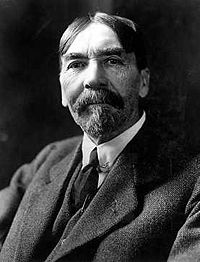 Thorstein Veblen was a professor at the University of Missouri from 1911 to 1918, following stints at Chicago and Stanford and before moving to New York to co-found the New School for Social Research with Charles Beard and John Dewey. Little has been written about Veblen’s time at Missouri, or his relationship with Herbert J. Davenport, who recruited Veblen to Missouri and provided his lodgings. (Veblen is mostly forgotten, locally, but Davenport, who founded the College of Business, is fondly remembered.)
The most detailed account of Veblen’s Missouri years (to my knowledge) appears in Russell H. Hartley and Sylvia Erickson Hartley, “In the Company of T. B. Veblen: A Narrative of Biographical Recovery” (International Journal of Politics, Culture, and Society 13, no. 2: 273-331 — the entire issue is devoted to Veblen). One snippet:
The notion that Veblen’s years in Missouri were a kind of Siberian exile which he spent as an embittered recluse seems more the fancy of academic urbanites than a reflection of actual fact. Dorfman’s puzzling assertion that Columbia “was the first country town where Veblen had stayed for any length of time” contradicts both the facts of Veblen’s life and Dorfman’s own account of those facts. By the time he settled into the Davenports’ at the end of 1910, Thors had lived thirty of his fifty-three years in rural and small-town settings. Columbia was a veritable metropolis compared with Nerstrand or Stacyville and was more than twice the size of Northfield, where he had spent six years attending Carleton.
Veblen’s reported description of Columbia as “a woodpecker hole of a town in a rotten stump called Missouri,” cited by Dorfman as evidence of his “abhorrence” of the place, reflects his wit and mordant sense of humor rather than emotional distress over his physical location. It was an offhand commentary on the local Chamber of Commerce’s campaign to elicit a promotional slogan for the Boone County seat — a remark perfectly in tune with Veblen’s views of business and the commonweal, comprehensible only in light of his analysis of American country towns generally.
Humanoid Resource Management
| Peter Klein |
I can’t quite tell if this “Schumpeter” column, urging management scholars to think more carefully about “homo-robo relations,” is meant to be taken seriously. It gave me a few chuckles, anyway.
Until now executives have largely ignored robots, regarding them as an engineering rather than a management problem. This cannot go on: robots are becoming too powerful and ubiquitous. Companies may need to rethink their strategies as they gain access to these new sorts of workers. Do they really need to outsource production to China, for example, when they have clever machines that work ceaselessly without pay? They certainly need to rethink their human-resources policies — starting by questioning whether they should have departments devoted to purely human resources.
And what about robo-agency theory? Can robots be programmed to be intrinsically motivated — finally rendering certain management theories intelligible — or do they respond to incentives in a predictable way? Are they risk averse? Will they behave opportunistically? Can they be “nudged” by clever behavioral economists?
Actually the article does make some serious points, e.g., economists and management scholars should prepare for an onslaught of neo-Luddite, anti-automation, protectionist gibberish about robots “taking away our jobs.” (Maybe if they’re domestically made robots it will be OK?)
Management Textbooks Bungle Weber
| Peter Klein |
Most management scholars, like most economists, have little interest in doctrinal history, so it’s not surprising they don’t pay much attention to the history of management thought. But Stephen Cummings and Todd Bridgman’s “The Relevant Past: Why the History of Management Should Be Critical for Our Future” (Academy of Management Learning and Education, March 2011) is an eye-opener. Focusing on Max Weber, Cummings and Bridgman document a series of whoppers that appear consistently in leading management texts, such as the belief that “ideal type” means best or optimal; that Weber did his major work in the 1940s (Parsons’s translation of Wirtschaft and Gesellschaft appeared in 1947, 27 years after Weber’s death); that Weber personally admired bureaucracy (In Search of Excellence avers that Weber “pooh-poohed charismatic leadership and doted on bureaucracy”); and other gross misunderstandings. FAIL.
Creative Destruction in Popular Culture
| Peter Klein |
Thanks to Thomas B. for forwarding links to US Sen. Rand Paul’s Monday-night appearance on the Daily Show (part 1, part 2, part 3). At the start of part 3, while discussing government bailouts, Paul uses the words “creative destruction,” and Jon Stewart bursts out laughing, apparently hearing the term for the first time. I guess Schumpeter is not as culturally relevant as I thought!
The show had some interesting moments, but I found the discussions (in the parts I watched) pretty shallow. Stewart was grilling Paul on his “free-market” views, focusing on health, safety, and environmental regulation. Both Paul and Stewart took the milquetoast position that sure, some of this type of regulation is needed, but it shouldn’t be “too much.” They didn’t get into a serious discussion of theory or evidence, however, or explore specific trade-offs. There are huge political economy and public-choice literatures on the FDA, EPA, OSHA, etc., showing that these organizations are easily captured, tend to retard innovation, fail to weigh marginal benefits and costs, and so on. The Journal of Law and Economics under Coase’s leadership made its bones on these kinds of studies in the 1970s. The FDA has been a particular target. The Stewart view also ignores comparative institutional analysis — e.g., the role of private ordering (third-party certification, reputation, etc. ) in the protection of health and safety.
At least Paul didn’t say he intended to become the best Senator, horseman, and lover in all Washington!
Famous Quotations Taken Out of Context
| Peter Klein |
 Kenneth Olsen, former head of computer-industry pioneer Digital Equipment Corporation, died over the weekend. DEC was probably the most important “minicomputer” firm of the 1970s and 1980s, one that failed to make the transition to the PC era and dropped out of sight. (DEC plays a major role in Tracy Kidder’s 1981 Pulitzer-winning book Soul of a New Machine — a book I read just this last year and which, despite the now-obsolete subject matter, feels surprisingly fresh. DEC was the dominant incumbent and foil to Kidder’s protagonist firm, Data General.)
Despite his many accomplishments — a 1986 Fortune article called him “America’s most successful entrepreneur” — Olsen is remembered today mostly for saying, in 1977, “There is no reason for any individual to have a computer in his home.” This is usually taken to show how the leading mainframe and minicomputer firms failed to see the gale of creative destruction on the horizon, or just to illustrate businessperson cluelessness more generally. (Bill Gates’s 1981 remark that “640K ought to be enough for anybody” falls in the same category.)
Olsen consistently maintained that he was quoted out of context, that he wasn’t talking about the ordinary desktop PC, but a sort of master house computer that would run the home, much like HAL in 2001. According to the useful Snopes.com entry on Olsen, “What Olsen was addressing in 1977 was the concept of powerful central computers that controlled every aspect of home life: turning lights on and off, regulating temperature, choosing entertainments, monitoring food supplies and preparing meals, etc. The subject of his remark was not the personal use computer that is now so much a part of the American home, but the environment-regulating behemoth of science fiction.” As Olsen himself put it: “A long time ago when the common knowledge was that PCs would run our lives in every detail, I said that if you stole something from the refrigerator at night you didn’t want to enter this into the computer so that it would mess up the computer plans for coming meals.” I wouldn’t make that sandwich if I were you, Dave.
What are some other examples of famous quotations taken out of context?
WSJ on Conglomerates
| Peter Klein |
Industrial conglomerate ITT announced in January a split into three more focused companies, one concentrated in hotels and gaming, one in education (technical training centers), and a slimmed-down ITT Corporation containing the remaining manufacturing businesses. This is the second major restructuring for ITT, once the poster child of the conglomerate movement of the 1960s and early 1970s.
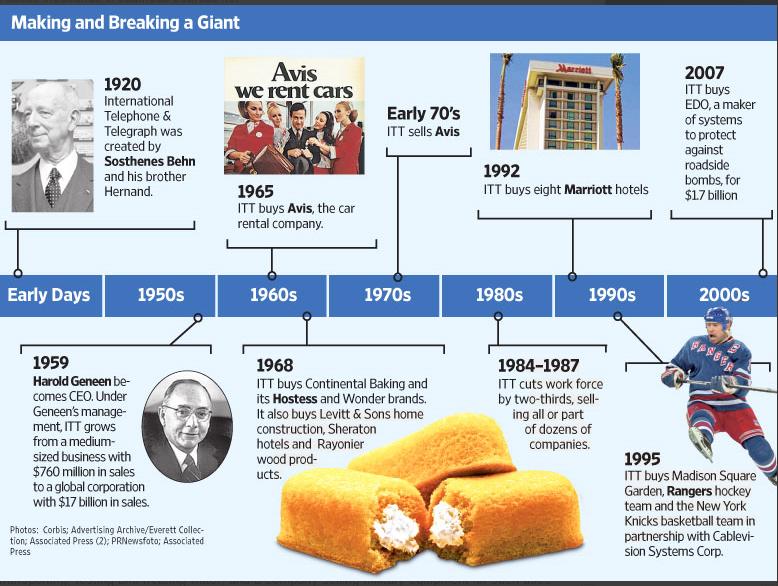 The Wall Street Journal’s article of 13 January contains a nice graphic on the firm’s history, including a picture of Harold Geneen, the quintessential “management by the numbers” CEO (click to enlarge). It also includes ruminations on the conglomerate form more generally, about which I have a continuing research interest. Yale’s Jeffrey Sonnenfeld says conglomerates represented “an unholy mix of opportunistic investment bankers, misguided consultants and the vanities of CEOs.” A companion article puts it this way: “Conglomerates blossomed five decades ago, when favorable interest rates made it relatively easy to boost revenue and stock prices with serial acquisitions. But they fell out of favor when the stock increases slowed and investors began to question whether promised efficiencies would materialize.”
But this is not quite right. In fact, the research literature finds little evidence that conglomerate growth was fueled mainly by cheap credit and rising stock prices. (more…)
Scientific Misconduct in Management Research
| Nicolai Foss |
Fraudulent behavior in research is the ultimate academic gossip. It is hardly surprising that our post on Thomas Basbøll’s claim that management theory heavyweight Karl Weick has engaged in plagiarism (here) was one of O&M’s most popular posts in 2010. One of my own papers was once directly copied. All that was changed was the front page. In one of those strange coincidences, the journal editor asked my co-author to review the paper. The plagiarist was a consultant, not an academic, so it is possible that the case had no consequences for him.
How prevalent is scientific misconduct in management research? And how strongly should we care? After all, what gets published in the management journals does not have the same direct impact as what gets published in the medicine journals, or what the UN’s Intergovernmental Climate Panel utters. While management research may not cure cancer, it likely has considerable impact on resource allocation, and therefore on what is available for curing cancer. Moreover, there are strong externalities: A reputation for “bad science” in one field or discipline may easily spill over to other fields and disciplines. Hence, misconduct should be regarded with as severely in management research as in other fields and disciplines.
With respect to the incidence of fraudulent research behavior, rather little is known. While fraud in, particularly, medicine tends to draw major headlines in the press, I cannot recall anything similar in the case of management research. It seems unlikely that management researchers should be significantly more honest than researchers in medicine, so our lack of knowledge in this seems troublesome. In “Management Science on the Credibility Bubble: Cardinal Sins and Various Misdemeanors,” recently published in the Academy of Management Learning and Education, Arthur G. Bedeian, Shannon G. Taylor, and Alan N. Miller present evidence that research misconduct is quite a prevalent phenomenon. Briefly, they collected data from faculty in 104 PhD-granting management departments in the US. Questions identified “eleven different types of questionable research conduct, including data fabrication, data falsification, plagiarism, inappropriately accepting or assigning authorship credit, and publishing the same data or results in two or more publications.”
Some of Bedeian et al.’s examples of “questionable research conduct” seem somewhat open to interpretation and questioning (e.g., “developing ‘ins’ with journal editors” — in fact, the initiative for such “ins” often emerge from the editor side; “published the same data or results in two or more publications” — presumably, there is nothing necessarily wrong with publishing “the same data … in two or more publications”), and the procedure of asking faculty to indicate their “knowledge of faculty engaging in” research misconduct is questionable, as different faculty may relate to the same episode of research misconduct (they acknowledge this problem). Still, the numbers are quite striking. More than 70% reports knowledge of cases of not giving due credit to originators of ideas (i.e., plagiarism). Even more report knowledge of data manipulation, although only (?) 27% report knowledge of outright data fabrication.
Economic Growth Quote of the Day
| Peter Klein |
The path of economic progress is strewn with the wreckage of failures. Every business man knows this, but few economists seem to have taken note of it. In most of the theories currently in fashion economic progress is apparently regarded as the more or less automatic outcome of capital investment, “autonomous” or otherwise. Perhaps we should not be surprised at this fact: mechanistic theories are bound to produce results which look automatic.
— Ludwig Lachmann, Capital and Its Structure (1956), pp. 36-37.
Why Do Bad Ideas Spread? Luzzetti and Ohanian on the Rise and Fall of Keynesianism
| Peter Klein |
O&M generally takes a dim view of Keynesian economics. And yet Keynesianism triumphed after WWII and, while mostly dormant among academics from the 1970s to the 2000s, made a sweeping comeback over the last 2-3 years. If we anti-Keynesians are so smart, why is Keynesianism so popular?
This is an important question for the history, philosophy, and sociology of science, and we’ve addressed it before. Keynesianism appeals to fine-tuners, is easily formalized, appeared to “work” during and after WWII, has a “progressive” and “scientific” veneer, and justifies policies that governments have long championed (but all serious economists opposed).
Matthew Luzzetti and Lee Ohanian propose a similar narrative in their new NBER paper, “The General Theory of Employment, Interest, and Money After 75 Years: The Importance of Being in the Right Place at the Right Time.” In a nutshell, Keynesianism told people what they wanted to hear, gave them hope that the “new” economics could cure the Depression and bring long-term prosperity, worked well with the new empirical methods appearing in the 1940s and 1950s, and seemed consistent with observation. By the 1970s, however, the situation became almost reversed, and Keynesianism was dumped by the research community. Here’s an excerpt from the introduction: (more…)
Democracy and Credible Commitment in Universities
| Nicolai Foss |
In 2003, Denmark enacted what is the easily the least democratic university legislation in the world (the North Korean one may be less democratic). Essentially, faculty voting rights are now limited to selecting members of an “academic council” which mainly serves as a quality check on candidates for evaluation committees and as a body that offers advice to the university president and the deans. A board of directors (with a majority of external members) appoints the president, the president appoints the dean, and the dean appoints department heads.
This truly major change was partly motivated by the various inefficiencies of the earlier, much more democratic conditions. However, as autocratic systems also have well-known inefficiencies, the question is whether Denmark let the governance pendulum swing too much toward the opposite end. My colleague Henrik Lando directed my attention to a truly excellent paper by O&M guest blogger Scott Masten that is directly relevant to the understanding of this issue. (more…)
Henry Manne on Behavioral Economics
| Peter Klein |
Henry Manne’s contribution to the Truth on the Market symposium on behavioral economics brought to mind Lasse’s recent post (and the accompanying brilliant paper) on the survivor principle:
What I would like to point out . . . is the irrelevance of much of the substance of Behavioral Economics for “doing” economics. My principal (as a matter of fact my sole) authority for this proposition (though some of Gary Becker’s work also comes to mind) is the magnificent classic article by Armen Alchian, Uncertainty, Evolution, and Economic Theory, 58 JPE 211 (1950). In this work Alchian is himself taking on the “full information” assumption of the classical model, which is actually broader than the rationality assumption attacked by the Behavioralists. The basic conclusion of that work is that, even if individuals or firms make totally uniformed choices (to say nothing of merely somewhat irrational ones) the end result as far as the allocation of resources is concerned will be the same as in the traditional model. This is so because the theory of competition in the classical model is itself a survival theory, and the survival mechanism will operate to winnow out the less efficient uses to which resources will unknowingly or irrationally be put, even if the human actors don’t understand the process or their role in it. Of course, an economy based on this (again) purely heuristic assumption of perfect ignorance would not be as productive as one in which information and rationality play their usual assigned roles, but the difference may not be so great as would first appear and there is nothing peculiar or earth-shattering about finding that there are transactions costs in the world and that in equilibrium they will be accounted for. And, as one begins to add notions of imitation and improvement, as Alchian does, one gets very close to a highly descriptive model of the real economy, and one which has plenty of room in it for all sorts of irrational behavior but without throwing the received theory out with the bath water.
The point that behavioral economics neglects the role of market competition as a moderator between individual behavior and aggregate outcomes is a good one. (We’ve discussed other problems with behavioral approaches before.) Still, I side with Kirzner in his debate with Becker; an entrepreneurial view of the market requires some notion of purpose or intent — I prefer the term judgment — but one far removed from the neoclassical economics, straw-man notion of “rationality” attacked by the behaviorists.
Entrepreneurial Paradoxes
| Peter Klein |
A new working paper from the always-interesting Peter Lewin: “Entrepreneurial Paradoxes: Implications of Radical Subjectivism.” Sample paradoxes:
- Entrepreneurial opportunities are complicated by uncertainty but would not exist without uncertainty.
- An entrepreneurial opportunity for everyone is an opportunity for no one in particular.
- Entrepreneurial opportunities are subjective and objective; discovered and created.
See the paper for the full set of paradoxes and some informative and challenging discussion.
Entrepreneurial Firms and Job Creation: Size Matters Not
| Peter Klein |
 The view that small and new firms create a disproportionate share of new jobs is one of the most important stylized facts of the entrepreneurship literature. But, as always, the devil is in the details. Small and new firms naturally grow at a faster rate than their large, mature counterparts, ceteris paribus, simply because they have few employees to start with. But they differ on a number of other grounds and have a higher hazard rate. What’s the bottom line?
John Haltiwanger, Ron Jarmin, and Javier Miranda have taken a close look at the US data and conclude that age, not size, is what matters.
There’s been a long, sometimes heated, debate on the role of firm size in employment growth. Despite skepticism in the academic community, the notion that growth is negatively related to firm size remains appealing to policymakers and small business advocates. The widespread and repeated claim from this community is that most new jobs are created by small businesses. Using data from the Census Bureau Business Dynamics Statistics and Longitudinal Business Database, we explore the many issues regarding the role of firm size and growth that have been at the core of this ongoing debate (such as the role of regression to the mean). We find that the relationship between firm size and employment growth is sensitive to these issues. However, our main finding is that once we control for firm age there is no systematic relationship between firm size and growth. Our findings highlight the important role of business startups and young businesses in U.S. job creation. Business startups contribute substantially to both gross and net job creation. In addition, we find an “up or out” dynamic of young firms. These findings imply that it is critical to control for and understand the role of firm age in explaining U.S. job creation.
American Exceptionalism
| Dick Langlois |
From a review by Andrei S. Markovits of Peter Baldwin, The Narcissism of Minor Differences: How America and Europe Are Alike — An Essay in Numbers:
Baldwin commences his data-rich book with the economy, where he demonstrates convincingly that the stereotype of America’s being ruled by an unfettered free market with minimal state intervention and low taxes, while Europe is controlled by the dirigiste étatism of faceless bureaucrats who stifle all market initiatives with high taxes and cumbersome regulations, is totally erroneous. Indeed, Baldwin musters impressive data that a) taxes on income and profits are lower in ten European countries than they are in the United States, b) America’s income tax progressivity hovers in the middle among European states, c) its taxation of the wealthy far exceeds those in any European country, and d) its property taxes are only surpassed by those of Luxembourg, France, and the United Kingdom.
The U.S. is in the middle of the pack in almost all other statistical categories as well. The book is a tour de force, says the reviewer, but it will have no impact, since the idea — or, rather, multiple formulations of the idea — that the U.S. and Europe are fundamentally different is so strongly entrenched on both sides of the political spectrum on both sides of the Atlantic.
Lock-In, Path Dependence, and Efficiency: Railway Gauge Edition
| Peter Klein |
 Doug Puffert’s new book on the history of railway gauge standardization apparently takes a middle position between the “lock-in always” position of Paul David and the “lock-in rarely” position of Liebowitz and Margolis. Writes reviewer Dan Bogart:
Puffert’s narrative convincingly dispels the extreme version of the Liebowitz and Margolis critique which argues that market participants had perfect foresight. On the other hand, it does suggest historical actors understood the role of positive feedbacks and tried to manipulate gauge adoption in an effort to lock-in their preferred standard. The degree to which gauge selection was efficient is a lingering question throughout the book. Puffert does not take a stand on the relative efficiency of different gauges, but an argument is made that diversity entailed large costs.
I’m not sure what Bogart means by the “extreme version” of the Liebowitz-Margolis critique; L&M have certainly never used the concept of perfect foresight in their analysis of alleged QWERTY effects. Indeed, their critique of Paul David is based mostly on comparative institutional analysis. As Peter Lewin puts it in his excellent summary of the QWERTY debate:
Somewhat paradoxically both Liebowitz and Margolis and their critics (in varying degrees) are critical of mainstream neoclassical (textbook) economics and its standards of welfare. That is to say, they are both highly critical of the kind of neoclassical economics that assumes perfect knowledge, perfect foresight, many traders, etc., the kind that derives perfect competition as a Pareto optimal efficient standard against which to judge real world outcomes. Both focus (to a greater or lesser extent) on the importance of ignorance and uncertainty (and the importance of institutions) in rendering such a standard problematic. Where they differ decisively, however, is in the policy lessons that they take away from this.
The critics argue that the ideal of perfect competition is an ideal that, for one reason or another, the free market is incapable of attaining, and that, therefore, one should look to the government to obtain by collective action or regulation, what the market, with decentralized actors, cannot. Liebowitz and Margolis have explained clearly why the endorsement of government intervention does not follow from a valid critique of neoclassical welfare economics (and, for that matter, why a defense of neoclassical welfare economics, in itself, is insufficient to establish an argument against intervention).
See here for a previous discussion on path dependence and Williamson’s “remediableness” criterion.
Misbehavioral Antitrust
| Peter Klein |
I suggested earlier that behavioral economics could use a dose of comparative institutional analysis. The New Paternalists are very worried about various biases and forms of “irrationality” on the part of consumers, managers, entrepreneurs, investors, etc. but have little or nothing to say about the rationality of regulators, legislators, judges, and other non-market actors. Josh Wright and Judd Stone offer a parallel critique of behavioral economics applied to antitrust law: the behavioralists focus on presumed bias and irrationality on the part of incumbents, while largely ignoring the cognitive attributes of rivals and potential entrants. Josh and Judd propose an “irrelevance theorem”: “If one assumes a given behavioral bias applies to all firms — both incumbents and entrants — behavioral antitrust policy implications do not differ from those generated by the rational choice models of mainstream antitrust analysis.”
Addendum: Steve Horwitz made the comparative institutional argument in an earlier post that I unfortunately missed.





 Organizations and Markets
Recent Comments