Posts filed under ‘New Institutional Economics’
Economists on Interdisciplinarity
| Peter Klein |
I missed the ASSA/AEA session “What Should Be the Core of Graduate Economics?” featuring Susan Athey, Ed Gleaser, Bo Honoré, Blake Lebaron, Derek Neal, and Michael Woodford but there is a write-up in the Chronicle (gated, though a free version is temporarily available here). Gleaser offers perhaps the most interesting comment for the O&M crowd:
“We actually shouldn’t be thinking narrowly in terms of first-year economics.” . . . “We should be thinking about first-year social science. The whole division between economics, sociology, and political science feels like a hangover from the 19th century. So many of the people in our profession are working on problems that have traditionally been seen as part of sociology or political science.
“We should probably be rethinking from the ground up all of the social sciences,” Mr. Glaeser continued. “A more attractive model might be a first-year course sequence that trains a social scientist to work on anything, rather than having separate first-year economics, sociology, and political science course work. But maybe that’s a discussion for a different panel.”
My guess is that such a first-year sequence would have two much economics-based sociology, economics-based political science, and the like to satisfy our friends at orgtheory.net. But it is an intriguing possibility. (more…)
ASSA 2008 Papers on Organizations
| Peter Klein |
Some interesting papers from the ASSA Meeting in New Orleans, where I’ll be spending the next couple of days. (I don’t have links, so you’ll have to do your own Googling to find the texts.)
ROBERT GIBBONS and REBECCA HENDERSON, Massachusetts Institute of Technology — What Do Managers Do? Suggestive Evidence and Potential Theories about Building and Managing Relational Contracts
CLAUDE MENARD, ATOM – University of Paris Pantheon-Sorbonne — The Governance of Interfirm Agreements: A Relational Contract Perspective
RICARD GIL, University California-Santa Cruz, and JEAN-MICHEL OUDOT, ATOM – University Paris Pantheon-Sorbonne — Contractual Completeness and Ex-post Efficiency: Trade-Offs between Ex-Ante and Ex-Post Costs in Contract Design
LUIS GARICANO and PAUL HEATON, University of Chicago — Information Technology, Organization, and Productivity in the Public Sector: Evidence from Police Departments
DANIEL SPULBER, Northwestern University — Entrepreneurs in the Theory of the Firm (more…)
Summer Workshop on Social Norms
| Peter Klein |
It’s hosted by Spain’s Urrutia Elejalde Foundation and takes place in San Sebastián, 14-17 July 2008. (Basque Country, not Spain, if you prefer.) The impressive speaker list includes Jon Elster, Diego Gambetta, Herb Gintis, Russell Hardin, and Edna Ullmann-Margalit, among others. Details here.
Ben Hermalin’s Teaching Materials
| Peter Klein |
Many years ago I had the pleasure of taking Ben Hermalin’s class on mechanism design and agency theory. In those days (around 1990) Ben was a baby-faced assistant professor (now a baby-faced chaired professor), just arrived from MIT where, according to rumor, he had single-handedly proofread — and therefore solved — all the exercises in Tirole’s Theory of Industrial Organization. Naturally, this gave him a certain aura among the PhD students. I also recall that, during Ben’s first year at Berkeley, George Akerlof audited his mechanism design course, leading Ben to joke that he would always remember Akerlof as one of his brightest students.
I happened to be on Ben’s website today and discovered that he’s posted a set of lecture notes (see the bottom of this page) from his PhD theory courses. See, in particular, his notes from Economics 201B, the second course in the first-year micro theory sequence. Very useful material for economics PhD students (and their instructors).
Also worth a read is this entry on contract law by Hermalin, Avery Katz, and Richard Craswell (in the new Handbook of Law and Economics, not to be confused with the earlier Encyclopedia of Law and Economics). Check it out.
Agency Theory and Intrinsic Motivation
| Nicolai Foss |
Agency theory represents one of the most influential and controversial bodies of microeconomics. To some, it is an extraordinarily powerful theory that can be applied in all sorts of ways and provides the theoretical foundation for the understanding of reward systems, many contractual provisions, the use of accounting methods, corporate governance, etc. To others (e.g., Bob, Jeff, and Alfie), it is the brainchild of overly cynical economists, responsible for most evil in the World, including bad managerial practices and Enron. (more…)
Old JITE Symposia Now Online
| Peter Klein |
Old issues of the Journal of Institutional and Theoretical Economics (JITE) — by “old” I mean issues from the 1980s and 1990s, not the really old ones from the 19th century, when it was called Zeitschrift fuer die gesamte Staatswissenschaft — are finally online courtesy of the German site DigiZeitschrifte. Access is limited to members of subscribing universities (which, unfortunately, doesn’t include my own) but some of you, particularly in Europe, may be in luck. (If anyone knows other distribution channels please let me know.)
In 1986 editors Rudolf Richter and Eirik Furubotn began devoting each volume’s first issue to a symposium on the New Institutional Economics (the tradition continues today). There are terrific issues from the late 1980s and early 1990s with articles, comments, and replies by Williamson, North, Coase, Alchian, Demsetz, Tullock, Manne, Libecap, Masten, Frey, Teece, Goldberg, Alston, Wallis and many other NIE luminaries. Even T. W. Hutchison makes a couple of appearances. And don’t miss the classic Posner-Coase-Williamson exchange from 1993 (1, 2, 3, 4).
Those of us without online access might try that building — what is it called? — oh, yes, the “library.”
Demsetz, Coase, Postrel, and Williamson
| David Hoopes |
A recent post by Nicolai ponders Demsetz’s approach to transaction costs. My understanding (interpretation) of Demsetz’s “The Theory of the Firm Revisited” is quite different from Nicolai’s. Here’s how I remember that paper.
One of Demsetz’s complaints about transaction costs economics is that a number of very different events are bundled together under the term “transaction.” Williamson’s take on transaction costs focuses largely on comparative governance costs. How does making sure a supplier doesn’t cheat you compare to making sure your employees don’t cheat you? Coase’s version of transaction costs is very different. Coase tends to talk about a variety of other frictions that can occur independently of governance costs. These are what Demsetz calls management costs. Demsetz thinks (quite correctly) that referring to these two types of costs using the same term is confusing. In his Nobel speech Coase notes how his beliefs were more consistent with Demsetz’s than with those emphasizing governance.
Steve Postrel and I (in disucssing capabilities in SMJ 1999) separate cooperation costs from coordination costs. I think of this as fitting the Williamson versus Demsetz and Coase types of transaction costs (or management costs as Harold says). Costs dedicated to aligning incentives are different from costs of making sure everyone has the same plan. Steve and I go on to differentiate the costs of sharing specialized knowledge from the costs of coordinating. (Notice how I moved from Coase and Demsetz to myself?!).
Back to Harold. Demsetz believes that you needn’t have oppourtunism to have organizations. Postrel (2003) in an earlier version compared knowledge and governance as theories of the firm. Where Demsetz believes firms economize on managerial costs (or Coasian transaction costs) Postrel believes that without opportunism the firm is unnecessary.
I’m more with Harold (at least in my own mind I’m not sure Harold really wants me tagging along).
Are Transaction Costs a Distraction?
| Nicolai Foss |
Yes, says Harold Demsetz in a paper, “Ownership and the Externality Problem,” which was published in 2003, but which I only read recently (there does not seem to exist an online version; the paper is chpt. 11 in this book).
Consider the steel mill and the laundry of the Traditional Externality Tale. The two firms could merge, in which case externalities per definition would be absent. This, of course, only substitutes (additional) management costs (the costs of reduced specialization) for the transaction costs of market exchange. The former may exceed the latter in which case specialization is preferable, but then externalities emerge. (more…)
Tribute to Bob Higgs
| Peter Klein |
It was a great pleasure watching Robert Higgs accept the 2007 Schlarbaum Award for Lifetime Defense of Liberty at the Mises Institutes’s 25th Anniversary Celebration in New York. Bob is an outstanding scholar whose 1987 book, Crisis and Leviathan, should be required reading for Naomi Klein. He is a fierce defender of political and economic freedom, private property, and the rule of law. Bob also edits the Independent Review, a terrific interdisciplinary journal that values clear exposition as well as academic rigor (a rare combination, these days).
Earlier this year a group of Bob’s friends, colleagues, and former students produced a Festschrift volume, Government and the American Economy: A New History, in his honor. Contributors include Price Fishback (the editor), Gary Libecap, Stanley Engerman, Robert McGuire, Richard Sylla, John Wallis, Jeff Hummel, Robert Margo, Mark Guglielmo, Werner Troesken, Sumner La Croix, Randal Rucker, E. C. Pasour, Jr., Lee Alston, and Joseph Ferrie. The result is “a series of stimulating cameos by a distinguished assemblage of economic historians,” writes reviewer Gavin Wright (himself a distinguished economic historian). Check it out!
More on the Noble Prize (or the Economics Prize in Memory of Nobel)
| David Hoopes |
Since the O&Mers have been so quiet about the N prize I guess I’ll ramble a bit. In a comment on one of Peter’s posts I mentioned Demsetz and Alchian. For some reason I had it in my head that A.A. had already won. That’s what I get for staying at UCLA for so long (Alchian had just quit teaching when I got there).
I don’t know why I thought Alchian had won it. “Production, Information costs and Economic Organization” (with Harold Demsetz), American Economic Review 62 (1972): 777-95 is a pretty amazing paper. And “Vertical Integration, Appropriable Rents, and the Competitive Contracting Process” (with Robert Crawford and Bejamin Klein), Journal of Law and Economics (1978) has been very influential. Though I think people think of Ben Klein for that paper. As noted above, Alchian is very well known for (and thought of because of ) “Uncertainty, Evolution and Economic Theory,” Journal of Political Economy 58 (1950): 211-21.
Having said all that, I think srp is correct in that Alchian’s best chance is going in with Nelson and Winter for evolutionary economics or Demsetz and Williamson or Oliver Hart for theory of the firm. It’s hard to imagine that evolutionary economics is that appreciated. I think Sid Winter is grossly underrated. His body of work in economics and strategy is pretty amazing.
As readers of my posts might guess, I am a pretty big fan of Demsetz. I don’t know that Harold is as productive or quantitative as most award givers might like. Stilger and Coase were pretty big fans. But, Hart and Williamson seem more likely award winners.
Over at orgtheory.net they’ve been discussing sociologists and management people who (in some alternate universe) might win. There are not too many Herb Simons out there.
Nye on Wine and Trade
| Peter Klein |
John Nye is a very interesting economic historian. I still remember his fiery (and controversial) talk at the inaugural ISNIE conference in 1997, in which he urged new institutional economists to separate themselves from their brothers and sisters in mainstream economics. (Other participants, such as Paul Joskow, thought this was a bad idea.)
John’s new book, War, Wine, and Taxes: The Political Economy of Anglo-French Trade, 1689-1900 (Princeton, 2007) argues that Britain was not, contrary to popular perception, devoted to free trade after the repeal of the Corn Laws in 1846. The British retained high tariffs on French wine, among other goods, leading to substantial welfare losses among Britons. (more…)
Hagel on Institutional Innovation
| Peter Klein |
Here is John Hagel with a nice post on institutional innovation. Product, process, and management innovation are important, he notes, but institutional innovation — that which “redefines roles and relationships across independent entities to accelerate and amplify learning and reduce risks” — is the key to long-term value creation. Hagel names diversity, relationships, modularity, federated decision-making, reputation mechanisms, feedback loops, and incentive structures as the design principles underlying institutional innovation.
Hagel is clearly right to emphasize institutional innovation as a key driver of long-term firm, industry, and overall economic performance. He names the creation of the joint-stock company as a primary example. We could perhaps add the M-form structure, the franchise arrangement, relational contracting, the loosely organized network, and the venture-funded startup to this list.
And yet, there is a lot we don’t know about institutional innovation. (more…)
Foss & Klein Chapter on “Organizational Governance”
| Nicolai Foss |
Peter and I often get requests that we blog something of a more introductory nature on organizational economics, the theory of the firm, etc. Until now, we haven’t really had the opportunity.
However, we just completed a draft of a chapter on “Organizational Governance” for the Handbook of Rational Choice Social Research, a major project initiated by sociology professors Rafael Wittek, Tom Snijders and Victor Nee for the Russell Sage Foundations (thus dispelling strange claims by Brayden and others that this is the anti-sociology blog). As the title suggests, the contributors, representing economics (/game theory), anthropology, and sociology are united by their commitment to the rational choice approach. The project involves such luminaries as Avner Greif, Jean Ensminger, Sigwart Lindenberg, and others. You can find the chapter under “Papers.” (more…)
World Freedom Atlas
| Peter Klein |
Here is a terrific resource: the World Freedom Atlas, a “geovisualization tool” — i.e., cool interactive map — for world statistics. It includes the most important variables used by economists including income and purchasing power from the Penn World Table, legal origin from LLSV, economic freedom from the Fraser Institute and the Heritage Foundation, policy constraints from Witold Henisz, the World Bank’s governance indicators, and a host of other variables from Acemoglu, Johnson and Robinson; Barro and Lee; Easterly and Levine; Persson and Tabellini; and several others. All that’s missing is links to the original datasets. Still, an impressive tool. (HT: Mike Kellermann)
Institutions: It’s All Greek to Me
| Peter Klein |
The relationship between formal institutions (e.g., the legal environment) and informal rules (norms, culture, social conventions) is one of the least-well understood areas of the New Institutional Economics. Do norms create “order without law,” to borrow Robert Ellickson’s phrase, or should we understand private arrangements and law as complements, rather than substitutes (Cooter, Marks, and Mnookin, 1982)?
To understand all this, suggest Anastassios Karayiannis and Aristides Hatzis, we should turn to the ancient Greeks. Karayiannis and Hatzis’s paper, “Morality, Social Norms and Rule of Law as Transaction Cost-Saving Devices: The Case of Ancient Athens,” argues for a close relationship between Athenian legal institutions and supporting social norms:
Athenians developed a highly sophisticated legal framework for the protection of private property, the enforcement of contracts and the efficient resolution of disputes. Such an institutional framework functioned effectively, cultivating trust and protecting the security of transactions. This entire system however was based on social norms such as reciprocity, the value of reputation and business ethics. Conformity to social norms as well as moral behavior was fostered by social-sanction mechanisms (such as stigma) and moral education. The Athenian example is a further proof of the importance of morality and social norms as transaction cost-saving devices even in quite sophisticated legal systems. Their absence or decline leads inevitably to the need for more regulation, clear-cut rules, less judicial discretionary power and more litigation.
Private Disupte Resolution
| Peter Klein |
Brian Caplan and Edward Stringham explore the private provision of dispute-resolution services:
Must the state handle the adjudication of disputes? Researchers of different perspectives, from heterodox scholars of law who advocate legal pluralism to libertarian economists who advocate privatizing law, have increasingly questioned the idea that the state is, or should be, the only source of law. Both groups point out that government law has problems and that non-state alternatives exist. This article discusses some problems with the public judicial system and several for-profit alternatives. Public courts lack both incentives to be customer oriented and pricing mechanisms, plus they face problems associated with the bureaucratic provision of services. When parties can choose their tribunals, in contrast, those tribunals must serve customers and be mindful about conserving resources. Competition between arbitrators also can allow for experimentation and the provision of customized services rather than a centrally planned, one size fits all system. Contracts with an arbitration clause can easily stipulate the choice of tribunal, and we argue that if government courts simply refused to overrule binding arbitration agreements, de facto privatization could easily take place. This article discusses how private adjudication of disputes could enable the market to internalize externalities and provide services that customers desire.
See also these comments about Bruce Benson’s Enterprise of Law.
More on Eship and Transaction Costs
| Nicolai Foss |
As indicated here, I believe that transaction costs are key antecedents to opportunity discovery, that is, the exercise of entrepreneurship. The costs of establishing property rights to new discoveries, and the costs of combining and recombining resources, all transaction costs, influence which discoveries will be made. Here (or here) is an entirely different way of relating transaction costs and entrepreneurship, namely Steven Michael’s “Transaction Cost Entrepreneurship” which focus on transacting problems in the entrepreneur/consumer (user) interface. A fine piece that is highly recommended. Here is the abstract:
When offering a novel product, the entrepreneur desires the customer to choose to “buy” (from the entrepreneur) rather than to “make.” Transaction cost economics provides guidance to firms considering a make-versus-buy decision. In this paper we extend transaction cost economics to examine the novel transactions proposed by the entrepreneur. Application of the theory identifies three crucial considerations for the transaction: the cost of quality measurement, the risk of overconfidence by the entrepreneur (here termed identity risk), and the required cost of necessary transaction specific assets. By extending transaction cost analysis to cover novel transactions across customers, entrepreneurship can be analyzed using established theories and measures to generate novel propositions.
Papers for São Paulo Workshop
| Peter Klein |
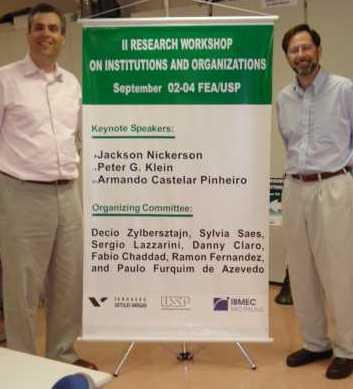
Papers for the II Research Workshop on Institutions and Organizations in São Paulo are now available here.
Keynote speakers Jackson Nickerson and I are headed to Brazil today. If I have time this morning I’ll post “My Favorite Things St. Louis Airport.”
Update (1 September): Here we are at PENSA, in a somewhat narcissistic pose, shortly after arrival.
Agency Theory in Management
| Nicolai Foss |
I believe that agency theory is one of the most informative, useful, and interesting theories coming out of economics ever. It is surely also one of the most influential econ theories in management. Agency theory is, however, fundamentally complicated, and difficult to teach. I find it impossible to teach without making use of at least some math (specifically, simple versions of the linear model). In particular, grasping the role that the risk premium plays in the theory, and, in this connection, what is really the source of the agency loss, is often very difficult for students.
However, not only students but also management academics have difficulties understanding the theory. (more…)
More Podcasts: Gordon, Weingast, Salerno-Klein
| Peter Klein |
- The History of Political Philosophy: From Plato to Rothbard by former O&M guest blogger David Gordon. A ten-lecture series delivered in June 2007 covering Plato, Aristotle, Aquinas, Hobbes, Locke, Rousseau, Kant, Hegel, Mill, Spooner, Spencer, Rawls, Nozick, Rothbard, and more. Only David Gordon could be an expert on all of these.
- Russ Roberts’s interview with Barry Weingast about the new book by North, Wallis, and Weingast, A Conceptual Framework for Interpreting Recorded Human History (what a title!). Weingast has become so prominent in political science it is easy to forget that he has an economics PhD (from Cal Tech) and started his career as an economics professor at Washington University in St. Louis. (His critics have not forgotten.)
- Fundamentals of Economic Analysis: A Causal-Realist Approach. Economics in the tradition of Carl Menger, starting with the basics of scarcity, choice, value, and exchange then moving to pricing, entrepreneurship, capital, competition, money, banking, and the business cycle. Joe Salerno and I give the lectures. You can also get these as videos in a handsome DVD set.





 Organizations and Markets

Recent Comments