Posts filed under ‘New Institutional Economics’
The Economist on Coase at 100
| Peter Klein |
 The new Economist celebrates Ronald Coase’s 100th birthday (this coming Wednesday) with a short piece on “The Nature of the Firm” (1937), the founding document of modern organizational economics (16,379 Google Scholar cites). (Thanks to Avi for the pointer.) It’s nice to see the theory of the firm get its props, and the first few paragraphs do a good job summarizing the paper. But the (anonymous) author has misread the modern literature, first in setting up an artificial conflict between Coase’s transaction-cost approach and the resource-based approach to the firm and, second, by missing the depth and nuance of Coase’s own research program.
 On the first point: Much recent work tries to reconcile transaction cost economics (TCE) and the resource-based view (RBV) (e.g., Silverman, 1999; Foss and Langlois, 1999; Tsang, 2000; Madhok, 2002; Foss and Foss, 2005), pointing out that the two theories are, in important ways, complementary. Put simply: TCE and RBV start with different explananda. The RBV asks which resources will be combined in which ways to produce which outputs, while TCE asks how this activity will be organized (market, hierarchy, or hybrid). RBV offers a theory of competitive advantage, while TCE focuses on boundaries and governance. Second, the Economist writer confuses Coase with the (Coase-inspired) transaction cost approach of Williamson (1971, 1975, 1979) and Klein, Crawford, and Alchian (1978): (more…)
Love, Marriage, and Money
| Peter Klein |
Most interesting passage I read today:
Contrary to prevailing interpretations that attribute the [historical] rise in voluntary, romantic unions to an increased sexual division of labor and the domestication of family life, Howell argues that true companionship between husband and wife was necessary to weather the challenges of commercial life. In her words, “love was by no means the antithesis of the market. It was the market’s helpmate” (p. 141).
It’s from Francesca Trivellato’s review of Martha C. Howell, Commerce before Capitalism in Europe, 1300-1600 (Cambridge, 2010). As Howell notes, “the commercialization of society was not just an economic history as we understand the term but a social, legal, and cultural story, and it is incomprehensible if told from the perspective of one of these modern conceptual categories alone.”
Ronald Coase’s New Book
| Peter Klein |
 Yes, you read that correctly. Ronald Coase, who turns 100 later this month, has a new book coming out from Palgrave Macmillan and the Institute of Economic Affairs, How China Became Capitalist. It’s coauthored with Ning Wang, Coase’s former research assistant at Chicago and now an assistant professor at Arizona State, and scheduled for publication in June 2011.
Examining the astonishing events that led to China’s transformation from a close socialist economy to an invincible manufacturing powerhouse of the global economy, How China Became Capitalist argues that the impact of events that led China to become capitalist could not have been predicted. From the death of Mao to China’s market reform and move to capitalism under the auspices of the Chinese Communist Party, How China Became Capitalist controversially argues that China’s growth potential will be inhibited in future without a vibrant market in ideas.
Palgrave Entry on Oliver Williamson
| Scott Masten |
If you have access to The New Palgrave Dictionary of Economics, Online Edition, my entry on Oliver Williamson is now available: Oliver E. Williamson.
Report on the North Conference
| Peter Klein |
 Responsibilities abroad kept me from attending the recent Douglass North celebration, but the University of Missouri was well represented by a group of energetic and enthusiastic PhD students, who sent me the following report:
The conference on Legacy and Work of Douglass North was an outstanding meeting with discussions on the past, present, and future of the New Institutional Economics. Top scholars discussed the contribution and influence of North (and the New Institutional Economics) in a diverse range of fields, covering everything from the impact of the initial contributions to the outlook for continued research.
It’s hard to summarize the insights and contributions from six paper sessions, Elinor Ostrom’s keynote, and the roundtable on North and the Rise of the New Institutional Economics. One takeaway was the depth and breadth of North’s contributions – many speakers were North coauthors working on a wide variety of topics, from many different perspectives (economics, political science, history, cognition, etc.). North’s influence is huge across the social sciences.
One burning issue: what’s the next step for New Institutional Economics? Besides bridging or integrating Northean institutional analysis with Williamsonian organizational economics, many speakers emphasized the need to be more rigorous, to examine more details, to go farther than the “big picture” studies that are so prominent in the field. There are too many grand, sweeping claims, and not enough mundane, middle-of-the-road analysis. (John Nye, for example, expressed concern that some Northean ideas are very difficult to operationalize, a particular problem since younger scholars are confronted with very high standards for formalization, empirical technique, etc.) (more…)
PENSA 20th Anniversary
| Peter Klein |
Congratulations to Decio Zylbersztajn and the rest of the group at PENSA on their 20th anniversary. PENSA, a research center within the University of São Paulo, is the home of New Institutional Economics research and teaching in Brazil (and Latin America more generally), producing papers, training graduate students, hosting international conferences, and other activities. The group celebrated its 20th year with a party this past weekend. You can see current and former PENSA personnel in the photo below, including Decio, my Missouri colleague Fabio Chaddad (to Decio’s right), Luciana Florencio de Almeida (just in front of Decio), Paulo Furquim de Azevedo (back row), Sergio Lazzarini (front row), Sylvia Saes (middle row, right side), and other well-known New Institutional Scholars.
The current issue of the Revista de Administração da Universidade de São Paulo has an article on financial constraints and agricultural contracting in Brazil by Decio, Luciana, and me.

The Legacy and Work of Douglass North
| Peter Klein |
Washington University, St. Louis is hosting a major international conference, 4-6 November, on the Legacy and Work of Douglass North. The all-star panel includes Lee Alston, Robert Bates, Joel Mokyr, Elinor Ostrom, Ken Shepsle, Barry Weingast, and many others. The conference is organized by Wash U’s Center for New Institutional Social Science.
In other conference news, the CFP for next year’s Atlanta Competitive Advantage Conference, 17-19 May 2011, has been posted. Featured presenters include Jay Barney, Joel Baum, and Rebecca Henderson.
“The Meanest and Most Contemptible Persons in Society”*
| Scott Masten |
*That would be Peter, Dick, Lasse (I think), and me, but not Nicolai. (See below.)
I haven’t posted anything on higher education governance in a couple of weeks, so I guess it is about time. My excuse will be an Instapundit link to an opinion column titled “End Our ‘Multiuniversities’.”
The author, David Warren, complains that the “great majority of the universities — founded since the Second World War to bureaucratically process and credentialize a large part of the general population, as a matter of ‘right’ and regardless of their intellectual capacities — are in effect ‘community colleges’ or trade schools,” a condition that he attributes in the main to public funding. (Warren is writing from Canada but a related piece makes clear his reprobation is catholic.) I am broadly sympathetic with his lament, though I am less confident that public funding is the ultimate culprit. What I want to comment on, however, is his (possibly facetious) solution: (more…)
Lock-In, Path Dependence, and Efficiency: Railway Gauge Edition
| Peter Klein |
 Doug Puffert’s new book on the history of railway gauge standardization apparently takes a middle position between the “lock-in always” position of Paul David and the “lock-in rarely” position of Liebowitz and Margolis. Writes reviewer Dan Bogart:
Puffert’s narrative convincingly dispels the extreme version of the Liebowitz and Margolis critique which argues that market participants had perfect foresight. On the other hand, it does suggest historical actors understood the role of positive feedbacks and tried to manipulate gauge adoption in an effort to lock-in their preferred standard. The degree to which gauge selection was efficient is a lingering question throughout the book. Puffert does not take a stand on the relative efficiency of different gauges, but an argument is made that diversity entailed large costs.
I’m not sure what Bogart means by the “extreme version” of the Liebowitz-Margolis critique; L&M have certainly never used the concept of perfect foresight in their analysis of alleged QWERTY effects. Indeed, their critique of Paul David is based mostly on comparative institutional analysis. As Peter Lewin puts it in his excellent summary of the QWERTY debate:
Somewhat paradoxically both Liebowitz and Margolis and their critics (in varying degrees) are critical of mainstream neoclassical (textbook) economics and its standards of welfare. That is to say, they are both highly critical of the kind of neoclassical economics that assumes perfect knowledge, perfect foresight, many traders, etc., the kind that derives perfect competition as a Pareto optimal efficient standard against which to judge real world outcomes. Both focus (to a greater or lesser extent) on the importance of ignorance and uncertainty (and the importance of institutions) in rendering such a standard problematic. Where they differ decisively, however, is in the policy lessons that they take away from this.
The critics argue that the ideal of perfect competition is an ideal that, for one reason or another, the free market is incapable of attaining, and that, therefore, one should look to the government to obtain by collective action or regulation, what the market, with decentralized actors, cannot. Liebowitz and Margolis have explained clearly why the endorsement of government intervention does not follow from a valid critique of neoclassical welfare economics (and, for that matter, why a defense of neoclassical welfare economics, in itself, is insufficient to establish an argument against intervention).
See here for a previous discussion on path dependence and Williamson’s “remediableness” criterion.
Do Economic Freedom and Entrepreneurship Impact Total Factor Productivity?
| Nicolai Foss |
Cross-country studies of the antecedents and consequences of entrepreneurship have become something of a cottage industry. My contribution to the industry is an earlier paper with Christian Bjørnskov, as well as rather recent one, also written with Christian, “Do Economic Freedom and Entrepreneurship Impact Total Factor Productivity?” (and we have a third paper in the works with a certain Klein).
In the former paper we analyzed institutions and economic policies as determinants of entrepreneurship, paying particular attention to “freedom variables,” like sound money and a stable legal framework. In the latter paper, we focus on where the action is in the growth process, namely Total Factor Productivity, and proffer Austro-institutional arguments why entrepreneurship and the institutions associated with a free society may be expected to positively impact TFP.
While we find that entrepreneurship strongly and significantly impacts TFP, our results only partially support the intuition that institutions of liberty as well as liberal economic policies promote growth in productivity. In fact, we find no significant effects of sound money and legal quality on TFP in the medium run. When some of the freedom variables are interacted with the entrepreneurship variable, we in fact find that entrepreneurial activity is more effective in raising levels of TFP in environments dominated or strongly influenced by government activity, either through production in government-owned enterprises and investments or in its financing activities. Thus, increasing the active involvement of the government in the economy as well as the tax burden actually increases the impact of entrepreneurship on TFP. Our explanation of this somewhat surprising finding is that a reduced supply of entrepreneurship increases the marginal productivity of entrepreneurship; thus, the best ideas do survive even in the relatively hostile welfare state environment. (more…)
The (Very) Early Adoption of Modern HRM Practices
| Peter Klein |
Bruce Kaufman’s book Hired Hands or Human Resources? Case Studies of HRM Programs and Practices in Early American Industry (Cornell U. P., 2010) shows that US firms started adopting “modern” HRM practices around World War I, not during the New Deal, and they did so primarily to increase productivity, not in response to union or government pressure. Writes reviewer Chad Pearson:
Kaufman illustrates the ways in which several companies created professional human resource management (HRM) models after World War I. This is the most valuable part of the book principally because he used the records of the Industrial Relations Councilors (IRC), a consulting firm that began assisting employers in the 1910s. The IRC offered consulting services, provided research, and ran courses on industrial relations topics throughout the nation. Kaufman, the first scholar to examine these records, believes that “no other [industrial relations consulting firm] before World War II had IRC’s reach and influence” (p. 108). . . .
In most cases, these firms, in consultation with the IRC, began to, in Kaufman’s words, treat labor not as “a short-term commodity,” as was common in previous decades, but rather as “a longer-term human capital asset (the ‘human resource’ approach)” (p. 219). Why? Pressure from unions and the law were factors, but “they were less than half the story in the time period we are examining” (p. 228). In his view, employers’ desires to improve “management and productivity” better explain why companies improved workplace conditions (p. 227).
Labor historians and specialists in business regulation used to focus on the Progressive Era as a watershed period — e.g., Wiebe (1962), Weinstein (1981), and of course Kolko (1977) — but interest seems to have waned.
Misbehavioral Antitrust
| Peter Klein |
I suggested earlier that behavioral economics could use a dose of comparative institutional analysis. The New Paternalists are very worried about various biases and forms of “irrationality” on the part of consumers, managers, entrepreneurs, investors, etc. but have little or nothing to say about the rationality of regulators, legislators, judges, and other non-market actors. Josh Wright and Judd Stone offer a parallel critique of behavioral economics applied to antitrust law: the behavioralists focus on presumed bias and irrationality on the part of incumbents, while largely ignoring the cognitive attributes of rivals and potential entrants. Josh and Judd propose an “irrelevance theorem”: “If one assumes a given behavioral bias applies to all firms — both incumbents and entrants — behavioral antitrust policy implications do not differ from those generated by the rational choice models of mainstream antitrust analysis.”
Addendum: Steve Horwitz made the comparative institutional argument in an earlier post that I unfortunately missed.
Tilburg Conference on Private Ordering
| Scott Masten |
O&M readers might be interested in a conference held this week (Sept. 30 – Oct. 1) at the Tilburg Law and Economics Center on the topic “Economic Governance and Competition: The Pros and Cons of Private Ordering in the Shadow of the Law.” The conference was organized by Jens Prüfer and featured keynote presentations by Lisa Bernstein, Avinash Dixit, Robert Gibbons, and Bentley MacLeod. Many interesting papers, several of the authors of which will be familiar to the O&M/ISNIE crowd. The full program, including downloadable papers, can be found here. (Would have liked to attended but classes interfered.)
Elgar Companion to TCE
 | Peter Klein |
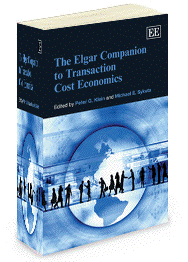
The Elgar Companion to Transaction Cost Economics, edited by Mike Sykuta and me, has just been published. Twenty-nine chapters cover the basic structure of TCE, its precursors and influences, fundamental concepts, applications and evidence, along with alternatives and critiques. Oliver Williamson was kind enough to contribute an introduction and overview. Co-blogger Foss is in there as well.
O&M readers can get it here 10 percent off the list price! (Actually, anybody can get the deal.) Mike beat me to the punch with an announcement and description, so I’ll just add that we’re really pleased with the final product and grateful to all the distinguished contributors and the production staff.
Here are previous O&M posts on transaction cost economics.
Secure Abjure Tenure
| Scott Masten |
Thanks to Peter, Nicolai, Dick, and Lasse for the invitation to guest blog and for the opportunity to sound off on current issues to a broader audience than just my LCD screen. [Thank you! — LCD Screen.]
A fairly recent example of such an issue was the discussion — anew — of proposals — anew — to abolish professorial tenure. Earlier this month, the New York Times Sunday Book Review ran an essay titled “The End of Tenure?” This was preceded by a July NYT “Room for Debate” forum on the question “What if College Tenure Dies?” and a proposal a week or so later by the American Bar Association to eliminate the term “tenure” from the ABA standards covering job security and academic freedom. A flurry of blog posts on the merits of tenure — many by law professors — ensued.
Leaving aside the details of the debate, an interesting pattern emerged in the “sides,” with more market-oriented (libertarian- or conservative-leaning) writers tending to be more critical, or at least skeptical of the merits, of tenure (see, for example, here and here; here; and here, compared, for instance, with this. The rule-proving exception is here). (more…)
Introducing Guest Blogger Scott Masten
| Peter Klein |
It’s a real pleasure to introduce Scott Masten as our newest guest blogger. Scott is Professor of Business Economics and Public Policy at the University of Michigan’s Ross School of Business and a leading figure in the transaction cost approach. Trained by Oliver Williamson at Penn, Scott was one of the first (along with David Teece and a few others) to do systematic empirical work on alternative institutions of governance. Scott’s 1984 paper on procurement in aerospace, his 1985 paper (with Keith Crocker) on characteristics of natural gas contracts, and his 1991 paper (with James Meehan and Ted Snyder) on the costs of internal organization are classics in the transaction cost literature. Scott has also made important contributions to law and economics, antitrust, contract theory, and many other areas. He’s a past president of ISNIE, co-editor of JEMS, and, as I learned a few years ago at a conference for Williamson’s 70th birthday, a wickedly funny after-dinner speaker.
We’re delighted to have Scott on the team and look forward to his insights. Welcome, Scott!
24 September 2010 at 11:40 pm Peter G. Klein Leave a comment
Research Findings That Don’t Surprise Me
| Peter Klein |
The Institutional Causes of China’s Great Famine, 1959-61
Xin Meng, Nancy Qian, Pierre Yared
NBER Working Paper No. 16361, September 2010This paper investigates the institutional causes of China’s Great Famine. It presents two empirical findings: 1) in 1959, when the famine began, food production was almost three times more than population subsistence needs; and 2) regions with higher per capita food production that year suffered higher famine mortality rates, a surprising reversal of a typically negative correlation. A simple model based on historical institutional details shows that these patterns are consistent with the policy outcomes in a centrally planned economy in which the government is unable to easily collect and respond to new information in the presence of an aggregate shock to production.
It is said that when the Nobel Prize in economics was first established, prizes were given for using economics to teach people things they didn’t already know, e.g., that economic growth might increase inequality, that depressions are caused by central banks, that macroeconomic stabilization policy doesn’t work, etc. Now, prizes are given to economists who teach other economists things that regular people already know — politicians are self-interested, you shouldn’t put all your eggs in one basket, institutions matter, different people know different things, etc.
Two Economics Papers About Culture
| Peter Klein |
The New Institutional Economics focuses mainly on formal rules, both “macro” (constitutions, legal systems, written languages) and “micro” (firms, contracts, other formal agreements). But there are many studies of informal or semi-formal constraints — norms, conventions, religion, belief systems, and other aspects of culture, broadly conceived. Given their commitment to methodological individualism, New Institutional Economists tend to explain the emergence and stability of these phenomena as the consequences — typically unintended — of purposeful individual choices (which distinguishes us from our colleagues on the other side of the aisle). (Culture is important within organizations, as well as between them, though attempts to explain organizational culture in this manner have been less successful.)
Does Culture Matter?
Raquel FernándezThis paper reviews the literature on culture and economics, focusing primarily on the epidemiological approach. The epidemiological approach studies the variation in outcomes across different immigrant groups residing in the same country. Immigrants presumably differ in their cultures but share a common institutional and economic environment. This allows one to separate the effect of culture from the original economic and institutional environment. This approach has been used to study a variety of issues, including female labor force participaiton, fertility, labor market regulation, redistribution, growth, and financial development among others.
Do Social Connections Reduce Moral Hazard? Evidence from the New York City Taxi Industry
C. Kirabo Jackson, Henry S. SchneiderThis study investigates the role of social networks in aligning the incentives of economic agents in settings with incomplete contracts. We study the New York City taxi industry where taxis are often leased and lessee-drivers have worse driving outcomes than owner-drivers as a result of a moral hazard associated with incomplete leasing contracts. Using instrumental variables and fixed-effects analyses, we find that: (1) drivers leasing from members of their country-of-birth community exhibit significantly reduced effects of moral hazard; (2) network effects appear to operate primarily via social sanctions; and (3) network benefits can help to explain the organization of the industry in terms of which drivers and owners form business relationships.
Korean Institutional Economics Conference
| Dick Langlois |
I’m in Seoul (a quick trip) to present at the second annual conference on “Institutions and National Competiveness” organized by the Korea Institution and Economics Association. The conference is being held in conjunction with the annual meeting of the Korean Economics Association. Notable presenters include Young Back Choi, Randy Holcombe, Elias Khalil, Stefan Voigt, and Yong J. Yoon.
Add to: Facebook | Digg | Del.icio.us | Stumbleupon | Reddit | Blinklist | Twitter | Technorati
Hayek Interviews
| Peter Klein |
 In 1983 the Earhart Foundation sponsored a lengthy set of interviews with F. A. Hayek in Los Angeles. The transcripts have long been available (and form the basis of the interview parts of Hayek on Hayek), but the complete set of videos has just now been put online, courtesy of the Universidad Francisco Marroquín. The interviewers are an impressive lot as well: James Buchanan, Armen Alchian, Axel Leijonhufvud, Robert Bork, Tom Hazlett, Jack High, Bob Chitester, Leo Rosten, and Earlene Craver. (I hardly recognized the youthful Hazlett!) You can also get the transcripts, if you prefer plain text.
Add to: Facebook | Digg | Del.icio.us | Stumbleupon | Reddit | Blinklist | Twitter | Technorati





 Organizations and Markets
Recent Comments