Posts filed under ‘New Institutional Economics’
ISNIE Conference Papers
| Peter Klein |
 I’m in lovely Stirling, Scotland, for the ISNIE Annual Meeting. (And, driven in part by my Scottish ancestry, feeling the urge to slay an Englishman.) Nobel Laureates Williamson and Ostrom are giving the keynote speeches, and many additional members of the O&M extended family are here. You can access most of the accepted papers at this link, which is almost as good as being here. Enjoy!
 Next year’s conference, organized by Barry Weingast, will take place mid-June at Stanford University, so start making plans now!
Add to: Facebook | Digg | Del.icio.us | Stumbleupon | Reddit | Blinklist | Twitter | Technorati
Taking AIM
| Dick Langlois |
 Aha! So that’s why nobody met me at the airport: I was supposed to be in France. Actually, I’m in the UK, traveling around as a Visiting Fellow of the Academy of Advanced International Management (AIM). I will be giving a series of talks under their aegis in Lancaster, London, and Edinburgh. I am now in Lancaster, where my host is Martin Spring, an operations management guy who is interested in modularity and contracting in the delivery of complex services like engineering. My first stop in the UK was Nottingham, where I refrained from any tax protests let alone progressive redistribution of rents. (This despite the ads for the new Ridley Scott-Russell Crowe movie prominently displayed on all the busses.) But I did speak at the Nottingham University Business School, which is home to the likes of Paul Windrum and Peter Swann.
 Today I hope to see some of Lancaster, possibly including Williamson Park. Among its highly specific assets is the pictured Ashton Memorial, built by James Williamson, Jr., Lord Ashton, who made his fortune in the linoleum trade. (According to the city council website, he was able to afford this grand edifice because he paid his workers so little.)
During the trip I also plan to stop in at several conferences, including DRUID (for one day), the ISNIE conference in Stirling (where I am likely to view a flesh-and-blood Williamson), and the Schumpeter Society in Aalborg. If I can, and if the material warrants, I may try a little live (or at least half-dead) blogging from the conferences.
Add to: Facebook | Digg | Del.icio.us | Stumbleupon | Reddit | Blinklist | Twitter | Technorati
Study this Summer with Klein
 | Peter Klein |
I’m participating in a distance-learning experiment this summer — no, not Bootsy Collins’s Funk University, but the Mises Academy, a new Mises Institute service offering short, non-degree courses to university students, management professionals, and the general public. Everything’s online — lectures, readings, discussions, assignments. I’m teaching “Entrepreneurship in the Capitalist Economy,” a course based on my favorite book (as Mankiw would put it). The course runs for 9 weeks from 7 June to 7 August and costs a mere $255 — that’s less than one or two of Nicolai’s books!
The course is pitched at the undergraduate/MBA level, with no formal prerequisites except intellectual curiosity, a good work ethic, and a sense of humor. Perhaps I’ll offer special extra-credit assignments for O&M readers. . . .
Drop me a line if you have any questions. I’d love to have you join me on this journey!
Add to: Facebook | Digg | Del.icio.us | Stumbleupon | Reddit | Blinklist | Twitter | Technorati
Scribd Version of Book
| Peter Klein |
I just learned I can embed the full document right here in a blog entry. Very cool!
Add to: Facebook | Digg | Del.icio.us | Stumbleupon | Reddit | Blinklist | Twitter | Technorati
The Capitalist and The Entrepreneur: Available Now!
| Peter Klein |
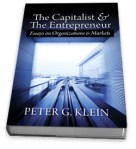 My new book, The Capitalist and the Entrepreneur: Essays on Organizations and Markets (Mises Institute, 2010), is now available. For a limited time, you can get it for just $15 — a bargain at half the price! Actually, the resource-constrained among you can read the Full Monty here, free of charge. A PDF version is also available. A promotional essay appears today on Mises.org.
The editorial and production staff did a terrific job, and I’m thrilled with the volume’s look and feel. The contents aren’t bad either!
Order two or more and I will personally send you a set of Ginsu knives.
Add to: Facebook | Digg | Del.icio.us | Stumbleupon | Reddit | Blinklist | Twitter | Technorati
Religion and Economic Development
| Peter Klein |
Thanks to Tyler for calling my attention to Davide Cantoni’s job-market paper, “The Economic Effects of the Protestant Reformation: Testing the Weber Hypothesis in the German Lands”:
Many theories, most famously Max Weber’s essay on the ‘Protestant ethic,’ have hypothesized that Protestantism should have favored economic development. With their considerable religious heterogeneity and stability of denominational affiliations until the 19th century, the German Lands of the Holy Roman Empire present an ideal testing ground for this hypothesis. Using population figures in a dataset comprising 276 cities in the years 1300-1900, I find no effects of Protestantism on economic growth. The finding is robust to the inclusion of a variety of controls, and does not appear to depend on data selection or small sample size. In addition, Protestantism has no effect when interacted with other likely determinants of economic development. I also analyze the endogeneity of religious choice; instrumental variables estimates of the effects of Protestantism are similar to the OLS results.
In my AE 8050 class last semester we discussed several papers on religion, and other aspects of culture, as they affect economic development (e.g., Stulz and Williamson, 2003). Cantoni’s paper will go on my reading list next year.
Add to: Facebook | Digg | Del.icio.us | Stumbleupon | Reddit | Blinklist | Twitter | Technorati
Miscellaneous Conference and Paper Links
| Peter Klein |
SSRN has a new Philosophy and Methodology of Economics working-paper series, sponsored by the International Network for Economic Method.
Here’s a CFP for a Special Issue of the E-conomics e-Journal on the Social Returns to Higher Education, R&D and Innovation.
You can watch a live stream of this weekend’s SEJ Special Issue Conference on Knowledge Spillovers & Strategic Entrepreneurship.
The registration and accommodations section of the ISNIE 2010 website is now open.
Add to: Facebook | Digg | Del.icio.us | Stumbleupon | Reddit | Blinklist | Twitter | Technorati
Posner on Institutions and Organizations, Round Two
| Peter Klein |
Remember the infamous Posner-Coase-Williamson exchange from JITE, 1993? Posner dismissed the New Institutional Economics as a derivative form of Posnerian law and economics, prompting unhappy replies from Coase and Williamson. Here’s Coase:
Posner [1993, 79] says that the first part of his paper describes “the conception of the field [the new institutional economics] held by Ronald Coase.” Reading this part of his paper recalled to my mind Horace Walpole’s opening remarks in his book on King Richard the Third: “So incompetent has the generality of historians been for the province that they have undertaken, that it is almost a question, whether, if the dead of past ages could revive, they would be able to reconnoitre the events of their own times, as transmitted to us by ignorance and misrepresentation” (Walpole [1768, 1]). I have only one foot through the door but should the final yank come before this piece is published, Horace Walpole’s words would apply exactly to Posner’s highly inaccurate account of my views.
Adds Williamson, wryly: “Richard Posner is a prolific writer and distinguished jurist. He is frequently asked to speak with wisdom and authority on many issues. Whether he hits the mark or misses varies with his depth of knowledge and understanding of those issues. . . . I content that Posner’s [1993] commentary mainly misses.”
Now Geoff Hodgson has produced a reboot: a long essay by Posner in the Journal of Institutional Economics titled “From the New Institutional Economics to Organization Economics: with Applications to Corporate Governance, Government Agencies, and Legal Institutions,” with replies from Jürgen Backhaus, Bruno Frey, Lin Ostrom, John Roberts, Tom Ulen, and several others (but not Coase or Williamson!). Posner focuses almost exclusively on the principal-agent problem, perhaps unaware that information, delegation, coordination, and adaptation are also important issues in organizational economics. His main conclusion seems to be that both private firms and public agencies are equally inefficient. Interesting reading, to be sure (and much better than Posner’s solipsistic essay on his conversion to Keynesianism, inexplicably published by the New Republic).
Mannepalooza at Austrian Scholars Conference
| Peter Klein |
Tune in here at 3:45 EST today for a live broadcast of the ASC session, “The Contributions of Henry G. Manne,” organized by yours truly. Panelists include me, Alexandre Padilla, Richard Vedder, Thomas DiLorenzo, and Henry Manne. And buy your copy of the Collected Works.
Update: audio files are now available: Klein, Padilla, Vedder, DiLorenzo, Manne.
Why Academic Freedom?
| Nicolai Foss |
At least in Europe, academic freedom is under siege. Politicians justify their meddling with the fact that universities are (largely) financed by taxpayers’ money, and they are assisted in their meddling by a growing class of bureaucrats in ministries, the EU and increasingly in universities themselves. All this derives legitimacy from a questionable ideology of Mode II research that broadly asserts that most important scientific advance (now) happens in the intersection of disciplines and as a result of collaborative relations between universities and business (here is the Wiki on Mode II).
Given this, it seems necessary to rethink the defense of academia and academic freedom. There is, of course, Polanyi’s application of Hayek’s unplanned order idea in the context of the “republic of science.” However, that argument lacks concreteness and cutting power against those bureaucrats/politicians who wants to intervene just a tiny bit but doesn’t want centrally planned science.
In a recent paper, “Academic Freedom, Private-sector Focus, and the Process of Innovation,” Aghion, Dewatripont, and Stein provide a rationale — derived from property rights economics rather than from considerations of appropriability — for academia. Academia is defined as an organizational form which “represents a precommitment to leave control over the choice of research strategy in the hands of individual scientists” (p. 621) (note that this does not necessarily entail public funding). (more…)
Price Level Shocks, uhm, Screwed Up Relative Prices, and Organization
| Craig Pirrong |
Peter’s post on the relation between inflation, vertical integration, and markets brings a couple of other thoughts to mind.
First, and most importantly, the number and characteristics of markets are endogenous too, and respond to changes in the amount of uncertainty in the environment, including the amount of uncertainty resulting from monetary shocks that (in Sherwin Rosen’s unforgettable in-class phrase) “f*ck up relative prices.” In particular, the number and variety of futures markets depends on the amount of uncertainty. The big boom in the creation of futures markets in the 1970s corresponds with, and was arguably caused by, the coincident inflation of that period, and the associated volatility in relative prices.
Second, although Peter’s point, and previous research, focuses on the implications of inflation on organizational choices and market vs. firm choices, in the current environment it is worthwhile pondering the implications of deflation. Certainly we have more research on the effect of inflation on the variability of relative prices due to our more recent inflationary experiences, and this was a major source of concern about inflation among Austrians, but the current situation makes it worthwhile to consider the effects of deflation on the pricing system, and firms’ responses to that.
Perhaps an examination of Japanese experience since 1990 would be worth some in-depth analysis.
Personally I am torn as to whether inflation or deflation is the greater risk in the near to medium term. The huge monetary overhang in the US and around the world (resulting from quantitative easing and other extraordinary monetary policies), and the inability of the Fed to commit credibly to drain reserves from the system when money demand picks up make me believe that it will be hard to avoid a burst of inflation. But all current indicators point to flat or declining prices.
It is hard to see things ending in a Goldilocks moment — just right. Thus, it is likely that that there will be a shock to prices generally, arguably a large one, and that this will disrupt relative prices for a variety of reasons. (Including, notably, the very likely case where these price level shocks lead to government policy interventions that distort relative prices.)
Thus, Peter’s research program may be rejuvenated, courtesy of the Fed, ECB, the Chinese Central Bank, etc. It is indeed an ill wind that blows nobody any good.
Vertical Integration and the Informational Content of Prices
| Peter Klein |
Many years ago, when I was taking Williamson’s Economics of Institutions class at Berkeley and fishing around for dissertation topics, I had the idea to do some empirical work on the relationship between inflation and vertical integration or conglomerate diversification. The basic idea is that monetary expansion not only raises price levels, but also increases the dispersion of relative prices — introducing “noise” into the price mechanism — giving entrepreneurs an incentive to internalize transactions, on the margin, they would have otherwise conducted in the market. My interest was partly piqued by an off-hand remark by Dick in a review of Chandler’s Scale and Scope:
Things began to go wrong in the 1960s with the wave of conglomerate diversification, that is, with diversification by companies into areas wholly unrelated to their “core competence.” ITT was the paradigm of this phenomenon. Originally an international maker of telephone switching equipment, it bought, among other things, an insurance company and the maker of Hostess Twinkies. Chandler sees this as an inefficient practice, with many of the disbenefits of overextended British personal capitalism. There is no historical precedent for such unrelated diversification, he notes, except for German Konzerne during the hyperinflation of the 1920s. What is interesting — and what Chandler doesn’t mention — is that it is precisely inflation, in this case the Lyndon Johnson inflation of the 1960s, to which many have pointed as the cause of the wave of conglomerate mergers. The conglomerate is in effect an “internal capital market” that invests in a diversified portfolio of unrelated interests. But why? The stock market is much better at diversifying away risk than is such an arrangement, and it has many other advantages as well. In a time of inflation, the argument goes, price signals become distorted as managers find it difficult to disentangle changes in relative prices (that is, real prices) from changes in the price level. In such a world, the internal information and control within a conglomerate may have advantages that outweigh the disadvantage.
But, in any case, the trend in the less-inflationary 80s was the opposite one, the breaking apart of corporate holdings. . . .
The idea that conglomerate diversification, and “hierarchies” more generally, are responses to conditions in external markets has proven very useful in my own work; it also appears in Amar Bhidé’s neglected 1990 paper on diversification. Dick’s review cites a 1989 paper by Don Boudreaux and Bill Shughart linking US inflation rates and a measure of vertical integration but I couldn’t find such a relationship for diversification, and ended up going in a different direction. (more…)
The Best and the Brightest
| Dick Langlois |
I read Peter’s post about paternalism — and the limits of smart people in government — just after I read about the death of Carl Kaysen, long-time MIT economist and one-time Kennedy advisor. Obituaries praise Kaysen for his role as a policy intellectual of great scope, especially in the area of nuclear non-proliferation. But they either fail to mention, or mention with considerable approval, Kaysen’s pivotal role in the famous 1954 United Shoe Machinery case. Kaysen’s view of the case, and of the role of economic analysis in antitrust, is a key example of what Williamson calls the “inhospitality tradition” — that any kind of contract we don’t understand must therefore be anticompetitive. In the eyes of many present-day economists, Kaysen is implicated in having destroyed the American shoe machinery industry and with it the American shoe industry. (The post-mortem is by Masten and Snyder.) Not exactly McNamara in Vietnam, but worth mentioning amid the hagiography of Kaysen, not to mention the reawakened culture of elitist decision-making in Washington.
Williamson Tribute in California Management Review
| Peter Klein |
Six new essays on Oliver Williamson by Haas School colleagues appear in the new issue of the California Management Review. They’re behind a subscription firewall, but just $6 a pop. Check ’em out:
Institutions, Politics, and Non-Market Strategy
de Figueiredo, Jr., Rui J.P.
Holdup: Implications for Investment and Organization
Hermalin, Benjamin E.
Antitrust Economics
Shapiro, Carl
Regulation: A Transaction Cost Perspective
Spiller, Pablo T.
Williamson’s Contribution and Its Relevance to 21st Century Society
Tadelis, Steven
Williamson’s Impact on the Theory and Practice of Management
Teece, David J.
Thanks to Mike Cook for the tip.
Measure for Measure
| Craig Pirrong |
The FT has an interesting article about the difficulties and uncertainties facing cap & trade schemes, even in Europe where they’ve been implemented. A good part of the article focuses on the loss of intellectual coherence in climate policy in Europe, as regulations and taxes are being mooted to reduce CO2 emissions. Such command and control bolt-ons are inconsistent with the basic concept of cap & trade, which is that by determining a price of carbon the market will induce efficient responses to reduce emissions on all relevant dimensions:
And the more the carbon market shrinks in its ambitions, the more it faces a broader threat: that of losing touch with its original objective. Credits could continue being traded in the old way. But if the main thrust of carbon reduction is tackled by other means, the market could face questions about its social utility.
But to me, the most interesting part of the article relates to the arcane area of offsets: (more…)
Stuck on the Methodological Hamster Wheel
| Craig Pirrong |
I’ve read John Cassidy’s New Yorker article (not available online) in which he described his journey to the freshwater provinces in his attempt to see whether the financial crisis had caused Chicago economists to reject their reactionary views. (With one exception, the answer is blessedly “no.”) I’ve also read his paean to Pigou in the WSJ. So I pretty much knew what to expect when I picked up his How Markets Fail. Let’s say I wasn’t disappointed, in the sense that my very low expectations were met.
The book is a very conventional, Stiglitz-esque critique of market economics and those who defend markets. The latter are always described with Homer-esque modifiers, just so you’ll know that they [we!] are retrograde knuckle draggers. (more…)
ISNIE 2010 Call for Papers
| Peter Klein |
The Call for Papers is out for the International Society for New Institutional Economics’s 2010 meeting, 17-19 June in Stirling, Scotland. Proposals are due 1 March. President-Elect Frank Stephen is putting together an impressive program with keynotes from Bruno Frey and two longtime ISNIE members you may have heard of: Elinor Ostrom and Oliver Williamson. Don’t miss it!
Corporations Are People Too
| Craig Pirrong |
Legally, in some respects, anyways. That was a key issue in the recent Supreme Court decision re McCain-Feingold (see Dick’s post). I don’t have a lot to say about the specifics of the decision, as campaign finance law is way too arcane for me. Suffice it to say that I am inherently skeptical about any regulation regarding elections designed by incumbent politicians. People yammer about conflicts of interest all the time, but there’s a colossal one for you.
I just wanted to make a quick point about a debate between Stevens and Scalia carried out in the opinion and the dissent. Stevens noted that the Founders were deeply skeptical of corporations. Indeed so. Scalia noted that there are so many corporations today. Also true. The interesting question is how we got from A (Stevens) to B (Scalia).
The story is told in the North, Wallis and Weingast natural-state book Violence and Social Orders I’ve blogged about several times over at Streetwise Professor, mostly in the context of Russia. The relevant chapter is primarily based on John Wallis’s work. The basic story is that hostility to corporations — reflected very well in Adam Smith’s Wealth of Nations — was due to the fact that historically, English corporations were created by the crown, and were essentially very profitable favors provided to the politically connected. They were, in NWW terms, part of the “closed order” of the natural state, in which access to certain contracting forms was limited to a select powerful few. This animus towards corporations was inherited in the United States, but in the early years of the 19th century, state legislatures confronting issues associated with the financing of new infrastructure turned the corporate form into a prop of an open-order system in which this contracting form was made available to all. Rather than limit the right of incorporation to an elite, they made it available to everybody. The system changed from one in which legislatures had to grant every incorporation, to one in which pretty much anybody could incorporate if they met a set of general, universally applicable requirements. Hence, the proliferation of corporations. (more…)
Socialist Calculation Meets the OTC Markets
| Craig Pirrong |
A new Federal Reserve Bank of NY staff report by Darrell Duffie, Ada Li, and Theo Lubke, “Policy Perspectives on OTC Derivatives Market Infrastructure” has received a lot of attention in the press.
There are some good things in the paper. Notably, it is suitably cautionary about the potential systemic risks posed by central counterparties, and the consequent need for prudential regulation thereof. It also makes a good case for data repositories, and for the role of the Fed and other government agencies in reducing the costs that intermediaries incur to coordinate risk-reducing actions, such as portfolio compression and improvements in the process of confirming deals.
But overall the paper is extremely disappointing. Its tone is Olympian and prescriptive. The word “should” is used 61 times 21 pages of text (that includes several space-eating tables and charts).
This is extremely dangerous because these prescriptions and dictates are not based on a a rigorous analysis of costs and benefits. Most disturbingly, there is virtually no discussion whatsoever of the informational demands inherent in the prescriptions. We’re told that regulators should set the right capital and collateral requirements on non-cleared deals, and that CCPs should maintain “high collateral standards.” (more…)
A Tale of Two Papers, or, Humpty Dumpty Writes About Exchanges
| Craig Pirrong |
The American Economic Association/American Finance Association Meetings are just about over. I made a quick trip there to comment on a paper. Upon returning home, I downloaded a couple of the papers presented that seemed of interest. Good call on one, bad call on the other.
The bad one is “Centralized versus Over The Counter Markets” by Viral Acharya of LBS and NYU, and Alberto Bisin of NYU. Although the motivation of the paper is admirable, the execution is execrable, and is representative of a lot of what is wrong in the profession.
The motivation is to compare the efficiencies of alternative ways of organizing derivatives trades: centralized exchanges and over-the-counter (OTC) markets. Great. Big question. I’ve written a lot about it, and would be very interested in seeing other takes thoughtful on the subject.
The paper concludes that organized exchanges are (constrained) first best efficient, and more efficient than OTC markets. A quick review of the paper makes it clear, however, that they’ve rigged the game to produce that result. (more…)





 Organizations and Markets
Recent Comments