Posts filed under ‘People’
Things You Learn from David Gordon
| Peter Klein |
Nicolai has written on great beards in philosophy. From David Gordon’s talk this morning on “Money and Philosophy” I learn that Thomas Aquinas, among his many other distinctions, was also the heaviest of all the great philosophers. Apparently his church had to install a special altar with a large cutout so Aquinas could take communion. According to David, Aquinas’s only possible rival for the title of heaviest great philosopher is David Hume.
Interviews with Alchian, Coase, Kirzner, Manne
| Peter Klein |
 The Liberty Fund has put online several interviews from its Intellectual Portrait Series. Of particular interest to O&M readers:
- Armen Alchian, interviewed by Dan Benjamin
- Ronald Coase, interviewed by Richard Epstein
- Israel Kirzner, interviewed by Tibor Machan
- Henry Manne, interviewed by Fred McChesney
Update (Nov. 2): Manne link fixed.
Some New Academic Bloggers
| Peter Klein |
The academic blogosphere becomes more densely populated every day. Please welcome these new (to me at least) citizens:
- Larry Ribstein, blogging at Ideoblog
- Casey Mulligan, blogging at Supply and Demand
- Diane Rogers, blogging at Economist Mom
Philosophy: Who Needs It?
| Peter Klein |
When Greenspan was appointed Fed chair in 1987 the New York Times Magazine ran a lengthy profile noting, among Greenspan’s other eccentricities, that he was a follower of Ayn Rand, generally regarded as a strong advocate of laissez faire. But Greenspan is doctrinaire only “at a high philosophical level,” wrote Leonard Silk, reassuringly. Murray Rothbard, who knew Greenspan in the 1950s, when both were friends with Rand, got a kick out of that line:
There is one thing, however, that makes Greenspan unique, and that sets him off from his Establishment buddies. And that is that he is a follower of Ayn Rand, and therefore “philosophically” believes in laissez-faire and even the gold standard. But as the New York Times and other important media hastened to assure us, Alan only believes in laissez-faire “on the high philosophical level.” In practice, in the policies he advocates, he is a centrist like everyone else because he is a “pragmatist.” . . .
Thus, Greenspan is only in favor of the gold standard if all conditions are right: if the budget is balanced, trade is free, inflation is licked, everyone has the right philosophy, etc. In the same way, he might say he only favors free trade if all conditions are right: if the budget is balanced, unions are weak, we have a gold standard, the right philosophy, etc. In short, never are one’s “high philosophical principles” applied to one’s actions. It becomes almost piquant for the Establishment to have this man in its camp.
Today Tyler Cowen, writing on Anna Schwartz’s very good interview with the WSJ, calls Bernanke a person “with libertarian sympathies,” which I find puzzling, since I can’t recall any evidence of this sympathy in Bernanke’s writings or policy actions. Perhaps he is a sympathetic libertarian “at a high philosophical level.”
Krugman
| Peter Klein |
I don’t have time for a thoughtful and intelligent post on Paul Krugman’s Nobel Prize, so a few snippets from other commentators will have to do for now.
In a surprise twist, Paul Krugman (Princeton) was announced the winner of the 2008 Nobel Prize in economics. Surprise not because he does not deserve it — Krugman’s work on trade theory is widely acknowledged — but because the Nobel committee passed over Jagdish Bhagwati (Columbia), who has lobbied for it for years. As Professor Bhagwati’s main work is also on trade theory, it makes it unlikely he will get the Nobel any time soon. (Bhagwati was also Krugman’s teacher at MIT.) This announcement also dents the hopes of Anne Krueger, another top trade theorist.
What is perhaps most interesting about Krugman’s choice is that he stopped doing economics almost 10 years ago and has instead been a columnist for the New York Times. This is good news: shows that you can have a second life and still get dividends on the first.
Funny how most economist like Tyler [Cowen] are “most fond of Krugman’s pieces on economic geography, in particular on cities and the economic rationales for clustering” when in fact Krugman added very little to a body of knowledge that is more than a century old. But it was new to most economists.
An anonymous economic grographer:
I did my graduate school training in the mid 1990s when economic geographers and regional scientists would bitch slap Krugman behind closed doors, yet were grateful that he was bringing them respectability among mainstream economists. Interestingly, Krugman published his first significant piece of work on the issue (Geography and Trade, 1991) at about the same time that the University of Pennsylvania was shutting down its regional science department (1993). But in his modest opinion, Regional Science was just a bunch of techniques or tools lacking an integrative framework (one way to avoid looking bad by being so obviously ignorant about it when he first began writing on location theory and the like).
Paul Krugman, speaking at a 1999 conference in honor of Bertil Ohlin (HT to Neel):
Let me begin with an embarrassing admission: until I began working on this paper, I had never actually read Ohlin’s Interregional and International Trade. I suppose that my case was not that unusual: modern economists, trained to think in terms of crisp formal models, typically have little patience with the sprawling verbal expositions of a more leisurely epoch. To the extent that we care about intellectual history at all, we tend to rely on translators — on transitional figures like Paul Samuelson, who extracted models from the literary efforts of their predecessors. And let me also admit that reading Ohlin in the original is still not much fun: the MIT-trained economist in me keeps fidgeting impatiently, wondering when he will get to the point — that is, to the kernel of insight that ended up being grist for the mills of later modelers.
Essays on Cournot
| Peter Klein |
Martin Shubik reviews Jean-Philippe Touffut’s edited volume Augustin Cournot: Modelling Economics (Elgar, 2007) for EH.Net. Contributors deal with Cournot’s contributions to economics, probability theory, and statistics, with mixed results (according to Shubik, who thinks Cournot’s contributions to game theory deserved more ink). Shubik thinks Cournot was “not only was a mathematician and probabilist, he was an excellent modeler linking the economic world with basic abstract models . . . [particularly the] modeling and application of a mutually consistent expectations model to oligopoly and economic competition.”
Shubik opens the review with this interesting (if a touch immodest) anecdote:
In the early 1950s, when I was a graduate student at Princeton, I had two academic heroes. They were Cournot and Edgeworth (in my lesser Pantheon were Jevons and Walras). As soon as John Nash discussed his thesis on noncooperative games with me, I pointed out to him that his solution which was mathematically highly general was in essence the one that Cournot had applied to economics and had presented in his great book of 1838. The solution called for individual mutually consistent expectations. At that time game theory in either cooperative or noncooperative form was virtually ignored in economics. It seemed to me that this natural extension of Cournot, whose work was unknown to Nash, was going to extend the scope of oligopolistic studies considerably. Nash and I were joined by John Mayberry in writing an article accepted by _Econometrica_ (“A Comparison of Treatments of a Duopoly Situation,” 1953, 141-54.) This, I believe was the first treatment of oligopoly expanding on Cournot’s work utilizing modern game theory. The mathematical tools were being forged to expand vastly the noncooperative equilibrium methods to economics so brilliantly started by Cournot.
In his introduction to Menger’s Principles Hayek expresses surprise that Menger, unlike Jevons and Walras, seemed unfamiliar with Cournot.
Best of “On the Economy”
| Peter Klein |
 Tom Keane’s greatest (interview) hits, featuring Nassim Taleb, Bill Gross, Robert Lord Skidelsky, Mohamed El-Erian, Eugene Fama, Peter Peterson, James MacGregor Burns, Peter Bernstein, Allan Meltzer, Martin Feldstein, James Poterba, Peter Fisher, David Malpass, Milton Friedman, Thomas Schelling, Myron Scholes, William Sharpe, Edmund Phelps, Gary Becker, Robert Mundell, Robert Solow, Amartya Sen, Robert Lucas, Kenneth Arrow, and Paul Samuelson.
30 September 2008 at 11:08 am Peter G. Klein Leave a comment
Klein Bottle
| Lasse Lien |
Behold, below, the Klein Bottle.
It’s described in mathematical topology as a bottle with no distinct inside or outside. Just one side. Strictly speaking, it can only be constructed in four spatial dimensions, but in our three-dimensional world it might be useful for constructing witty remarks for Peter.

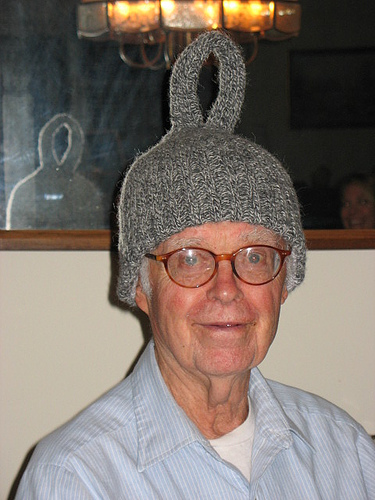 It’s also possible to construct a handsome Klein bottle hat, something the gentleman to the right has done. I don’t know about other O&M readers, but I am surely getting one.
Westgren to Missouri
| Peter Klein |
I’m delighted to announce that Randy Westgren, organizational scholar, academic entrepreneur, bon vivant, and all-around great guy — and, most important, former O&M guest blogger — has been named McQuinn Professor of Entrepreneurial Leadership at the University of Missouri. I’ve greatly enjoyed interacting with Randy over the years from his perch in Urbana-Champaign and am looking forward to having him just down the hallway.
As McQuinn Professor Randy will also direct the McQuinn Center, which was launched in 2004 under the leadership of Bruce Bullock. The Center is creating an innovative and unusual program to research and teach the “functional” aspects of entrepreneurship, with particular emphasis on firm organization and strategy and applications to food, agriculture, biotechnology, natural resources, and rural development.
Please join me in congratulating Randy on his new post!
An Orthodox Response to Max Weber
| Peter Klein |
“Orthodox” with a capital O, that is. The current issue of the Acton Institute’s flagship journal, the Journal of Markets and Morality, features the first English translation of Sergey Bulgakov’s 1909 essay “The National Economy and the Religious Personality,” described by translator Krassen Stanchev as “the first Orthodox Christian response to Max Weber’s The Protestant Ethic and the Spirit of Capitalism.” Bulgakov, widely regarded as the greatest 20th-century Orthodox theologian, has been attracting increasing interest in recent decades, in both East and West. Writes Stanchev:
Only in the 1906s did scholars turn their attention to business in the Orthodox medieval world. Professors in theological academies in Communist countries carefully avoided the topic while economic historians, at best, studied the relations between religion and business for closed audiences, but most often they pretended the phenomenon did not exist.
Just a few years after Weber, Bulgakov managed to put together similar theoretical arguments and a set of historical evidence that allowed claiming origins of the capitalist spirit from Orthodox Christianity as well. For those who are familiar with the later Russian “scientific” philosophers’ disregard for facts and documents, it will be a surprise as to how rich Russian historiography in the nineteenth century has been.
The article is currently gated but should be available to non-subscribers later this year. Or you can subscribe now and avoid the wait.
McNamara on Management
| Peter Klein |
From Abraham Zaleznik in HBS Working Knowledge (via Marshall Jevons):
[Robert S. McNamara] was a brilliant student at the University of California and at Harvard Business School, where he became a member of the HBS faculty. McNamara was a devotee of managerial control, an expertise he applied in his work at the Ford Motor Company and later at the Department of Defense as secretary in President John F. Kennedy’s cabinet.
His mantra was measurement. As secretary of defense, McNamara developed, along with key subordinates, including Robert Anthony of the HBS control faculty, long-range procurement cycles. He even tried to get the U.S. Navy to subscribe to a common aircraft for the three branches of the military. The Navy refused to go along, since this branch was concerned about aircraft operating from carriers.
McNamara urged field commanders in Vietnam to apply measurement to enemy losses, but did not realize until it was too late that the measurements were unreliable to assess enemy losses. The most reliable assessments came from correspondents like Neil Sheehan and David Halberstam. McNamara published a book years after he retired to reassess the Vietnam War and his role in it as secretary of defense. His main theme was the failure to examine critically the assumptions leading to U.S. involvement in this disaster. Editorial writers took no pains to spare McNamara’s feelings.
The moral I took away from his story is to avoid the perils of the fox and its reliance on a single belief, in this case measurement, and the technology of control.
For more on McNamara’s management philosophy and experiences, Deborah Shapley’s 1992 biography Promise and Power is pretty good. I also recommend The Whiz Kids: Ten Founding Fathers of American Business — and the Legacy They Left Us by John Byrne. As these books point out, McNamara was not a pioneer in this area but a follower of Tex Thornton, head of the US Army’s Statistical Control Group in WWII and later CEO of Litton Industries. It was Thornton who brought McNamara and the rest of his “Whiz Kids,” as a group, to Ford in 1945. Harold Geneen, the most famous “management-by-the-numbers” guy, was not part of this group but shared much of Thornton’s philosophy. (See Robert Sobel’s Rise and Fall of the Conglomerate Kings.)
CSI: Reform
| Dick Langlois |
My old friend Roger Koppl has an interesting article in Slate on reforming the system of forensic analysis and testimony. He and his coauthor argue for such measures a forensic counsel for the indigent; greater independence of experts from the prosecutorial team; more competition among labs; more statistical analysis to uncover anomalous findings; and the masking of evidence from analysts to reduce cognitive bias.
Roger has started something called the Institute for Forensic Science Administration. Check out his website for links to papers and others materials. (The website also declares that Roger’s Erdös number is 6. As Roger and I have written a couple of papers together, my Erdös number must be no greater than 7.)
Top Management Scholars, Journals, and Universities
| Peter Klein |
Rankings, rankings, more rankings. . . . If you like to bibliometric analysis of individual researchers, journals, and universities you’ll find more than you can handle in “Scholarly Influence in the Field of Management: A Bibliometric Analysis of the Determinants of University and Author Impact in the Management Literature in the Past Quarter Century” by Philip Podsakoff, Scott MacKenzie, Nathan Podsakoff, and Daniel Bachrach (Journal of Management 34, no. 4 (2008): 641-720). Over 25,000 individual scholars are reviewed, their institutions evaluated, journal impact factors computed, and numbers crunched hither and yon. Some qualitative conclusions:
The findings showed that (a) a relatively small proportion of universities and scholars accounted for the majority of the citations in the field; (b) total publications accounted for the majority of the variance in university citations; (c) university size, the number of PhDs awarded, research expenditures, and endowment assets had the biggest impact on university publications; and (d) total publications, years in the field, graduate school reputation, and editorial board memberships had the biggest effect on a scholar’s citations.
Call For an Annual Adam Smith Festival
| Peter Klein |
 In 1990 I was privileged to attend a conference on “Adam Smith and his Legacy” commemorating the 200th anniversary of Smith’s death. The speakers included eight of the twenty Economics Nobel Laureates then living along with Smith scholars such as Andrew Skinner, general editor of the 1976 Glasgow edition of Smith’s Works and Correspondence. The papers were published in this book; you can read my conference report here. Listening to and visiting with the Laureates was fun, though I didn’t learn much about Adam Smith at the conference (most economists — Nobel Laureates included — know and care little about the history of economic thought). There was also an event at Smith’s grave in Canongate Kirk. (Somewhere I have a picture of myself at the site of Smith’s birthplace in Kirkcaldy; it’s basically me standing next to this).
From Gavin Kennedy I learn that Eamonn Butler has called for an annual Adam Smith Festival, to be held each summer in Edinburgh. The city already holds an internationally recognized and highly successful arts festival so it knows how to do this sort of thing. Butler proposes several activities that could be part of a Smith festival then adds, wryly:
[O]ther people will have their own ideas. After all, it would not do for an Adam Smith Festival to be too rigidly planned. How much more appropriate it would be if different people’s initiatives came together — as if led, indeed, by an invisible hand.
New Edition of Hayek’s Early Works
| Peter Klein |
 The Mises Institute has just released a new edition of Hayek’s early works on economic theory, Prices and Production and Other Works: F. A. Hayek on Money, the Business Cycle, and the Gold Standard, edited and introduced by Joe Salerno. It collects the monographs Prices and Production, Monetary Theory and the Trade Cycle, and Monetary Nationalism and International Stability, along with the important essays “The Paradox of Saving,” “Reflections on the Pure Theory of Money of Mr. J.M. Keynes,” “The Mythology of Capital,” and “Investment That Raises the Demand for Capital.” These works, written between 1929 and 1937, established Hayek’s reputation as one of the great technical economists of his day, and the leading opponent of Keynes in monetary and business-cycle theory. Ironically, Hayek is mostly known today for his popular writings, particularly The Road to Serfdom, and for his later work on knowledge, evolution, and social theory. It is often forgotten that he was first and foremost an economic theorist.
Here is a detailed Hayek bibliography (through 1982) compiled by Leonard Liggio. Here’s a biographical essay written by yours truly. Here is the home page of the Collected Works of F. A. Hayek (and a pointer to my favorite volume). And it’s never too early to begin preparations for this important holiday.
Update: By coincidence, Collected Works editor Bruce Caldwell was interviewed in today’s Carolina Journal about his new edition of The Road to Serfdom.
Ben Klein’s Contributions to Law and Economics
| Peter Klein |
Josh Wright has written a nice piece on Benjamin Klein for Josh’s forthcoming volume with Lloyd Cohen, Pioneers of Law and Economics. Klein’s 1978 paper with Armen Alchian and Robert Crawford and his 1981 paper with Keith Leffler are of course part of the organizational economics canon. His ongoing debate with Ronald Coase on the GM-Fisher Body case has helped clarify important issues on the role of asset specificity in vertical integration.
Trivia: Klein and Walter Block were college roommates at Columbia. Walter tells me they even went together to Ayn Rand’s apartment once during Walter’s Randian phase.
Sudha R. Shenoy (1943-2008)
| Peter Klein |
I’m saddened to report the death yesterday of Sudha Shenoy, the distinguished Australian economic historian and important contributor to the “Austrian revival” of the 1970s. Her father, the eminent Indian economist B. R. Shenoy, was a student at the London School of Economics in the 1930s when Hayek gave his famous “Prices and Production” lectures and both father and daughter were deeply influenced by Hayek. Sudha too studied at the LSE and eventually took a position at the University of Newcastle, where she taught until her retirement in 2004. Sudha was writing a book on Hayek and would have given a week-long lecture series on Hayek at the Mises Institute this fall. Here is a 2003 interview, here are some audios and videos, and here are some materials collected by Google Scholar. Some obituaries and personal remembrances are here, here, and here.
Suhda was a regular reader and occasional commentator here at O&M. You can get a sense of her erudition from this blog post, one of our most popular, which was basically a cut-and-paste job from one of her emails.
Suhda was a quiet, kind, and gentle person. This may be hard for our younger American readers to comprehend but she didn’t know how to drive. I once had the pleasure of chauffeuring her around Auburn, Alabama at an Austrian Scholars Conference. Spending time with her was a real treat.
Before They Were Famous
| Randy Westgren |
If we point to “The Nature of the Firm” (1937) as the moment when Ronald Coase earned is place in the Pantheon, then we can go back two years (and 16 years before his doctorate was awarded) to a period when he was lecturing at LSE and working on public utilities to find the beginning of a series of papers in Economica (with R.F. Fowler) on the English pig industry (see here, here, here, and here for JSTOR links). The story line is about the effects of anticipated prices (based on lags) for hogs and corn on production decisions and the consequent cobweb model of dynamic prices. A classic in agricultural economics.
Another giant figure, Sewell Wright, examined the same phenomenon in the US in an obscure publication ten years earlier: Corn and Hog Correlations, USDA Department Bulletin # 1300, July 1925. Wright was an animal husbandman (and guinea pig breeder) at USDA after completing a doctorate in genetics at Harvard. (more…)
From Rumination to Rumelt via Dobzhansky
| Randy Westgren |
I was perusing the website of the Oxford Symposium on Food and Cookery to find the references to last year’s theme: food and morality. Some interesting reads there. I noticed that the Symposium awards the Sophie D(obzhansky) Coe Prize in Food History annually. Dr. Coe was an anthropologist who wrote on pre-Columbian diets and was the daughter of Theodosius Dobzhansky, one of “the Four Horsemen” of the modern synthesis of genetics and evolution (American Philosophical Society). Dobzhansky emigrated from the University of Kiev in 1927 to Columbia University, thence to Caltech, where he and his colleagues bred squillions of generations of fruit flies and provided the empirical basis for the mathematical models of evolution of the other horsemen: Haldane, Fisher, and Wright.
In 1937, Dobzhansky had two publications. One was his landmark book, Genetics and the Origin of Species, which was the siren song that drew Ernst Mayr and other biologists to the field of evolutionary biology. Mayr has often been credited with developing the concept of the isolating mechanism as the basis for speciation. Methinks that Mayr’s long shadow at Harvard fell on Richard Rumelt, who ported the concept to strategic management without much attribution in his 1984 and 1987 pieces. Mahoney and Pandian must be credited with the most complete exposition of the concept. (more…)
Interview with Peter Bernstein
 | Peter Klein |
Here is Peter Bernstein, author of the terrific books Capital Ideas and Against the Gods, interviewed by Tom Keene of Bloomberg’s On the Economy series.





 Organizations and Markets

Recent Comments