Posts filed under ‘People’
More Coase
| Peter Klein |
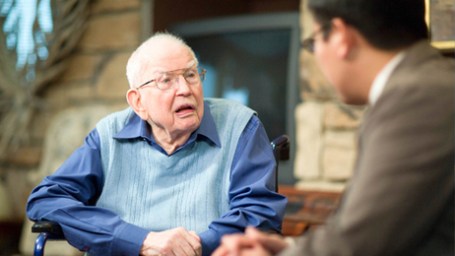
Russ Roberts interviews Coase on EconTalk. Familiar stuff, but it’s great to hear Coase talk about it at age 101. Some highlights:
Roberts: “[I]t’s hard to measure transactions costs; it’s hard to quantify the theory. Is that correct or is it irrelevant.” Coase: “It’s very relevant. But the state of economics is such that people don’t try to measure these things, to study them, and so people can engage in discussions and explanations without any real knowledge of what happens in the real world.”
Roberts: “What was your reaction to [game theory] and its influence on the study of the firm?” Coase: “I think the influence was wholly bad, because people developed high theoretical approaches instead of approaches based on what actually happens.”
Roberts: “[D]id you have contact with Keynes and Hayek, two great economists of that era in England?” Coase: “Yes. I was very friendly with Hayek. I liked him, and he liked me. But we didn’t have great contact. He tended to deal with these big questions, and I’m always interested in how the actual system operates. Therefore, in much smaller matters than Hayek.” Roberts: “And how about Keynes? Did you know Keynes?” Coase: “I can tell you– I was helping when Britain was trying to get a loan from the United States immediately after the war, and I was talking to one of Keynes’s assistants. And Keynes came in the room and walked over to us and the man I was talking to us said, ‘This is Coase, who is helping us with the statistics. I don’t think you know him.’ And Keynes said, ‘No, I don’t.’ And walked off. And that’s my life with Keynes. “
Qantum + Politics = Ψ(Fun)
| Lasse Lien |
O&M is nonpartisan, but this description of Mitt Romney as the first quantum politician is IMHO so funny that it would be downright irresponsible to ignore it.
After describing how other candidates operate under Newtonian principles, where a candidate’s position on an issue remains constant until acted upon by some outside force, David Javerbaum goes on to describe how things are very different in the quantum Romneality (excerpt):
Complementarity. In much the same way that light is both a particle and a wave, Mitt Romney is both a moderate and a conservative, depending on the situation. It is not that he is one or the other; it is not that he is one and then the other. He is both at the same time.
Probability. Mitt Romney’s political viewpoints can be expressed only in terms of likelihood, not certainty. While some views are obviously far less likely than others, no view can be thought of as absolutely impossible. Thus, for instance, there is at any given moment a nonzero chance that Mitt Romney supports child slavery.
Uncertainty. Frustrating as it may be, the rules of quantum campaigning dictate that no human being can ever simultaneously know both what Mitt Romney’s current position is and where that position will be at some future date. This is known as the “uncertainty principle.”
Entanglement. It doesn’t matter whether it’s a proton, neutron or Mormon: the act of observing cannot be separated from the outcome of the observation. By asking Mitt Romney how he feels about an issue, you unavoidably affect how he feels about it. More precisely, Mitt Romney will feel every possible way about an issue until the moment he is asked about it, at which point the many feelings decohere into the single answer most likely to please the asker.
Noncausality. The Romney campaign often violates, and even reverses, the law of cause and effect. For example, ordinarily the cause of getting the most votes leads to the effect of being considered the most electable candidate. But in the case of Mitt Romney, the cause of being considered the most electable candidate actually produces the effect of getting the most votes.
Duality. Many conservatives believe the existence of Mitt Romney allows for the possibility of the spontaneous creation of an “anti-Romney” that leaps into existence and annihilates Mitt Romney. (However, the science behind this is somewhat suspect, as it is financed by Rick Santorum, for whom science itself is suspect.)
What does all this bode for the general election? By this point it won’t surprise you to learn the answer is, “We don’t know.” Because according to the latest theories, the “Mitt Romney” who seems poised to be the Republican nominee is but one of countless Mitt Romneys, each occupying his own cosmos, each supporting a different platform, each being compared to a different beloved children’s toy but all of them equally real, all of them equally valid and all of them running for president at the same time, in their own alternative Romnealities, somewhere in the vast Romniverse.
David Javerbaum (NYT March 31).
HT: Svein T. Johansen
Murray Rothbard Day
| Peter Klein |
 Today would have been Murray Rothbard’s 86th birthday. Rothbard is widely (and rightly) regarded as the father of the modern libertarian movement, and a driving force behind the “Austrian” revival in the US, beginning in the late 1950s. For this occasion I hope I can be forgiven a bit of personal reminiscence, courtesy of a brief excerpt from the introduction to my 2010 book, The Capitalist and the Entrepreneur:
As a college senior, I was thinking about graduate school—possibly in economics. By pure chance, my father saw a poster on a bulletin board advertising graduate-school fellowships from the Ludwig von Mises Institute. (Younger readers: this was an actual, physical bulletin board, with a piece of paper attached; this was in the dark days before the Internet.) I was flabbergasted; someone had named an institute after Mises? I applied for a fellowship, received a nice letter from the president, Lew Rockwell, and eventually had a telephone interview with the fellowship committee, which consisted of Murray Rothbard. You can imagine how nervous I was the day of that phone call! But Rothbard was friendly and engaging, his legendary charisma coming across even over the phone, and he quickly put me at ease. (I also applied for admission to New York University’s graduate program in economics, which got me a phone call from Israel Kirzner. Talk about the proverbial kid in the candy store!) I won the Mises fellowship, and eventually enrolled in the economics PhD program at the University of California, Berkeley, which I started in 1988.
Before my first summer of graduate school, I was privileged to attend the “Mises University,” then called the “Advanced Instructional Program in Austrian Economics,” a week-long program of lectures and discussions held that year at Stanford University and led by Rothbard, Hans-Hermann Hoppe, Roger Garrison, and David Gordon. Meeting Rothbard and his colleagues was a transformational experience. They were brilliant, energetic, enthusiastic, and optimistic. Graduate school was no cake walk—the required core courses in (mathematical) economic theory and statistics drove many students to the brink of despair, and some of them doubtless have nervous twitches to this day—but the knowledge that I was part of a larger movement, a scholarly community devoted to the Austrian approach, kept me going through the darker hours.
I go on to discuss Oliver Williamson’s influence on my research program. Later I include Rothbard among my dedicatees:
Murray Rothbard, the great libertarian polymath whose life and work played such a critical role in the modern Austrian revival, dazzled me with his scholarship, his energy, and his sense of life. Rothbard is widely recognized as a great libertarian theorist, but his technical contributions to Austrian economics are not always appreciated, even in Austrian circles. In my view he is one of the most important contributors to the “mundane” Austrian analysis described above.
Gentle Ben
| Peter Klein |
I don’t think of Ben Bernanke’s approach to monetary policy as soft, passive, or restrained, but of course my optimal monetary policy is no monetary policy. Laurence Ball thinks that Bernanke’s actions after 2008 were surprisingly cautious, compared to what Bernanke advocated as an academic and Fed Governor in the early 2000s.
From 2000 to 2003, when Bernanke was an economics professor and then a Fed Governor (but not yet Chair), he wrote and spoke extensively about monetary policy at the zero bound. He suggested policies for Japan, where interest rates were near zero at the time, and he discussed what the Fed should do if U.S. interest rates fell near zero and further stimulus were needed. In these early writings, Bernanke advocated a number of aggressive policies, including targets for long-term interest rates, depreciation of the currency, an inflation target of 3-4%, and a money-financed fiscal expansion. Yet, since the U.S. hit the zero bound in December 2008, the Bernanke Fed has eschewed the policies that Bernanke once supported and taken more cautious actions — primarily, announcements about future federal funds rates and purchases of long-term Treasury securities (without targets for long-term interest rates).
Ball describes a June 2003 meeting of the Fed’s Open Market Committee at which senior staffer Vincent Reinhart convinced Bernanke that when interest rates are near zero, the right policies are persuading market participants that federal funds rates will continue to fall, selling medium-term bonds and buying longer-term ones (“Operation Twist”), and quantitative easing. When the financial crisis hit, this is exactly what Bernanke did, although — according to Ball — Bernanke had long argued for much more aggressive moves.
Ball argues that Bernanke fell victim to groupthink:
We can interpret the June 2003 FOMC meeting as an example of groupthink. The recommendations in Reinhart’s briefing were presented as the views of a unified Fed staff. In the FOMC discussion, nobody, including Chairman Greenspan, seriously questioned Reinhart’s focus on his three preferred policy options. By the time Bernanke spoke, a consensus had emerged on a number of points, such as opposition to targets for long-term interest rates. Groupthink may have discouraged Bernanke from shaking up the discussion with his past ideas for zero-bound policy.
A reluctance to disagree with the consensus was common at the Greenspan Fed, according to some observers. Cassidy (1996) describes how Alan Blinder, Fed Vice Chair from 1994 to 1996, reacted to FOMC meetings: “The thing that surprised Blinder most was the way decisions were made at the Board. Most of the time, the governors were presented with only one option: the staff recommendation.”
He also suggests that Bernanke, unlike Greenspan, Paulson, Summers, and other key economic policy figures, is shy, withdrawn, and unassertive.
Without intending to, I think Ball makes powerful arguments against conventional monetary policy itself, which relies on a small, secretive, cabal of powerful technocrats, interest-group representatives, and fixers to design and implement rules and procedures that affect the lives of millions, that reward some (commercial and investment bankers, homeowners) and punish others (savers, renters), that shape the course of world events. Do we really want a system in which one person’s personality type has such a huge effect on the global economy?
Foss at Missouri
| Peter Klein |
 O&M co-founder Nicolai Foss will give the 2012 Sherlock Hibbs Distinguished Lecture in Business and Economics Tuesday, 6 March 2012, 10:00-11:30am, in 205 Cornell Hall on the University of Missouri campus. The title is “Open Entrepreneurship: The Role of External Knowledge Sources for the Entrepreneurial Value Chain.” The lecture is sponsored by the Hibbs Professors of the University of Missouri’s Trulaske College of Business and the University of Missouri’s McQuinn Center for Entrepreneurial Leadership (which I direct).
The full announcement (with Nicolai’s impressive bio) is below the fold. The lecture is free and open to the public, so all are welcome! (more…)
Birger Wernerfelt to Become Honorary Doctor at CBS
| Nicolai Foss |
Over the last few years, CBS has bestowed honorary doctoral degrees on the likes of Jay Barney, Oliver Williamson, Oliver Hart, Michael Brennan, and other luminaries in strategy, the theory of the firm, and finance (in addition to a number of reps of pomo in management research that are of small interest to O&M readers). At a ceremony on 19 April a CBS honorary doctorate will be bestowed upon Birger Wernerfelt.
Wernerfelt is the JC Penney Professor of Management of the MIT Sloan School of Management. A Danish citizen, Wernerfelt holds degrees from the University of Copenhagen and Harvard. Wernerfelt’s best known work is no doubt “A Resource-based View of the Firm.” With more than 12,000 cites (google scholar) this paper is also one of the most cited social science research articles ever, and, of course, one of the founding papers of strategy’s (still) dominant view, the resource-based approach. The paper develops a conception of firms as bundles of heterogeneous and partly firm-specific resources, and links this conception to sustainable performance differences between firms as well as to growth strategies through resource-based diversification. These ideas opened up several paths of research in strategic management in the following decades, including Wernerfelt’s own influential empirical work (with Cynthia Montgomery) on diversification and its link to performance (e.g., here).
More recently, Wernerfelt has been working on other truly fundamental aspects of the theory of the firm, namely the reason why firms exist and what explains their boundaries and internal organization. Thus, in a series of papers, Wernerfelt has developed an argument that the employment relationship exists because it allows the parties to the contract to exploit economies of scale in bargaining costs (e.g., here) — a stream that may be seen as much more true to the original message in Coase’s (1937) “The Nature of the Firm” than the asset-specificity branch of the theory of the firm. Wernerfelt has extended the argument to the understanding of asset ownership, communication within and between firms, and the strength of incentives in firms versus markets. In addition to these contributions to strategic management and the theory of the firm, Wernerfelt has contributed to the economics of search and numerous important contribution to marketing theory.
What Did Keynes Mean by “Animal Spirits”?
 | Peter Klein |
Keynes’s idea that investors are motivated by “animal spirits” has come back into vogue with the recent Keynesian revival, but the term is often misunderstood. Keynes referred not to psychological factors that make investors reluctant to invest, but those that make them invest at all — in the face of deep uncertainty, he thought, only a manic, driven, strong-willed person would put capital at risk. When animal spirits are strong, investment is sufficient to maintain aggregate demand; when they lag, aggregate demand falls, and the economy lapses into depression. (Lord Skidelsky approvingly calls this the “mood swings theory” of business cycles — an idea just crazy enough to spawn a recent NBER paper.)
The new issue of Capitalism and Society features a piece on What Keynes Really Meant on this issue, and it’s a good read:
Alexander Dow, Glasgow Caledonian University
Sheila C. Dow, University of StirlingThe term ‘animal spirits’ has returned to academic and public discourse in a way which departs significantly from the original use of the term by Keynes. The new behavioural economics literature uses the term to refer to a range of behaviour which falls outside what is normally understood as rational. This treatment follows from the mainstream dichotomisation between rationality and irrationality. However, Keynes explained that, given fundamental uncertainty, rationality alone was insufficient to justify action. Animal spirits was the name he gave to the (psychological) urge to action which explained decisions being taken in spite of uncertainty; animal spirits for him were neither rational nor irrational. Nor are they beyond analysis. We explore how the nature and role of animal spirits can vary according to context (as between different sectors, types of firm and within firms). This analysis indicates ways in which policy can promote structural change to strengthen animal spirits in the long term as well as offset short-term weakening in animal spirits.
Too Freaky
| Peter Klein |
We’ve been somewhat critical on this blog of the Freakonomics approach, but not as critical as Andrew Gelman. Here’s his latest (with Kaiser Fung) in the American Scientist:
On the heels of Freakonomics, the pop-economics or pop-statistics genre has attracted a surge of interest, with more authors adopting an anecdotal, narrative style.
As the authors of statistics-themed books for general audiences, we can attest that Levitt and Dubner’s success is not easily attained. And as teachers of statistics, we recognize the challenge of creating interest in the subject without resorting to clichéd examples such as baseball averages, movie grosses and political polls. The other side of this challenge, though, is presenting ideas in interesting ways without oversimplifying them or misleading readers. We and others have noted a discouraging tendency in the Freakonomics body of work to present speculative or even erroneous claims with an air of certainty. Considering such problems yields useful lessons for those who wish to popularize statistical ideas.
Here’s some additional commentary from Andrew.
My unease with Freakonomics is not its anecdotal, narrative style, but the emphasis on clever puzzles rather than substantive problems, over-reliance on weird instrumental variables, and belief that one can tackle almost any phenomenon with only the barest knowledge of its history and prior literature. Economic theory is indeed quite general and powerful, but not to be thrown around willy-nilly. After all, with great power comes great responsibility.
Rafe Champion at Missouri
| Peter Klein |
 It’s been fun hosting Australian writer (and frequent O&M commenter) Rafe Champion at Missouri the last couple of days. Rafe spoke to the economists about the philosophy of science (handout here), and to the graduate philosophy seminar of my colleague André Ariew on current research topics in the philosophy of biology. We’ve had many talks about Hayek, Mises, Popper, Parsons, and our mutual friend Bill Bartley, among others. Rafe blogs at Catallaxy Files and the Critical Rationalist blog, and his website The Rathouse contains a treasure-trove of writings by, and commentary on, the most important twentieth-century philosophers of science.
Anita McGahan at Missouri
| Peter Klein |
Friend of O&M and leading management scholar Anita McGahan will present the University of Missouri’s Monroe-Paine Distinguished Lecture in Public Affairs, “The Health of Humanity 2050,” Thursday, 27 October 2011. She’ll also do a faculty-student seminar, “Changing the World,” that morning. Besides her important contributions to industry and competitor analysis Anita has become a leading expert in public health, poverty, and economic growth. Local O&Mers, make plans to attend!
Monroe-Paine Distinguished Lecture in Public Affairs
You’re invited to attend
Dr. Anita McGahan
Associate Dean-Research, Director of the PhD Programs, Professor of Strategic Management and
Rotman Chair in Management, Rotman School of Management,
Munk School of Global Affairs, University of Torontowill present
“The Health of Humanity 2050”
October 27, 2011 — 1:30 pm
2501 Missouri Student Center, Chambers Auditorium
RSVP to McGahan Lecture
For more information on Dr. McGahan, please visit the Truman School website.
Of Categories and Killers
| Peter Lewin |
A recent issue of the Review of Austrian Economics (edited by Virgil Storr) honors the contributions of Don Lavoie who died at a very young age in 2001. It contains contributions by Storr, Boettke and Prychitko, Klamer, Chamlee-Wright, Horwitz, Lewis, and High. In addition, published for the first time is a seminal article by Lavoie on the interpretive turn in economics.
Lavoie was an audacious pioneer. Like many such pioneers he was ahead of his time. The newly re-emergent Austrian school was not ready for him — did not understand what he was about. Most of them either ignored Lavoie’s products (and those of his collaborators at the Program on Social and Organizational Learning — a center he co-founded with Jack High), or else marginalized him. To the latter his preoccupation with late Continental Philosophy and hermeneutics was seen as a real threat to doing social science. His young, loyal and creative collaborators were caught in the crossfire. After his death the furor simply died down.
With the publication of this issue it is possible to gain a fresh perspective (something Lavoie’s hermeneutics might have predicted). For me it is a case of “distance lends enchantment to the view.” I confess I was in the group who neglected his work for lack of sufficient understanding of its significance.
For management and industrial organization types Lavoie’s work is highly relevant. There is a growing appreciation of the connection between language, communication, meaning, action, purpose and organization — about which Lavoie’s approach has much to say, not to mention his prescient contributions on culture, modularity, and computer science. For those wishing to benefit from his work, unless you have an interest in the epistemology of Continental philosophers, I would suggest concentrating on the contributions that have to do with information, knowledge, computing, and organization. (more…)
The Institutional Revolution
| Peter Klein |
I’m very excited about Doug Allen’s forthcoming book The Institutional Revolution (University of Chicago Press). Trained by Yoram Barzel (and hence part of the Tree of Zvi), Doug is a leading contemporary scholar on property rights, transaction costs, contracting, and economic history. His work on agricultural contracting with Dean Lueck, including their 2002 book The Nature of the Farm, is a classic contribution to the economics literature on economic organization. He also has a very good introductory textbook. More information is at Doug’s informative (and amusing) website.
Here’s the cover blurb for the new book:
Few events in the history of humanity rival the Industrial Revolution. Following its onset in eighteenth-century Britain, sweeping changes in agriculture, manufacturing, transportation, and technology began to gain unstoppable momentum throughout Europe, North America, and eventually much of the world—with profound effects on socioeconomic and cultural conditions.
In The Institutional Revolution, Douglas W. Allen offers a thought-provoking account of another, quieter revolution that took place at the end of the eighteenth century and allowed for the full exploitation of the many new technological innovations. Fundamental to this shift were dramatic changes in institutions, or the rules that govern society, which reflected significant improvements in the ability to measure performance—whether of government officials, laborers, or naval officers—thereby reducing the role of nature and the hazards of variance in daily affairs. Along the way, Allen provides readers with a fascinating explanation of the critical roles played by seemingly bizarre institutions, from dueling to the purchase of one’s rank in the British Army.
Engagingly written, The Institutional Revolution traces the dramatic shift from premodern institutions based on patronage, purchase, and personal ties toward modern institutions based on standardization, merit, and wage labor—a shift which was crucial to the explosive economic growth of the Industrial Revolution.
Bonus: Here’s the syllabus from Doug’s course on the economics of property rights.
Peter Lewin Interview
| Peter Klein |
Adrián Ravier has put together a nice collection of Spanish-language interviews with economists of the Austrian school (volume 1, volume 2). The leading modern figures are all included: Mises, Hayek, Machlup, Lachmann, Rothbard, Kirzner, fellow travelers such as Buchanan and Shackle, and contemporary Austrians such as Garrison, Block, Hoppe, Higgs, Ebeling, Salerno, Boettke, and more.
Guest blogger Peter Lewin’s interview is coming out in a third volume, to be published later this year, and Adrián has given me permission to post the English version here. You’ll find Peter’s intellectual odyssey very interesting!
(I am also featured in the collection, via translation of an old interview from 1995. Those were the days!)
Warning to My Future Biographers
| Peter Klein |
Daniele Besomi, writing at the SHOE list (and shared with permission):
[N]ot only memory is treacherous and selective, but even archival sources are not always fully reliable. In my work on the papers of Roy Harrod I have found examples of self-selection of documents to be preserved for posterity. Already aged 30 he annotated some documents as witnessing his position on some university matters; at 32 he preserved his own side of the correspondence he entertained with some politicians apparently because he deemed it important to keep a trace of it (he normally never kept copies of his outgoing correspondence, almost all handwritten); at 45 he started going through his own archives, annotating some correspondence for the benefit of “future historians of thought.”
At some (probably later) point in life he organized his own archives for the benefit of future readers, and he is likely to have manipulated some contents (besides rearranging the correspondence: annoyingly, the archivists undid some of Harrod’s work and moved some papers to different folders …).
It is in fact very strange that one who preserved tailor’s bills and bus tickets had kept no documents relating to his activities with the New Fabian Research Bureau in the early 1930s: he didn’t keep any of the memoranda he wrote (two at least survive in the NFRB’s archives) nor the correspondence he received about it (but the outgoing letters are in the recipients’ archives), except for a letter from James Meade dealing with theoretical matters and mentioning the NFRB in a postscript — perhaps (I am speculating here) Sir Roy turned conservative was embarrassed of the left-wing tendencies of his younger self.
Look below the fold for some annotations and sources (via Daniele). (more…)
A Krugmanian Slasher Flick
 | Peter Klein |
Paul Krugman is furious about the deficit-reduction plan reportedly agreed to yesterday, which Krugman says will “slash government spending,” introducing “big spending cuts” that “will depress the economy even further.” And yet, the deal apparently does not cut one penny of government expenditures, but simply increases them at a slower pace (over ten years) than originally projected by the CBO. Remember, in Washington-speak, “cut” means “reduction in the planned rate of increase.”
Imagine a scene from a Krugman-style slasher flick: the villain approaches the victim, and gives him a smaller hug than the victim was expecting! The audience gasps as the victim screams in terror and flees from the vicious attack.
The Menger Sponge
| Lasse Lien |
Earlier the investigative arm of O&M (with only limited hacking of phones and bribing of police officers) discovered the sensational news that Peter is named after a bottle with no inside and no outside, the endlessly fascinating Klein bottle. Apparently this sort of thing is quite common in Austrian circles. We can now reveal that Menger is named after a sponge, the Menger sponge, which is described in greater detail here.
(Actually the Menger Sponge is named after Karl the mathematician, son of Carl.)
2011 Spengler Prize
| Peter Klein |
Congratulations to Robert Leonard for winning the 2011 Joseph J. Spengler Prize for the best book in the history of economics for Von Neumann, Morgenstern and the Creation of Game Theory: From Chess to Social Science 1900-1960 (Cambridge University Press, 2010). I’ve only skimmed the book but it looks exceptionally well done. Required reading for O&Mers interested in intellectual history, methodology, Austrian economics, strategy, and/or game theory. . . . (That’s pretty much all of you.)
Against (Karl) Polanyi
| Peter Klein |
 I mentioned Karl Polanyi (not to be confused with Michael) in yesterday’s post on anonymity. Gavin Kennedy points us today to Mark Pennington, who writes that Polanyi’s claims “are either historically inaccurate or based on a crude misrepresentation of classical liberalism.” Specifically,
classical liberalism has never claimed that narrowly selfish behaviour is all that is required to sustain the social fabric. Of course markets are always “embedded” in a broader nexus of institutions, but the question we need to ask is precisely what sort of institutional and social norms are required to facilitate social cooperation on the widest possible scale. Polanyi and his followers prefer to rely on hackneyed accounts of the Wealth of Nations rather than recognise that Smith’s support for markets and “self interest” constituted part of a broader ethical system set out in the Theory of Moral Sentiments. Specifically, Smith was concerned to elucidate the balance between the social norms appropriate to contexts of commercial exchange and those appropriate in more intimate environments. From Smith’s point of view feelings of sympathy which include love, friendship and reciprocity are reserved for people of whom we have detailed personal knowledge. The morals expected in commercial relations which are often between relative strangers, however, tend to be more impersonal, focussed on principles such as the observance of contracts and are oriented more towards the “self interest” of the parties involved rather than the direct benefit of “others.” The great mistake is to suppose that the type of ethos that pervades family life or that in tight knit communities can operate on a much wider scale. The development of inclusive markets requires a more impersonal ethos which enables people to engage with diverse actors who may not share the same moral outlook. If people deal only with those who share the same moral outlook or trade only with “locals” rather than engage in transactions with “foreigners” then the sphere of potentially cooperative relationships will be reduced. The alternative to self-interest is not solidarity, but suspicion if not outright conflict.
Anti-Williamson
| Peter Klein |
Thanks to Per for reminding me of this 2004 paper by Daniel Ankarloo and Giulio Palermo, “Anti-Williamson: A Marxian Critique of New Institutional Economics” (Cambridge Journal of Economics 28, no. 3). It’s one thing to question Williamson’s behavioral assumptions and to complain about their implications for education and business practice. But apparently “Williamson’s categories, his method and conception are themselves products of bourgeois ideology.” Who knew?
Bonus: Here’s Doug North getting the same treatment. And if anyone thinks I don’t take Marx seriously, let me say that I once mitigated a contractual hazard in my pajamas — how it got in my pajamas I’ll never know.





 Organizations and Markets
Recent Comments