Posts filed under ‘Public Policy / Political Economy’
The Impotence of the Economists, Part II
| Peter Klein |
The financial-market bailout is one thing. While most economists, rightly in my view, strongly opposed the Paulson plan, one can at least imagine intelligent arguments for it. The proposed auto-industry bailout is something else entirely. Does any economically literate person support it? Industry bailouts are textbook examples of the fallacy of composition, taught in every Econ 101 class. When I teach it I use exactly this kind of example (bailing out Chrysler in 1980, bailing out the airline and insurance industries after 9/11, etc.). Saving the X industry simply harms the Y and Z industries, while substituting the political process for the market in determining the allocation of resrouces. And yet, here we go.
Along these lines, here are some sentences to ponder from David Yermack, writing in today’s WSJ:
In 1993, the legendary economist Michael Jensen gave his presidential address to the American Finance Association. Mr. Jensen’s presentation included a ranking of which U.S. companies had made the most money-losing investments during the decade of the 1980s. The top two companies on his list were General Motors and Ford, which between them had destroyed $110 billion in capital between 1980 and 1990, according to Mr. Jensen’s calculations.
I was a student in Mr. Jensen’s business-school class around that time, and one day he put those rankings on the board and shouted “J’accuse!” He wanted his students to understand that when a company makes money-losing investments, the cost falls upon all of society. Investment capital represents our limited stock of national savings, and when companies spend it badly, our future well-being is compromised. Mr. Jensen made his presentation more than 15 years ago, and even then it seemed obvious that the right strategy for GM would be to exit the car business, because many other companies made better vehicles at lower cost. . . .
Over the past decade, the capital destruction by GM has been breathtaking, on a greater scale than documented by Mr. Jensen for the 1980s.
See also: Lynne Kiesling.
A Silver Lining
| Peter Klein |
As I mentioned in a recent talk, one good thing to come out of the bailout disaster is the diminished reputation of St. Alan the Wise. It was fun watching the same Congressional clowns who months earlier praised the “Maestro” as the greatest Fed chair in history slap him down for failing to prevent the housing bubble. Of course, Greenspan, like these clowns, ignored the issue of credit expansion, expressing regret only that he had put “too much trust” in market forces. Ha!
Now Paulson, never too popular in the first place, is suffering a similar fate, as he abandons the Troubled Asset Relief Program — the rationale for the bailout itself — and praises Congress for giving him the broad authority to do, well, whatever the hell he wants. Oh, please, let Bernanke be next!
BTW, Bob Higgs continues to offer some of the best commentary on the disaster — the political, journalistic, and educational disaster, I mean, not the supposed economic disaster. I hope his term, “Bailout of Abominations,” catches on.
Update: The Economist puts it this way: “One of the most humbling features of the financial crisis is its ability to humiliate policymakers who, thinking that they have a bazooka in their closet, soon discover that it is a mere popgun.”
Halo Alert
 | Peter Klein |
Phil Rosenzweig’s excellent Halo Effect takes to task the typical “guru” book in business, one that picks a few successful companies, describes their business practices, and attributes success to those practies, without any attempt to design a “controlled experiment.” As I wrote last year:
The most common problems are sampling on the dependent variable (i.e., choosing a sample of high-performing companies and explaining what their managers did, ignoring selection bias) and using independent variables based purely on respondents’ ex post subjective assessments of strategy, corporate culture, leadership, and other “soft” characteristics. The latter is the “Halo Effect” of the book’s title. When a company’s financial or operating performance is strong, managers, consultants, journalists, and management professors tend to rate strategy, culture, and leadership highly, while rating the same strategies, cultures, and leadership poorly when a company’s performance is weak. It’s as if the authors of “guru” books have never taken a first-year graduate course on empirical research design. Or, as Rosenzweig puts it (p. 128): “None of these studies is likely to win a blue ribbon at your local high school science fair.” Ouch.
Look for a series of Halo-style analyses of the Presidential contest. Today’s NY Times, for example, contains a lengthy profile of the Obama campaign, “Near-Flawless Run Is Credited in Victory,” which recapitulates the Obama campaign’s hodge-podge of tactics, some good and some bad, without trying to isolate and identify the effects of particular tactics. The writers note that Obama’s chief strategists, David Axelrod and David Plouffe, have never before been involved with a successful campaign, which right away makes you wonder how “flawless” their strategy could have been. Still, the Times describes almost everything the campaign did as exactly right. Had Obama lost, no doubt the same pundits would be calling the same hodge-podge of tactics an obvious failure, placing the blaime on Alexrod and Plouffe and praising the McCain campaign’s own strategy and tactics. Post hoc, ergo propter hoc!
Needed: A Little Cost-Benefit Analysis
| Peter Klein |
Andrew Gelman, Nate Silver, and Aaron Edlin estimate the the probability of any given vote being decisive in Tuesday’s US election is about one in 60 million. Residents of a few states, like New Mexico, Virginia, New Hampshire, and Colorado, are especially important: their chance is one in 10 million. Oh, did I mention that your vote doesn’t matter?
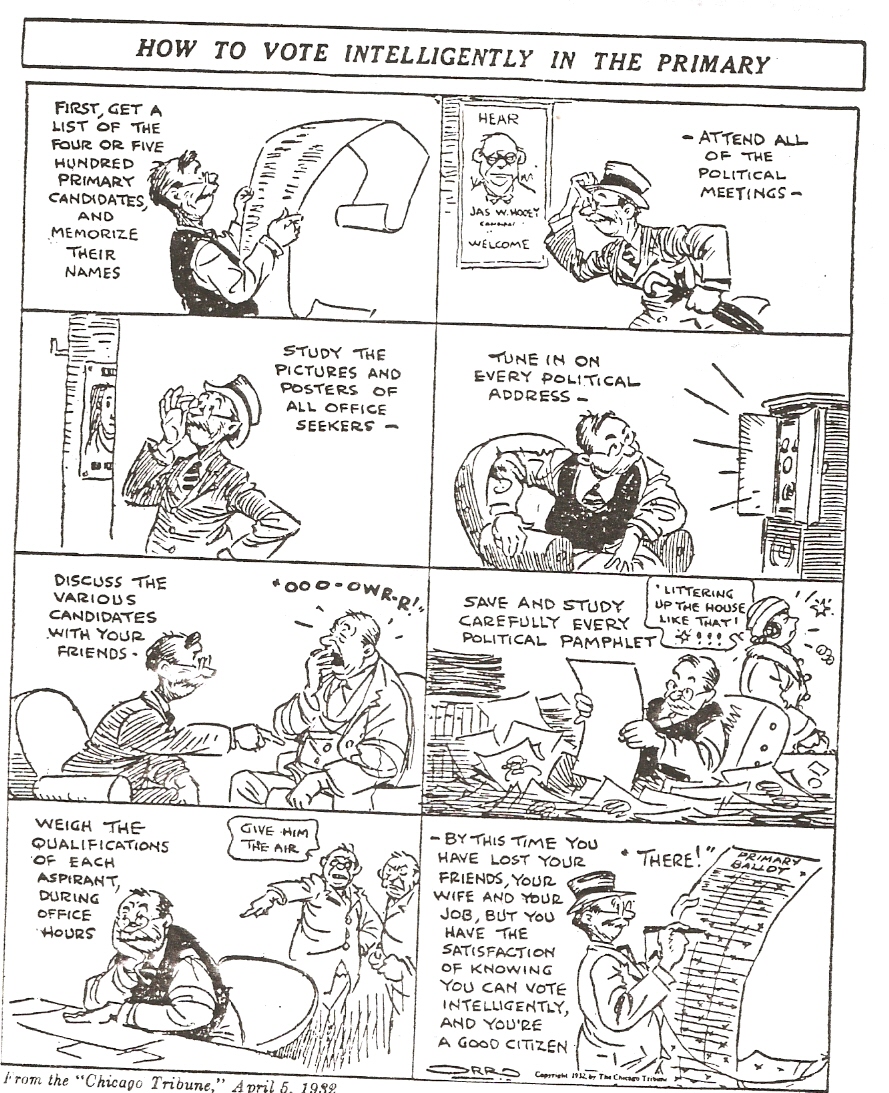 Cliff sent me a couple of amusing items on People Who Don’t Get It. Here’s one on a young Chicago woman who can’t decide between McCain and Obama, and is “probably going to cram the night before the election and really study them both.” Gee, I wonder which candidate is going to win Illinois? And here’s a wonderful cartoon from the 1932 Chicago Tribune, “How to Vote Intelligently in the Primary.” Ah, where are the Colonel McCormicks of today?
A Billion Here, A Trillion There
| Peter Klein |
How expensive is the bailout? Where will the money come from?
Consider the numbers: $29 billion for the Bear Stearns mess; $700 billion to buy spoiled assets; $200 billion to buy stock in Fannie Mae and Freddie Mac; an $85 billion loan to AIG insurance; another $37.8 billion for AIG; and $250 billion for bank stocks. Hundreds of billions in guarantees to back up money market funds and to guarantee bank deposits. And who knows what expenses are still to come. . . .
How will the U.S. pay for it all? Answer: by borrowing — raising worries about how the country’s ballooning annual budget deficits and aggregating debt will affect the economy and financial markets. Some guidelines, such as interest rates and the ratio of debt and deficits to gross domestic product, suggest the new debt will be digested easily. But some experts think those guidelines are misleading, warning that obligations are piling up like tinder on a forest floor.
“This kind of accounting that the government does — if they did it in the private sector they would go to jail,” says Kent Smetters, a professor of insurance and risk management at Wharton.
From Knowldge@Wharton, which reminds us that there’s plenty more to come — a probable bailout of Chrysler and G.M., for instance. And who knows what else. Of course, the US government now has a $10.5 trillion national debt. “To economists, the most frightening fact is that the enormous cost of today’s financial rescues is just a drop in the bucket.”
Tooth-Fairy Economics
| Peter Klein |
Art Laffer offers this succinct summary of Bernankeconomics:
No one likes to see people lose their homes when housing prices fall and they can’t afford to pay their mortgages; nor does any one of us enjoy watching banks go belly-up for making subprime loans without enough equity. But the taxpayers had nothing to do with either side of the mortgage transaction. If the house’s value had appreciated, believe you me the overleveraged homeowner and the overly aggressive bank would never have shared their gain with taxpayers. Housing price declines and their consequences are signals to the market to stop building so many houses, pure and simple.
But here’s the rub. Now enter the government and the prospects of a kinder and gentler economy. To alleviate the obvious hardships to both homeowners and banks, the government commits to buy mortgages and inject capital into banks, which on the face of it seems like a very nice thing to do. But unfortunately in this world there is no tooth fairy. And the government doesn’t create anything; it just redistributes. Whenever the government bails someone out of trouble, they always put someone into trouble, plus of course a toll for the troll. Every $100 billion in bailout requires at least $130 billion in taxes, where the $30 billion extra is the cost of getting government involved.
If you don’t believe me, just watch how Congress and Barney Frank run the banks. If you thought they did a bad job running the post office, Amtrak, Fannie Mae, Freddie Mac and the military, just wait till you see what they’ll do with Wall Street.
Heckman on Academia
| Peter Klein |
Steve Levitt links to this update on the travails of the University of Chicago’s proposed Milton Friedman Institute. Jim Heckman, an Institute supporter who has recently expressed public doubts about its conception and development, is on the hot seat. Heckman makes an interesting observation, in passing, that relates to a previous discussion of research funding:
Heckman added that all institutes are affected by bias, citing hiring decisions as a source of bias throughout the University.
“I doubt there is a truly unbiased academic. Besides, most biased people don’t see themselves as biased. If you think the [Chicago Graduate School of Business] is an unbiased environment, think again. They are recruited for their views. I wonder also how many free marketers would get jobs in anthropology or sociology,” he said.
“It’s true for any institute. You state a mission, attract funders. They expect the mission to be fulfilled. Very rarely do people fund pure knowledge,” he said.
The Case Against Corporate Social Responsibility
| Dick Langlois |
Another sign of the Apocalypse: Robert Reich channels Milton Friedman.
Philosophy: Who Needs It?
| Peter Klein |
When Greenspan was appointed Fed chair in 1987 the New York Times Magazine ran a lengthy profile noting, among Greenspan’s other eccentricities, that he was a follower of Ayn Rand, generally regarded as a strong advocate of laissez faire. But Greenspan is doctrinaire only “at a high philosophical level,” wrote Leonard Silk, reassuringly. Murray Rothbard, who knew Greenspan in the 1950s, when both were friends with Rand, got a kick out of that line:
There is one thing, however, that makes Greenspan unique, and that sets him off from his Establishment buddies. And that is that he is a follower of Ayn Rand, and therefore “philosophically” believes in laissez-faire and even the gold standard. But as the New York Times and other important media hastened to assure us, Alan only believes in laissez-faire “on the high philosophical level.” In practice, in the policies he advocates, he is a centrist like everyone else because he is a “pragmatist.” . . .
Thus, Greenspan is only in favor of the gold standard if all conditions are right: if the budget is balanced, trade is free, inflation is licked, everyone has the right philosophy, etc. In the same way, he might say he only favors free trade if all conditions are right: if the budget is balanced, unions are weak, we have a gold standard, the right philosophy, etc. In short, never are one’s “high philosophical principles” applied to one’s actions. It becomes almost piquant for the Establishment to have this man in its camp.
Today Tyler Cowen, writing on Anna Schwartz’s very good interview with the WSJ, calls Bernanke a person “with libertarian sympathies,” which I find puzzling, since I can’t recall any evidence of this sympathy in Bernanke’s writings or policy actions. Perhaps he is a sympathetic libertarian “at a high philosophical level.”
Blame Basel, Not “Deregulation”
| Peter Klein |
Says Charles Calorimis in the Saturday WSJ. First, as Calorimis points out, there wasn’t any deregulation. (Jacob Weisberg, what part of this can’t you understand?) Indeed, by any reasonable measure, government has grown more under George W. Bush than under any administration since LBJ — after this month, perhaps since FDR. Specifically, Calomiris notes:
Financial deregulation for the past three decades consisted of the removal of deposit interest-rate ceilings, the relaxation of branching powers, and allowing commercial banks to enter underwriting and insurance and other financial activities. Wasn’t the ability for commercial and investment banks to merge (the result of the 1999 Gramm-Leach-Bliley Act, which repealed part of the 1933 Glass-Steagall Act) a major stabilizer to the financial system this past year? Indeed, it allowed Bear Stearns and Merrill Lynch to be acquired by J.P. Morgan Chase and Bank of America, and allowed Goldman Sachs and Morgan Stanley to convert to bank holding companies to help shore up their positions during the mid-September bear runs on their stocks.
Even more to the point, subprime lending, securitization and dealing in swaps were all activities that banks and other financial institutions have had the ability to engage in all along. There is no connection between any of these and deregulation. On the contrary, it was the ever-growing Basel Committee rules for measuring bank risk and allocating capital to absorb that risk (just try reading the Basel standards if you don’t believe me) that failed miserably. The Basel rules outsourced the measurement of risk to ratings agencies or to the modelers within the banks themselves. Incentives were not properly aligned, as those that measured risk profited from underestimating it and earned large fees for doing so.
That ineffectual, Rube Goldberg apparatus was, of course, the direct result of the politicization of prudential regulation by the Basel Committee, which was itself the direct consequence of pursuing “international coordination” among countries, which produced rules that work politically but not economically.
Update: Here’s Larry White on the phantom deregulation.
The Impotence of the Economists
| Peter Klein |
My friends in sociology don’t like being ignored by politicians and by the general public. Well, one thing we’ve learned over the last several weeks is that academic economics, too, has virtually no influence on public policy. It’s increasingly clear that the majority of academic economists oppose, often strongly, the AIG rescue, the Paulson plan, the Fed’s move into the commercial-paper market, the Treasury’s acquisition of equity stakes in large banks, and the new round of financial-market regulations that’s just around the corner. Even Greg Mankiw, who sort-of favors the bailout, worries that his pal Ben hasn’t worked hard enough to convince his fellow academic economists.
What do we learn from all this? That economists are poor communicators? That economics is an inherently difficult subject? Or that politicians and special-interest groups willfully ignore what economics teaches about scarcity, tradeoffs, incentives, and the general welfare?
Surely the poor state of economics education plays some role. I’m not an admirer of Paul Krugman’s newspaper columns, but I respect the fact that he’s willing to write for the general public. (If only his columns had some economics in them!) Very few elite economists concern themselves with public education. Ultimately, however, the blame rests with politicians — that uniquely vile breed of humanity — and the special interests they serve. Maybe Albert Jay Nock had it right after all. Economists keep thinking, writing, and teaching, not because anybody in power is listening, but in hope that somewhere out there is a Remnant, however small, keeping the flame alive.
Today’s Bailout Links
| Peter Klein |
Ok, so let me get this straight. Credit got all constipated from banks’ misguided feast on crappy assets. My thought (see, especially, the most recent posts in this archive) was that maybe bank managers need better incentives.
I guess I must have been wrong, because the government is now putting a quarter trillion in non-voting stock. Well, that’s one way to fix the misalignment of manager-shareholder incentives — undermine the shareholders’ incentives too.
The Banks get below cost capital grants. Loans would cost 11 to 12 percent. The government gives them cash at 5 percent for five years and 10 percent thereafter with optional repayment; it is senior preferred stock. Large banks cumulate foregone dividends on the preferred; small banks do not. Existing shareholders still get dividends at past levels (no increases) and the government cannot vote any of its stock. Why ever pay it back? . . .
Lehman, J.P. Morgan and AIG look like AAA suckers. They paid dearly for their capital infusions. Greenberg, the ex-CEO of AIG and a major shareholder, is, sensibly, asking the government to renegotiate the AIG bailout package. The lesson for future crises? Stall, stall, stall.
Peter Schiff (via Karen):
After supposedly bailing out the fat cats on Wall Street, no politician wants to be accused of evicting struggling families. Once you understand this, all of your anxiety should melt away. Why pay your mortgage if foreclosure is off the table, and if you know that lower payments, and possibly a reduced loan amount, would result? A tarnished a credit rating is a small price to pay for such a benefit.
Unfortunately, this boon will not extend to those foolish individuals who either made large down payments or resisted the temptation of cashing out equity. The large amount of home equity built up by these suckers, I mean homeowners, means that in the case of default foreclosure remains a financially attractive option. As a result, these loans will be much less likely to be turned over to the government.
Monetary Policy and the Housing Crisis
| Dick Langlois |
I know I’m swimming over my head in macro-infested waters, but I thought I would think out loud some more about the housing mess. In my previous post on the subject (and comments), I posed the question whether a politically influenced (exogenous) lowering of credit standards was more of a culprit than monetary policy (or other macro forces) in causing the housing bubble and subsequent collapse. So I looked at an NBER Working Paper by John Taylor at Stanford that’s been out for a few months. Taylor argues that it was indeed Fed policy that caused the run-up in housing prices. He rejects the alternative possibilities (A) that most of the liquidity fueling the boom was money rushing in to the U.S. from overseas or (B) that it was the increased liquidity that came from securitization and financial innovation. Most interestingly, he argues — as have others, though I can’t find a good reference — that a large part of the reduction in lending standards was endogenous. Foreclosure risk was (is) anticorrelated with an increase in housing prices; so in the run-up, risk of foreclosure was actually declining ceteris paribus. Partly because of the complex and often impenetrable structure of housing finance, lenders took these foreclosure rates as stable in the long term. Moreover, as others have pointed out, lenders were concerned less with default in the run-up than with the risk of early repayment as people refinanced the equity out of their houses (or sold quickly for speculation, as Liebowitz says). All of this meant that lenders considered it optimal to lower credit standards.
This story strikes me as having a Hayekian flavor to it, though I don’t know if Peter and his commentators would agree. It also has something of Leijonhufvud about it, as Taylor’s main message is that the Great Moderation was a matter of the Fed sticking to the program — staying within the “corridor” — and not deviating as it did in 2003-2006, presumably in an effort to stimulate the economy after the Internet crash. The deviation of 2003-06 was “comparable to the turbulent 1970s.”
Political Origins of the Financial Crisis
| Dick Langlois |
Okay, so maybe I’ll write about the financial crisis after all.
Stan Liebowitz has been pointing for a long time to the political origins of lowered lending standards — pressure on Fannie Mae to increase “affordable housing” — and to the role of those lowered standards in the mortgage bubble. “[I]n an attempt to increase homeownership, particularly by minorities and the less affluent, an attack on underwriting standards was undertaken by virtually every branch of the government since the early 1990s. The decline in mortgage underwriting standards was universally praised as an ‘innovation’ in mortgage lending by regulators, academic specialists, GSEs, and housing activists. This weakening of underwriting standards succeeded in increasing home ownership and also the price of housing, helping to lead to a housing price bubble.”
Today the AEI has posted a nice piece by Peter Wallison and Charles Calomiris saying much the same thing. Even more interesting, however, is a long article in Saturday’s New York Times that chronicles the process in great detail.
Capitol Hill bore down on Mr. Mudd as well. The same year he took the top position, regulators sharply increased Fannie’s affordable-housing goals. Democratic lawmakers demanded that the company buy more loans that had been made to low-income and minority homebuyers.
“When homes are doubling in price in every six years and incomes are increasing by a mere one percent per year, Fannie’s mission is of paramount importance,” Senator Jack Reed, a Rhode Island Democrat, lectured Mr. Mudd at a Congressional hearing in 2006. “In fact, Fannie and Freddie can do more, a lot more.” (more…)
Amethyst and Public Choice
| Dick Langlois |
Many of you have heard of the Amethyst Initiative, a petition signed (at this writing) by 130 American college and university presidents in favor of lowering the drinking age from 21 back down to 18. As the website puts it, prohibition is not working. The college presidents are hoping that, by removing the black-market character of college drinking in the U.S., lowering the drinking age might be part of a solution to the problem of binge drinking on campus. (Although American 18-year-olds may not buy alcohol because such an activity is unsafe and unhealthy, it is quite alright for the same 18-year-olds to join the military and be posted to Iraq or Afghanistan.) Needless to say, this proposal has generated an enormous amount of controversy, and is vociferously opposed by politically powerful groups like Mothers Against Drunk Driving. The authoritarian response, typified by this column in Slate, is to point to the many studies that show that a higher drinking age reduces driving fatalities, although the Slate article does come around at the very end to the point that economists would make: taxes are more efficient at regulating behavior than is prohibition. (This would also include binge drinking. A student of mine, recently returned from a semester abroad, reports that there is no binge drinking at the National University of Singapore despite a drinking age of 18 — not because of that government’s well-known authoritarianism but because alcohol is highly taxed.) Not, of course, that I would personally like to see higher taxes on my pinot grigio.
My point here is not to engage the debate but to raise a Public Choice point I haven’t seen raised elsewhere. A quick reading of the list of university presidents who have signed suggests that many of them are from private schools. Among the most prominent of these are Dartmouth, Duke, and Johns Hopkins. Public Choice theory might suggest that presidents of state universities are much less likely to sign, since they depend on politicians for funding, and are much less willing to take positions that groups like MADD would oppose. The president of my university is certainly not about to sign it. The six Connecticut schools that have signed are all private, including Trinity College but not including Connecticut College, Wesleyan, or Yale. (Of course, Rick Levin at Yale may be just as reluctant to take unpopular positions given the hungry eye the government has been casting at his endowment.) On the other hand, there are a number of public colleges among the signatories, notably Maryland, UMass, and Ohio State. Are the signatories really biased in favor of private schools? Or are people actually taking moral positions despite possible consequences? That would be interesting. Do we have enough data to tell? Might be an good project for someone talented in the relevant econometrics.
I hesitated at first to post this, since I didn’t see its relevance to the current financial crisis. On reflection, however, it occurred to me that there is an important connection, since the best possible response to the financial crisis might well be binge drinking.
Self-Fulfilling Prophecy?
| Peter Klein |
 Commentators seem to take it for granted that this week’s crazy stock-market performance, particularly Monday’s 700-point drop in the Dow, proves the reality of the financial crisis. But in today’s Fed-watching age, in which even the most cryptic pronouncements of Federal Reserve officials send traders rushing to their keyboards, do you think the repeated statements by the Fed chair, Treasury secretary, and other insiders that the economy is on the verge of total collapse might just have a teensy, weensy effect on financial markets?
“Henry, banks are still lending. Hurry, say ‘credit crunch’ again and maybe we can scare ’em off!”
BTW isn’t it interesting that the phrase “not lending” has become a synonym for “lending less”? The Paulson plan “could channel enough money to enough banks to get them to resume lending,” says Knowledge@Wharton. So banks are currently making zero loans? Wow. I sense a profit opportunity. Hmmm, Don Boudreaux points to a Christian Science Monitor piece revealing that “only 63 percent of consumers applying for a car loan are being approved compared with 83 percent a year ago.” Yep, sounds like zero lending to me.
Strange Bedfellows
| Peter Klein |
One of the interesting aspects of this week’s House vote on the Paulson plan was the coalitions it generated. The Treasury Secretary, the Fed Chair, and leaders of both the Democratic and Republican sides stood hand-in-hand to urge lawmakers to support the bailout. Conservative Republican and liberal Democratic members joined forces to defeat it. What gives? Larry White points to ideology: “Republicans who voted no didn’t like the fact that $700 billion would be taken from taxpayers. . . . Democrats who voted no didn’t like the fact that it would be going to Wall Street.” Maybe, but I prefer Gordon Smith’s suggestion:
Anthony Ha uses the data at MapLight.org (a website dedicated to “illuminating the connection” between money and politics) to tell another familiar political story. Looking at this page, Anthony observes:
Overall, bailout supporters received an average of 54 percent more in campaign contributions from banks and securities than bailout opponents over the last five years. The disparity also held true if you look at individual parties. In fact, the 140 Democrats who voted for the bailout received almost twice as much money from banks and securities as the 95 Democrats who voted against it. (The difference was closer to 50 percent for Republicans.)
Does anybody have data that would permit some quick-and-dirty analysis, say a logistic regression of the House votes as a function of legislator and district characteristics, contributions from the commercial and investment banking industries, and other interest-group variables?
I’m From the Government, and I’m Here to Make You Some Money
| Peter Klein |
I’ve noted before how most commentators on the financial crisis are ignoring political economy. Virtually everyone, with the exception of the good folks at Mises.org, The Beacon, and a few other sites, treats Paulson, Bernanke, bank regulators, members of Congress, and other principals as the benevolent dictators of neoclassical welfare economics. (This is true even of people you’d think might know something about public choice.) But it’s impossible to analyze the current situation without reference to special interests — not only those whose actions are responsible for the current mess, but also those taking advantage of the situation to rewrite the rules and increase their authority.
One example: A particularly foolish (and dangerous) meme working its way through Washington and the surrounding punditocracy is the idea that the Paulson or modified Paulson plan isn’t really a $700 billion bailout. It’s an asset purchase, the argument goes, not a transfer payment; the Treasury buys $700 billion of bad securities, holds them, and sells them later, once market conditions improve. Maybe the Treasury can sell these assets for, say, $500 billion, so the net cost to the taxpayer is only $200 billion. Heck, if prices rise enough, taxpayers may even make money on the deal! (That’s what the junior senator from Missouri said today. Plenty of clever-silly people are saying this kind of thing too.)
The scenario is pure fantasy. Think of it this way. Treasury gets the $700 billion by borrowing (say, from the Chinese) or through increased tax revenue. Suppose the value of these assets really does rise to $500 billion, and the Treasury sells them back to investors. What will the US government do then — return the 500 billion to taxpayers? Does anyone seriously think Congress would cut taxes or offer rebates to give that money back? Not on your life. Congress will simply take that $500 billion and spend it on new programs. The Paulson plan represents an increase in government expenditures of $700 billion, period. Joe and Jane taxpayer will never get a penny of that $700 billion back, no matter what happens to asset prices.
Karl’s Revenge
 | Peter Klein |
I closed my first post on the bailout mess with “Capitalism, requiescat in pace.” Here’s Martin Masse with the details. (Thanks to Mark Thornton.)
Paulson, Bernanke, Congress: We Need Your Help!
| Peter Klein |
With our economy in crisis, the US Government is scrambling to rescue our banks by purchasing their “distressed assets”, i.e., assets that no one else wants to buy from them. We figured that instead of protesting this plan, we’d give regular Americans the same opportunity to sell their bad assets to the government. We need your help and you need the Government’s help!
Use the form below to submit bad assets you’d like the government to take off your hands. And remember, when estimating the value of your 1997 limited edition Hanson single CD “MMMbop”, it’s not what you can sell these items for that matters, it’s what you think they are worth. The fact that you think they are worth more than anyone will buy them for is what makes them bad assets.
Here’s the link (via Sean Corrigan, and please excuse the language). Remember, if people can’t get rid of their bad assets, they will have to cut back their spending, hurting local businesses, which will then be unable to spend, hurting other businesses, and so on, generating a “consumption crunch” that will cause the next Great Depression. Please, somebody, break some windows!





 Organizations and Markets
Recent Comments