Posts filed under ‘Public Policy / Political Economy’
Organizational Learning without Markets
| Peter Klein |
A really interesting NBER paper from Thomas Triebs and Justin Tumlinson confirms what you may suspect, that firms operating outside the market system — in this case, in the former East Germany — do not learn the capabilities for judging market signals. Triebs and Tumlinson compare East and West German firms after unification and find that East German firms did not anticipate, or respond to, market information as well as their West German counterparts, other things equal, suggesting that during the Communist period, firms lost (or failed to acquire) the ability to work within a market setting. The paper is based on a formal learning model but the empirical results seem to square with a variety of approaches, including resource-based and managerial capabilities theories.
Learning Capitalism the Hard Way—Evidence from Germany’s Reunification
Thomas P. Triebs, Justin Tumlinson
NBER Working Paper No. 19209, July 2013Communism in East Germany sought to dampen the effect of market forces on firm productivity for nearly 40 years. How did East German firms respond to the free market after being thrust into it in 1990? We use a formal learning model and German business survey data to analyze the lasting impact of this far-reaching treatment on the way firms in former East Germany predicted their own productivity relative to firms in former West Germany during the two decades since Reunification. We find in confirmation of our formal model’s predictions, that Eastern firms forecast productivity less accurately, particularly in dynamic and uncertain markets, but that the gap gradually closed over 12 to 13 years. Second, by analyzing the direction of firm level errors in conjunction with contemporaneous market signals we find that, in the years immediately following Reunification, Eastern firms estimate the market’s role as generally less potent than Western firm do, an observation consistent with overweighting experiences from the communist era; however, over roughly 14 years both converge to the same (incorrect) overestimate of the market’s role on their productivity.
I’m reminded of Mises’s remark that entrepreneurs, in a socialist economy, learn to excel at “diplomacy and bribery.” I suspect a study like Triebs and Tumlinson’s on political capabilities or skill at political entrepreneurship might yield the opposite result.
Sampling on the Dependent Variable, Robert Putnam Edition
| Peter Klein |
Famed sociologist Robert Putnam makes his case for government funding of social science research:
One of the harshest critics of National Science Foundation funding of political science has even praised my study [on civil society and democracy] as “one of the most influential pieces of practical research in the last half-century.”
Ironically, however, if the recent amendment by Sen. Tom Coburn (R-Okla.) that restricts NSF funding for political science had been in effect when I began this research, it never would have gotten off the ground since the foundational grant that made this project possible came from the NSF Political Science Program.
Well, yes, if it hadn’t been for NASA, we wouldn’t have put a man on the moon. What this shows about the average or marginal productivity of government science funding is a little unclear to me.
Of course, Putnam’s piece is a short editorial making an emotional, rather than logical, appeal. But this kind of appeal seems to be all the political scientists have offered in response to the hated Coburn Amendment.
Shelanski Tapped for Top Regulatory Post
| Peter Klein |
 My old classmate, fellow Oliver Williamson student, and coauthor Howard Shelanski has been nominated to head the Office of Information and Regulatory Affairs (the post typically described as Regulation Czar). Howard was in the joint PhD-JD program at Berkeley, went on to clerk for Antonin Scalia, joined the faculty at Berkeley’s School of Law, and served in a number of regulatory posts before moving to Georgetown. He currently heads the FTC’s Bureau of Economics.
Howard’s a super-smart guy, whom I’d describe as an antitrust moderate (unlike me, an anti-antitrust extremist). He’s sympathetic to “post Chicago” antitrust theory and policy, but more of a nuts-and-bolts, case-by-case guy. I’m not a fan Cass Sunstein, current head of the OIRA, and I expect to like Howard’s performance much better. Howard doesn’t share Sunstein’s enthusiasm for behavioral analysis, for example, as seen in an interview last December, where he said this about the role of behavioral economics in antitrust:
I think there is a role, but one needs to be very modest and cautious. There has been a lot written and a lot said about how behavioral economics fundamentally undermines the models on which we do antitrust analysis. And I think most people involved with antitrust enforcement, most people who think about competition issues, would disagree that there is some fundamental new paradigm shift in the works. But behavioral economics does supply insights into how consumers might respond to certain kinds of information, contracting practices, or pricing schemes. This can be very useful to understanding certain kinds of market performance and has led to greater modesty about imputing perfect foresight or rationality to consumers.
But one needs to understand that that is not the sign of a broader behavioral economics revolution in antitrust.
My general feelings about regulatory czars are well summarized by this passage from Fiddler on the Roof, quoted today by Danny Sokol in the same context:
Young Jewish Man: Rabbi, may I ask you a question?
Rabbi: Certainly, my son.
Young Jewish Man: Is there a proper blessing for the Tsar?
Rabbi: A blessing for the Tsar? Of course! May God bless and keep the Tsar . . . far away from us!
Blanchard on Fed Independence
| Peter Klein |
I’ve argued before (1, 2) that the usual arguments for central bank independence aren’t very strong, particularly in the current environment where Bernanke has interpreted the “unusual and exigent circumstances” provision to mean “I will do whatever I want.” (This was a major point in my Congressional testimony about the Fed.) So it was nice to see Olivier Blanchard express similar reservations in an interview published in today’s WSJ (I assume it’s not an April Fool’s Day prank):
One of the major achievements of the last 20 years is that most central banks have become independent of elected governments. Independence was given because the mandate and the tools were very clear. The mandate was primarily inflation, which can be observed over time. The tool was some short-term interest rate that could be used by the central bank to try to achieve the inflation target. In this case, you can give some independence to the institution in charge of this because the objective is perfectly well defined, and everybody can basically observe how well the central bank does..
If you think now of central banks as having a much larger set of responsibilities and a much larger set of tools, then the issue of central bank independence becomes much more difficult. Do you actually want to give the central bank the independence to choose loan-to-value ratios without any supervision from the political process. Isn’t this going to lead to a democratic deficit in a way in which the central bank becomes too powerful? I’m sure there are ways out. Perhaps there could be independence with respect to some dimensions of monetary policy - the traditional ones — and some supervision for the rest or some interaction with a political process.
Henderson on Business Ethics
| Dick Langlois |
Rebecca Henderson, one of my favorite management scholars, has a new paper (with Karthik Ramanna) on – Milton Friedman and business ethics. Here’s the abstract.
Managers and Market Capitalism
In a capitalist system based on free markets, do managers have responsibilities to the system itself, and, in particular, should these responsibilities shape their behavior when they are attempting to structure those institutions of capitalism that are determined through a political process? A prevailing view — perhaps most eloquently argued by Milton Friedman — is that managers should act to maximize shareholder value, and thus that they should take every opportunity (within the bounds of the law) to structure market institutions so as to increase profitability. We maintain here that if the political process is sufficiently ‘thick,’ in that diverse views are well-represented and if politicians and regulators cannot be easily captured, then this shareholder-return view of political engagement is unlikely to reduce social welfare in the aggregate and thus damage the legitimacy of market capitalism. However, we contend that sometimes the political process of determining institutions of capitalism is ‘thin,’ in that managers find themselves with specialized technical knowledge unavailable to outsiders and with little political opposition — such as in the case of determining certain corporate accounting standards that define corporate profitability. In these circumstances, we argue that managers have a responsibility to structure market institutions so as to preserve the legitimacy of market capitalism, even if doing so is at the expense of corporate profits. We make this argument on grounds that it is both in managers’ self-interest and, expanding on Friedman, managers’ ethical duty. We provide a framework for future research to explore and develop these arguments.
On the one hand, we might quibble about whether they get Friedman right. Friedman meant in the first instance that managers should pursue their self-interest within the framework of “good” institutions, not in the (Public Choice) context of changing the institutional framework itself. I haven’t actually gone back to see what Friedman says about this, but here is how Henderson and Ramanna interpret the Chicago tradition: “Friedman and his colleagues were keenly aware that capitalism can only fulfill its normative promise when markets are free and unconstrained, and that managers (and others) have strong incentives to violate the conditions that support such markets (e.g., Stigler, 1971). But they argued both that dynamic markets tend to be self-healing in that the dynamics of competition itself generates the institutions and actions that maintain competition and that government could be relied on to maintain those institutions—such as the legal system—that are more effectively provided by the state (on this latter point, see, in particular, Hayek, 1951).” There is a sense in which Chicago saw (and economic liberals in general see) the system as self-healing in the longest of runs: every inefficiency is ultimately a profit opportunity for someone who can transmute deadweight loss into producer’s surplus; and economic growth cures a lot of ills. But one can hardly accuse Chicago of being insensitive to those bad incentives for rent-seeking in the short and medium term.
On the other hand, Henderson and Ramanna make a valuable point when they draw our attention to the gray area in which market-supporting institutions (the same term I tend to use) are often forged through private action or through public action in which the private actors possess the necessary local knowledge. There is a scattered literature on this – the setting of technical standards, for example – but it is not a major focus of Public Choice or political economy. Perhaps it is naïve to say that managers in this gray area have an ethical duty to support institutions that make the pie bigger rather than institutions that transfer income to them. But what else can we say? It’s a lot better than blathering on about “public-private partnerships,” which are frequently cover for rent-seeking behavior. One (possibly embarrassing) implication of this stance is that it makes a hero of the much-reviled Charles Koch, who funds opposition to many of the rent-seeking institutions from which his own company benefits.
At one point Henderson and Ramanna mention the Great Depression as a “market failure” that incubated anti-capitalist sentiment. The second part of that assertion is certainly true, but the Depression was not a market failure but a spectacular failure of government. (Read Friedman (!), whose once-controversial view about this is now widely accepted by economic historians and monetary economists, including Ben Bernanke.) The Depression is actually an interesting case study in the gray area of institutions. Before the Fed, private financiers acted collectively to provide the public good of stopping bank panics. Now that role has fallen to the state, with private interests – and their asymmetrical local knowledge – influencing the bailout process. Which system was less corrupt? A more general question: are there any examples of fully private creation of institutions in which the self-interest of the participants led to inefficient rent-seeking?
Sequestration and the Death of Mainstream Journalism
| Peter Klein |
Much virtual ink has been spilled over the decline of the mainstream media, measured by circulation, advertising revenue, or a general sense of irrelevance. Usual explanations relate to the changing economics of news gathering and publication, the growth of social media, demographic and cultural shifts, and the like. These are all important but the main issue, I believe, is the characteristics of the product itself. Specifically, news consumers increasingly recognize that the mainstream media outlets are basically public relations services for government agencies, large companies, and other influential organizations. Journalists do very little actual journalism — independent investigation, analysis, reporting. They are told what stories are “important” and, for each story, there is an official Narrative, explaining the key issues and acceptable opinions on these issues. Journalists’ primary sources are off-the-record, anonymous briefings by government officials or other insiders, who provide the Narrative. A news outlet that deviates from the Narrative by doing its own investigation or offering its own interpretation risks being cut off from the flow of anonymous briefings (and, potentially, excluded from the White House Press Corps and similar groups), which means a loss of prestige and a lower status. Basically, the mainstream news outlets offer their readers a neatly packaged summary of the politically correct positions on various issues. In exchange for sticking to the Narrative, they get access to official sources. Give up one, you lose the other. Readers are beginning to recognize this, and they don’t want to pay.
Nowhere is this situation more apparent than the mainstream reporting on budget sequestration. The Narrative is that sequestration imposes large and dangerous cuts — $85 billion, a Really Big Number! — to essential government services, and that the public reaction should be outrage at the President and Congress (mostly Congressional Republicans) for failing to “cut a deal.” You can picture the reporters and editors grabbing their thesauruses to find the right words to describe the cuts — “sweeping,” “drastic,” “draconian,” “devastating.” In virtually none of these stories will you find any basic facts about the budget, which are easily found on the CBO’s website, e.g.:
- Sequestration reduces the rate of increase in federal spending. It does not cut a penny of actual (nominal) spending.
- The CBO’s estimate of the reduction in increased spending between 2012 and 2013 is $43 billion, not $85 billion.
- Total federal spending in 2012 was $3.53 trillion. The President’s budget request for 2013 was $3.59 trillion, an increase of $68 billion (about 2%). Under sequestration, total federal spending in 2013 will be $3.55 trillion, an increase of only $25 billion (a little less than 1%).
- Did you catch that? Under sequestration, total federal spending goes up, just by less than it would have gone up without sequestration. This is what the Narrative calls a “cut” in spending! It’s as if you asked your boss for a 10% raise, and got only a 5% raise, then told your friends you got a 5% pay cut.
- Of course, these are nominal figures. In real terms, expenditures could go down, depending on the rate of inflation. Even so, the cuts would be tiny — 1 or 2%.
- The news media also talk a lot about “debt reduction,” but what they mean is a reduction in the rate at which the debt increases. Even with sequestration, there is a projected budget deficit — the government will spend more than it takes in — during every year until 2023, the last year of the CBO estimates. The Narrative grudgingly admits that sequestration might be necessary to reduce the national debt, but sequestration doesn’t even do that. It’s as if you went on a “dramatic” weight-loss plan by gaining 5 pounds every year instead of 10.
This is all public information, easily accessible from the usual places. But mainstream news reporters can’t be bothered to look is up, and don’t feel any need to, because they have the Narrative, which tells them what to say. Seriously, have you read anything in the New York Times, Washington Post, or Wall Street Journal or heard anything on CNN or MSNBC clarifying that the “cuts” are reductions in the rate of increase? Even Wikipedia, much maligned by the establishment media, gets it right: ” sequestration refers to across the board reductions to the planned increases in federal spending that began on March 1, 2013.” If we have Wikipedia, why on earth would we pay for expensive government PR firms?
NB: See also earlier comments on the mainstream media here and here.
Arrunada Seminar: Grand Opening
| Lasse Lien |
Today we are proud to launch a virtual seminar over Benito Arruñada’s important new book: Institutional Foundations of Impersonal Exchange: Theory and Policy of Contractual Registries (U. of Chicago Press).
First, what on earth is a virtual seminar? In this case a virtual seminar means that we over the next two weeks will launch a series of posts that address issues in Arruñada’s book, or issues that are inspired by issues in Arruñada’s book. Our hope is that many of you will join the discussion by adding your reflections, objections, or thoughts under the lead posts in the usual O&M way. Please note that if you haven’t had the time to read the book, but have thoughts on the subjects brought up or think additional subjects should be brought up, don’t let that stop you. We want to hear your thoughts!
Who is Benito? Benito is Professor of Business Organization at the Department of Economics and Business at Pompeu Fabra University, Barcelona. Prior to joining Pompeu Fabra and after graduating from the universities of Oviedo and Rochester, he held positions at the Universities of Oviedo and León, and was John M. Olin Visiting Scholar in Law and Economics at Harvard Law School. He has also taught at the Universities of Paris (I and X), Frankfurt, Autónoma de Madrid and Pablo de Olavide in Seville, and visited UC Berkeley, Washington and George Mason Universities. Benito Arruñada was a member of the founding board of directors and served as President (2005-2006) of the International Society for New Institutional Economics, ISNIE. And most prestigious of all; he is a former guest blogger at O&M.
What about the book? As the title reveals, the essence of the book is the institutional foundations for impersonal exchange. If you are reading a blog called Organizations and Markets, it seems safe to assume that you will find this topic interesting and profoundly important. To flesh it out a bit more, what could be better than to let Benito himself explain the main thrust of the book:
| Benito Arruñada |
Governments and development agencies spend considerable resources building property and company registries to protect property rights. When these efforts succeed, owners feel secure enough to invest in their property and banks are able use it as collateral for credit. Similarly, firms prosper when entrepreneurs can transform their firms into legal entities and thus contract more safely. Unfortunately, developing registries is harder than it may seem to observers, especially in developed countries, where registries are often taken for granted. As a result, policies in this area usually disappoint.
In this book, I have aimed to avoid such failures by deepening our understanding of both the value of registries and the organizational requirements for constructing them. Presenting a theory of how registries strengthen property rights and reduce transaction costs, I analyze the major tradeoffs and propose principles for successfully building registries in countries at different stages of development. The focus is on land and company registries, explaining the difficulties entailed, including current challenges like the subprime mortgage crisis in the United States and the dubious efforts being made in developing countries toward universal land titling. But the analytical framework covers other registries, including intellectual property and organized exchanges of financial derivatives.
Arruñada, Benito, Institutional Foundations of Impersonal Exchange: Theory and Policy of Contractual Registries, University of Chicago Press, Chicago, 2012. (Amazon site: http://ow.ly/cBMU5).
Romney and Rent-Seeking
| Peter Klein |
I teased Obama for his “you didn’t build that” gaffe, so it’s only fair that I say something about Romney’s infamous “47%” remark. A friend of mine says that rather than pick on Romney we should “address the very real concern that liberals are using the ‘safety net’ to create a majority underclass that makes our whole system and political class impervious to change or criticism.”
I too was puzzled by the outrage over Romney’s gaffe; wasn’t he just expressing the median voter theorem? But there’s a more substantive point here. My friend is right about welfare bums, just not exactly in the way he thinks. It’s true that many Americans are drinking deeply from the public trough and will resist any attempts at fundamental entitlement reform. These are not the urban poor, however, but the government-connected firms, professionals, bureaucrats, and other rent-seekers who enjoy special privilege at the expense of the rest of us. Try to get US manufacturers to support free trade, farmers to give up crop subsidies, defense contractors to end foreign wars, doctors to relax licensing restrictions, and so on. How many commercial bankers are lining up behind Ron Paul’s call to abolish the Federal Reserve System and subject banks to real competition? Are ADM, Cargill, and Bunge lobbying to reduce taxpayer expenditures on foreign aid? Come to think of it, how many professors at US public universities want to cut subsidies for higher education? (“Hey, don’t touch my research budget, bro!”)
Mencken famously quipped that “every election is a sort of advance auction in stolen goods.” Indeed, given the magnitude of the rents, we should perhaps be surprised that rent-seekers aren’t fighting even harder for a piece of the action.
The Wrong Way to Measure Returns to Public Science Funding
| Peter Klein |
A new Milken Institute report purports to show that “[t]he benefit from every dollar invested by National Institutes of Health (NIH) outweighs the cost by many times. When we consider the economic benefits realized as a result of decrease in mortality and morbidity of all other diseases, the direct and indirect effects (such as increases in work-related productivity) are phenomenal.” There are so many problems with the study I hardly know where to begin. For instance:
1. The authors measure long-term benefit to society as real GDP for the bioscience industries. This is a strange proxy. It is well-known that one of the major impact of public science funding is higher wages for science workers. It is hardly surprising that NIH funding results in higher wages and profits for those in the bioscience industry. Moreover, even if industry activity were the variable of interest, don’t we care about the composition of that activity, not the amount? Which projects were stimulated by NIH funding, and were they the right ones?
2. The results are based on a panel regression of the following equation:
Real GDP for the bioscience industries = f (employment in bioscience industry, labor skill, capital stock, real NIH funding, Industrial R&D in all industries) + state fixed effects + error term.
They interpret the coefficient on NIH funding as the causal effect of NIH funding on bioscience performance. E.g.: “Preliminary results show that the long-term effect of a $1.00 increase in NIH funding will increase the size (output) of the bioscience industry by at least $1.70.” But all the right-hand-side variables are potentially endogenous. For instance, the positive correlation between the dependent variable and NIH funding could reflect winner-picking: the NIH funds projects that are likely to be successful, with or without NIH funding. (The authors briefly mention endogeneity but dismiss it as unimportant.)
This is a version of the basic methodological flaw I attributed to the the political scientists lobbying for NSF money. The issue in question — even assuming the dependent variable is a reasonable measure of social benefit — is what bioscience industry output would have been in the absence of NIH funding. (And, even more important, what would have been the direction of that activity.) Public funding could crowd out private funding, and almost certainly changes the direction of research activity, for good or ill.
3. There are a host of econometric problems, aside from endogeneity — no year fixed effects, no interactions between federal and private funds, the imposition of linear relationships, etc.
If I’m being unfair to the authors, I hope readers will correct me. But this looks to me like another example of special pleading, not careful analysis.
Now THAT’s a Principal-Agent Problem
| Lasse Lien |
The Swedish secret service has caused quite an uproar recently. Following a difficult year, the Chief of the agency decided to spend 5 million Swedish kroner on a James Bond themed (!) party to boost the morale among its 1,000 employees. That sum amounts to more than 750 USD per agent-slash-employee for one single party. The principals — the Swedish taxpayers — seem to think that this was way over the top, and evidence of imperfect interest alignment and agents acting in their self interest. Jokesters have also pointed out that if they had thrown a STASI or KGB-themed party instead, it would have been a tad less glamorous, but spending could have been more in line with the principals’ interests. I don’t know, but perhaps the Swedes will have to invest more in monitoring their monitors.
Obama on Small Business
| Peter Klein |
 President Obama’s gaffe about business creation — “If you’ve got a business, you didn’t build that. Somebody else made that happen” — has been met with the usual reactions. Defenders claim he simply used infelicitous language to describe the vital role of government in providing essential goods, while critics point out, for instance, that he didn’t even get it right on the Golden Gate Bridge (which received no federal money). I actually feel sorry for the guy. It was an pretty dumb thing to say, politically, and may end up hurting him more than Romney’s role in “exporting American jobs” (gag) hurts the challenger.
The idea that no one builds a business on his own, without help from other people, is in once sense trivially true, as Leonard Read never tired of explaining. No one person knows how to make a pencil, let alone a microprocessor. As a defense of government spending on infrastructure (not only roads and bridges, but things like the internet), it falls completely flat. Of course some entrepreneurs profit from government spending on infrastructure — not just directly (e.g., road contractors, engineering companies hired by ARPA, etc.) but indirectly (from lower transportation or transmission cost, net of tax payments). But such anecdotes do not at all “justify” the expenditures. As I once wrote about the internet:
[E]nthusiasts tend to forget the fallacy of the broken window. We see the internet. We see its uses. We see the benefits it brings. We surf the web and check our email and download our music. But we will never see the technologies that weren’t developed because the resources that would have been used to develop them were confiscated by the Defense Department and given to Stanford engineers. Likewise, I may admire the majesty and grandeur of an Egyptian pyramid, a TVA dam, or a Saturn V rocket, but it doesn’t follow that I think they should have been created, let alone at taxpayer expense.
A gross benefit to particular entrepreneurs from a government program does not, by itself, demonstrate net benefits to the taxpaying community. Vague references to spillovers and multipliers may sound good in a press conference, but are no substitute for serious analysis.
Today’s Mini-Rant
| Peter Klein |
From my colleague John Howe. Here’s the news item:
MarketWatch (June 20, Orol), meanwhile, has learned that “regulatory observers urged policy makers on Wednesday to require companies to make road-show discussions available to the broader public.” Among them was Ann Sherman, associate professor of finance at DePaul University. She spoke at the Senate Banking Committee hearing that was devoted to whether the IPO process was working for ordinary investors and stated: “It is very important that we try to give everyone the same information.” Lise Buyer, founder of Class V Group LLC, a firm that guides IPO-bound companies, agreed with Sherman. She added that one way to improve the flow of information would be to require companies on a road show to hold a scheduled “Ask the Management” Q&A session via the Internet.
John asks:
Do people actually think we can level the information playing field? Not only is that naive (stupid), but it leads small/individual investors to the wrong conclusion — that they are not at a comparative disadvantage in the financial markets. They are, and they’re better off knowing it.
Elinor Ostrom (1933-2012)
| Peter Klein |
A guest post from former guest blogger Joe Mahoney, the Caterpillar Chair in Business and Director of Graduate Studies in the Department of Business Administration, University of Illinois:
As many readers of O&M know by now, Elinor Ostrom of Indiana University (born August 7, 1933) died of pancreatic cancer on Tuesday, June 12th at the age of 78. She shared the Nobel Prize in Economics in 2009 with Professor Oliver Williamson (UC-Berkeley). Elinor along with her husband Vincent Ostrom (now 93) founded Indiana University’s Workshop in Political Theory and Policy in the mid-1960s, in which she remained active until this Spring, only a couple of weeks before her hospitalization. She also donated most of her Nobel Prize money to the Workshop, as Elinor and Vincent had no children and few living relatives. Williamson said in a statement that Ostrom was “a great human being,” an inspiring teacher and colleague and accomplished social scientist. “She had a wonderful sense of joy about the importance of her work that she successfully communicated to others,” he said. A record five women won Nobel prizes in 2009, and Elinor Ostrom is the only woman to have been awarded the prize in Economics.
Elinor Ostrom, who was born and raised in Los Angeles as a child of the Great Depression, and received her education from undergraduate through Ph.D. at UCLA, contributed to our understanding of the evolution of institutions for collective action in common resource contexts such as forests, fisheries, oil fields, and grazing lands. She emphasized citizen involvement, the creativity of local communities, and cutting through sterile dichotomous classifications and ideological “solutions” that are glib and inaccurate. Ostrom states that “neither the State nor the market is uniformly successful in enabling individuals to sustain long-term, productive use of natural resources” (1990: 1). She emphasized the complementarities between public and private mechanisms for solving collective good problems (see Governing the Commons, Cambridge University Press, 1990.) Ostrom conducted field studies of the world’s fisheries, roamed with shepherds in Swiss pastures, and trudged around the Los Angeles water basin (during her dissertation work) to distill the essentials of harnessing cooperation. She writes in the preface to her 1990 book: “It is my conviction that knowledge accrues by the continual process of moving back and forth from empirical observation to serious efforts at theoretical formulation.” From this theoretically informed field case study method Elinor Ostrom concludes that instead of presuming that individuals sharing a common resource are “inevitably caught in a trap from which they cannot escape, . . . the capacity of individuals to extricate themselves from various types of dilemma situations varies from situation to situation” (1990: 14).
Ostrom championed unlocking the spirit of “public entrepreneurship” — a term she coined in her 1965 UCLA dissertation. Her spirit can live on within us, if we decide to “make it so.” Good years.
“Give Me Money!”
| Peter Klein |
I’ve received quite a few emails from various academic organizations asking me to help defeat the Flake Amendment, which would eliminate National Science Foundation funding for political science research. The American Political Science Association is all over this, even publishing a virtual special issue of APSR highlighting NSF-funded research results.
Ironically, none of the arguments I’ve seen for preserving public funding of social science research makes an argument consistent with, well, social-science research. All take the form: “Government funding has supported the following important research findings, which have had the following social benefits.” This argument receives three Fs for research design. First, there is no counterfactual. The point isn’t whether government-funded research result X is good, but whether it’s better than Y, the research result that would have obtained in the absence of government funding. Government funding doesn’t simply increase the quantity of research, it shapes the direction of research. How do we know NSF-funded work isn’t crowding out even more valuable work?
Second, there is no attempt at causal inference. Where are the natural experiments, the randomized controlled trials, the valid instruments? There is evidence that a main effect of government funding of hard science is to increase the wages of scientists, not the quality or quantity of research. Even if NSF funds good political science research, how do we know the funding is the cause, not the consequence, of the research?
Third, there is no cost-benefit analysis. The lobbying statements simply list purported benefits. Well, sure, the government could give me hundreds of millions of dollars and I’d do some good with it too. Would those benefits exceed the costs? “Political science research has wide-spread effects beyond specific projects,” say the APSA’s talking points. Maybe so, but what about the effects of those goods and services that would have been produced with the taxpayer dollars that went to NSF? Has nobody at the Monkey Cage read Bastiat?
Put differently, I’m certain the APSR would desk-reject an empirical paper with the logical structure of this argument for funding!
My advice to social scientists seeking government funding is to start by acting like social scientists, not K Streeters.
More Coase
| Peter Klein |
Russ Roberts interviews Coase on EconTalk. Familiar stuff, but it’s great to hear Coase talk about it at age 101. Some highlights:
Roberts: “[I]t’s hard to measure transactions costs; it’s hard to quantify the theory. Is that correct or is it irrelevant.” Coase: “It’s very relevant. But the state of economics is such that people don’t try to measure these things, to study them, and so people can engage in discussions and explanations without any real knowledge of what happens in the real world.”
Roberts: “What was your reaction to [game theory] and its influence on the study of the firm?” Coase: “I think the influence was wholly bad, because people developed high theoretical approaches instead of approaches based on what actually happens.”
Roberts: “[D]id you have contact with Keynes and Hayek, two great economists of that era in England?” Coase: “Yes. I was very friendly with Hayek. I liked him, and he liked me. But we didn’t have great contact. He tended to deal with these big questions, and I’m always interested in how the actual system operates. Therefore, in much smaller matters than Hayek.” Roberts: “And how about Keynes? Did you know Keynes?” Coase: “I can tell you– I was helping when Britain was trying to get a loan from the United States immediately after the war, and I was talking to one of Keynes’s assistants. And Keynes came in the room and walked over to us and the man I was talking to us said, ‘This is Coase, who is helping us with the statistics. I don’t think you know him.’ And Keynes said, ‘No, I don’t.’ And walked off. And that’s my life with Keynes. “
With the Pols
| Peter Klein |
Two years ago I was in D.C. on Hayek-Klein day and found myself on an elevator with Ben Bernanke, upon which I persuaded him to sing me a few bars of Happy Birthday. True story. This year I was in D.C. again, this time to give an organizational economist’s perspective on the Federal Reserve System to the House Financial Services Committee’s Subcommittee on Domestic Monetary Policy and Technology. You can read my written testimony here and see the oral remarks at C-SPAN which has archived the event.
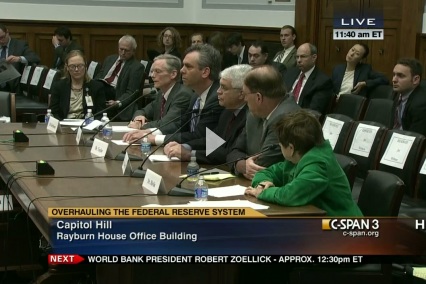
That’s Jeff Herbener to my right and John Taylor to my left, with Jamie Galbraith by Taylor. The one on the end is not Yoda, but Alice Rivlin.
Because the hearing was televised, I can truthfully say, “I’m not a macroeconomist, but I play one on TV.”
The Bizarro World of Professor Sen
| Peter Klein |
Here is another of those head-scratchers, this one from Amartya Sen, about how neoclassical economics is partly responsible for the financial crisis because neoclassical economists believe that markets work “perfectly”:
Since the crisis broke out the economics profession in general and mainstream economics in particular have been severely criticised. Do you think this is justified?
The criticism of mainstream economics is justified to a limited extent. It is certainly true that the focus of attention in mainstream economics has tended to be on assuming the market to be working perfectly and there being no need for regulation. However, while this view has been a very dominant part of mainstream economics, you have to bear in mind that mainstream economics is not all centered around one unified theme. I don’t think all of mainstream economics should be held responsible.
Do you think that neoclassical macro economists should bear the brunt of the blame?
This would be an oversimplification. Neoclassical economics has many different paths. There are mainstream neoclassical economists who have been very critical of the complete reliance on the markets.
I’ve been around neoclassical economists since my undergraduate days and I can’t think of a single neoclassical economist who says that markets work “perfectly” and favoring “complete reliance on the markets.” David Friedman comes to mind, but even his arguments for anarchism are not based on the belief that markets are somehow “perfect,” but that they are less imperfect than regulation. The truth, of course, is that virtually all neoclassical economists favor a substantial amount of economic regulation — government production of law and order, government control of the monetary system, competition policy, and other government actions to combat purported market failures.
Statements like Sen’s make sense only as a rhetorical ploy to fool the reader. If the mainstream thinks, say, that government should control 25% of the economy, and you think government should control 75%, you describe the mainstream as “extremists” who believe in “no government,” thus making your position seem like a reasonable middle ground. Krugman of course employs the same rhetorical strategy. Sen is obviously too intelligent to mean what he says literally, so I can only assume mendacity. Am I missing something?
Computers in Higher Education, 1960s Edition
| Peter Klein |
An illuminating passage from James Ridgeway’s 1968 book The Closed Corporation: American Universities in Crisis, a scathing critique of the university-military-industrial complex. Note the cameo by Jim March:
[University of California officials Ralph W.] Gerard and [R. Dan] Tschirgi are computer fetishists who insist information is knowledge, and that the function of a university is to provide information.
In 1963 and 1964 Chancellor David G. Aldrich, Jr., at Irvine, and Gerard got IBM interested in setting up programs there. The company agreed to install a 1400 system and to supply staff and engineers. An IBM employee, Dr. J. A. Kearns, came along to head the project and was given a part-time appointment at the Graduate School of Administration. The idea was to see whether the computer could be used as a library, for various administrative functions and for teaching.
Gerard paints a glowing picture. He says that one half of the students on the Irvine campus spend at least one hour a week on the computer, and that computers are used in teaching biology, mathematics, economics, sociology and psychology.
After speaking with Gerard, I went along to see the computer in action, and ran into a senior staff man who told me in a jaundiced manner that it wasn’t operating because they couldn’t make the new IBM 360 system work right. This gentleman was exceedingly glum about the possibilities of very many students learning much of anything on the Irvine computers. So was the dean of Social Sciences, James G. March. When I asked him about the use of the machine to teach sociology, he replied grimly that all the computer did was to print out some basic definitions in an introductory course, which, as he pointed out, one could get just as well from reading a book. He went on to say that a minute portion of any introductory course was on a computer, that students spent little time on them, and that most of the time was taken up programming them. March said the difficulty was to devise a system which could answer questions rather than ask them. The most one could really expect was to have a machine pose a problem to the student, who could then go ahead an answer it on his own.
The tech described here is dated but the book itself still packs a punch. In the late 1906s concerns about the close relationships between the federal government (particularly the Pentagon), public research universities, and industry (particularly defense contractors) were new. Now we take for granted that a primary task of the research university is to produce “applied” research in close cooperation with government and industry sponsors, to commercialize its scientific discoveries, to train students for industry, and so on. But this is a fairly recent — mid-20th century — development, and not an obviously desirable one.
Gentle Ben
| Peter Klein |
I don’t think of Ben Bernanke’s approach to monetary policy as soft, passive, or restrained, but of course my optimal monetary policy is no monetary policy. Laurence Ball thinks that Bernanke’s actions after 2008 were surprisingly cautious, compared to what Bernanke advocated as an academic and Fed Governor in the early 2000s.
From 2000 to 2003, when Bernanke was an economics professor and then a Fed Governor (but not yet Chair), he wrote and spoke extensively about monetary policy at the zero bound. He suggested policies for Japan, where interest rates were near zero at the time, and he discussed what the Fed should do if U.S. interest rates fell near zero and further stimulus were needed. In these early writings, Bernanke advocated a number of aggressive policies, including targets for long-term interest rates, depreciation of the currency, an inflation target of 3-4%, and a money-financed fiscal expansion. Yet, since the U.S. hit the zero bound in December 2008, the Bernanke Fed has eschewed the policies that Bernanke once supported and taken more cautious actions — primarily, announcements about future federal funds rates and purchases of long-term Treasury securities (without targets for long-term interest rates).
Ball describes a June 2003 meeting of the Fed’s Open Market Committee at which senior staffer Vincent Reinhart convinced Bernanke that when interest rates are near zero, the right policies are persuading market participants that federal funds rates will continue to fall, selling medium-term bonds and buying longer-term ones (“Operation Twist”), and quantitative easing. When the financial crisis hit, this is exactly what Bernanke did, although — according to Ball — Bernanke had long argued for much more aggressive moves.
Ball argues that Bernanke fell victim to groupthink:
We can interpret the June 2003 FOMC meeting as an example of groupthink. The recommendations in Reinhart’s briefing were presented as the views of a unified Fed staff. In the FOMC discussion, nobody, including Chairman Greenspan, seriously questioned Reinhart’s focus on his three preferred policy options. By the time Bernanke spoke, a consensus had emerged on a number of points, such as opposition to targets for long-term interest rates. Groupthink may have discouraged Bernanke from shaking up the discussion with his past ideas for zero-bound policy.
A reluctance to disagree with the consensus was common at the Greenspan Fed, according to some observers. Cassidy (1996) describes how Alan Blinder, Fed Vice Chair from 1994 to 1996, reacted to FOMC meetings: “The thing that surprised Blinder most was the way decisions were made at the Board. Most of the time, the governors were presented with only one option: the staff recommendation.”
He also suggests that Bernanke, unlike Greenspan, Paulson, Summers, and other key economic policy figures, is shy, withdrawn, and unassertive.
Without intending to, I think Ball makes powerful arguments against conventional monetary policy itself, which relies on a small, secretive, cabal of powerful technocrats, interest-group representatives, and fixers to design and implement rules and procedures that affect the lives of millions, that reward some (commercial and investment bankers, homeowners) and punish others (savers, renters), that shape the course of world events. Do we really want a system in which one person’s personality type has such a huge effect on the global economy?
Review of Allen’s Institutional Revolution
| Peter Klein |
I wrote earlier about Doug Allen’s The Institutional Revolution (University of Chicago Press, 2011). Here’s a new EH.Net review by Mark Koyama.
Institutions in Allen’s view minimize transaction costs, where transaction costs include the costs associated with opportunistic behavior. Transaction costs precluded “first-best” institutions from developing in the pre-industrial world. Instead, apparently inefficient institutions such as tax farming, the sale of offices, and the aristocratic dominance of politics persisted for centuries. Allen argues that these apparently inefficient institutions were, in fact, efficient given the existing configuration of transaction costs. This insight, which builds on the ideas of Yoram Barzel, provides a powerful hypothesis for studying institutional change. Allen places particular emphasis on the importance of measurement. In the high variance pre-modern world, measurement was costly or impossible and consequently bureaucrats, soldiers, sailors, and policemen could not be paid on the basis of observable inputs. Alternative institutions had to emerge to deter opportunism and reward effort. These institutions were often elaborate, and sometimes strange; they involved making the bureaucrats, soldiers, or tax collectors residual claimants of some sort. The story of how these institutions disappeared and were replaced by modern institutions is The Institutional Revolution.
The institutional revolution Allen proposes is linked to the industrial revolution because technological change drove institutional change by reducing measurement costs. Standardization reduced variance. This reduction in variance lessened the possibilities for opportunistic behavior and enabled institutions based around the idea of rewarding individuals for their marginal contribution to emerge.





 Organizations and Markets
Recent Comments