Posts filed under ‘Public Policy / Political Economy’
Corporations Are People Too
| Craig Pirrong |
Legally, in some respects, anyways. That was a key issue in the recent Supreme Court decision re McCain-Feingold (see Dick’s post). I don’t have a lot to say about the specifics of the decision, as campaign finance law is way too arcane for me. Suffice it to say that I am inherently skeptical about any regulation regarding elections designed by incumbent politicians. People yammer about conflicts of interest all the time, but there’s a colossal one for you.
I just wanted to make a quick point about a debate between Stevens and Scalia carried out in the opinion and the dissent. Stevens noted that the Founders were deeply skeptical of corporations. Indeed so. Scalia noted that there are so many corporations today. Also true. The interesting question is how we got from A (Stevens) to B (Scalia).
The story is told in the North, Wallis and Weingast natural-state book Violence and Social Orders I’ve blogged about several times over at Streetwise Professor, mostly in the context of Russia. The relevant chapter is primarily based on John Wallis’s work. The basic story is that hostility to corporations — reflected very well in Adam Smith’s Wealth of Nations — was due to the fact that historically, English corporations were created by the crown, and were essentially very profitable favors provided to the politically connected. They were, in NWW terms, part of the “closed order” of the natural state, in which access to certain contracting forms was limited to a select powerful few. This animus towards corporations was inherited in the United States, but in the early years of the 19th century, state legislatures confronting issues associated with the financing of new infrastructure turned the corporate form into a prop of an open-order system in which this contracting form was made available to all. Rather than limit the right of incorporation to an elite, they made it available to everybody. The system changed from one in which legislatures had to grant every incorporation, to one in which pretty much anybody could incorporate if they met a set of general, universally applicable requirements. Hence, the proliferation of corporations. (more…)
Paging John Stuart Mill
| Dick Langlois |
I have been amused by the firestorm of outrage in the press over the Supreme Court’s recent mild affirmation of the free-speech rights of corporations. As many readers of this blog will probably appreciate, the point of a right to free speech is that it must apply even to speech, and to speakers, we don’t like. Many if not most angry commentators, like the writers of the Times editorial on the subject, don’t even bother to worry about the nature of rights. To the Times and many others, constitutional jurisprudence is a purely consequentialist exercise no different from legislation (which, sadly, may be often be true in practice). But other writers and organizations aghast at the Court’s decision have a thorny problem of argument, to the extent that they have themselves invoked the First Amendment in an effort to protect speech of which they approve (or, more generally, to protect specific sub-spheres of discourse in which they themselves participate). A case in point is People for the American Way, which has called for a constitutional amendment to outlaw corporate political speech (via William Saletan). “People For the American Way,” they write, “has been at the forefront of defense of free speech and the First Amendment for almost 30 years. We continue in that role today.” In order to square the circle, PFAM and like-minded pundits and Justices have to find a way to define corporate speech as not speech. The answer? Spending is not speech and corporations aren’t people. So: does this mean that it would be OK under this logic for the government, say, to decree that the New York Times must limit its editorial budget — limiting dollars not ideas, after all — because the Times is a corporation not an individual? Why should this logic not apply to the other Amendments as well? The Times should flat-out not have freedom of the press because it is a corporation; and the Roman Catholic Church should certainly not have freedom of religion.
My favorite line, from Justice Stevens (in dissent): “The Court’s blinkered and aphoristic approach to the First Amendment may well promote corporate power at the cost of the individual and collective self-expression the Amendment was meant to serve.” So freedom of speech is really a neoclassical or Benthamite exercise in which we aren’t trying to protect individual (let alone corporate) speech but are instead trying to maximize the total amount of self-expression in society.
In its recent obituary of Erich Segal, the Times cites the following cringe-inducing line, spoken by college-student protagonist Oliver Barrett IV, as a measure of the literary caliber of Segal’s novel Love Story: “Jenny, for Christ’s sake, how can I read John Stuart Mill when every single second I’m dying to make love to you?” This suggests that many a Justice, editorial writer, and pundit must have fallen prey to similar distractions in college. They certainly failed to read John Stuart Mill.
Endogenous Indoctrination
| Dick Langlois |
I have been wanting for some time to write about an interesting paper by Gilles St. Paul called “Endogenous Indoctrination.” (I wasn’t familiar with his work, but he seems to do interesting things, including this.) Here’s the abstract:
Much of the political economy analysis of reform focuses on the conflict of interest between groups that stand to gain or lose from the competing policy proposals. In reality, there is also a lot of disagreement about the working of the policy: in addition to conflicting interests, conflicting views play an important role. Those views are shaped in part by an educational bureaucracy. It is documented that the beliefs of that bureaucracy differ substantially from those of the broader constituency. I analyse a model where this effect originates in the self-selection of workers in the educational occupation, and is partly reinforced by the insulation of the educational profession from the real economy (an effect which had been discussed by Hayek). The bias makes it harder for the population to learn the true parameters of the economy if these are favourable to the market economy. Two parameters that govern this capacity to learn are social entropy and heritability. Social entropy defines how predictable one’s occupation is as a function of one’s beliefs. Heritability is the weight of the family’s beliefs in the determination of the priors of a new generation. Both heritability and social entropy reduce the bias and makes it easier to learn that the market economy is “good,” under the assumption that it is. Finally I argue that the capacity to learn from experience is itself affected by economic institutions. A society which does not trust markets is more likely to favour labour market rigidities that in turn reduces the exposure of individuals to the market economy, and thus their ability to learn from experience. This in turn reinforces the weight of the educational system in the formation of beliefs, thus validating the initial presumption against the market economy. This sustains an equilibrium where beliefs and institutions reinforce each other in slowing or preventing people from learning the correct underlying parameters.
I was catalyzed to write today because of a related article I recently saw in the Times, which enthuses giddily about a paper called “Why Are Professors Liberal?” by two sociologists called Fosse [N. B. not Foss] and Gross. The Times lauds the paper for its sophistication and use of the quantitative. (more…)
Josh Lerner on Public Policy Toward Entrepreneurship
| Peter Klein |
Speaking of public entrepreneurship, here’s an interview with Josh Lerner about his new book Boulevard of Broken Dreams: Why Public Efforts to Boost Entrepreneurship and Venture Capital Have Failed — and What to Do About It (Princeton, 2009). Excerpt:
There are two well-documented problems that can derail government programs to boost new venture activity. First, they can simply get it wrong: allocating funds and support in an inept or, even worse, a counterproductive manner. Decisions that seem plausible within the halls of a legislative body or a government bureaucracy can be wildly at odds with what entrepreneurs and their backers really need. . . .
Economists have also focused on a second problem, delineated in the theory of regulatory capture. These writings suggest that private and public sector entities will organize to capture direct and indirect subsidies that the public sector hands out. For instance, programs geared toward boosting nascent entrepreneurs may instead end up boosting cronies of the nation’s rulers or legislators. The annals of government venturing programs abound with examples of efforts that have been hijacked in such a manner.
Thanks to Ross Emmett for the tip.
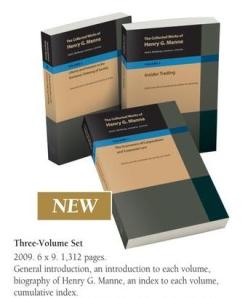
The Collected Works of Henry Manne
 | Peter Klein |
Via Geoff Manne, a description and ordering information for the new Collected Works of Henry Manne, produced by Liberty Fund. A great collection of scholarly articles, reviews, and shorter popular pieces divided into three volumes, “The Economics of Corporations and Corporate Law,” “Insider Trading,” and “Liberty and Freedom in the Economic Ordering of Society.” Order your copy today!
Happy Keynesian New Year
| Craig Pirrong |
Keynes and Hayek were major adversaries in the 1930s, but it is interesting to note that they shared some important ideas in common, but drew diametrically opposed conclusions from them.
In particular, Hayek, and the Austrians generally, believed in radical uncertainty, in the sense that individual economic agents had too little information about the world to assess probabilities of states of the world, or even to identify the possible states. Keynes similarly believed in the inability of individuals to evaluate investments in a rigorous quantitative way. Keynes concluded that this made investors subject to radical shifts in sentiment and “animal spirits” that could cause an autonomous collapse in investment. (more…)
Public Entrepreneurship
| Peter Klein |
Joe Mahoney, Anita McGahan, Christos Pitelis, and I have written a paper, “Toward a Theory of Public Entrepreneurship,” exploring the application of concepts, theories, and approaches from the entrepreneurship literature to non-market behavior. We argue that governments, government agencies, social enterprises, charitable organizations, and other “public” actors can be described as being alert to opportunities for value creation and capture, exercising judgment over the deployment of resources under uncertainty, introducing technological and organizational innovations, and so on. These actors are, in a sense, “public entrepreneurs.” This characterization also helps highlight critical differences between private and public actors and organizations, differences relating to the definition and measurement of objectives, the ability to evaluate performance, the nature of external governance, and, of course, the role of coercion. The paper is very much an exploratory effort in this area, and we certainly welcome comments and suggestions.
Here’s the abstract:
This paper explores innovation, experimentation, and creativity in the public domain and in the public interest. Researchers in various disciplines have studied public entrepreneurship, but there is little work in management and economics on the nature, incentives, constraints and boundaries of entrepreneurship directed to public ends. We identify a framework for analyzing public entrepreneurship and its relationship to private entrepreneurial behavior. We submit that public and private entrepreneurship share essential features but differ critically regarding the definition and measurement of objectives, the nature of the selection environment, and the opportunities for rent-seeking. We describe four levels of analysis for studying public entrepreneurship, provide examples, and suggest new research directions.
The Thoughtful President
| Peter Klein |
The President’s supporters portray him as thoughtful, well-informed, and deliberative. Unlike his predecessor, who acted on impulse, rarely considered dissenting points of view, and lived in a protective bubble, Obama reads, understands alternative perspectives, and thinks through arguments. Look how long it took him to decide on an Afghanistan policy!
And yet, on economic policy, the President is shockingly parochial. He has repeatedly challenged critics of his stimulus program to “produce a single economist” who opposes his actions. Anyone who disagrees with massive government borrowing and expenditures to “rescue” the economy is simply an obfuscationist, a partisan trying to score cheap political points at the expense of the national good. I think Obama genuinely believes this. He’s certain he’s right, so criticism bewilders him. He simply can’t fathom that there might be honest disagreement on basic economic issues. For Obama, the range of macroeconomic opinion runs from, say, Krugman to Summers. It’s like Pauline Kael’s famous line that Nixon couldn’t have won in 1972 because “no one I know voted for him.”
Of course, I’m not expecting a White House invitation for me and my friends to present Austrian business-cycle theory. But you’d think he might listen to Cochrane, Zingales, Mulligan, Becker, Glaeser, or even Mankiw.
This is our thoughtful, well-informed, deliberative Chief Executive?
CFP: “Contracts, Procurement, and Public-Private Arrangements”
| Peter Klein |
It’s 14-15 June 2010 in Paris. Submissions are due 15 February. Stéphane Saussier is organizing, so you know it will be good. From the CFP:
This conference focuses on the recent developments in contract theories. Papers are invited on all topics of contract theories including:
- relational contracting,
- transaction costs,
- renegotiations,
- incentives,
- attribution mechanisms,
- incomplete contracting
- contract design, etc.
Papers presented may be theoretical or applied. A special attention will be given to proposals addressing issues related to procurement and public-private arrangements.
Boeing and the Higgs Effect
| Peter Klein |
In their calls for greatly expanding the Federal Reserve System’s and Treasury Department’s roles in the economy, Chairman Bernanke, Secretaries Paulson and Geithner, and their academic enablers have repeatedly emphasized the temporary nature of these “emergency” measures. “History is full of examples in which the policy responses to financial crises have been slow and inadequate, often resulting ultimately in greater economic damage and increased fiscal costs. In this episode, by contrast, policymakers in the United States and around the globe responded with speed and force to arrest a rapidly deteriorating and dangerous situation,” said Bernanke in September. Yeah, no kidding. But, we are assured, the basic structure of our “free-enterprise” system remains soundly in place.
 However, as Bob Higgs has taught us, “temporary,” “emergency” government measures are never that. Indeed, virtually all the major, permanent expansions of US government in the twentieth-century resulted from supposedly temporary measures adapted during war, recession, or some other “crisis,” real or imaginary. Cousin Naomi’s “disaster capitalism” thesis is exactly backward: it is socialism, or interventionism, that thrives during the crisis, and Washington, DC never looks back. I mean, does anyone seriously believe that the Fed will deny, or give back, the authority to purchase whatever financial assets it wishes at some future date when it deems the crisis officially “over”? Will the Treasury credibly commit never again to purchase equity or guarantee debt or otherwise protect some major industrial or financial firm after the economy returns to “normal”? Not a chance. Everything the authorities have done in the last two years to deal with this “emergency” will become part of the federal government’s permanent tool kit.
Today’s WSJ has a good example of Higgs’s ratchet effect, a front-pager on Boeing’s dependence on export loan guarantees from the Export-Import Bank, a federal government agency created in — you guessed it — 1934, as a temporary agency to deal with the Great Depression. “No company has deeper relations with Ex-Im Bank than Chicago-based Boeing. Without Ex-Im, aviation officials say, Boeing this year could have been forced to slash production, endangering hundreds of U.S. suppliers, thousands of skilled American jobs and billions of dollars in export contracts.” Bank official Bob Morin is described as “Ex-Im Bank’s rainmaker. His Boeing deals accounted for almost 40% of the bank’s $21 billion in business last year. To help Boeing through the credit crunch, his team has spent the past year developing government-backed bonds that promise to raise billions.” So, a massive industrial-planning apparatus, supposedly born during a temporary crisis, lives on as the lifeblood of a huge, politically connected US company.
Thank goodness all that money flowing to Goldman Sachs is only temporary!
Update: Here’s a short Higgs piece from 2000 on the Ex-Im Bank, appropriately titled “Unmitigated Mercantilism.”
War, Taxes, and Doux Commerce
| Dick Langlois |
Uwe Reinhardt, a health economist at Princeton, is eminently familiar with the idea of moral hazard. In a recent blog in the New York Times, he applies the idea to war. “If the monetary and the blood cost of war are shifted mainly to citizens other than the elites who are empowered to declare war and decide how it is conducted,” he writes, “then that elite is more likely to embrace war and to spend on it.” (I’m sure others have said this before, though I’ll rely on my colleagues and readers to supply the cites. Bob Higgs?) Reinhardt points out that, rather than raise taxes to pay for war, Bush cut taxes after entering Afghanistan. This had the effect of hiding the cost and pushing the financing into deficit spending, which is less easy for voters to detect. Those of us of a certain age remember how Lyndon Johnson, with the acquiescence of the Fed, financed Vietnam (and his domestic programs) largely through inflation. Apparently, some in Congress are calling for a law that would require a tax surcharge whenever war is declared.
As I say, these ideas may already be familiar to O&M readers and may even have been touched on in previous posts. But the Reinhardt piece reminded me of an idea I’ve been playing with for a long time. There is a large literature on the doux commerce thesis (see especially Albert Hirschman): the idea that increasing trade and wealth (increasing capitalism, if you will) leads to less violent and warlike societies. Oversimplifying more than a bit, the idea is that increased wealth increases the opportunity cost of war and violence. Maybe this is already in Hirschman or elsewhere, but it seems to me, however, that there must be not just a substitution effect but also an income effect. Higher GDP increases the opportunity cost of war on average (even if, as Reinhardt points out, not necessarily for the elites). At the same time, however, a wealthier society is more able to buy more war, all other things equal. Someone with the wherewithal might try to see which effect is more important by using cross-country historical data sets in the Acemoglu-Johnson-Robinson vein. If you ever run into somebody doing that sort of thing, remember that you heard it here first.
My Naïveté
| Peter Klein |
I hoped Christy Romer would be a voice of reason within Obama’s economic team. What was I thinking? If yesterday’s WSJ op-ed is any indication, her role has been reduced to that of cheerleader for the President’s preposterous “stimulus” program. The editorial is a string of banalities, unsupported by argument or evidence, about the wonderful effects of stimulus and the need to “confront the challenges” that remain. For example, noting that real GDP increased slightly in the third quarter of 2009, after a sharp fall in the first quarter, she says that the “vast majority of professional forecasters attribute much of this dramatic turnaround to the fiscal stimulus.” Professional forecasters? Of course, we have no idea what GDP would have been in the absence of stimulus. And what of the secondary consequences, both short- and long-term? What of the unseen? She even praises the cash-for-clunkers program, recently skewered by my old friend John Chapman.
She knows all this. As Christy’s teaching assistant at Berkeley I saw her explain, patiently and carefully, how government programs have side effects, often unintended (she specifically used the airplane-child-safety-seat example of the Peltzman effect). All forgotten now. Some version of Lord Acton’s dictum, I guess.
Fed Independence and Comparative Institutional Analysis
| Peter Klein |
I’ve written before on Fed “independence” and why I don’t support it. The vast majority of economists, especially the more prominent ones, are strongly in favor of independence and against Congressional attempts to limit the Fed’s discretion in monetary and regulatory policy. The standard argument is that a “politicized” — i.e., accountable — central bank will be more expansionary than an unaccountable central bank, assuming that credit expansion affects output first and prices (inflation) second. Last week’s piece by Kashyap and Mishkin follows this script. On the face of it, this seems absurd, as — to take only the most obvious example — the Greenspan-Bernanke “independent” Fed has been the most expansionist in modern history, with a ballooning money supply throughout the 2000s and near-zero interest rates and injections of giggledysquillions of dollars into the banking sector in the last 18 months. The independence crowd cites cross-country studies finding a negative correlation between central-bank independence and inflation, but these studies are controversial (many problems with reverse causation, omitted variables, sample size, etc.).
My question today is different: Where, in those arguments, is the comparative institutional analysis? After all, in policy analysis, we are always comparing imperfect alternatives. We try to avoid the Nirvana fallacy. Craig does this in his post below, asking if a centralized financial regulator would be less bad than the competing regulatory bodies we have today.
But the macroeconomists entirely ignore this problem. Consider Mark Thoma’s defense of independence:
The hope is that an independent Fed can overcome the temptation to use monetary policy to influence elections, and also overcome the temptation to monetize the debt, and that it will do what’s best for the economy in the long-run rather than adopting the policy that maximizes the chances of politicians being reelected.
This naive wish is simply that, a hope. Where is the argument or evidence that a wholly unaccountable Fed would, in fact, “do what’s best for the economy in the long-run”? What are the Fed officials’ incentives to do that? What monitoring and governance mechanisms assure that Fed officials will pursue the public interest? What if they have private interests? Maybe they’re motivated by ideology. Suppose they make systematic errors. Maybe they’ve been captured by special-interest groups like, oh, I don’t know, the banking industry (duh). To make a case for independence, it is not enough to demonstrate the potential hazards of political oversight. You have to show that these hazards exceed the hazards of an unaccountable, unrestricted, ungoverned central bank. The mainstream economists totally ignore this question, choosing to put a naive faith in the wisdom of central bankers to do what’s right. Guys, have you never heard of public-choice theory?
On the Border*
| Craig Pirrong |
This is my inaugural post as guest blogger here at O&M. I am grateful for the opportunity.
In his very gracious introduction, Peter Klein noted that my research is at the border of finance and industrial organization. Quite true (and indeed, “borderer” is a good description of me overall.)
That border is very, very busy today. Indeed, so much is happening there that it is difficult to keep up. In the aftermath of the financial crisis, Congress and regulators are beavering away on laws and regulations that will completely reshape the organization and regulation of financial markets, and especially of the area of particular interest to me — derivatives.
I anticipate that many of my O&M blog posts will explore these issues, but I’ll start with something very topical. Senator Chris Dodd just yesterday heaved up a 1,136-page proposed financial regulation bill, and one proposal that is attracting considerable attention is his plan to consolidate banking regulators. Dodd is not alone in thinking along these lines. Even before the financial crisis, there were myriad proposals to consolidate various regulators, such as the Securities and Exchange Commission and the Commodity Futures Trading Commission. These have only gained in popularity in light of the crisis.
In the modern financial markets, firms are big and complex, and operate in many markets (defined geographically, or by product). It is difficult to fit a big financial firm into any box. A Goldman Sachs deals in the securities markets and the derivatives markets. So it doesn’t fit comfortably in a securities box, or a derivatives box, so in the current system for regulatory purposes the firm is split into pieces, some of which are put into the securities box and others into the derivatives box (and there are many other boxes too for a big firm like Goldman).
This leads to potential for conflicting regulations, jurisdictional disputes, regulatory arbitrage, and other problems. So, the Dodd proposal — and most of the other consolidation proposals — advocate creating really big boxes, and in the extreme, one big box that regulates everything a financial firm does.
The problems of the seen are well known (though arguably exaggerated). What concerns me are the largely unexamined problems of the as-yet-unseen big-box alternative. (more…)
Cochrane on Krugman
| Peter Klein |
John Cochrane tackles Paul Krugman’s infamous essay (via Casey Mulligan). My own view of the crisis (and of macroeconomics) is different from Cochrane’s, but his skewering of Krugman is delightful, and there are many nuggets of wisdom. A few snippets:
Crying “bubble” is empty unless you have an operational procedure for identifying bubbles, distinguishing them from rationally low risk premiums, and not crying wolf too many years in a row. . . . This difficulty is no surprise. It’s the central prediction of free-market economics, as crystallized by Hayek, that no academic, bureaucrat or regulator will ever be able to fully explain market price movements. Nobody knows what “fundamental” value is. If anyone could tell what the price of tomatoes should be, let alone the price of Microsoft stock, communism and central planning would have worked. . . .
[T]he economist’s job is not to “explain” market fluctuations after the fact, to give a pleasant story on the evening news about why markets went up or down. Markets up? “A wave of positive sentiment.” Markets went down? “Irrational pessimism.” ( “The risk premium must have increased” is just as empty.) Our ancestors could do that. Really, is that an improvement on “Zeus had a fight with Apollo?” . . . (more…)
Sidak and Teece on Dynamic Competition
| Peter Klein |
A “neo-Schumpeterian” framework for antitrust analysis that favors dynamic competition over static competition would put less weight on market share and concentration in the assessment of market power and more weight on assessing potential competition and enterprise-level capabilities. By embedding recent developments in evolutionary economics, the behavioral theory of the firm, and strategic management into antitrust analysis, one can develop a more robust framework for antitrust economics.
Via Truth on the Market (where my colleague Mike Sykuta has joined the blogging team). On a related note, see Jesús Huerta De Soto’s Theory of Dynamic Efficiency. It was a pleasure meeting De Soto at last week’s fantastic Mises conference in Salamanca, where he spoke on dynamic efficiency (based on the book’s first chapter). You have to love medieval university towns. We held our meetings in the Convent of San Esteban, including breakfast in the room where Christopher Columbus reportedly waited to hear if Queen Isabella would finance his little expedition West.
The First Secretary of Agriculture
| Peter Klein |
 Mises.org has posted Frank Chodorov’s 1952 classic, “Joseph, Secretary of Agriculture”:
The dream plan worked wonders — for Pharaoh and his secretary of agriculture. . . . On the other hand, it is told how a delegation of Egyptians came to Joseph and declared: “Thou hast saved our lives: let us find favor in the sight of my lord, and we will be Pharaoh’s servants.” Showing that the proletariat had come to terms with collectivism (since that was the only way to get by in this world) and were content with whatever security the secretary would provide.
Joseph, however, had to make some concession to private property, perhaps to encourage more taxable production; he restored to some of the Egyptians the land he had taken from them in their adversity, on a rental basis. The rent? One-fifth of all the annual output. By this well-timed act of policy, informs historian Flavius Josephus, “Joseph established his own authority in Egypt and increased the standing revenue of all its succeeding monarchs.”
Though the succeeding monarchs and the succeeding commissars did well under the plan introduced by Joseph, it seems (according to later historians) that it put upon the proletarians a moral blight, so that when conquerors from other lands came to Egypt they met with little resistance; those who had nothing to lose had nothing to fight for, so that even the monarchs had to beg the invaders for administrative jobs. And lots of dust fell on the civilization of Pharaoh.
Chodorov goes on to describe the obvious analogy to twentieth-century agriculture policy. Of course, without farm programs, how would we have food?
Bentham and Hume in the West Wing
| Dick Langlois |
From a perhaps uncharacteristic source — David Brooks at the New York Times — comes a funny and spot-on column about Bentham and Hume as present-day DC policy advisors.
The people on Mr. Bentham’s side believe that government can get actively involved in organizing innovation. . . . The people on Mr. Hume’s side believe government should actively tilt the playing field to promote social goods and set off decentralized networks of reform, but they don’t think government knows enough to intimately organize dynamic innovation.
So let’s have the debate. But before we do, let’s understand that Mr. Bentham is going to win. The lobbyists love Bentham’s intricacies and his stacks of spending proposals, which they need in order to advance their agendas. If you want to pass anything through Congress, Bentham’s your man.
A New Negative Externality
| Lasse B. Lien |
If you haven’t been brilliant lately, here is a possible explanation. It’s not at all your fault, it’s just that your colleagues are too good-looking. Note, though, that this excuse can apparently only be used by men.
Abstract: The present research tested the prediction that mixed-sex interactions may temporarily impair cognitive functioning. Two studies, in which participants interacted either with a same-sex or opposite-sex other, demonstrated that men’s (but not women’s) cognitive performance declined following a mixed-sex encounter. In line with our theoretical reasoning, this effect occurred more strongly to the extent that the opposite-sex other was perceived as more attractive (Study 1), and to the extent that participants reported higher levels of impression management motivation (Study 2). Implications for the general role of interpersonal processes in cognitive functioning, and some practical implications, are discussed.
Isn’t this a classic case of a negative externality? Surely there must be some kind of taxation or side payment scheme that can reduce this burden to society.
Source: Johan C. Karremans, Thijs Verwijmeren, Tila M. Pronk, and Meyke Reitsma, “Interacting with women can impair men’s cognitive functioning,” Journal of Experimental Social Psychology 45(4), July 2009, 1041-44.
Climate Change Economics
| Glenn MacDonald |
Some thoughts about how carbon emissions will evolve. Assume carbon emissions cause climate change. (Obviously this is controversial. But I have nothing new to add to this and so am willing to grant this assumption.) There are two fundamental economic forces at work. One is that emissions are a classical prisoners’ dilemma. That is, reducing emissions is costly, and the benefits to any one country are mainly enjoyed by others. Thus, in equilibrium, there will not be a lot of effort devoted to reducing emissions. Getting around this would require either some sort of external enforcement, e.g., the United Nations (pause for laughter!), or some approach based on repeated interaction; unfortunately the latter requires more patience and information than is realistic in this situation. Thus, consistent with the data, emissions will grow, and, per my assumption, climate change will ensue. Second, tastes for amenities such as clean air appear to be normal goods, maybe even luxuries. Individuals in China, eastern Europe, . . . appear to have little interest in these amenities, given what they might have to forego to have them, whereas many in the US, Canada, western Europe, . . . seem more inclined to pay a little more for green goods and services. Thus, efforts to reduce emissions will grow as more and more countries prosper sufficiently that their inhabitants are willing to forgo consumption for cleaner air, etc. So, from an economic perspective, the most realistic way to fewer carbon emissions and (per my assumption) less climate effects is through the aggressive promotion of activities that promote growth: free trade, democracy, economic freedom, reduced taxes, regulations and tariffs, protection of property rights. . . . Interestingly, freeing individuals to pursue their interests is likely the best practical/realitic approach to what, at first blush, seems like a classical case for collective action.





 Organizations and Markets
Recent Comments