Posts filed under ‘Public Policy / Political Economy’
A Second Act for the CAFE Standards
| Peter Klein |
From former guest blogger David Gerard:
As you have no doubt learned, President Obama and Governor Schwarzenegger have teamed up for a healthy bump in the federal Corporate Average Fuel Economy (CAFE) standards, forcing automakers to boost their fleet averages to 35 miles per gallon by 2016. The announcement will dismay many economists, who for many, many reasons have advocated steeper gasoline taxes instead. Lester Lave and I argued that that there were some solid reasons to support some form of CAFE standards in conjunction with higher gasoline taxes. On pragmatic grounds, the CAFE standards have enjoyed public support and gas taxes decidedly have not, so CAFE has carried the day.
The original CAFE measures did not do much in terms of pushing the envelope of vehicle technology, as a change in consumer tastes toward more fuel efficient vehicles in the late 1970s. As a result, the standards were met by altering the mix of vehicles sold, not by any radical improvements in technology. It wasn’t until the early 1980s when oil prices tanked that the CAFE became a serious binding constraint. In contrast, the CAFE standards announced Monday are very aggressive. However, setting the standard is only the first part of the story. The real action takes place during the second act. What happens as the deadline approaches if firms are unable to meet the stricter standards? (more…)
The Symbolic Uses of Politics
| Dick Langlois |
One of the most interesting law-and-economics scholars out there is Amitai Aviram at the University of Illinois, whom I met at a conference a few years ago. I only just discovered his recent work on what he calls bias arbitrage, “the extraction of private benefits through actions that identify and mitigate discrepancies between objective risks and the public’s perception of the same risks.” The idea is that people often misperceive the risks of various events. This creates an entrepreneurial opportunity for someone who can benefit from manipulating those misperceptions.
In some ways, this is an elaboration of Murray Jacob Edelman’s The Symbolic Uses of Politics (1964). In Edelman’s story, the citizenry are worried about various large issues about which they have no control: the Russians, global warming, swine flu, or — Edelman’s example, as I recall — the threat of business monopolies. In most cases, these fears are exaggerated or have no basis at all in fact — like the fear of spontaneous monopolies. But politicians can advance themselves by taking symbolic steps to allay these fears — like passing the Sherman Antitrust Act. (As Tom DiLorenzo, Jack High, Tom Hazlett, and others have suggested, the Sherman Act was also about diverting attention away from the McKinley tariffs, which would indeed transfer income from consumers to producers.)
Aviram’s spin is that there can be a welfare-improving effect to this process, to the extent that, by changing people’s perceptions of the underlying risks, entrepreneurs can bring people’s assessments in line with the actual underlying risks and thus get people to behave more efficiently. One example he uses is security measures at airports. After 9/11, people overestimated the probability of highjackings and shifted away in droves from air travel and toward automobile travel, which is actually a less-safe alternative. By instituting the ceremony of airline security, the government might have persuaded people that the probability of highjackings went down — even though it probably didn’t go down and was already low anyway — and therefore got them to return to (safer) air travel, an efficient outcome even taking into account the costs of the ceremony. (If you don’t believe that the ceremonies of the Transportation Security Administration are purely symbolic — or even if you do — check out this interesting piece in the Atlantic Monthly a while back.) Aviram understands perfectly well that this process can also lead to bad outcomes: the much-discussed case of seatbelt laws making car travel less safe might be an example. Whether the placebo effect (as Aviram calls it) has good or bad effects is a case-by-case question. One might well wonder whether today, eight years almost since 9/11, it isn’t the case that airport security ceremonies actually serve to remind people of terrorist threats and therefore to raise their assessments of the probabilities (?)
I thought of all of this recently in my own local context. Because of the recession, the State government has imposed on the University a variety of purely symbolic measures to demonstrate our frugality to the voting public. At least in principle, faculty can’t travel out of state even on money that came from grants or awards. And the library and museums were recently instructed to shorten their opening hours, even though those shorter hours don’t in fact save any money.
One Part of the Financial Sector Is Still Growing
| Peter Klein |
Courtesy of EconomPicData:
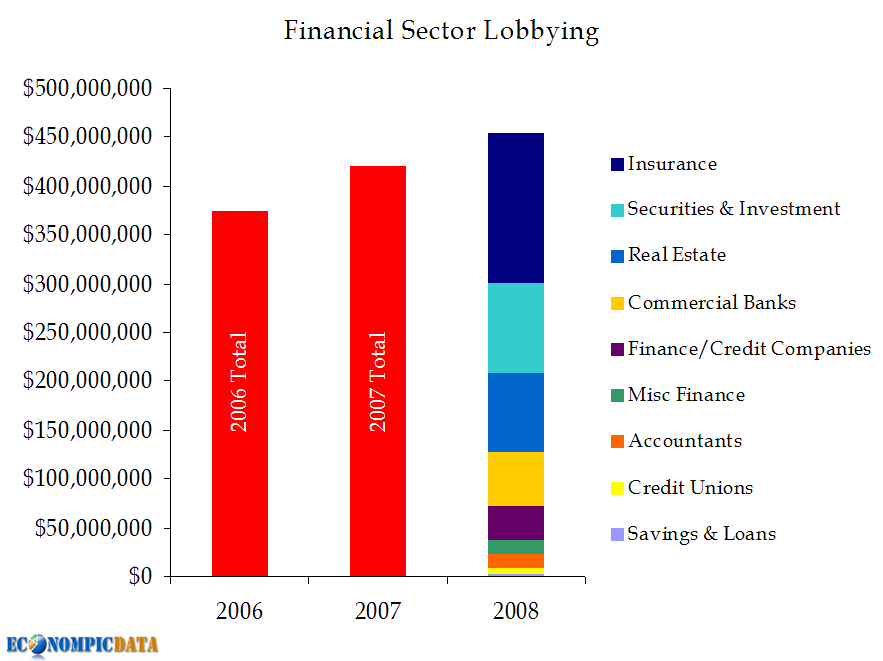
It takes money to make money, you know.
Keynesian Economics in a Nutshell
| Peter Klein |
An earlier post on Keynesian economics in four paragraphs has proven extremely popular. Here’s Keynesian economics in just one-and-a-half paragraphs, courtesy of Mario Rizzo:
Clearly, DeLong is a rigid aggregate demand theorist. He talks about output and employment as if it were some homogeneous thing. In his mind, macroeconomics is just about spending to increase the production of stuff. Yes, there is lip service to the idea that the stuff should have economic value. But that is easy when you assume that the only alternative is value-less idleness. . . .
The sectoral problems generated, not only by exogenous shocks but by the low interest rate policy of the Fed, are of critical importance. The aggregate demanders are blind to this.
Here at O&M we take the opposite perspective, namely that heterogeneity matters. Actually, as Mario has pointed out in a series of posts (1, 2, 3), Keynes himself was much better than his latter-day followers. Keynes may have been wrong — deeply, deeply wrong, in my view — but he was no fool. As for today’s Keynesians. . . .
Update (14 April): See also Mario’s fine essay in the April Freeman, “A Microeconomist’s Protest.”
Another Regulation Not Worth Its Salt
| Mike Sykuta |
Thanks to Randy Westgren for calling attention to an April 7 article in the New York Times concerning a new regulatory initiative in the Big Apple. It seems Mayor Bloomberg has decreed that salt consumption should be cut in half and has pledged the coercive power of New York City’s food industry regulatory system to launch a “nationwide initiative” to pressure the food industry to change its salty ways.
Apparently Mayor Bloomberg has identified salt consumption as a major public health crisis. Never mind that scientific research fails to demonstrate a causal relationship between salt consumption and actual health outcomes. Never mind that the human body requires some level of salt and there is no research demonstrating the potential health consequences of restricting persons’ salt intake to the level the Mayor prescribes. And don’t even think about the idea of personal responsibility and liberty in choosing what to eat and whether (and how much) salt to consume.
“if the salt has become tasteless, how can it be made salty again? It is no longer good for anything, except to be thrown out and trampled under foot by people.” Perhaps a better approach would be to throw out such ill-founded regulations and trample them under foot.
Today, SNL or the Onion, Tomorrow . . . ?
| Peter Klein |
From the opening sketch of last weekend’s Saturday Night Live:
My administration intends to do to every industry in this country, exactly what we are doing to the automakers. Every company will be vetted for fiscal soundness. Those judged best able to compete in the global economy will be offered a governmental subsidy. The others will be asked to cease operations at once. Hopefully, they will do so voluntarily, if not, they will be shut down by force.

Thanks to Gary Peters for the pointer.
Relative Prices Matter
| Peter Klein |
Hate to keep flogging a dead horse, and perhaps preaching to the choir, but the point can’t be made often enough: relative prices matter. The childish Keynesianism of people like DeLong and Krugman, like Bernanke and Geithner, understands only aggregate concepts like “national output,” “employment,” and “the price level.” A consistent theme of this blog’s rants is that resources are heterogeneous (1, 2) and, consequently, relative prices must be free to adjust to changes in demand, technology, market conditions, and so on. When government policy generates an artificial boom in a particular market, such as housing — drawing resources away from other parts of the economy — the key to recovery is to let resources flow out of that market and back to the sectors of the economy where those resources belong (i.e., to match the pattern of consumer demands). It’s quite simple: home prices should be falling, interest rates should be rising, savings rates should be going up, and debt levels should be going down. The Administration’s policies, like that of the last Administration, are designed to achieve exactly the opposite. Why? Because relative prices don’t matter, the allocation of resources across activities doesn’t matter, all that matters is to keep any sector from shrinking, any prices from falling, any firms from failing, any consumers from reducing their consumption. A child thinks only about what he can see. The unseen doesn’t exist.
Here are some excellent posts on the subject. Craig Pirrong notes that Sherwin Rosen had a colorful way of emphasizing relative price effects. Mario Rizzo (1, 2) points to data on the housing market and the Fed’s continuing attempt to keep resources from flowing out of this bloated sector. And here’s a snippet from Israel Kirzner’s short book on Mises explaining that insolvent financial institutions should be liquidated, not rescued. Good reading for grown-ups.
Public Entrepreneurship
| Peter Klein |
A surprising aspect of the recent growth in the entrepreneurship literature is the number of papers, projects, courses, centers, etc. studying entrepreneurship in non-market settings: “social entrepreneurship,” “cultural entrepreneurship,” “environmental entrepreneurship,” and so on. At my own university students can take entrepreneurship courses not only in the Colleges of Business or Engineering but in the College of Agriculture, the School of Natural Resources, the College of Journalism, and even the School of Social Work. (One of my colleagues organized a conference last year aimed at cattle ranchers seeking to market their, um, byproducts as fertilizer, with the classic title: “Manure Entrepreneurship: Turning Brown into Green.”
Translating concepts, theories, and research methods from the entrepreneurship literature to non-market settings raises challenging issue, however. How is entrepreneurship defined? What corresponds to entrepreneurial profit and loss? What is the entrepreneur’s objective function? Are there competitive processes that select for the better entrepreneurs? None of the classic writers on entrepreneurship — Cantillon, Say, Schumpeter, Knight, Mises, Kirzner — wrote explicitly on entrepreneurship in non-market settings, as far as I am aware. Mises, in fact, distinguishes sharply between “profit management” (or entrepreneurial management) and “bureaucratic management,” identifying the former with initiative, responsibility, creativity, and novelty and the latter with rule-following within strict guidelines (see Bureaucracy, 1944, and chapter 15, section 10 of Human Action, 1949). (more…)
Thoughts on AIG
| Peter Klein |
Nothing has annoyed me more in the last 24 hours than the constant parade of angry, self-righteous, and ill-informed denunciations of AIG coming from Capitol Hill and the mainstream media. No one, of course, likes the thought of a failing, taxpayer-supported firm paying large bonuses to executives. But let’s talk some common sense here.
- The main lesson is that AIG should never, ever have been bailed out with taxpayer dollars. I said that at the beginning, and I stand by it even more today. AIG should have declared bankruptcy. Under bankruptcy there are well-established, orderly procedures for winding down a firm, distributing the remaining assets among the various legal claimants, and so on. Injecting taxpayer money without any serious thought about the implications of government subsidy and/or ownership for management and governance is just plain dumb. Naturally, that’s what Congress and the last President — people who know exactly zilch about what companies do and how they are run — did.
- Performance-based pay is a complicated subject. There are dozens, if not hundreds, of theoretical and empirical studies on the effects of performance-based pay on company performance, the benefits and costs of various compensation formulas, and the like. As Jensen and Murphy wrote back in 1990, “It’s Not How Much You Pay, But How.” Of course, the people screaming the loudest right now haven’t a clue about any of this. (more…)
The Political Economy of Vertical Integration
| Peter Klein |
An understudied area in the organizations literature is the effect of organizational form on lobbying, rent-seeking, tax-rate arbitrage, and similar kinds of political behavior. The accounting literature on transfer pricing looks at the ability of vertically integrated multinationals to shift income between tax jurisdictions to reduce the overall tax burden, and regulators have expressed concerns about diversified multinationals putting downward pressure on environmental and labor regulations (by threatening to withdraw production from countries with high tax or regulatory burdens). Of course we know that as industries mature, firms are more likely to open lobbying offices in state or national capitols. But, in general, we know little about how firms organize to take advantage of political processes and institutions.
Joseph Fan, Jun Huang, Randall Morck, and Bernard Yeung have a new NBER paper on vertical integreation in China showing that vertical integration in highly interventionist environments may be aimed not at reducing transaction costs, protecting relationship-specific investments, and the like, but at rent-seeking and the pursuit of other forms of political privilege. Abstract:
Where legal systems and market forces enforce contracts inadequately, vertical integration can circumvent these transaction difficulties. But, such environments often also feature highly interventionist government, and even corruption. Vertical integration might then enhance returns to political rent-seeking aimed at securing and extending market power. Thus, where political rent seeking is minimal, vertical integration should add to firm value and economy performance; but where political rent seeking is substantial, firm value might rise as economy performance decays. China offers a suitable background for empirical examination of these issues because her legal and market institutions are generally weak, but nonetheless exhibit substantial province-level variation. Vertical integration is more common where legal institutions are weaker and where regional governments are of lower quality or more interventionist. In such provinces, firms led by insiders with political connections are more likely to be vertically integrated. Vertical integration is negatively associated with firm value if the top corporate insider is politically connected, but weakly positively associated with public share valuations if the politically connected firm is independently audited. Finally, provinces whose vertical integrated firms tend to have politically unconnected CEOs exhibit elevated per capita GDP growth, while provinces whose vertically integrated firms tend to have political insiders as CEOs exhibit depressed per capita GDP growth.
The Farmer’s Cow
| Dick Langlois |
This morning I read a story in the Hartford Courant about the state legislature’s proposals to save the small local dairy farmer. The naïveté and economic illiteracy of the article filled me with a sudden (and, for me, unusual) urge to post a comment on the newspaper’s website. Here is what I wrote.
This article is awash in errors of commission and omission.
First: it is misleading to the point of mendacity to say that the federal government “tells farmers what prices to set.” The government effectively specifies the price floor — it mandates that farmers set a price no lower than the floor, but it permits farmers to raise the price if they like. What is forcing prices down to the floor is supply and demand.
Second: the plight of the farmers is entirely the fault of the byzantine federal farm-price system, which creates a myriad bad incentives. For a short description with further references, see: http://www.cato.org/pubs/tbb/tbb_0707_47.pdf
Third: it is wrong to imply that the beneficiaries of the current supply and demand situation are the supermarkets. Retailing milk is a highly competitive industry — milk is often a price loss-leader for convenience stores. The real point is that the milk price support system, and the proposals being considered by the State legislature, will raise the prices consumers pay for milk. This is what economists call a “regressive” transfer. Since poor people spend a larger fraction of their incomes on milk than do affluent people, raising milk prices to keep farmers afloat transfers income from the poorer people in Connecticut to a group whose income is above the state average.
Finally: if you have a Romantic desire to save small or local farmers, you are free to pay extra to buy their milk. Marketing associations like The Farmer’s Cow explicitly brand their milk as local. If it pleases you to do so, spend your own money on local farmers; don’t force poor Connecticut consumers and taxpayers to do it for you.
Ah, Democracy!
| Peter Klein |
I learned this week from Doug French that Dissident Books has published a new edition of H. L. Mencken’s classic and extremely politically incorrect Notes on Democracy. Who but Mencken could write that the common man “is not actually happy when free; he is uncomfortable, a bit alarmed, and intolerably lonely. He longs for the warm, reassuring smell of the herd, and is willing to take the herdsman with it.” As for democratically elected politicians, Mencken reminds us how quickly all those sappy paeans to the people’s will evaporate when a “crisis,” real or imagined, is on the horizon. “All the great tribunes of democracy, on such occasions, convert themselves, by a process as simple as taking a deep breath, into despots of an almost fabulous ferocity. Lincoln, Roosevelt and Wilson come instantly to mind.”
This was on my mind when I read (via Kathryn Muratore) about a new study appearing in Science finding that children looking at pictures of political candidates correctly pick the eventual winner 64% of the time. Apparently we are hard-wired to prefer pretty faces, even when supposedly choosing based on policy views, ideology, “the issues,” etc . So much for the rational voter.
Reducing Transaction Costs in Government Procurement
| Mike Sykuta |
Lest anyone think I (or, by association, O&M) am just a disgruntled Obama-basher, let me applaud the Administration’s announcement today of its intent to overhaul the ways in which the government contracts for goods and services, particularly in the Department of Defense. I suspect the collective “we” are all in favor of identifying methods and processes that will reduce transaction costs (and overall costs) in government procurement programs.
On this point, there is economic research that should help guide the Administration’s deliberations. To wit, William Rogerson provides a pretty thorough assessment of the economic incentives in defense procurement (JEP, 1994) and has a follow-up article on the optimal structure of fixed-priced cost reimbursement contracts (AER, 2003). Bajari and Tadelis (RAND J., 2001) provide a study of incentives versus transaction costs in procurement contracts. Although focused on private-sector construction, their findings are likely relevant to government procurement as well. Important lesson: cost-plus is not necessarily bad.
Blue Eagle Redux
| Peter Klein |
 Assuming this is not a joke, Obama has unveiled a new stimulus-plan logo. Projects funded by the American Recovery and Reinvestment Act — primarily roads and bridges, I presume — will sport this handsome emblem. It lacks the 1930s-era fascist style of the NRA’s Blue Eagle but is much in the same spirit. Will those who maintain these roads and bridges be fined for failing to display the logo? (Business owners without a Blue Eagle could be fined up to $500 — more than $8,000 in today’s dollars — and get six months in jail.) Will consumers be encouraged to bycott those without the colorful insignia?

 Jason Taylor and I have written that the Blue Eagle may be more important than economic historians have realized. In the early days of the NRA it seems to have played a strong cartel-enforcement role. Eventually business owners and consumers learned that NRA officials were not punishing cartel violations and the Blue Eagle began to disappear from store windows and newspaper advertisements. Our analysis is game-theoretic, but I’m sure our friends from that other discipline would proffer a different explanation based on institutional legitimacy and that stuff.
Helland at Missouri
| Mike Sykuta |
Eric Helland will be on campus this Friday, 6 March, to give a seminar on the effects of insurance reimbursement policies on the provision of medical services. In this paper, Helland and his co-author Paul Heaton compare the level and number of treatments recommended for auto-injury trauma patients in Colorado before and after a change in state law that shifted the burden from more generous auto-policy reimbursements to less generous, traditional health-insurance policies. Following the change, doctors recommended more reimbursable treatments per patient despite negligible changes in the character of auto injuries or in the health outcomes of those cases.
This is the latest in a stream of research Eric has done examining the (sometimes perverse) incentive systems created by different market and regulatory structures and the political economy of such outcomes, including issues of corporate governance (here), class-action lawsuits (here), and workings of the judicial system (here and here).
Eric’s talk is part of the Economics Department’s seminar series. If you are within driving distance, I’m sure you would find it worth your while.
Blogging to Fame on CNN
| Mike Sykuta |
Nicolai’s recent post about improving your impact factor led to some friendly banter about the efficacy of being cited on O&M as a means to increase one’s exposure. Turns out there may be some truth in that nifty little nugget. I was contacted last week by a senior producer at CNN concerning my skeptical views on the U.S. stimulus package. I can only imagine some of my posts on O&M and my appearance on Brad Delong’s list of ethics-free-Republican-hacks had something to do with my reputation as an stimulus stickler.
The CNN crew came to town yesterday as part of their reporting on how (and how well) stimulus funds are being spent and interviewed me regarding the wisdom (or lack thereof) in the stimulus effort and the veracity of claims about job creation. I’m told the segment will air twice tonight on CNN, once on Campbell Brown’s “No Bias. No Bull” (8:00pm Eastern) and again on Anderson Cooper 360 (10:00pm Eastern). I tried to figure out a way to reference O&M directly. I hope the administrators will forgive my inability to work it into the conversation.
Funding Higher Education
| Dick Langlois |
Inspired by Peter’s post about salaries at private universities, I thought I would write a bit about public universities, notably my own. It was big news in Connecticut this week when Jim Calhoun, our head basketball coach, got nasty with a self-styled activist who attacked him at a post-game press conference. The activist, who had gotten in on a photographer’s press pass, wanted to know how Calhoun could justify his $1.6 million salary at a time of massive state deficits. Calhoun pointed out that, essentially because of him, the basketball program is a big profit maker for the University: it apparently brings in on the order of $12 million and costs about $6 million. The controversy arose because of the less-than-genteel way in which Calhoun made his case, prompting Governor Jodi Rell to issue a rebuke.
It turns out that Calhoun is not only the highest-paid University employee, he is the highest-paid State employee. (See here for a roster of the top state salaries.) The next two on the list are football coach Randy Edsall ($1.38 million) and women’s basketball coach Geno Auriemma ($1.31 million). The next three are physicians at the UConn Health Center — in the same specialties noted in the Chronicle article Peter cites: reproductive medicine, dermatology, and neurosurgery. (Basketball may not be brain surgery, but Calhoun won his 800th career game on Wednesday, and Auriemma’s team is a juggernaut likely headed for another undefeated season and a national championship.) UConn president Mike Hogan is seventh on the list. (There is an old story about the university president who was asked how he felt about making less money than the football coach: “he’s had a better year than I have,” was the answer.) (more…)
An Obamanable Housing Plan
| Peter Klein |
So, let me get this straight. We’re in a major recession triggered by a collapse in the housing market, itself the inevitable result of government policies, led by Fannie Mae and Freddie Mac, to get the wrong loans to the wrong people so they could buy the wrong houses. The Obama Administration’s remedy is not to let Fannie and Freddie die a long-overdue and merciful death, but to prop them up, to give them additional powers, and to subsidize private mortgage lenders who extend yet more credit to more borrowers who can’t pay it back, thus making what might have been a temporary misallocation of the housing stock into a permanent one. Brilliant!
I am bewildered. But, more than that, I am angry. I can’t count how many news accounts I’ve seen about the poor, struggling homeowners who can’t make the monthly mortgage payment, are about to be foreclosed, and risk losing the family home, yard, white picket fence, and piece of the American Dream. But I haven’t heard one word about the poor, struggling renters, the ones who scrimped and saved and put money away each month towards a down payment, who kept the credit cards paid off, stayed out of trouble, and lived modestly, and thought that maybe, just maybe, the fall in housing prices meant that they, finally, could afford a house — maybe one of those foreclosed units down the street. These people are Bastiat’s unseen. For them, Obama’s housing plan is a giant slap in the face. To hell with the prudent. Party on, profligate! Now that’s what I call moral hazard.
Update: Here it is in pictures (from EconomiPicData via Wayne Marr).
Regime Uncertainty
| Peter Klein |
Much wisdom in John Taylor’s piece in today’s WSJ. The housing boom and crash were caused primarily by monetary policy and a government-induced relaxation of borrowing standards. Policymakers mistakenly diagnosed the problem as a lack of liquidity and tried to increase loan volume as early as 2007. Further “stimulus” and even lower federal-funds rates came in 2008, followed by a set of arbitrary interventions (selective bank bailouts, the inexplicable TARP). Taylor places special blame on Bernanke and Paulson for creating regime uncertainty:
On Friday, Sept. 19, the Treasury announced a rescue package, though not its size or the details. Over the weekend the package was put together, and on Tuesday, Sept. 23, Fed Chairman Ben Bernanke and Treasury Secretary Henry Paulson testified before the Senate Banking Committee. They introduced the Troubled Asset Relief Program (TARP), saying that it would be $700 billion in size. A short draft of legislation was provided, with no mention of oversight and few restrictions on the use of the funds. . . .
The realization by the public that the government’s intervention plan had not been fully thought through, and the official story that the economy was tanking, likely led to the panic seen in the next few weeks. And this was likely amplified by the ad hoc decisions to support some financial institutions and not others and unclear, seemingly fear-based explanations of programs to address the crisis. What was the rationale for intervening with Bear Stearns, then not with Lehman, and then again with AIG? What would guide the operations of the TARP?
I argued before that the whole “credit crunch” may be a kind of self-fulfilling prophecy. Taylor suggests that more generally, the government, having created the crisis, is now deepening and prolonging it by trying to “fix” the problem is made, a classic example of Mises’s theory of interventionism.
Speaking of Executive Compensation. . . .
| Peter Klein |
Chris Manion has a dream:
Obama Cuts Salaries for Presidents of Universities that Receive Federal Money
$100,000 annual cap enrages literati, “Violates academic freedom,” one president declares, from his limousine’s satellite phone.
Obama Limits Baseball Salaries to $100,000 per Player per Year
Administration points to baseball’s antitrust exemption as authority; “This could force our players to gamble on the side and maybe throw the world series even” says players union president.
Obama Limits Salaries of Former Government Employees
$100,000 a year ceiling enrages lobbyists, retired generals, and Trent Lott.
Obama Caps Federal Retirement Pensions
“These benefits should be no higher than those of the private sector taxpayers who pay the taxes to support them,” President says. Government Employee Union president threatens a general strike, scratches his head for a moment, and then retracts statement “pending further discussions.”
And then I woke up.
In my dream the President announces a cap on compensation for TV and movie stars, recording artists, writers, Hollywood directors and producers, celebrity speakers, and investors. “In this time of economic hardship, for Tom Cruise to earn millions for Valkyrie, even though Lions for Lambs was a total flop, for President Clinton to pick up $500,000 for recycling the same boring speech, and for George Soros to rack up interest and dividends even though he completely missed calling the financial crisis, is the height of irresponsibility. It is shameful. And I will not tolerate it as President.”





 Organizations and Markets

Recent Comments