Posts filed under ‘Recommended Reading’
Interesting New Books
| Peter Klein |
In place of the “What I’ve Been Reading Lately” posts that show up regularly on certain blogs, I hereby offer something slightly less egocentric, the “What I’ve Been Receiving Lately” post. It contains a list of books I’ve recently received by mail, some by choice, others because publishers sent them (perhaps hoping I’d blog about them — Mission Accomplished!). Not the most scientific sample selection process, but there you go.
- Jesús Huerta de Soto, Socialism, Economic Calculation, and Entrepreneurship (Elgar, 2010). English translation of an important work first published in Spanish in 1992.
- Guinevere Liberty Nell, Rediscovering Fire: Basic Economic Lessons from the Soviet Experiment (Algora, 2010). What the failure of central planning teaches about markets and institutions.
- Koray Çaliskan, Market Threads: How Cotton Farmers and Traders Create a Global Commodity (Princeton, 2010). Economic sociology meets global commodity systems. Contains dust-jacket endorsements from Richard Swedberg and Donald MacKenzie, so expect a review from the orgtheory boys soon.
- Peter J. Boettke, ed., Handbook on Contemporary Austrian Economics (Elgar, 2010). Essays by young Austrian economists associated with George Mason University.
- Robert E. Wright, Fubarnomics: A Lighthearted, Serious Look at America’s Economic Ills (Prometheus, 2010). I think the title says it all.
- Ranjay Gulati, Reorganize for Resilience: Putting Customers at the Center of Your Business (Harvard Business School, 2010). Looks fluffy, but I have a teaching interest in change management so I’ll give it the benefit if the doubt.
- David Stark, The Sense of Dissonance: Accounts of Worth in Economic Life (Princeton, 2009). Also deals with organizational change, but in a more serious way. Ethnographic studies of three organizations dealing with large exogenous shocks. Looks interesting.
Entrepreneurial Paradoxes
| Peter Klein |
A new working paper from the always-interesting Peter Lewin: “Entrepreneurial Paradoxes: Implications of Radical Subjectivism.” Sample paradoxes:
- Entrepreneurial opportunities are complicated by uncertainty but would not exist without uncertainty.
- An entrepreneurial opportunity for everyone is an opportunity for no one in particular.
- Entrepreneurial opportunities are subjective and objective; discovered and created.
See the paper for the full set of paradoxes and some informative and challenging discussion.
Assorted Links
| Peter Klein |
- A new paper by Randall Morck and Bernard Yeung, “Agency Problems and the Fate of Capitalism.” A very good comparative-institutional analysis of shareholder democracy and its benefits and costs relative to “stakeholder” models.
- A Washington Post story on “moral licensing” (via Sheen Levine) — suggesting that some people view ethical behavior, like goods and services, in terms of trade-offs at the margin!
- A call for contributions to The Ethics and Economics of Agrifood Competition, a Springer volume in preparation by my colleague Harvey James.
- Videos and papers from the Coase centenary conference held last year at the University of Chicago Law School.
Lock-In, Path Dependence, and Efficiency: Railway Gauge Edition
| Peter Klein |
 Doug Puffert’s new book on the history of railway gauge standardization apparently takes a middle position between the “lock-in always” position of Paul David and the “lock-in rarely” position of Liebowitz and Margolis. Writes reviewer Dan Bogart:
Puffert’s narrative convincingly dispels the extreme version of the Liebowitz and Margolis critique which argues that market participants had perfect foresight. On the other hand, it does suggest historical actors understood the role of positive feedbacks and tried to manipulate gauge adoption in an effort to lock-in their preferred standard. The degree to which gauge selection was efficient is a lingering question throughout the book. Puffert does not take a stand on the relative efficiency of different gauges, but an argument is made that diversity entailed large costs.
I’m not sure what Bogart means by the “extreme version” of the Liebowitz-Margolis critique; L&M have certainly never used the concept of perfect foresight in their analysis of alleged QWERTY effects. Indeed, their critique of Paul David is based mostly on comparative institutional analysis. As Peter Lewin puts it in his excellent summary of the QWERTY debate:
Somewhat paradoxically both Liebowitz and Margolis and their critics (in varying degrees) are critical of mainstream neoclassical (textbook) economics and its standards of welfare. That is to say, they are both highly critical of the kind of neoclassical economics that assumes perfect knowledge, perfect foresight, many traders, etc., the kind that derives perfect competition as a Pareto optimal efficient standard against which to judge real world outcomes. Both focus (to a greater or lesser extent) on the importance of ignorance and uncertainty (and the importance of institutions) in rendering such a standard problematic. Where they differ decisively, however, is in the policy lessons that they take away from this.
The critics argue that the ideal of perfect competition is an ideal that, for one reason or another, the free market is incapable of attaining, and that, therefore, one should look to the government to obtain by collective action or regulation, what the market, with decentralized actors, cannot. Liebowitz and Margolis have explained clearly why the endorsement of government intervention does not follow from a valid critique of neoclassical welfare economics (and, for that matter, why a defense of neoclassical welfare economics, in itself, is insufficient to establish an argument against intervention).
See here for a previous discussion on path dependence and Williamson’s “remediableness” criterion.
Misbehavioral Antitrust
| Peter Klein |
I suggested earlier that behavioral economics could use a dose of comparative institutional analysis. The New Paternalists are very worried about various biases and forms of “irrationality” on the part of consumers, managers, entrepreneurs, investors, etc. but have little or nothing to say about the rationality of regulators, legislators, judges, and other non-market actors. Josh Wright and Judd Stone offer a parallel critique of behavioral economics applied to antitrust law: the behavioralists focus on presumed bias and irrationality on the part of incumbents, while largely ignoring the cognitive attributes of rivals and potential entrants. Josh and Judd propose an “irrelevance theorem”: “If one assumes a given behavioral bias applies to all firms — both incumbents and entrants — behavioral antitrust policy implications do not differ from those generated by the rational choice models of mainstream antitrust analysis.”
Addendum: Steve Horwitz made the comparative institutional argument in an earlier post that I unfortunately missed.
Mmmmmm. . . . Bacon!
| Peter Klein |
 This post begged to be written. It started last weekend when I heard Jim Gaffigan’s bacon routine on the Slacker Comedy Channel. Then, during the week, the Mises Institute ran an excerpt from Murray Rothbard’s History of Economic Thought on Francis Bacon. (Rothbard wasn’t impressed, calling Bacon “the prophet of primitive and naive empiricism, the guru of fact grubbing.”) As if that weren’t enough, Rafe Champion decided around the same time to summarize Terence Kealey’s Economic Laws of Scientific Research, the first chapter of which contrasts Bacon’s and Adam Smith’s views on the relationship between science and economic growth. (Bacon’s model: State support -> Basic Research -> Technology -> Progress in human welfare. Smith’s model: Old technology -> New Technology -> Wealth and Welfare.) Bacon — you just can’t get enough!
Elgar Companion to TCE
 | Peter Klein |
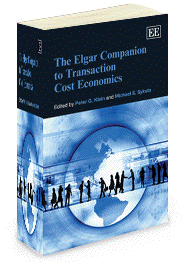
The Elgar Companion to Transaction Cost Economics, edited by Mike Sykuta and me, has just been published. Twenty-nine chapters cover the basic structure of TCE, its precursors and influences, fundamental concepts, applications and evidence, along with alternatives and critiques. Oliver Williamson was kind enough to contribute an introduction and overview. Co-blogger Foss is in there as well.
O&M readers can get it here 10 percent off the list price! (Actually, anybody can get the deal.) Mike beat me to the punch with an announcement and description, so I’ll just add that we’re really pleased with the final product and grateful to all the distinguished contributors and the production staff.
Here are previous O&M posts on transaction cost economics.
ScienceCodex
| Nicolai Foss |
ScienceCodex is the name of a great resource for serious procrastination, amusement, and — sometimes — useful inputs to research and teaching. Signing up for the feed will result in about 20 daily pieces of science news, and, at least for me, a couple of them are usually great fun and potentially useful for teaching. For example, those who teach OB or HRM may find this piece, “Over 50? You probably prefer negative stories about young people,” useful for classroom discussion. There are also potentially offensive stories (e.g., “You Kick Like a Girl“), so be forewarned ;-)
Two Economics Papers About Culture
| Peter Klein |
The New Institutional Economics focuses mainly on formal rules, both “macro” (constitutions, legal systems, written languages) and “micro” (firms, contracts, other formal agreements). But there are many studies of informal or semi-formal constraints — norms, conventions, religion, belief systems, and other aspects of culture, broadly conceived. Given their commitment to methodological individualism, New Institutional Economists tend to explain the emergence and stability of these phenomena as the consequences — typically unintended — of purposeful individual choices (which distinguishes us from our colleagues on the other side of the aisle). (Culture is important within organizations, as well as between them, though attempts to explain organizational culture in this manner have been less successful.)
Does Culture Matter?
Raquel FernándezThis paper reviews the literature on culture and economics, focusing primarily on the epidemiological approach. The epidemiological approach studies the variation in outcomes across different immigrant groups residing in the same country. Immigrants presumably differ in their cultures but share a common institutional and economic environment. This allows one to separate the effect of culture from the original economic and institutional environment. This approach has been used to study a variety of issues, including female labor force participaiton, fertility, labor market regulation, redistribution, growth, and financial development among others.
Do Social Connections Reduce Moral Hazard? Evidence from the New York City Taxi Industry
C. Kirabo Jackson, Henry S. SchneiderThis study investigates the role of social networks in aligning the incentives of economic agents in settings with incomplete contracts. We study the New York City taxi industry where taxis are often leased and lessee-drivers have worse driving outcomes than owner-drivers as a result of a moral hazard associated with incomplete leasing contracts. Using instrumental variables and fixed-effects analyses, we find that: (1) drivers leasing from members of their country-of-birth community exhibit significantly reduced effects of moral hazard; (2) network effects appear to operate primarily via social sanctions; and (3) network benefits can help to explain the organization of the industry in terms of which drivers and owners form business relationships.
Experimental Philosophy
| Peter Klein |
 Experimental economics is mainstream, and is increasingly popular in management (as well as sociology, political science, criminology, etc.). Laboratory and natural experiments seem to fill more journal pages every year. Esther Duflo took home this year’s Clark Medal for her work on randomized controlled trials. Identification is all the rage in empirical social science, and who needs instrumental variables or fixed effects if you can force ceteris to be paribus through experimental design?
But wait a minute: philosophy? Apparently philosophers are getting into the game, via a new experimental philosophy movement (“X-Phi,” to the cool kids). The NYT Magazine surveyed the field a few years back, and this week’s this week’s “Room for Debate” asks important philosophers what they think. Note the wide range of opinions. My initial reaction was similar to Brian Leiter’s, namely that X-Phi is about being trendy, attracting funding, and keeping philosophy departments from being shredded by budget-conscious administrators. Academia, after all, is among the most faddish of the professions. But who knows. (Thanks to MLC for the link.)
Add to: Facebook | Digg | Del.icio.us | Stumbleupon | Reddit | Blinklist | Twitter | Technorati
New Books on Entrepreneurship
| Peter Klein |
 Princeton University Press has just published Will Baumol’s latest work, The Microtheory of Innovative Entrepreneurship. One of the celebrity dust-jacket endorsers (OK, me) says: “Baumol is one of the giants in the entrepreneurship field. The Microtheory of Innovative Entrepreneurship will be widely read, discussed, and debated, and is likely to have a significant impact on the scholarly conversation.” Hmmm, that’s a bit pedantic. But it’s really a very interesting book, though Baumol defines entrepreneurship differently than I do (as a Schumpeterian, he identifies entrepreneurship primarily with innovation and economic growth). The book is oriented more towards mainstream economists than management scholars, but both groups will benefit from Baumol’s careful and scholarly treatment.
 Next month Oxford is bringing out Amar Bhidé’s A Call for Judgment: Sensible Finance for a Dynamic Economy. HBR is running an excerpt titled “The Judgment Deficit” that is worth a read. There Bhidé writes:
As we rebuild from the economic crisis, we must renew the search for the appropriate balance — in finance and in other endeavors — not just between centralization and decentralization but also between case-by-case judgment and standardized rules. The right level of control is an elusive and moving target: Economic dynamism is best maintained by minimizing centralized control, but the very dynamism that individual initiative unleashes tends to increase the degree of control needed. And how to centralize — whether through case-by case judgment, a rule book, or a computer model — is as difficult a question as how much. But these are questions that we cannot afford to stop asking.
While Bhidé doesn’t offer a formal definition of judgment, his treatment in earlier books makes extensive use of Knight (and Hayek), and I think he has in mind the kind of middle ground between formal rule-following and randomness that was central to Knight’s understanding of entrepreneurship.
Add to: Facebook | Digg | Del.icio.us | Stumbleupon | Reddit | Blinklist | Twitter | Technorati
Does Knowledge Management Improve Performance?
| Peter Klein |
Yes, says Peter Cappelli:
The extensive literature on knowledge management spans several fields, but there are remarkably few studies that address the basic question as to whether knowledge management practices improve organizational performance. I examine that question using a national probability sample of establishments, clear measures of IT-driven knowledge management practices, and an experimental design that offers a unique approach for addressing concerns about endogeneity and omitted variables. The results indicate that the use of company intranets, data warehousing practices, performance support systems, and employee competency databases have significant and meaningful effects on a range of relevant business outcomes.
Cappelli relies on a national (US), establishment-level survey of knowledge-management practices to construct a panel in which (according to the practioner literature) none of the knowledge-management practices under consideration existed at the start of the sample period. Check it out.
Add to: Facebook | Digg | Del.icio.us | Stumbleupon | Reddit | Blinklist | Twitter | Technorati
Historical Foundations of Entrepreneurship Research
| Peter Klein |
 Look for this new collection later this Fall. Hans Landström and Franz Lohrke have put together an excellent set of essays on the intellectual origins and historical development of entrepreneurship research. Nicolai and I have a chapter on “Entrepreneurial Alertness.” Other topics include entrepreneurial orientation, the liability of newness, entrepreneurial groups, governance, social networks, social enterprise, culture, and psychology. Check it out!
Add to: Facebook | Digg | Del.icio.us | Stumbleupon | Reddit | Blinklist | Twitter | Technorati
“De Gustibus Non Est Disputandum”?
| Nicolai Foss |
History of econ nerds (wonks?) will know that John Stuart Mill was trained by his father (James Mill) from the age of three in the Greek and Latin languages. Since Mill, economists’ Latin capabilities have deteriorated rather badly (a result of the dominance of Greek notation? ;-)). In fact, most economists only know two Latin sentences (or rather, dicta) that, however, they love to blurt out, often with a smug smile. One is a sound analytical principle, namely the ceteris paribus principle. The other is a much more problematic (if applied outside of economics) claim, made famous to economists by George Stigler and Gary Becker, namely “de gustibus non est disputandum.”
I have always been surprised by the readiness of many economists to endorse this claim as a general claim that goes beyond the simple implication that in economics we take preferences as given and applies on the aesthetic domain (perhaps this simply reflects the fact that many people nowadays subscribe to total or near-total relativism in aesthetics). However, understood as an aesthetic claim, “de gustibus non est disputandum” lies entirely outside of the orbit of economics (and economists-as-economists should shut up), and is emphatically not implied by subjective value theory, or any related branch of subjectivism in economics. (more…)
Too Much Research
| Peter Klein |
Bill McKelvey is one of the signatories to a controversial Chronicle piece that ran last month, “We Must Stop the Avalanche of Low-Quality Research.” The five authors, from a variety of academic disciplines, argue that “the amount of redundant, inconsequential, and outright poor research has swelled in recent decades, filling countless pages in journals and monographs.” As evidence they point to increases in the numbers of journals, journal pages, and authors and decreases in average citation rates.
[I]nstead of contributing to knowledge in various disciplines, the increasing number of low-cited publications only adds to the bulk of words and numbers to be reviewed. Even if read, many articles that are not cited by anyone would seem to contain little useful information. The avalanche of ignored research has a profoundly damaging effect on the enterprise as a whole. Not only does the uncited work itself require years of field and library or laboratory research. It also requires colleagues to read it and provide feedback, as well as reviewers to evaluate it formally for publication. Then, once it is published, it joins the multitudes of other, related publications that researchers must read and evaluate for relevance to their own work. Reviewer time and energy requirements multiply by the year. The impact strikes at the heart of academe.
I think this assessment is generally on target, in my own field at least. What percentage of the articles in your favorite scholarly journal do you read, let alone remember? How much of the research in your field really adds value? Of course, search tools make it easier to find relevant information, so I’m not sure the point about lit reviews is all that compelling. Still, it does seem increasingly difficult to sort wheat from chaff.
I’m less impressed with the authors’ proposed solutions — limiting the number of publications that can be considered for promotion and tenure, making greater use of impact factors, and enforce tighter page restrictions. These strike me as superficial fixes. The main problem is the vast increase in the scale and scope of the “scientific” enterprise itself, almost all of it due to public funding. There are simply too many universities and institutes, too many research faculty, too many granting agencies, too much research money. It’s a self-perpetuating process, almost exclusively driven by supply-side considerations (who on earth “demands” the output of most English departments?). Some of you will be shocked by the claim that there’s “too much” research money, particularly in today’s austere climate. But I mean too much relative to some social optimum, not too much relative to what university professors want.
Why would we expect this kind of system to produce high-quality research? Perhaps it’s a miracle that any good work gets done at all.
Add to: Facebook | Digg | Del.icio.us | Stumbleupon | Reddit | Blinklist | Twitter | Technorati
Bailouts in Historical Perspective
| Peter Klein |
O&M has been consistently anti-bailout, whether recipients are banks, manufacturing firms, or homeowners. Besides encouraging moral hazard, bailouts also stymie the fundamental market process of moving productive assets from lower- to higher-valued uses. A market economy, after all, is a profit-and-loss system. Without losses, what’s the point?
A new edited volume, Bailouts: Public Money, Private Profit (Columbia University Press, 2010), explores bailouts in historical perspective, going back as far as the US financial crisis of 1792. Editor Robert Wright and his contributors try to steer a middle course, with Wright endorsing Hamilton’s Rule (formerly Bagehot’s Rule) of providing public loans to failing firms only if they have good collateral, and at “penalty” interest rates. Still, as Wright notes in his introduction, “There is no statistical evidence, however, that bailouts [of any kind] can speed economic recovery. In fact, bailouts can slow recovery by creating policy uncertainty, distorting market incentives, and in extreme cases fomenting sociopolitical unrest.”
Add to: Facebook | Digg | Del.icio.us | Stumbleupon | Reddit | Blinklist | Twitter | Technorati
Economics of Creativity
| Peter Klein |
David Galenson has written a series of papers on the creative arts, including songwriting, architecture, filmmaking, photography, and many kinds of visual art. A new paper, “Understanding Creativity,” summarizes and synthesizes much of this work. A central theme is the distinction between “experimental” and “conceptual” innovators. Experimental innovators focus on perception, proceed incrementally, and tend to make their most important contributions late in their careers. Conceptual innovators emphasize emotions, proceed in bold strokes, and tend to peak early. (A cinematic example: John Ford and Alfred Hitchcock fall in the former category, Orson Welles and Jean-Luc Godard in the latter.)
There are obvious parallels with the study of technological innovation, management, and entrepreneurship. Think of incremental versus systemic innovation, sustaining versus disruptive change, low-key management versus charismatic leadership, Kirznerian coordination versus Schumpeterian innovation. The analogies are inexact, but nonetheless intriguing (particularly the life-cycle aspects). What connections do you see?
The abstract of “Understanding Creativity” is below the fold. (The paper itself is gated, unfortunately). (more…)
The Role of Assumptions in Management Research
| Nicolai Foss |
A striking difference between economics and (most) management research is that while economists are obsessed with the role of assumptions in theorizing, management scholars as a rule don’t seem to spend much time on assumptions, at best tucking them away under “boundary conditions,” and, in general, having rather little patience with “assumptions discussions.” In particular, the eyes of management scholars of the more descriptive (“phenomenological”) stripe glaze over from boredom or inattention when the issue is raised.
Major economists (Samuelson and Friedman come immediately to mind) have written famous methodological papers on assumptions. A significant portion of what passes as “economic methodology” is taken up with the nature and status of assumptions. Prominent philosophers have written on the role of assumptions in economics (e.g., Alan Musgrave, Daniel Hausman). However, I know of not a single paper in management research dedicated to the issue. (more…)
Handbook of the Economics of Innovation
| Peter Klein |
Elsevier has just released the Handbook of the Economics of Innovation, edited by Bronwyn Hall and Nathan Rosenberg. At USD 250 for the two-volume set (a bit less at Amazon), it’s not exactly cheap, but I expect a high ratio of good ideas to pages. You can read the introduction here, and here’s a draft of one of the chapters.
Add to: Facebook | Digg | Del.icio.us | Stumbleupon | Reddit | Blinklist | Twitter | Technorati
Intro to The Capitalist and the Entrepreneur
| Peter Klein |
Here’s a nicely formatted HTML version of the introduction to The Capitalist and the Entrepreneur. I’d apologize for the self-promotion but, well, isn’t that the whole point of blogging?
(PS: Those of you who like to run your transactions through Amazon can get the book here. Not sure about a Kindle edition but I’m told an epub version will be available soon.)
Add to: Facebook | Digg | Del.icio.us | Stumbleupon | Reddit | Blinklist | Twitter | Technorati





 Organizations and Markets
Recent Comments