Posts filed under ‘Strategic Management’
Lachmannian Entrepreneurship
| Dick Langlois |
The new issue of Organization Studies carries an article by John Mathews called “Lachmannian Insights into Strategic Entrepreneurship: Resources, Activities, and Routines in a Disequilibrium World.” Here’s the abstract.
Recent contributions to the organizational literature see the radical subjectivist and disequilibrium framework of Ludwig Lachmann as providing a suitable foundation for strategic entrepreneurial studies, in that his approach seeks independence from conventional equilibrium-based reasoning. In a Lachmannian spirit, this article suggests that strategizing can fruitfully be viewed as choices made by the entrepreneur in terms of the organization’s constituent resources, activities and routines together with their recombinations and complexifications. Cast in a general, disequilibrium setting, the strategic goals that guide the organizational entrepreneur’s strategizing can be formulated in terms of the construction and capture of resource complementarities, the pursuit of increasing returns through activities reconfiguration, and the generation of learning and dynamic capabilities through reconfiguration of routines. Once formulated in this way, the strategizing issues may be seen to make sense not just in the comparative static and imperfect equilibrium frameworks within which they have hitherto been posed, but in a more general dynamic and disequilibrium setting that corresponds to the real conditions in which firms are required to make entrepreneurial decisions. The simplified framework offers some hope for overcoming the balkanization of management scholarship that is so widely deplored.
Add to: Facebook | Digg | Del.icio.us | Stumbleupon | Reddit | Blinklist | Twitter | Technorati
Behavioral Corporate Strategy
| Peter Klein |
I’m not a huge fan of behavioral economics, though I obviously recognize its substantial and growing influence in economics, finance, entrepreneurship, and potentially, strategy. Many academics and commentators see the financial crisis as a vindication for behavioral economics research. Behavioral reasoning underlies the New Paternalism. I see the importance and implications of behavioral economics as overstated — the literature typically focuses on straw-man versions of “rationality” and largely ignores the effect of biases and heuristics on political decision-making — but it raises interesting issues in applied psychology.
My old friend Dan Lovallo has a nice piece (with Olivier Sibony) in the new McKinsey Quarterly making “The Case for Behavioral Strategy.” (It’s gated, but registration is free.) They make good arguments for applying behavioral insights into corporate decision making. The basic claim is that “we need new norms for activities such as managing meetings . . . , gathering data, discussing analogies, and stimulating debate that together can diminish the impact of cognitive biases on critical decisions. To support those new norms, we also need a simple language for recognizing and discussing biases, one that is grounded in the reality of corporate life, as opposed to the sometimes-arcane language of academia.” I agree, and urge you to check it out.
Add to: Facebook | Digg | Del.icio.us | Stumbleupon | Reddit | Blinklist | Twitter | Technorati
Posner on Institutions and Organizations, Round Two
| Peter Klein |
Remember the infamous Posner-Coase-Williamson exchange from JITE, 1993? Posner dismissed the New Institutional Economics as a derivative form of Posnerian law and economics, prompting unhappy replies from Coase and Williamson. Here’s Coase:
Posner [1993, 79] says that the first part of his paper describes “the conception of the field [the new institutional economics] held by Ronald Coase.” Reading this part of his paper recalled to my mind Horace Walpole’s opening remarks in his book on King Richard the Third: “So incompetent has the generality of historians been for the province that they have undertaken, that it is almost a question, whether, if the dead of past ages could revive, they would be able to reconnoitre the events of their own times, as transmitted to us by ignorance and misrepresentation” (Walpole [1768, 1]). I have only one foot through the door but should the final yank come before this piece is published, Horace Walpole’s words would apply exactly to Posner’s highly inaccurate account of my views.
Adds Williamson, wryly: “Richard Posner is a prolific writer and distinguished jurist. He is frequently asked to speak with wisdom and authority on many issues. Whether he hits the mark or misses varies with his depth of knowledge and understanding of those issues. . . . I content that Posner’s [1993] commentary mainly misses.”
Now Geoff Hodgson has produced a reboot: a long essay by Posner in the Journal of Institutional Economics titled “From the New Institutional Economics to Organization Economics: with Applications to Corporate Governance, Government Agencies, and Legal Institutions,” with replies from Jürgen Backhaus, Bruno Frey, Lin Ostrom, John Roberts, Tom Ulen, and several others (but not Coase or Williamson!). Posner focuses almost exclusively on the principal-agent problem, perhaps unaware that information, delegation, coordination, and adaptation are also important issues in organizational economics. His main conclusion seems to be that both private firms and public agencies are equally inefficient. Interesting reading, to be sure (and much better than Posner’s solipsistic essay on his conversion to Keynesianism, inexplicably published by the New Republic).
Agribusiness Economics and Management
| Peter Klein |
Congratulations to my colleague Mike Cook for his review paper on “Agribusiness Economics and Management” (with Rob King, Mike Boehlje, and Steve Sonka) in the new issue of the American Journal of Agricultural Economics. It’s a special issue commemorating the centennial of the American Agricultural Economics Association. Lots of good stuff here on the history and development of management theory and pedagogy, the evolution of the food sector, and the effects of the institutional environment on firm structure. Here’s the abstract:
Agribusiness scholarship emphasizes an integrated view of the food system that extends from research and input supply through production, processing, and distribution to retail outlets and the consumer. This article traces development of agribusiness scholarship over the past century by describing nine significant areas of contribution by our profession: (1) economics of cooperative marketing and management, (2) design and development of credit market institutions, (3) organizational design, (4) market structure and performance analysis, (5) supply chain management and design, (6) optimization of operational efficiency, (7) development of data and analysis for financial management, (8) strategic management, and (9) agribusiness education.
Financial Constraints and Innovation
| Peter Klein |
Why are firms in poor countries less productive than firms in rich countries? Is it lack of technical know-how? Poor infrastructure? Insufficient human capital? Weak intellectual-property protection? Actually, the evidence suggests a more prosaic explanation: financial constraints.
One stylized fact that appears from emerging markets and transition economies . . . is that foreign owned fi rms tend to be more productive than domestically owned firms. . . . To the extent that foreign owned fi rms embody the technological frontier, one can interpret this fact as suggesting that some forces prevent domestically owned firms from emulating the best practices and techniques. . . .
We show that a fi rm’s decision to invest into innovative and exporting activities is sensitive to fi nancial frictions which can prevent fi rms from developing and adopting better technologies. Furthermore, we demonstrate that in a world without financial frictions, innovation and exporting goods are complementary activities. Thus, easing financial frictions can have an ampli ed eff ect on firms’ innovation eff ort and consequently the level of productivity. However, as financial frictions become increasingly severe, these activities become eff ectively substitutes since both exporting and innovation rely on internal funds of fi rms.
That’s from “Financial Constraints and Innovation: Why Poor Countries Don’t Catch Up” by Yuriy Gorodnichenko and Monika Schnitzer. One implication is that diversified firms, whose operating units have access to the firm’s internal capital market, have particular advantages in developing countries, an argument explored in several papers by Khanna and Palepu (e.g., here). In the US, these advantages may not outweigh other drawbacks of unrelated diversification.
Shareholder-Stakeholder Smackdown: Jensen, Freeman, Mintzberg, Khurana
| Peter Klein |
This looks like a fun event. Watch the Big Guys debate the future of the firm, management, and management education. It’s Fordham University’s W. Edwards Deming Memorial Conference, 11 May 2010 in New York City. Kudos to Mike Jensen for his willingness to walk into what will be, presumably, a line of fire. And remember, management theory is not to blame.
Assessing the Critiques of the RBV
| Nicolai Foss |
There is little doubt that the resource-based view, in its various guises and manifestations (e.g., see Gavetti & Levinthal’s distinction between “high church” and “low church” approaches to the RBV), is the dominant perspective in strategic management research. Naturally, all dominant approaches attract critique like flies. This is amplified by the fact that the RBV is still evolving; many things have been unclear (e.g., what exactly is assumed about managerial rationality, the game forms that describe strategic factor markets, the interaction (if any) between factor market and product market behaviors, etc.), and those things that have been reasonably clear (e.g., the RBV’s reliance on competitive equilibrium models) have been controversial. Some of the critiques of the RBV are fairly well-known, for example, the Priem and Butler tautology charge, while other critiques are less generally known.
Given that many of the critiques have basically been around for two decades or more, it is surprising that the first comprehensive treatment of the many critiques of the RBV has just been published — namely Kraaijenbrink, Spender, and Groen’s “The Resource-based View: A Review and Assessment of Its Critiques.” (more…)
Org. Structure and Diversification
| Peter Klein |
The March 2010 issue of the Journal of Industrial Economics has just come out, and it features my paper with Marc Saidenberg, “Organizational Structure and the Diversification Discount: Evidence from Commercial Banking.” I’m quite happy with the paper, which went through many rounds of revision and consumed a great deal of time and energy. I blogged the details earlier. The published version is behind a firewall; if you can’t get through I’d be happy to mail you a copy.
Vertical Integration and the Informational Content of Prices
| Peter Klein |
Many years ago, when I was taking Williamson’s Economics of Institutions class at Berkeley and fishing around for dissertation topics, I had the idea to do some empirical work on the relationship between inflation and vertical integration or conglomerate diversification. The basic idea is that monetary expansion not only raises price levels, but also increases the dispersion of relative prices — introducing “noise” into the price mechanism — giving entrepreneurs an incentive to internalize transactions, on the margin, they would have otherwise conducted in the market. My interest was partly piqued by an off-hand remark by Dick in a review of Chandler’s Scale and Scope:
Things began to go wrong in the 1960s with the wave of conglomerate diversification, that is, with diversification by companies into areas wholly unrelated to their “core competence.” ITT was the paradigm of this phenomenon. Originally an international maker of telephone switching equipment, it bought, among other things, an insurance company and the maker of Hostess Twinkies. Chandler sees this as an inefficient practice, with many of the disbenefits of overextended British personal capitalism. There is no historical precedent for such unrelated diversification, he notes, except for German Konzerne during the hyperinflation of the 1920s. What is interesting — and what Chandler doesn’t mention — is that it is precisely inflation, in this case the Lyndon Johnson inflation of the 1960s, to which many have pointed as the cause of the wave of conglomerate mergers. The conglomerate is in effect an “internal capital market” that invests in a diversified portfolio of unrelated interests. But why? The stock market is much better at diversifying away risk than is such an arrangement, and it has many other advantages as well. In a time of inflation, the argument goes, price signals become distorted as managers find it difficult to disentangle changes in relative prices (that is, real prices) from changes in the price level. In such a world, the internal information and control within a conglomerate may have advantages that outweigh the disadvantage.
But, in any case, the trend in the less-inflationary 80s was the opposite one, the breaking apart of corporate holdings. . . .
The idea that conglomerate diversification, and “hierarchies” more generally, are responses to conditions in external markets has proven very useful in my own work; it also appears in Amar Bhidé’s neglected 1990 paper on diversification. Dick’s review cites a 1989 paper by Don Boudreaux and Bill Shughart linking US inflation rates and a measure of vertical integration but I couldn’t find such a relationship for diversification, and ended up going in a different direction. (more…)
Product and Factor Markets in the RBV
| Nicolai Foss |
It is often argued that firm strategy is fundamentally rooted in various imperfections. Strategic management has long been characterized by an intellectual division of labor in which the resource-based view handled (strategic) factor market imperfections and various positioning approaches took care of product market imperfections. This dichotomy is beginning to break down. Two recent papers, one a theory of science-based piece, the other a theory piece, discuss the product/factor market dichotomy and show why it is problematic.
In “Theoretical Isolation and the Resource-based View: Symmetry Requirements and the Separation Between Product and Factor Markets,” Niklas Hallberg and yours truly argue that the RBV treats factor markets as imperfect and product markets as perfect (an approach that we argue is adopted from mainstream economics and its tendency to work with on-off assumptions). We argue that this asymmetry is problematic, as there is a general case to be made for symmetrical assumptions and as it borders on logical inconsistency to assume — within the same model — that one set of markets is perfect and another set is imperfect. The paper isn’t online, but you can email me at njf.smg@cbs.dk for a copy. (Abstract below).
In “Chicken, Stag, or Rabbit? Strategic Factor Markets and the Moderating Role of Downstream Competition,” my CBS (Center for Strategic Management and Globalization) colleague, Dr. Christian Geisler Asmussen, models various deviations from perfect(ly competitive) product markets and shows how these impacts firms’ factor market behaviors and whether they can derive rents from resources purchased on these markets. I believe this is the first systematic study of its kind in the literature (and there are some seriously counter-intuitive findings in it). Very highly recommended! (more…)
ACAC Paper Submission Deadline Extended
 | Peter Klein |
Due to all the weather-related foul-ups of the last couple of weeks the organizers of the Atlanta Competitive Advantage Conference have graciously extended the submission deadline through this Friday, 19 February 2010. The conference itself is 18-20 May 2010 in (duh) Atlanta. Click the link above for submission information.
ACAC is an O&M favorite, so make plans to participate!
Williamson Tribute in California Management Review
| Peter Klein |
Six new essays on Oliver Williamson by Haas School colleagues appear in the new issue of the California Management Review. They’re behind a subscription firewall, but just $6 a pop. Check ’em out:
Institutions, Politics, and Non-Market Strategy
de Figueiredo, Jr., Rui J.P.
Holdup: Implications for Investment and Organization
Hermalin, Benjamin E.
Antitrust Economics
Shapiro, Carl
Regulation: A Transaction Cost Perspective
Spiller, Pablo T.
Williamson’s Contribution and Its Relevance to 21st Century Society
Tadelis, Steven
Williamson’s Impact on the Theory and Practice of Management
Teece, David J.
Thanks to Mike Cook for the tip.
Mizzou Seminar on Evolutionary Models in Economics and Organization Theory
| Peter Klein |
Thanks largely to the organizing efforts of my colleague and former O&M guest blogger Randy Westgren, a group here at Missouri is examining evolutionary models in economics and organization theory. The centerpiece is a philosophy of science seminar directed by André Ariew, a leading American scholar in the philosophy of biology, especially Darwin and evolutionary theory.
I’ll let Randy explain:
The course is PHL 9830. Normally it is a traditional philosophy of science seminar aimed at graduate students in the department of philosophy, but we hijacked it to examine a specific theme. The subject focus is evolutionary theory applied to biology, economics, and management. There are three general types of questions we ask, (a) clarification, (b) conceptual, and (c) general philosophy of science. (more…)
Rethinking the Diversification Discount
| Peter Klein |
A very good summary by Don Sull of recent literature on diversification. I like points #1 and #4 the best. He missed a few of the seminal papers (1, 2, 3) but nobody’s perfect. Note also that Sull is focusing on the corporate finance literature, which generally ignores inter-industry relatedness. In the strategic management literature, by contrast, relatedness (and its measurement) has been a central concern (see the references here).
Now That’s a Complete Contract!
| Peter Klein |
A major theme of the contracting literature in organizational economics is that formal contracts are inevitably incomplete, meaning that they do not specify actions and remedies for every possible set of circumstances. Given genuine uncertainty about the future, parties may decide that formal contracts to not adequately protect relationship-specific investments, providing an important rationale for vertical integration or another mechanism to protect quasi-rents (alliances, equity-sharing arrangements, reputation, and other “hybrids”).
A recent WSJ piece suggests that writing complete contracts may not be so hard after all:
Decked out in sequined black and gold dresses, Anne Harrison and the other women in her Bulgarian folk-singing group were lined up to try out for NBC’s “America’s Got Talent” TV show when they noticed peculiar wording in the release papers they were asked to sign.
Any of their actions that day last February, the contract said, could be “edited, in all media, throughout the universe, in perpetuity.”
My Mom says she once told me I was the best little boy in the world, to which I responded, “and all the planets too?” The WSJ gives several examples of similarly expansive coverage:
- The terms of use listed on Starwars.com, where people can post to message boards among other things, tell users that they give up the rights to any content submissions “throughout the universe and/or to incorporate it in other works in any form, media or technology now known or hereafter developed.”
- In a May 15, 2008, “expedition agreement” between JWM Productions LLC, a film-production company, and Odyssey Marine Exploration Inc., a shipwreck-exploration outfit, JWM seeks the rights to footage from an Odyssey expedition. The contract covers rights “in any media, whether now known or hereafter devised, or in any form whether now known or hereafter devised, an unlimited number of times throughout the universe and forever, including, but not limited to, interactive television, CD-ROMs, computer services and the Internet.”
And my personal favorite:
A 189-word sentence in a September agreement between Denver-based Spicy Pickle Franchising Inc. and investment bank Midtown Partners & Co. — which has helped raise capital for the sandwich and pickle shops dotted across the region — unconditionally releases Spicy Pickle from all claims “from the beginning of time” until the date of the agreement.
Says Spicy Pickle’s Marc Geman, “the length of the paragraph is only limited by the creativity of the attorney.”
A New Hawthorne Study
| Peter Klein |
Tanjim Hossain and John List have done a Hawthorne-type study on a Chinese high-tech manufacturing company. The paper, “The Behavioralist Visits the Factory: Increasing Productivity Using Simple Framing Manipulations,” is unfortunately gated at NBER. I’m surprised it’s taken this long for someone to take advantage of the current craze for field experiments to do this kind of study. (I wonder if IRB approval is easier when the test subjects are in China?) Check out the abstract:
Recent discoveries in behavioral economics have led to important new insights concerning what can happen in markets. Such gains in knowledge have come primarily via laboratory experiments — a missing piece of the puzzle in many cases is parallel evidence drawn from naturally-occurring field counterparts. We provide a small movement in this direction by taking advantage of a unique opportunity to work with a Chinese high-tech manufacturing facility. Our study revolves around using insights gained from one of the most influential lines of behavioral research — framing manipulations — in an attempt to increase worker productivity in the facility. Using a natural field experiment, we report several insights. For example, conditional incentives framed as both “losses” and “gains” increase productivity for both individuals and teams. In addition, teams more acutely respond to bonuses posed as losses than as comparable bonuses posed as gains. The magnitude of the effect is roughly 1%: that is, total team productivity is enhanced by 1% purely due to the framing manipulation. Importantly, we find that neither the framing nor the incentive effect lose their importance over time; rather the effects are observed over the entire sample period. Moreover, we learn that worker reputation and conditionality of the bonus contract are substitutes for sustenance of incentive effects in the long-run production function.
See also List’s paper with Levitt on the original Hawthorne experiments.
Felin and Foss Best Paper Award
| Peter Klein |
Congratulations to Nicolai and Teppo Felin for winning this year’s SO!WHAT Award for Scholarly Contribution for their 2005 paper “Strategic Organization: A Field in Search of Micro-Foundations” (ungated version). These are given by the journal Strategic Organization for the best paper published five years earlier (i.e., after some seasoning, based on impact as well as substance and originality). Look here (about half-way down the page) for praise from Jay Barney and Bruce Kogut. Way to go, guys!
Here are some prior O&M posts on microfoundations.
Can We Tackle the Big Problems?
| Peter Klein |
Russ Coff, Emory University strategy professor extraordinaire and former O&M guest blogger, sends this special report:
I’m reporting live (but jet lagged) from the Israel Strategy Conference that Peter had mentioned earlier. A theme among the keynote speakers (particularly Jay Barney and Anita McGahan) has been how we can apply our theories to tackle more meaningful problems.
Jay delivered a tearful account of his personal efforts to apply resource based theory to help a small village in Bolivia. (more…)
Disney Organizational Chart, circa 1943
| Peter Klein |
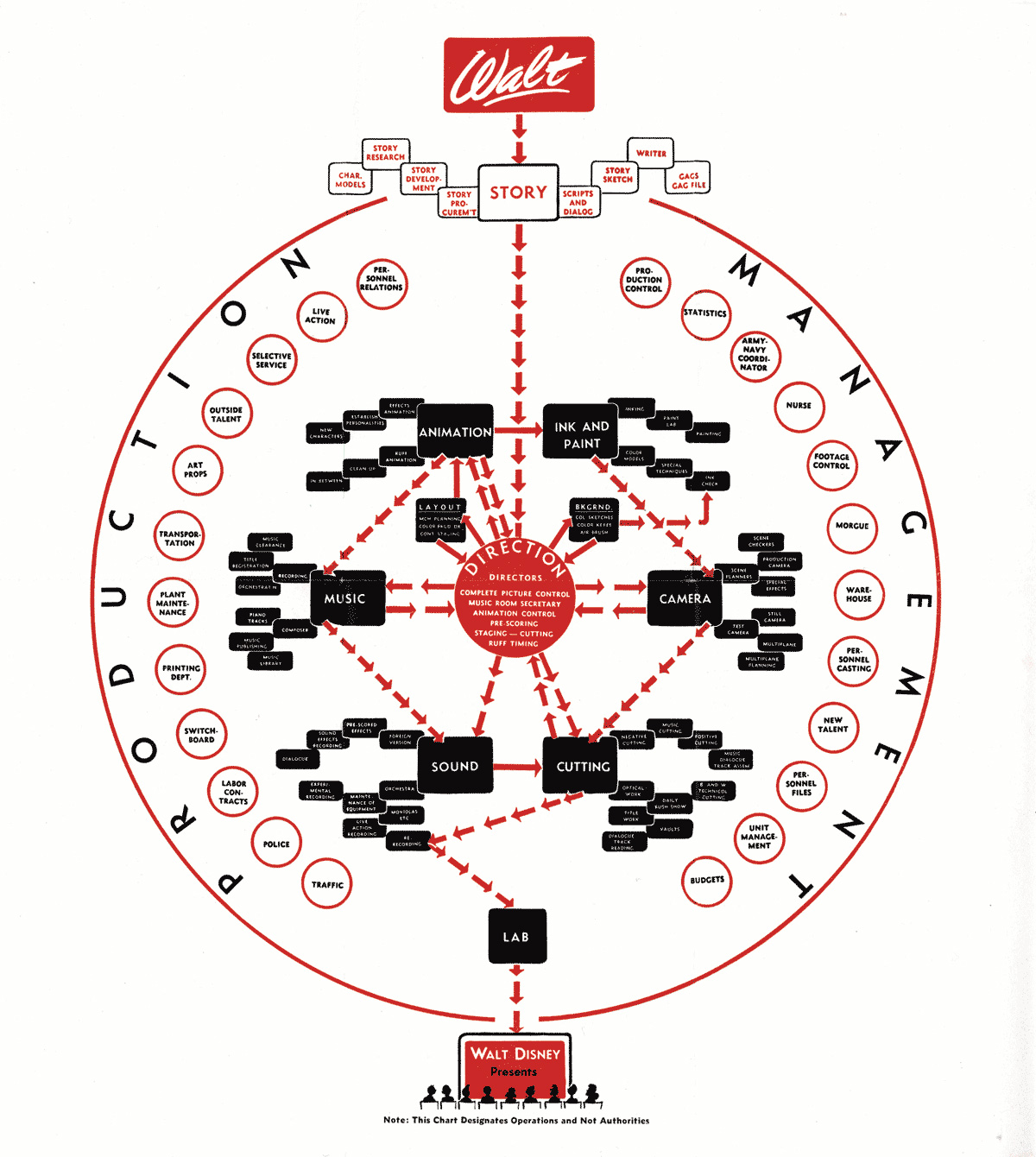
This week’s passing of Roy Disney has brought forth some interesting discussion of the firm founded by his uncle Walt and father Roy. Check out this Disney organizational chart from 1943 (click to enlarge), courtesy of design site @issue. Unlike the typical corporate hierarchy, writes Delphine Hirasuna, Disney’s “is based on process, from the story idea through direction to the final release of the film. All of the staff positions are in the service of supporting this work flow.” (From Cliff Kuang via WeLoveDataVis.)
CFP: “Contracts, Procurement, and Public-Private Arrangements”
| Peter Klein |
It’s 14-15 June 2010 in Paris. Submissions are due 15 February. Stéphane Saussier is organizing, so you know it will be good. From the CFP:
This conference focuses on the recent developments in contract theories. Papers are invited on all topics of contract theories including:
- relational contracting,
- transaction costs,
- renegotiations,
- incentives,
- attribution mechanisms,
- incomplete contracting
- contract design, etc.
Papers presented may be theoretical or applied. A special attention will be given to proposals addressing issues related to procurement and public-private arrangements.





 Organizations and Markets
Recent Comments