Posts filed under ‘Strategic Management’
Two Interesting and Different Strategies for Tie-in
| Peter Lewin|
I have an all-in-one color printer, fax, scanner (Canon MX7600). It is pricey, but the real kicker is the cost of the toner. It uses 6 different cartridges. Some of them run out pretty frequently. Each costs around $20, basically for a small container of ink. When any one of the cartridges runs out the machine shuts down — though it could easily print black and white when one of the colors runs out. Also, and this is the interesting thing, when any toner cartridge runs out all of the other functions of the machine shut down — no outgoing faxes, no scanning — even though these have nothing to do with printing. This way I am inclined to replace the cartridge sooner rather than later. Annoying. I suspect this is deliberate and maybe not enough of a nuisance to be a selling point in the competition for consumers.
Very different: I am running out of my blood-pressure medicine. I have my own blood pressure machine, and as horrendously complicated as it is to use it, I have somehow managed to master the art. My blood pressure is normal while on the medication. I attempt to refill the prescription (which costs $12 without insurance — not even worth claiming). No refills left. The pharmacy calls the doctor. The doctor’s office calls me to make an appointment. For what? To get my blood pressure taken. I have my own machine. That is not good enough. We have to do it! My appointment is at 10:45. I see the nurse at 11:15, after filling out paperwork that I have filled out multiple times before. I see the doctor at 11:45. I leave the doctor’s office at 12:05 after he has sent in my refill prescription. I pay him $30 copay. The insurance pays him about $150 for an office visit. Do the math to see how much this $12 prescription cost me (include the opportunity cost of my time and the cost of the office visit — which is reflected in my insurance premium). This ability to tie-in the purchase of a prescribed medicine with the purchase of an office visit is a massive social cost that we all face. It is the result of the non-market delivery of health-care.
C. K. Prahalad Interview
| Nicolai Foss |
The late über-influential management thinker C K Prahalad would have been 70 this August. booz&co’s strategy+business magazine features an interesting interview with CK, “The Life’s Work of a Thought Leader.” It may surprise some that Prahalad was trained as a physicist, and in the beginning of his career worked as an industrial engineer. And for someone, like myself, who has criticized the absence of microfoundations for notions such as “core competence” (e.g., here), it certainly came as a surprise to find Prahalad stating that
If I had to characterize my deepest belief, I would say it’s the centrality of the individual…. Institutions are not central. Institutions are different ways of combining skills and capabilities of the moment. That, of course, is the opposite of the traditional way of thinking, starting from Max Weber and Frederick Taylor in the early 20th century. They posited that institutions were central to society, not individuals. I believe the contrary is true.
Another notable feature in the interview is Prahalad’s view of scientific progress in strategic management which does not come from the kind of cross-sectional studies that take up 93 % of the pages of the Strategic Management Journal, but, he says, from in-depth small-N research:
If you look historically at the strategy literature, starting with Alfred D. Chandler Jr.’s Strategy and Structure: Chapters in the History of the Industrial Enterprise [MIT Press, 1962], the most powerful ideas did not come out of multiple examples. They came out of single-industry studies and single case studies. Big impactful ideas are conceptual breakthroughs, not descriptions of common patterns. You can’t define the “next practice” with lots of examples. Because, by definition, it is not yet happening.
Common MBA Problem-Solving Mistakes
| Peter Klein |
From Luke Froeb, author of the excellent Managerial Economics: A Problem-Solving Approach, shares his most common comments on MBA student assignments. Excerpt:
“What about the organizational design?” Figure out what is causing the problem, and then think about how to avoid the problem. A lot of papers identified a bad decision, and then suggested reversing it. But they neglected to address the issue of why the bad decision was made, and how to make sure the same mistakes wouldn’t be made in the future.
“Don’t define the problem as the lack of your solution.” For example, if the problem is “the lack of centralized purchasing,” then you are locked into a solution of “centralized purchasing.” Instead, define the problem as “high acquisition cost” and then examine “centralized purchasing” vs. “decentralized purchasing” (or some other alternative) as two solutions to the problem.
“What is the trade-off?” Every solution has costs as well as benefits. If you list only the benefits, it makes your analysis seem like an ex post rationalization of a foregone decision, rather than a careful weighing of the benefits and costs. If you spent some time thinking through the tradeoffs, show it. If not, then you should.
These are excellent suggestions. For example, students want us to teach them solutions, but usually the best we can do as instructors is help them understand the relevant tradeoffs.
AOM 2011
| Peter Klein |
The Academy of Management conference in San Antonio is in full swing, with lots of interesting activities for O&Mers. Friday I co-facilitated the theory workshop for the Entrepreneurship Division Doctoral Consortium (slides here), and Peter Lewin and I participated yesterday in a great Professional Development Workshop on the role of Austrian economics in entrepreneurship research. Today O&M friend Joe Mahoney will receive the Irwin Outstanding Educator Award. And there are paper sessions, roundtables, keynotes, and other events dealing with organizational design, entrepreneurship, strategy, innovation, regulation, and other topics near and dear to our collective hearts. A good time is being had by all!
Renegotiation
| Peter Klein |
The idea of a renegotiation-proof equilibrium — a situation in which all commitments are credible such that no party has an incentive to alter the arrangement — became popular in the game-theoretic contract literature in the 1980s. A recent paper by Michael Roberts shows that renegotiation is much more common in bank lending than is commonly recognized (by academics), suggesting that in many cases, formal financial contracting arrangements should be seen as starting points for future negotiation, not equilibrium agreements.
The Role of Dynamic Renegotiation and Asymmetric Information in Financial Contracting
Michael R. RobertsWe show that bank loans are repeatedly renegotiated by the borrower in an effort to loosen contractual constraints designed to mitigate information asymmetry. The typical loan is renegotiated every eight months, or four times during the life of the contract. The frequency of renegotiation is closely linked to the restrictiveness of the initial contact and the degree of information asymmetry between borrower and lender. In addition to significantly altering the terms of the contract, renegotiation reduces the speed of information revelation – more anticipated renegotiation rounds lead to longer durations between those renegotiations as information evolves more slowly. Consequently, later renegotiation rounds are more sensitive to new information regarding the borrower and their outside options than early rounds. An important by-product of our study is to show that many of the observations in the Dealscan database correspond to renegotiations of the same credit agreement, as opposed to originations of new loans.
The Downside of Case Studies
| Peter Klein |
As Herbert Simon once noted, while a case study is only a sample of one, a sample of one is infinitely more informative than a sample of none. This is surely true, but cases must be used with caution, particularly when more systematic evidence is available.
A couple months back I saw a Huffington Post piece claiming that, because Lincoln Electric retains workers even during recessions, and Lincoln Electric is a profitable company, firms should not fire workers when the demand for their products declines. QED. The author laments that business schools don’t teach the virtues of a “no-layoffs” policy more generally. As evidence that business schools are corrupt or incompetent, the author shows that management experts do not, in fact, believe that such a policy is desirable.
A more troubling reason is that many professors at Harvard and other MBA schools are deeply skeptical of offering workers such a bargain.
“It’s a terribly non-optimal and inefficient policy,” says George P. Baker, the co-chair of the HBS doctoral program. “Lincoln Electric is a special case. Unless there is some other reason for having it, as part of an incentive system, you would be wrong to recommend it.”
“I’m not unsympathetic to guaranteed employment and the long-term social strengths it builds,” says James Rebitzer, Chair of the Business Policy Department at Boston University’ School of Management, “But I think there are only a very few special circumstances where a commitment to no-layoffs actually improves operating efficiency.”
Harvard students such as Corey Crowell (MBA 2009), who read the [Lincoln Electric] case just days before we met, got the message: “I just worry that the sense of a guaranteed job would create complacency . . . look at the auto industry.”
There you have it. Despite a wealth of theory and evidence that guaranteed lifetime employment is generally harmful to firm performance, if one firm follows such a policy and prospers, then all firms should do so. That business schools don’t embrace the non sequitur is “troubling.” Okey dokey.
Is the Internet “Transforming” Business?
| Peter Klein |
In the 1990s and early 2000s there was a huge debate about the impact of information technology on productivity. Robert Solow famously quipped, “You can see the computer age everywhere but in the productivity statistics.” Robert Gordon, Erik Brynjolfsson, Jack Triplett, and many others participated in this debate, with issues revolving around productivity measurement, workplace incentives, organizational complementarities, and more. (I did some work on this too.) The end result was a rough consensus that IT did increase productivity, but that the effects were modest.
The buzz over “wikified” organizations — open-source communities, highly disaggregated firms, crowdsourced production, and the like — gives me a strong sense of déjà vu. Indeed, we have not been kind to the wikinomics view in these pages. Now Don Tapscott, a leader of this movement, seems to be having second thoughts:
In our 2006 book Wikinomics, Anthony D. Williams and I looked at dozens of companies that have used the Internet to transform their business models and achieve tremendous success.
However, in the five years since the book’s publication, we’ve noticed something striking: the rate of business model innovation has not accelerated. Yes, some individual companies have achieved competitive advantage by exploiting the web and networked business models. But overall the gains have been modest.
The reason, says Tapscott, is that “it’s becoming difficult or even impossible for companies to achieve breakthrough success without changing their entire industry’s modus operandi.” This reminds me of the conclusion from the earlier literature that IT has the biggest effect when combined with complementary organizational practices (e.g., Milgrom and Roberts, 1995), which suggests that change doesn’t occur until all elements of the complementary bundle are in place — maybe a long time after the initial innovation.
A Capital Approach
| Peter Lewin |
My thanks to Peter Klein (we have to be careful now to indicate which Peter is being addressed :-) ) and to O&M for this wonderful opportunity to participate in this forum. Though I have commented infrequently I have followed its musings with interest and profit. I am delighted to be here.
Perhaps, for my opening post, I might just mention a few areas of my past and current research that might be of interest.
- As part of the Routledge series on the Foundations of the Market Economy I wrote a book entitled Capital in Disequilibrium which was published in 1999. It is still available, but it is very expensive ($200) — certainly not worth that price! Routledge recently released their copyright to me exclusively and I have just got through revising the book for a second edition to be published very soon by the Mises Institute. I had hoped to have some copies available at the upcoming AOM meetings in San Antonio, but this seems very unlikely now. Still, it will be easily available on their website and an open source version will also be there. The price of the book will be $15 I believe. Based on inquiries I have received, this will be welcome news for a few interested scholars.
- I have made very few changes to the book — mainly stylistic improvements and corrections — but I have added a few references to relevant work that appeared after the first edition. For those who don’t know the work, it is basically an evaluative survey of capital theory Austrian-style. Capital theory has often been feared or avoided by economics students, never mind other interested scholars. I hoped and still hope that this book will provide them a comprehensive, sophisticated, yet accessible course in the subject. Of course, the amazing thing is the timing. The relevance of capital theory has, all of a sudden, burst upon the field of management and organization studies. Having discovered and digested Schumpeter and Kirzner, management scholars have now, in turn, discovered Lachmann. How delightful it is for me to see Lachmann’s insights being applied in this kaleidic, digital world. I know this would have pleased him beyond words. (A real paradox of sorts, because I cannot imagine he would ever have mastered the technology for his own personal use :-) ).
- Regarding the book, of course the material is at least twelve years old. Yet, those wishing to understand the recent work using concepts like radical subjectivism, capital heterogeneity, capital complementarity and subsititutability, etc. would probably find it useful — and need not pay attention to the every page. Chapters 2 and 3 seem to me particularly important for an understanding of the concept of equilibrium and disequilibrium about which so much confusion is evident in the literature. Chapter 9, and less so Chapter 10, address specifically the question of capital combinations in business organizations. The final part of the book is about human capital and creates a bridge between the work of Lachmann and Gary Becker. (more…)
AoM PDW on Austrian Economics
| Peter Klein |
 Four years ago I helped organize an Academy of Management pre-conference workshop on Austrian economics featuring Nicolai, me, Joe Mahoney, Yasemin Kor, Dick Langlois, and Elaine Mosakowski. It was well attended and very well received and we are doing something similar this year. Henrik Berglund, Todd Chiles, Steffen Korsgaard, and I have put together a Professional Development Workshop (PDW) on “Austrian Economics and Entrepreneurship Research.” Full details below. The conference home page is here. Hope to see many O&Mers at the workshop!
Austrian Economics and Entrepreneurship Research
Please join us Saturday, August 13, from 12:30 to 2:30pm in the San Antonio Convention Center, Room 212A, for a PDW on the Austrian school of economics and its implications for entrepreneurship studies (Program Session #281).
The Austrian school is increasingly well-known in the entrepreneurship field and is typically associated with Joseph Schumpeter’s idea of “creative destruction” and Israel Kirzner’s concept of “entrepreneurial alertness.” But Austrian economics features a number of additional themes, constructs, and emphases — resource heterogeneity, subjectivity of beliefs and expectations, processes of organizational emergence under complexity, and more — that are particularly relevant to research in entrepreneurship, organization, and strategy. Austrian economics is also receiving increasing attention in the broader economics and policy communities, as witnessed by the revival of interest in Austrian business cycle theory as an explanation for the financial crisis and subsequent economic downturn.
This PDW features a panel discussion and interactive table discussions designed to explore Austrian themes in greater detail and examine their applications to research in entrepreneurship and related areas of management studies. The organizers also hope to encourage and help develop the growing community of management scholars interested in the Austrian school.
The program begins with an introduction and overview by session organizers Henrik Berglund (Chalmers University of Technology), Todd Chiles (University of Missouri), Peter Klein (University of Missouri), and Steffen Korsgaard (Aarhus University), followed by breakout sessions organized around particular themes such as alertness and opportunity discovery, heterogeneity of the entrepreneurial imagination, resource heterogeneity and Austrian capital theory, entrepreneurship and equilibration, entrepreneurship and punctuated disequilibrium. Other distinctively Austrian (e.g., opportunities and action, the role of individuals, the individual-opportunity nexus, the market process, methodological individualism) and related (e.g., effectuation and bricolage) ideas will also figure prominently in the discussions.
The groups will then reassemble to share findings and results with the larger group. Ample time will be allowed for informal discussion and networking.
Please contact Henrik Berglund (henrik.berglund@chalmers.se) with any questions.
Decentralization and the Walmart Decision
| Peter Klein |
On Monday the US Supreme Court turned refused to hear the class-action discrimination suit against Walmart (technically, the Court denied to certify the plaintiffs as a single class for purposes of a class-action suit). I haven’t followed the case closely enough to have an opinion on the merits (or the role of sociologists). But a main legal issue in the case — whether Walmart’s policy of delegating hiring and promotion decisions to local managers makes the firm itself liable for illegal personnel behavior — raises important questions for organization theory.
According to the decision (no, I didn’t try to read all 42 pages):
Pay and promotion decisions at Wal-Mart are generally committed to local managers’ broad discretion, which is exercised “in a largely subjective manner.” . . . Local store managers may increase the wages of hourly employees (within limits) with only limited corporate oversight. As for salaried employees, such as store managers and their deputies, higher corporate authorities have discretion to set their pay within preestablished ranges.
Promotions work in a similar fashion. Wal-Mart permits store managers to apply their own subjective criteria when selecting candidates as “support managers,” which is the first step on the path to management. Admission to Wal-Mart’s management training program, however, does require that a candidate meet certain objective criteria,including an above-average performance rating, at least one year’s tenure in the applicant’s current position, and a willingness to relocate. But except for those requirements, regional and district managers have discretion to use their own judgment when selecting candidates for management training. Promotion to higher office — e.g., assistant manager, co-manager, or store manager — is similarly at the discretion of the employee’s superiors after prescribed objective factors are satisfied. (more…)
What Do Resource- and Capability-Based Theories Propose?
| Peter Klein |
Check out Michael Leiblein’s Guest Editorial in the new Journal of Management:
What Do Resource- and Capability-Based Theories Propose?
Michael J. Leiblein
The Ohio State UniversityThe purpose of this editorial is to review the basic definitions, assumptions, and propositions offered by the resource-based, strategic factor market, and dynamic capability literature streams. Considering the underlying definitions and assumptions associated with these approaches leads directly to a set of refutable propositions that highlight the distinct insights offered by each of these literatures. It is hoped that accentuating these distinctions may stimulate dialogue regarding the underlying causal mechanisms associated with these approaches and foster future empirical work testing these related perspectives.
A very useful reference, both for specialists and those new to the RBV and capabilities approaches. Highly recommended! (And not just because the author’s name ends in “-lein.”)
Incomplete Contracts and the Theory of the Firm
| Peter Klein |
 A very useful survey article from the Spring 2011 Journal of Economic Perspectives: “Incomplete Contracts and the Theory of the Firm: What Have We Learned over the Past 25 Years?” by Philippe Aghion and Richard Holden. From the introduction:
In the first section of this paper, we spell out Grossman and Hart’s argument using a simple numerical example, then then we show how the incomplete contracts approach can be extended beyond the firms’ boundaries issue to analyze firms’ internal organization; firms’ financial decisions; the costs and benefits from privatization; and the organization of international trade between inter- and intrafirm trade. In the second section, we discuss several criticisms of the incomplete contracts/property rights methodology, especially what we call the “implementation criticism,” and then we briefly review some recent developments of the incomplete contracts approach.
I plan to use it in “Economics of Institutions and Organizations” this fall.
Update: Thanks to Stéphane Saussier for the pointer to the upcoming conference, Grossman and Hart at 25, June 24-26 in Brussels.
Miscellaneous Links
| Peter Klein |
- A public service from our good-twin site: What makes a good review?
- History matters? “[T]he descendants of societies that traditionally practiced plough agriculture, today have lower rates of female participation in the workplace, in politics, and in entrepreneurial activities, as well as a greater prevalence of attitudes favoring gender inequality.”
- Another review of The Invention of Enterprise, by frequent O&M commenter Michael Marotta.
- Regression to the mean? A McKinsey report (via Russ) illustrates the difficulty of long-run supra-normal growth: “a startling 44 percent of all companies that grew at rates faster than 15 percent from 1994 to 1997 were growing at rates lower than 5 percent ten years later.”
- Another attempt to model the evolution of cooperation — this time by Acemoglu and Jackson.
Henry Manne on Entrepreneurship
| Peter Klein |
Important new paper by Henry Manne on entrepreneurship (Quarterly Journal of Austrian Economics, Spring 2011). It won’t surprise you to know that Henry has a solution to the problem of encouraging entrepreneurial behavior among corporate managers: allow them to trade on inside information.
Entrepreneurship, Compensation, and the Corporation
Henry G. ManneThis paper revisits the concept of entrepreneurship, which is frequently neglected in mainstream economics, and discusses the importance of defining and isolating this concept in the context of large, publicly held companies. Compensating for entrepreneurial services in such companies, ex ante or ex post, is problematic — almost by definition — despite the availability of devices such as stock and stock options. It is argued that insider trading can serve as a unique compensation device and encourage a culture of innovation.
Competitive Advantage, Network Advantage, and Vienna
| Peter Klein |
At last week’s ACAC Joel Baum gave a very interesting presentation (ppt) on the institutional and intellectual histories of two important strands in management thought, the literature on competitive advantage and the literature on network advantage. These two strands developed largely in isolation but, as it turns out, can both trace important parts of their development to the University of Vienna and the Austrian school of economics. Check out the genealogies below, captured from Joel’s slides. First, two diagrams on the origins of the competitive advantage approach (click to enlarge):
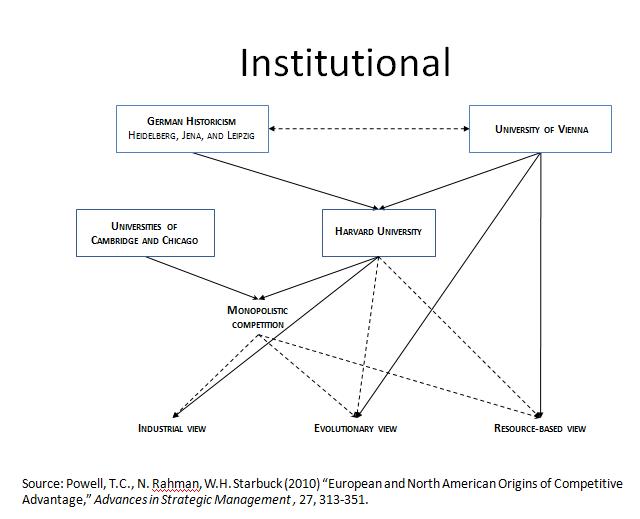

Now, two on the origins of network advantage theory: (more…)
ACAC 2011
| Peter Klein |
The Atlanta Competitive Advantage Conference, otherwise known as ACAC, starts tomorrow. I’m there, along with former O&M guest bloggers Joe Mahoney, Steve Postrel, and Russ Coff, and a whole bunch of interesting and important people in strategy, organization theory, entrepreneurship, innovation, HRM, and more. Check out the program, as well as the main site with information about past and future events. Besides the workshops and paper sessions there are special events like a symposium with Jay Barney on the RBV after 20 years and keynotes from Rebecca Henderson and Joel Baum. The only thing ACAC needs is a spokesperson — I think Gilbert Gottfried might be available.
The Prisoners’ Dilemma in Fiction
| Peter Klein |
From Walter Miller’s dystopian classic A Canticle for Liebowitz:
It was said that God, in order to test mankind which had become swelled with pride as in the time of Noah, had commanded the wise men of that age . . . to devise great engines of war such as had never before been upon the Earth, weapons of such might that they contained the very fires of Hell, and that God had suffered these magi to place the weapons in the hands of princes, and to say to each prince, “Only because the enemies have such a thing have we devised this for thee, in order that they may know that thou hast it also, and fear to strike. See to it, m’Lord, that thou fearest them as much as they shall now fear thee, that none may unleash this dread thing which we have wrought.”
But the princes, putting the words of their wise men to naught, thought each to himself, If I but strike quickly enough, and in secret, I shall destroy those others in their sleep, and there will be none to fight back; the earth shall be mine.
Such was the folly of princes, and there followed the Flame Deluge.
Entirely New Working Paper Approach
| Lasse Lien |
Here’s a new WP of mine (with T. Hillestad). Check out the sublimely boring title. We figure that the more boring we can make the title, the better what follows will appear. Earlier I have tended to do it the other way around, i.e. fancy title and intensely boring thereafter.
Recession, HR and Change
We document how the recession in the wake of the financial crisis created a general surge in pro-change attitudes and behavior. Next, we examine variation across firms with respect to this change boost. In particular we focus on how and why a firm’s use of HR-measures such as training, pay changes and layoffs matters. We find that training and layoffs increases the relative size of the effect, while pay cuts reduce it. We make sense of these findings by looking at managers’ choice among HR-measures as a signal used by employees to determine their employment risk. The level of employment risk is in turn linked to employees’ investments in change in a nonlinear, U-shaped fashion.
Mahoney Invested as Caterpillar Chair
| Peter Klein |
Congratulations to O&M friend and former guest blogger Joe Mahoney for his investiture as the Caterpillar Chair in Business at the University of Illinois at Urbana-Champaign. Here is the official announcement, which includes the following summary of Joe’s many accomplishments:
Joseph T. Mahoney is a professor of business administration at the University of Illinois who specializes in corporate governance and organizational economics. He is an editor for several top management journals, a prolific author, frequent advisor to Ph.D. candidates, and a professional consultant. For more than 20 years Mahoney has been an award winning teacher to undergraduates, MBAs and other graduate students. He holds a B.A. in Economics from the University of Pennsylvania, and M.S. and Ph.D. degrees in Business Economics from the Wharton School of Business.
Joseph Mahoney has published more than 50 scholarly articles in respected journals like the Academy of Management Review, Journal of Management, Journal of Management Studies, and Strategic Management Journal. His publications have been cited over 5,600 times by scholars in 65 countries. His book, Economic Foundations of Strategy has been adopted by over 30 top doctoral programs. Mahoney is an editor for the International Journal of Strategic Change Management and the Strategic Management Journal, and he contributes to 21 additional journals. Mahoney’s passionate teaching has garnered him many outstanding teacher awards since coming to Illinois in 1988. In that time he also served on 47 completed doctoral dissertation committees and currently serves on 8 others that are in progress.
You may recall that Joe is also this year’s recipient of the Academy of Management’s Irwin Award. Way to go, Joe!
CFP: Economics and Strategy of Entrepreneurship and Innovation
| Peter Klein |
Forwarded on behalf of Dan Spulber:
CALL FOR PAPERS
Journal of Economics & Management Strategy (JEMS)
Economics and Strategy of Entrepreneurship and Innovation IIIJEMS is planning a third special issue on the economics and strategy of entrepreneurship and innovation. JEMS welcomes both empirical and theoretical contributions.
Possible topics include:
- Economics of entrepreneurship
- Innovation and entrepreneurship
- R&D and the entrepreneur
- Intellectual property rights and the entrepreneur
- Entrepreneurship and the theory of the firm
- Entrepreneurship and finance
- Entrepreneurship and industrial organization
- Entrepreneurship and economic growth
Submissions to JEMS will be subject to the standard peer-review process. The submission deadline is July 1, 2011. To submit a manuscript to JEMS, visit ScholarOne at http://mc.manuscriptcentral.com/jems. If you have any questions about JEMS, please contact Susie Caruso at editjems@kellogg.northwestern.edu.





 Organizations and Markets
Recent Comments