Posts filed under ‘Strategic Management’
“Robert S. McNamara and the Evolution of Modern Management”
| Peter Klein |
That’s the title of a new HBR article by Phil Rosenzweig (author of the excellent Halo Effect). I’ve been interested in McNamara and his role in business history since grad school, when I was researching “management by the numbers” and similar techniques that flourished during the conglomerate boom in the 1960s. (See previous O&M posts on McNamara here and here.) Rosenzweig provides a nice summary of some of strengths and weaknesses of McNamara’s dispassionate, “rational,” quantitative approach (see especially the sidebar, “What the Whiz Kids Missed”). Lots of information and ideas related to decision theory, organizational design, multitasking, performance evaluation, innovation, etc. Excerpt:
Whether at Ford or in the military, in business or pursuing humanitarian objectives, McNamara’s guiding logic remained the same: What are the goals? What constraints do we face, whether in manpower or material resources? What’s the most efficient way to allocate resources to achieve our objectives? In filmmaker Errol Morris’s Academy Award–winning documentary The Fog of War, McNamara summarized his approach with two principles: “Maximize efficiency” and “Get the data.”
Yet McNamara’s great strength had a dark side, which was exposed when the American involvement in Vietnam escalated. The single-minded emphasis on rational analysis based on quantifiable data led to grave errors. The problem was, data that were hard to quantify tended to be overlooked, and there was no way to measure intangibles like motivation, hope, resentment, or courage. . . .
Equally serious was a failure to insist that data be impartial. Much of the data about Vietnam were flawed from the start. This was no factory floor of an automobile plant, where inventory was housed under a single roof and could be counted with precision. The Pentagon depended on sources whose information could not be verified and was in fact biased. Many officers in the South Vietnamese army reported what they thought the Americans wanted to hear, and the Americans in turn engaged in wishful thinking, providing analyses that were overly optimistic.
The Diversity of Strategic Management Research
| Peter Klein |
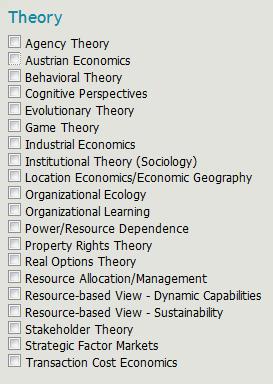
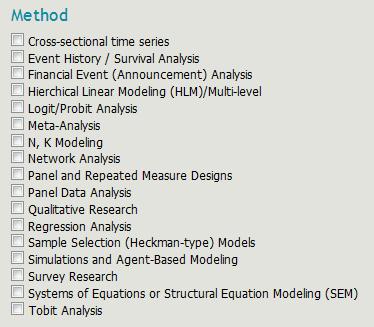
In my graduate class this morning we were discussing the diversity of theories and approaches in strategic management research when a useful illustration came to mind. I recently registered as a reviewer for the upcoming SMS conference and, as requested, indicated my areas of interest and expertise. The lists for “Theory” and “Method,” reproduced below, are instructive. I mean, can you imagine such lengthy lists for the AEA meeting or a conference in accounting or finance? (OK, perhaps still too short for some. . . .)
Entrepreneurial Ability as a Latent Variable
| Peter Klein |
It’s the weekend after Thanksgiving, so naturally I’m thinking about residuals — not leftover turkey and cranberry sauce, but entrepreneurial characteristics and behaviors as residuals, as latent variables that leave traces in outcomes that we can’t otherwise explain. I’ve argued before that common measures of entrepreneurship such as startups, self-employment, patents, venture funding, etc., while related to entrepreneurship, are epiphenomena, manifestations of an underlying, unobservable attribute or behavior such as judgment, alertness, innovation, or adaptation. (These are difficult, if not impossible, to measure directly; asking survey respondents, for instance, “How many opportunities did you identify this month?” is not quite the same thing as measuring Kirznerian alertness!) In a recent musing on strategic entrepreneurship I suggested that
many of the entrepreneurial capabilities we’re really interested in are latent, and best captured as residuals — e.g., something heritable and not explainable by other observables. . . . Mike Wright talked [at the CBS strategic entrepreneurship conference] about mobility, both across firms or projects (habitual entrepreneurs, spin-outs) and across countries (immigrant and returnee entrepreneurs, transnational entrepreneurs). From the perspective of research design, some of these movements may be useful for isolating the “entrepreneurial” essence, such as it is.
Seth Carnahan, Rajshree Agarwal, and Ben Campell have an interesting new paper, “The Effect of Firm Compensation Structures on the Mobility and Entrepreneurship of Extreme Performers,” that takes this kind of approach, measuring entrepreneurial ability as the residual in a wage regression. Most of the variation in wages can be explained by age, experience, race, gender, education, and other observables; what remains is partly measurement error, but can also include a latent ability parameter. Seth, Rajshree, and Ben use this parameter, along with the wage structure of an employee’s existing firm, to explain which employees tend to leave to join new firms, particularly startups. Check it out!
Prahalad Conference
| Peter Klein |
 My colleague Karen Schnatterly, along with Bob Hoskisson and M. B. Sarkar, are organizing a special SMS conference to honor the late C. K. Prahalad. It’s 10-12 June 2011 in San Diego. The conference “will bring together scholars, executives, and consultants who have researched or applied CK Prahalad’s ideas. There will also be a number of panel sessions that include individuals such as Gary Hamel, Yves Doz, and Stuart Hart.” Proposals are due 21 January 2011.
Counterintuitive Is Cool: The Case of Markups
| Lasse Lien |
Counterintuitive empirical findings are endlessly more fascinating than expected or obvious ones. One counterintuitive finding I have picked up since the onset of the financial crisis is that markups are on average counter-cyclical. To spell it out: markups go up in a recessions and they fall in a boom (on average). Maybe it’s just me, but if asked about this two years ago I would have bet that markups were bid down during recessions in all but extreme market structures.
Here is a cool new paper that deals with this and several other interesting aspects of the dynamics of business cycles:
We characterise endogenous market structures under Bertrand and Cournot competition in a DSGE model. Short-run mark ups vary countercyclically because of the impact of entry on competition. Long-run mark ups are decreasing in the discount factor and in productivity, and increasing in the exit rate and in the entry costs. Dynamic inefficiency can emerge due to excessive entry under Cournot competition. Positive temporary shocks attract entry, which strengthens competition so as to reduce the mark ups temporarily and increase real wages: this competition effect creates an intertemporal substitution effect which boosts consumption and employment. Endogenous market structures improve the ability of a flexible prices model in matching impulse response functions and second moments for US data.
Etro, F. and Colciago, A., “Endogenous Market Structures and the Business Cycle,” Economic Journal 120 (2010): 1201–33.
Interesting New Books
| Peter Klein |
In place of the “What I’ve Been Reading Lately” posts that show up regularly on certain blogs, I hereby offer something slightly less egocentric, the “What I’ve Been Receiving Lately” post. It contains a list of books I’ve recently received by mail, some by choice, others because publishers sent them (perhaps hoping I’d blog about them — Mission Accomplished!). Not the most scientific sample selection process, but there you go.
- Jesús Huerta de Soto, Socialism, Economic Calculation, and Entrepreneurship (Elgar, 2010). English translation of an important work first published in Spanish in 1992.
- Guinevere Liberty Nell, Rediscovering Fire: Basic Economic Lessons from the Soviet Experiment (Algora, 2010). What the failure of central planning teaches about markets and institutions.
- Koray Çaliskan, Market Threads: How Cotton Farmers and Traders Create a Global Commodity (Princeton, 2010). Economic sociology meets global commodity systems. Contains dust-jacket endorsements from Richard Swedberg and Donald MacKenzie, so expect a review from the orgtheory boys soon.
- Peter J. Boettke, ed., Handbook on Contemporary Austrian Economics (Elgar, 2010). Essays by young Austrian economists associated with George Mason University.
- Robert E. Wright, Fubarnomics: A Lighthearted, Serious Look at America’s Economic Ills (Prometheus, 2010). I think the title says it all.
- Ranjay Gulati, Reorganize for Resilience: Putting Customers at the Center of Your Business (Harvard Business School, 2010). Looks fluffy, but I have a teaching interest in change management so I’ll give it the benefit if the doubt.
- David Stark, The Sense of Dissonance: Accounts of Worth in Economic Life (Princeton, 2009). Also deals with organizational change, but in a more serious way. Ethnographic studies of three organizations dealing with large exogenous shocks. Looks interesting.
Random Thoughts on Strategic Entrepreneurship
| Peter Klein |
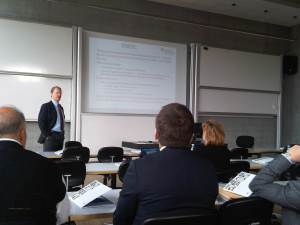
A few insights, interesting facts, provocative statements, and other things I managed to remember from the conference:
- As Nicolai mentioned in his post below, there is a lot of exciting work out there on the links between organizational design and characteristics (HRM practices, organizational culture, social learning processes, team characteristics, etc.) and entrepreneurial behavior. This is clearly a hot topic at the boundary of the strategic management, organizational behavior, entrepreneurship, and innovation literatures.
- This emerging literature is pretty eclectic, theoretically and empirically. The conference featured papers with formal models, conceptual theory papers, conventional econometric papers, simulation papers, and of course thought-provoking keynote addresses. The participants came from a variety of academic backgrounds and specialty areas.
- It’s a young field. The four keynote speakers (Mike Wright, Bill Schulze, Shaker Zahra, and Jeff Hornsby) are pioneers in the field, and not that old. (Shulze noted that he had been present “at the birth” of the modern entrepreneurship field, and he looks pretty spry and vigorous to me.)
- The empirical literature still struggles to operationalize entrepreneurship in a meaningful way. Despite various sermons about entrepreneurship being a generalized function, rather than a job description or firm type, most empirical papers use self-employment, management of particular kinds of firms, etc. as proxies. (I’m guilty of this myself, of course.) (more…)
The Emerging Strategic Entrepreneurship Field
| Nicolai Foss |
“Strategic entrepreneurship” has emerged as a field in the intersection of strategic management and entrepreneurship. It has its own specialized journal, Strategic Entrepreneurship Journal, now in its fifth year of existence. Some of the pioneers of strategic entrepreneurship characterize the field in the following manner:
Strategic entrepreneurship is the integration of entrepreneurial (i.e., opportunity-seeking actions) and strategic (i.e., advantage-seeking actions) perspectives to design and implement entrepreneurial strategies that create wealth. Thus, strategic entrepreneurship is entrepreneurial action that is taken with a strategic perspective” ( Hitt, Ireland, Camp & Sexton, 2002:2).
I am excited by this research stream and think that its attempt to identify the antecedents of new value creation in the context of established firms is entirely warranted (at least in management research, entrepreneurship has too often been associated solely with new firm formation). And yet, strategic entrepreneurship is clearly a field in search of a core and an identity.
It is not yet entirely clear whether the field amounts to more than relabelling existing “dynamic” strategic management ideas (e.g., dynamic capabilities, real options), ideas that have been around in entrepreneurship research for some time (e.g., entrepreneurial orientation), and ideas from innovation theory. It is also not clear what fundamental view of the firm is underlying this research. Given that extant entrepreneurship has had a strong emphasis on individuals, it is striking that individuals do not really seem to be present in strategic entrepreneurship research. It is not made clear, or even discussed, what role organization design (the design of organizational structure and control) plays for the discovery, evaluation and exploitation of opportunities.
The Center (soon Department) of Strategic Management and Globalization at the Copenhagen Business School has arranged a conference that is dedicated to furthering strategic entrepreneurship by “bringing organization design and micro-foundations into the field.” The conference begins tomorrow and features such luminaries as Shaker Zahra, Jeff Hornsby, Bill Schulze and Mike Wright — and O&M’s Peter Klein. More to come …
The Thin Mint Effect
| Peter Klein |
 A new study finds that as nonprofit organizations increase their for-profit activities, the share of resources going to the core mission decreases. (Thanks to Fast Company for the link and the Thin Mint reference.)
This strikes me as a good illustration of multitask principal-agent problems. The output of for-profit activities is more easily measured than the output of nonprofit activities, giving agents (under performance-based pay) the incentive to increase effort toward those for-profit activities. Mises’s discussion of performance measurement and delegation in Bureaucracy comes to mind as well.
Congratulations to J. C. Won
| Peter Klein |
Congratulations to University of Missouri PhD student Jong Chul Won for being one of three Don Lavoie Memorial Essay Competition Winners for 2010. His paper is “The Emergence, Limit, and Distortion of the Firm: The Entrepreneurship Approach.” The contest is sponsored by the Society for the Development of Austrian Economics. Details are below the fold.
Missouri student Per Bylund was a 2009 winner at the Austrian Student Scholars Conference for his paper “The Theory of the Firm: Coasean Misconceptions and Austrian Solutions.” If you’re interested in entrepreneurship and the theory of the firm, particularly from an Austrian perspective, the University of Missouri is the place to be! (more…)
The Legacy and Work of Douglass North
| Peter Klein |
Washington University, St. Louis is hosting a major international conference, 4-6 November, on the Legacy and Work of Douglass North. The all-star panel includes Lee Alston, Robert Bates, Joel Mokyr, Elinor Ostrom, Ken Shepsle, Barry Weingast, and many others. The conference is organized by Wash U’s Center for New Institutional Social Science.
In other conference news, the CFP for next year’s Atlanta Competitive Advantage Conference, 17-19 May 2011, has been posted. Featured presenters include Jay Barney, Joel Baum, and Rebecca Henderson.
The (Very) Early Adoption of Modern HRM Practices
| Peter Klein |
Bruce Kaufman’s book Hired Hands or Human Resources? Case Studies of HRM Programs and Practices in Early American Industry (Cornell U. P., 2010) shows that US firms started adopting “modern” HRM practices around World War I, not during the New Deal, and they did so primarily to increase productivity, not in response to union or government pressure. Writes reviewer Chad Pearson:
Kaufman illustrates the ways in which several companies created professional human resource management (HRM) models after World War I. This is the most valuable part of the book principally because he used the records of the Industrial Relations Councilors (IRC), a consulting firm that began assisting employers in the 1910s. The IRC offered consulting services, provided research, and ran courses on industrial relations topics throughout the nation. Kaufman, the first scholar to examine these records, believes that “no other [industrial relations consulting firm] before World War II had IRC’s reach and influence” (p. 108). . . .
In most cases, these firms, in consultation with the IRC, began to, in Kaufman’s words, treat labor not as “a short-term commodity,” as was common in previous decades, but rather as “a longer-term human capital asset (the ‘human resource’ approach)” (p. 219). Why? Pressure from unions and the law were factors, but “they were less than half the story in the time period we are examining” (p. 228). In his view, employers’ desires to improve “management and productivity” better explain why companies improved workplace conditions (p. 227).
Labor historians and specialists in business regulation used to focus on the Progressive Era as a watershed period — e.g., Wiebe (1962), Weinstein (1981), and of course Kolko (1977) — but interest seems to have waned.
Elgar Companion to TCE
 | Peter Klein |
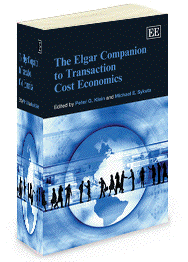
The Elgar Companion to Transaction Cost Economics, edited by Mike Sykuta and me, has just been published. Twenty-nine chapters cover the basic structure of TCE, its precursors and influences, fundamental concepts, applications and evidence, along with alternatives and critiques. Oliver Williamson was kind enough to contribute an introduction and overview. Co-blogger Foss is in there as well.
O&M readers can get it here 10 percent off the list price! (Actually, anybody can get the deal.) Mike beat me to the punch with an announcement and description, so I’ll just add that we’re really pleased with the final product and grateful to all the distinguished contributors and the production staff.
Here are previous O&M posts on transaction cost economics.
The Myth of the Razors-and-Blades Strategy
 | Peter Klein |
Not quite as exciting as the GM-Fisher contretemps, but in the same revisionist vein: Randy Picker’s new paper, “The Razors-and-Blades Myth(s).”
From 1904-1921, Gillette could have played razors-and-blades — low-price or free handles and expensive blades — but it did not do so. Gillette set a high price for its handle — high as measured by the price of competing razors and the prices of other contemporaneous goods — and fought to maintain those high prices during the life of the patents. For whatever it is worth, the firm understood to have invented razors-and-blades as a business strategy did not play that strategy at the point that it was best situated to do so.
Here’s a PPT version.
Well, as Bogey might have said to Bergman: “We’ll always have printer ink.”
RBV Primer
| Nicolai Foss |
With Nils Stieglitz I have written “Modern Resource-Based Theory(ies)” (creative title, eh?) for the Handbook on the Economics and Theory of the Firm (apparently, “economics” and “theory” are different things), edited by Michael Dietrich and Jackie Krafft (Edward Elgar, 2011). The paper is mainly an overview. However, we also argue that there are many indications that the different strands of the RBV are increasingly converging.
An Industry Study for the Beautiful People
| Peter Klein |
It’s Beauty Imagined: A History of the Global Beauty Industry by Geoffrey Jones (Oxford University Press, 2010). From the blurb:
This book provides the first authoritative history of the global beauty industry from its emergence in the nineteenth century to the present day, exploring how today’s global giants grew. It shows how successive generations of entrepreneurs built brands which shaped perceptions of beauty, and the business organizations needed to market them. They democratized access to beauty products, once the privilege of elites, but they also defined the gender and ethnic borders of beauty, and its association with a handful of cities, notably Paris and later New York. The result was a homogenization of beauty ideals throughout the world.
Sounds like a great study of entrepreneurship, industry dynamics, clustering and network effects, and the relationship between business and culture. Reviewer Ingrid Giertz-Mårtenson says it’s “one of the more fascinating stories in modern business history,” the journey of an industry once seen as “fickle, superficial, and feminine” to a “brand-driven global power house.” The book should make a beautiful addition to your collection!
The Corporate Hierarchy Dies, Again
| Peter Klein |
Ronald Coase described his 1937 paper on the firm as “much cited, but little used.” He was referring to the academic literature, but these days it seems to apply to the popular press as well. Almost every week brings a new article on the death of the corporate hierarchy: you know, firms only exist to deal with transaction costs, and the Internet has reduced them to almost zero, so who needs firms? This argument shows up again and again. But it’s wrong. Of course there are transaction costs between firms (search, bargaining, enforcement). But there are also transaction costs inside firms (agency and information costs, the Misesian calculation problem). The firm straddles these margins. Both sets of transaction costs matter, and both can be reduced through technological change. Coase was not as clear on this point as he could have been, but Williamson has been explaining it for decades, in terms of “comparative contracting costs.” You have to compare both sets of costs, not just look at one. Why is it so hard to see?
Saturday’s WSJ gives us the latest version of the bogus argument, this time from Alan Murray. Same old story: Internet, transaction costs, Tapscott and Williams, wikipedia, yada yada yada. “Mr. Coase received his Nobel Prize in 1991 — the very dawn of the Internet age. Since then, the ability of human beings on different continents and with vastly different skills and interests to work together and coordinate complex tasks has taken quantum leaps. Complicated enterprises, like maintaining Wikipedia or building a Linux operating system, now can be accomplished with little or no corporate management structure at all.” Yawn. “[T]he trends here are big and undeniable. Change is rapidly accelerating. Transaction costs are rapidly diminishing. And as a result, everything we learned in the last century about managing large corporations is in need of a serious rethink.” Zzzzzzzzzzzzzzz. Mr. Murray, please read The Victorian Internet three times fast and have a report on my desk first thing in the morning. “The new model will have to be more like the marketplace, and less like corporations of the past. It will need to be flexible, agile, able to quickly adjust to market developments, and ruthless in reallocating resources to new opportunities.” Right, no corporations of the past ever tried to do this.
Add to: Facebook | Digg | Del.icio.us | Stumbleupon | Reddit | Blinklist | Twitter | Technorati
O&M in Lund
| Peter Klein |
 Nicolai and I, along with Jay Barney and John Matthews, are headlining the 2010 Holger Crafoord Memorial Symposium on “Strategy and Entrepreneurship,” 7 September 2010 at the Lund School of Economics and Management. The symposium is free but registration is required; details at the link above. Lund is a lovely university town, a short train ride (via the Øresund Bridge) from Copenhagen and hence easy to reach. A good time will be had by all.
Add to: Facebook | Digg | Del.icio.us | Stumbleupon | Reddit | Blinklist | Twitter | Technorati
Lachmann on Capital Heterogeneity
| Peter Klein |
We have written often on the role of capital heterogeneity in an entrepreneurial theory of the firm. “We are living in a world of unexpected change,” wrote Ludwig Lachmann in 1956; “hence capital combinations . . . will be ever changing, will be dissolved and reformed. In this activity, we find the real function of the entrepreneur.” Of course, the concept of heterogeneous resources is fundamental to transaction cost and resource-based views of the firm. It is mostly ignored by mainstream economists, however — macroeconomists in particular, as evidenced by the Old School Keynesianism that drives bailout and stimulus policy.
Here is Richard Ebeling with a fine overview of Lachmann’s capital theory, in contrast to Keynes’s superficial treatment:
A crucial element in Lachmann’s view of capital . . . is that the relationships between and among capital goods are those of substitutes and complements.
The Keynesian fallacy, Lachmann implies, is that Keynes tended to view and consider the capital stock has a more or less homogeneous aggregate under which all capital goods might be considered as interchangeable substitutes. Thus, any increase in capital investment lowers the “marginal efficiency of capital” (Keynes’ term) of every other unit of capital, since every unit of capital is a substitute with all other capital. . . .
Thus, if monetary manipulation brings about an increase in money and credit, and a resulting distortion of the rates of interest, and if this generates a tendency for misguided capital and related investments, and as a consequences capital goods and various types of labor are drawn into particular sectors of the economy and “stages” of the time structure of production, then . . .
You know the rest. And the coda too:
Government interventions and “stimulus” gimmicks merely serve to delay the adjustments and further distort an already distorted market. It is an attempt to maintain capital and labor complementary production and investment structures that are unsustainable in many of the patterns generated during the boom phase of the business cycle.
Add to: Facebook | Digg | Del.icio.us | Stumbleupon | Reddit | Blinklist | Twitter | Technorati
Academy of Management Conference Open Thread
| Peter Klein |
 Much of the O&M extended family is heading home from Montréal, site of the Academy of Management Annual Meeting. I presented one paper, discussed several more, facilitated a research roundtable, and spoke at a doctoral student consortium. Then there are business meetings, editorial board pow-wows, and planning sessions. Plus the really important stuff: socializing, networking, exchanging gossip, and enjoying good food and drink. It was great to see so many O&M bloggers, former guest bloggers, regular and occasional commentators, lurkers, and secret admirers.
Several sessions dealt with pedagogy, data sharing, research collaboration, and other issues being transformed by the web/wiki/blog/tweet/Facebook revolution. There was even a session on academic blogging featuring some of our friends from That Other Site. Clearly the O&M community is on the cutting edge of organizational research, teaching, and policy.
What did you think of the conference? What were your favorite sessions, papers, discussions, and activities? What could be done to improve future conferences? (Believe it or not, many high-ranking AoM muckety-mucks are regular O&M readers, so now’s your chance to be heard!)
Add to: Facebook | Digg | Del.icio.us | Stumbleupon | Reddit | Blinklist | Twitter | Technorati





 Organizations and Markets
Recent Comments