Posts filed under ‘Strategic Management’
Does Knowledge Management Improve Performance?
| Peter Klein |
Yes, says Peter Cappelli:
The extensive literature on knowledge management spans several fields, but there are remarkably few studies that address the basic question as to whether knowledge management practices improve organizational performance. I examine that question using a national probability sample of establishments, clear measures of IT-driven knowledge management practices, and an experimental design that offers a unique approach for addressing concerns about endogeneity and omitted variables. The results indicate that the use of company intranets, data warehousing practices, performance support systems, and employee competency databases have significant and meaningful effects on a range of relevant business outcomes.
Cappelli relies on a national (US), establishment-level survey of knowledge-management practices to construct a panel in which (according to the practioner literature) none of the knowledge-management practices under consideration existed at the start of the sample period. Check it out.
Add to: Facebook | Digg | Del.icio.us | Stumbleupon | Reddit | Blinklist | Twitter | Technorati
Overconfidence
| Peter Klein |
 Busenitz and Barney (1997) famously argued that entrepreneurs (founders) are particularly susceptible to overconfidence and representativeness biases. Compared to professional managers, entrepreneurs systematically overestimate the probability that a new venture will succeed and tend to draw unwarranted generalizations about the future from small samples. Overconfidence is now one of the major themes in the contemporary entrepreneurship literature (Bernardo and Welch, 2001; Forbes, 2005; Koellinger, Minniti, and Schade, 2007).
A new NBER paper by Itzhak Ben-David, John Graham, and Campbell Harvey finds evidence for a particular kind of overconfidence, “miscalibration,” among corporate executives. Miscalibration occurs when the agent’s forecast probability distribution is too narrow, meaning that the likelihood of extremely positive or negative events is unrealistically discounted. The idea is that agents with miscalibrated expectations are overconfident, not in the success of their activities (what the authors label “optimism”), but in their ability to predict the success of their activities. Survey evidence from a sample of CFOs reveals a number of interesting regularities about the relationship between miscalibration and past financial performance, corporate investment, and other observables. Here’s the abstract:
Miscalibration is a form of overconfidence examined in both psychology and economics. Although it is often analyzed in lab experiments, there is scant evidence about the effects of miscalibration in practice. We test whether top corporate executives are miscalibrated, and study the determinants of their miscalibration. We study a unique panel of over 11,600 probability distributions provided by top financial executives and spanning nearly a decade of stock market expectations. Our results show that financial executives are severely miscalibrated: realized market returns are within the executives’ 80% confidence intervals only 33% of the time. We show that miscalibration improves following poor market performance periods because forecasters extrapolate past returns when forming their lower forecast bound (“worst case scenario”), while they do not update the upper bound (“best case scenario”) as much. Finally, we link stock market miscalibration to miscalibration about own-firm project forecasts and increased corporate investment.
I’m not aware of any entrepreneurship studies that distinguish miscalibration from optimism, in the sense those terms are used here. Am I missing something?
Add to: Facebook | Digg | Del.icio.us | Stumbleupon | Reddit | Blinklist | Twitter | Technorati>
Performance Evaluation Links
| Peter Klein |
Performance evaluation is a favorite topic here at O&M; readers may enjoy these miscellaneous items on measurement:
- “Is Impact Measurement a Dead End?” by Alanna Shaikh, guest blogging at AidWatch.
- Moneyball’s Michael Lewis on basketball player statistics (HT: PB).
- The Urban Institute’s Outcome Indicators Project for nonprofits.
- Relevant Demotivators: Flattery, Ineptitude, and Mediocrity.

Add to: Facebook | Digg | Del.icio.us | Stumbleupon | Reddit | Blinklist | Twitter | Technorati
The Organizational Economics of the BP Oil Spill
 | Peter Klein |
Now that passions are cooling regarding the BP disaster, it’s time to bring organizational issues into the discussion.
1. Everyone knows about the liability caps and the role they may have played in encouraging moral hazard. Just as bank deposits are guaranteed by government deposit insurance, and large banks themselves are probably Too Big to Fail, liability for property damage from oil spills off US waters is limited to $75 million (plus cleanup costs), based on a 1990 law passed after the Exxon Valdiz spill. This presumably mitigates drillers’ incentives to manage environmental risk. Indeed, oil companies enjoy a very cozy relationship with their ostensible guardians; as the NY Times noted, “[d]ecades of law and custom have joined government and the oil industry in the pursuit of petroleum and profit.” The federal agency that oversees drilling, the Minerals Management Service, rakes $13 billion a year in fees in what amounts to a public-private partnership. And does anyone really think the British government would “stand idly by” if BP’s status as an ongoing concern were threatened by criminal or civil penalties?
2. As Bill Shughart points out, BP did not own the Deepwater Horizon platform, but leased it from a company called Transocean. To Bill this suggests “a classic principal-agent problem in which the duties and responsibilities of lessor and lessee undoubtedly were not spelled out fully, especially with respect to maintenance and testing of the rig’s blowout preventer as well as to the advisability of installing a second ‘blind sheer ram,’ which may have been able to plug the well after the first (and only one then in service) failed to do so.” Would BP have paid more attention to safety if it owned, rather than leased, the platform? (more…)
Miscellaneous Organizational Links
| Peter Klein |
- The much-anticipated KKR IPO turned out to be a snoozer. But what the heck is a publicly traded private-equity firm anyway?
- Is the flattening hierarchy an illusion, driven by job-title inflation?
- How call centers use behavioral economics.
- Belén Villalonga’s new paper on ownership concentration and internal-capital-market efficiency — highly recommended.
Add to: Facebook | Digg | Del.icio.us | Stumbleupon | Reddit | Blinklist | Twitter | Technorati
SMS India Workshop on Strategic Entrepreneurship
| Peter Klein |
 In 2008 C. K. Prahalad, along with Charles Dhanaraj and O&M friend M. B. Sarkar, established the SMS India Research Initiative. The next event is a paper development workshop on strategic entrepreneurship, 10-12 December 2010 in Bangalore, aimed at “Western scholars interested in research on emerging markets, and aspiring scholars primarily in Indian business schools.” See the link above for the CFP and the list of senior scholar-participants including Dean Shepherd, Candy Brush, Saras Sarasvathy, Harry Sapienza, Jay Barney, Will Mitchell, Zoltan Acs, Mike Hitt, and many more.
Add to: Facebook | Digg | Del.icio.us | Stumbleupon | Reddit | Blinklist | Twitter | Technorati
SMS Competitive Strategy Junior Faculty and Paper Development Workshop
| Peter Klein |
Forwarded for Don Hatfield:
Call for Participants
Competitive Strategy Junior Faculty and Paper Development Workshop
Saturday, September 11, 2010
1:00 p.m.-6:00 p.m.Submission deadline: July 15, 2010
The Competitive Strategy Interest Group is offering a research focused junior faculty and paper development workshop at the 2010 Strategic Management Society meetings in Rome, Italy. Although all members of the Competitive Strategy IG are invited to participate, preference will be given to junior faculty who defended their dissertations after September 2005.
This workshop will include panel discussions and breakout sessions. Senior faculty panels will discuss critical aspects of the research and publication process, ways to craft a successful research program and future directions in competitive strategy research. A breakout session will provide opportunities for participants to discuss and receive feedback on their work in an informal setting. (more…)
Study this Summer with Klein
 | Peter Klein |
I’m participating in a distance-learning experiment this summer — no, not Bootsy Collins’s Funk University, but the Mises Academy, a new Mises Institute service offering short, non-degree courses to university students, management professionals, and the general public. Everything’s online — lectures, readings, discussions, assignments. I’m teaching “Entrepreneurship in the Capitalist Economy,” a course based on my favorite book (as Mankiw would put it). The course runs for 9 weeks from 7 June to 7 August and costs a mere $255 — that’s less than one or two of Nicolai’s books!
The course is pitched at the undergraduate/MBA level, with no formal prerequisites except intellectual curiosity, a good work ethic, and a sense of humor. Perhaps I’ll offer special extra-credit assignments for O&M readers. . . .
Drop me a line if you have any questions. I’d love to have you join me on this journey!
Add to: Facebook | Digg | Del.icio.us | Stumbleupon | Reddit | Blinklist | Twitter | Technorati
The Role of Assumptions in Management Research
| Nicolai Foss |
A striking difference between economics and (most) management research is that while economists are obsessed with the role of assumptions in theorizing, management scholars as a rule don’t seem to spend much time on assumptions, at best tucking them away under “boundary conditions,” and, in general, having rather little patience with “assumptions discussions.” In particular, the eyes of management scholars of the more descriptive (“phenomenological”) stripe glaze over from boredom or inattention when the issue is raised.
Major economists (Samuelson and Friedman come immediately to mind) have written famous methodological papers on assumptions. A significant portion of what passes as “economic methodology” is taken up with the nature and status of assumptions. Prominent philosophers have written on the role of assumptions in economics (e.g., Alan Musgrave, Daniel Hausman). However, I know of not a single paper in management research dedicated to the issue. (more…)
Does Behavioral Economics Offer Anything New and True?
| Peter Klein |
One of my frustrations with behavioral economics is that it often seems to restate common, obvious, well-known ideas as if they are really novel insights (e.g., that preferences aren’t stable and predictable over time). More novel propositions are questionable at best (e.g, the paradox of choice).
Dan Ariely’s column in this month’s HBR is particularly frustrating. He claims as a unique insight of behavioral economics that when people are evaluated according to quantitative measures of performance, they tend to focus on the measures, not the underlying behavior being measured. Well, duh. This is pretty much a staple of introductory lectures on agency theory (and features prominently in Steve Kerr’s classic 1975 article). Ariely goes on to suggest that CEOs should be rewarded not on the basis of a single measure of performance, but multiple measures. Double-duh. Holmström (1979) called this the “informativeness principle” and it’s in all the standard textbooks on contract design and compensation structure (e.g., Milgrom and Roberts, Brickley et al., etc.) (Of course, agency theory also recognizes that gathering information is costly, and that additional metrics are valuable, on the margin, only if the benefits exceed the costs, a point unmentioned by Ariely.)
Ariely says firms should not evaluate CEO’s on stock price, but on a variety of measures. What, for example? Here the story gets a bit murky:
Ideally, they’d vary by industry, situation, and mission, but here are a few obvious choices: How many new jobs have been created at your firm? How strong is your pipeline of new patents? How satisfied are your customers? Your employees? What’s the level of trust in your company and brand? How much carbon dioxide do you emit?
Ariely seems unaware that stock price is the most frequently used measure of firm performance precisely because it is a composite measure that captures all of those things. Stock price reflects the best available information about current and expected future performance — products, jobs, customer satisfaction, etc. Is it a perfect measure? Hardly. But it isn’t obvious how owners or Boards can create their own quantitative, composite measure by by picking their favorite elements, proxies, weighting schemes, and so on, in a way that provides better overall assessments of performance than market valuations. Boards, after all, may be predictably irrational too.
Add to: Facebook | Digg | Del.icio.us | Stumbleupon | Reddit | Blinklist | Twitter | Technorati
Strategic Entrepreneurship Conference at CBS
| Nicolai Foss |
As many O&M readers will know, “strategic entrepreneurship” has emerged as an exciting new research field in the intersection of, well, strategic management and entrepreneurship. In a very broad (perhaps too broad) reading, the field is taken up with explaining the emergence of essentially entrepreneurial acts of those competitive advantages that are so central to the strategic management field. In recognition of the very close links between the strategic entrepreneurship field and the strategic management field, the Strategic Entrepreneurship Journal was established in 2007 as a sister journal to the Strategic Management Journal.
However, like many other macro management fields, strategic entrepreneurship pays rather little attention to the micro-foundations of the explanation of its macro explanandum, firm-level entrepreneurship. Moreover, the influence of formal structure and organizational control on the discovery, evaluation and implementation of opportunities at the firm level has been remarkably under-researched.
To meet these challenges, I have arranged, assisted by my two highly able PhD students, Stefan Linder and Jacob Lyngsie, a conference, “Strategic Entrepreneurship: Bringing Organization Design and Micro-foundations Into the Field,” to take place at the Copenhagen Business School, 11-12 November 11-12 2010. Keynote speakers include such luminaries as Jeff Hornsby, Bill Schulze, Mike Wright and Shaker Zahra. Peter Klein fans will be pleased to be informed that it is quite likely that he will participate!
Here is the — still quite preliminary — conference site. Submit a paper!
Add to: Facebook | Digg | Del.icio.us | Stumbleupon | Reddit | Blinklist | Twitter | Technorati
Intro to The Capitalist and the Entrepreneur
| Peter Klein |
Here’s a nicely formatted HTML version of the introduction to The Capitalist and the Entrepreneur. I’d apologize for the self-promotion but, well, isn’t that the whole point of blogging?
(PS: Those of you who like to run your transactions through Amazon can get the book here. Not sure about a Kindle edition but I’m told an epub version will be available soon.)
Add to: Facebook | Digg | Del.icio.us | Stumbleupon | Reddit | Blinklist | Twitter | Technorati
Scribd Version of Book
| Peter Klein |
I just learned I can embed the full document right here in a blog entry. Very cool!
Add to: Facebook | Digg | Del.icio.us | Stumbleupon | Reddit | Blinklist | Twitter | Technorati
The Capitalist and The Entrepreneur: Available Now!
| Peter Klein |
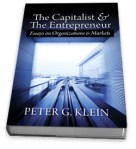 My new book, The Capitalist and the Entrepreneur: Essays on Organizations and Markets (Mises Institute, 2010), is now available. For a limited time, you can get it for just $15 — a bargain at half the price! Actually, the resource-constrained among you can read the Full Monty here, free of charge. A PDF version is also available. A promotional essay appears today on Mises.org.
The editorial and production staff did a terrific job, and I’m thrilled with the volume’s look and feel. The contents aren’t bad either!
Order two or more and I will personally send you a set of Ginsu knives.
Add to: Facebook | Digg | Del.icio.us | Stumbleupon | Reddit | Blinklist | Twitter | Technorati
Personnel Economics Survey
| Peter Klein |
Paul Oyer and Scott Schaefer provide a helpful overview:
Personnel Economics: Hiring and Incentives
Paul Oyer, Scott Schaefer
NBER Working Paper No. 15977We survey the Personnel Economics literature, focusing on how firms establish, maintain, and end employment relationships and on how firms provide incentives to employees. This literature has been very successful in generating models and empirical work about incentive systems. Some of the unanswered questions in this area — for example, the empirical relevance of the risk/incentive tradeoff and the question of whether CEO pay arrangements reflect competitive markets and efficient contracting — are likely to be very difficult to answer due to measurement problems. The literature has been less successful at explaining how firms can find the right employees in the first place. Economists understand the broad economic forces — matching with costly search and bilateral asymmetric information — that firms face in trying to hire. But the main models in this area treat firms as simple black-box production functions. Less work has been done to understand how different firms approach the hiring problem, what determines the firm-level heterogeneity in hiring strategies, and whether these patterns conform to theory. We survey some literature in this area and suggest areas for further research.
Add to: Facebook | Digg | Del.icio.us | Stumbleupon | Reddit | Blinklist | Twitter | Technorati
Transaction Costs and the Virtual Personal Assistant
| Peter Klein |
You can outsource grading, paralegal work, and other services, so why not personal assistance? Some credit cards now feature a concierge service that acts like a crowdsourced, virtual, personal assistant. By exploiting scale economies (a network of specialist assistants that can respond quickly and cheaply to specific client requests) and reducing excess capacity, such ser vices offer dramatically lowered production costs, compared to the conventional model of one dedicated assistant per client (or small group of clients). But the lack of bilateral commitment may make it difficult to encourage relationship-specific investments, so the transaction-cost effects are ambiguous. (Thanks to Chihmao for the pointer.)
If you want to discuss this further, have your people contact my people.
Add to: Facebook | Digg | Del.icio.us | Stumbleupon | Reddit | Blinklist | Twitter | Technorati
Readings for Hayek-Klein Day
| Peter Klein |
Here are some readings to help you celebrate tomorrow’s Hayek-Klein Day:

- Klein’s Biography of Hayek
- Hayek and Entrepreneurship
- Austrian Economics and Strategic Management
- The Use of Knowledge in Firms
- Austrian Economics and the Transaction Cost Approach
- Rothbard and Hayek
- Hayek versus Hayek
Add to: Facebook | Digg | Del.icio.us | Stumbleupon | Reddit | Blinklist | Twitter | Technorati
ICC Special Issue on Alfred Chandler
| Dick Langlois |
The most recent number of Industrial and Corporate Change is a special issue: Management Innovation-Essays in the Spirit of Alfred D. Chandler, Jr. Guest editors are Bill Lazonick and David Teece. Some interesting articles and definitely many interesting contributors. Yours truly was not involved — indeed, I didn’t learn about it until the table of contents appeared in my inbox. But I am cited in at least four of the papers. Indeed, the paper by Susan Helper and Mari Sako, both of whom I admire greatly, spends considerable time comparing my argument with Chandler’s. For the most part, I don’t disagree with their assessment except in respect of spin (more on which in a moment); but at one point they make an assertion that had me scratching my head.
Some argue that as a central tendency, the buffering and coordination functions of management are devolving to the mechanisms of modularity and the market — informational decomposition, flexibility, and risk spreading (Langlois, 2003: 377). In contrast, in Chandler’s world, “Increased specialization must, almost by definition, call for more carefully planned coordination if the volume of output demanded by the mass market is to be achieved” (Chandler, 1977: 490). The disagreement lies in different assumptions made. Langlois assumes that thickness of the market is exogenously given or that it is already established, while Chandler assumes that the mass market is something that has to be developed. Chandler’s view seems more correct here. (Helper and Sako 2010, p. 420)
Hello? One can argue that I have spent most of my career making precisely the point they attribute to Chandler: it’s the basis of the theory of dynamic transaction costs. Neither markets nor firms snap into existence but evolve slowly and — as I often quote Brian Loasby as pointing out — both require managerial coordination. (more…)
C. K. Prahalad (1941-2010)
| Peter Klein |
C. K. Prahalad died Friday at the age of 68. He’s best known for his “guru” work with Gary Hamel, but had turned his attention more recently to economic development , particularly the “bottom-of-the-pyramid” approach to poverty reduction. Here are thoughts and reminiscences from the WSJ, HBR, Ross Emmett, and the Ross School. HBR has already set up a Prahalad page. Here are previous O&M mentions. I last saw him at the 2009 SMS conference in Washington, D.C. where he spoke with Yves Doz on “The Future of Strategy.”
Add to: Facebook | Digg | Del.icio.us | Stumbleupon | Reddit | Blinklist | Twitter | Technorati
Miscellaneous Conference and Paper Links
| Peter Klein |
SSRN has a new Philosophy and Methodology of Economics working-paper series, sponsored by the International Network for Economic Method.
Here’s a CFP for a Special Issue of the E-conomics e-Journal on the Social Returns to Higher Education, R&D and Innovation.
You can watch a live stream of this weekend’s SEJ Special Issue Conference on Knowledge Spillovers & Strategic Entrepreneurship.
The registration and accommodations section of the ISNIE 2010 website is now open.
Add to: Facebook | Digg | Del.icio.us | Stumbleupon | Reddit | Blinklist | Twitter | Technorati





 Organizations and Markets
Recent Comments