Posts filed under ‘Teaching’
My Proudest Academic Achievement
| Peter Klein |
I’ve produced so many seminal papers in my long and distinguished career that I can’t name them all. Um, I can’t name any, actually. But here’s one for the ages: “‘They Have the Internet on Computers Now?’ Entrepreneurship and Economics in the Simpsons.” It’s coauthored with talented Missouri PhD students Per L. Bylund and Christopher H. Holbrook and is forthcoming in Joshua Hall, ed., Homer Economicus: The Simpsons and Economics (Springer, 2011), which should be on every economics and management teacher’s bookshelf.
Prahalad Conference
| Peter Klein |
 My colleague Karen Schnatterly, along with Bob Hoskisson and M. B. Sarkar, are organizing a special SMS conference to honor the late C. K. Prahalad. It’s 10-12 June 2011 in San Diego. The conference “will bring together scholars, executives, and consultants who have researched or applied CK Prahalad’s ideas. There will also be a number of panel sessions that include individuals such as Gary Hamel, Yves Doz, and Stuart Hart.” Proposals are due 21 January 2011.
Interesting New Books
| Peter Klein |
In place of the “What I’ve Been Reading Lately” posts that show up regularly on certain blogs, I hereby offer something slightly less egocentric, the “What I’ve Been Receiving Lately” post. It contains a list of books I’ve recently received by mail, some by choice, others because publishers sent them (perhaps hoping I’d blog about them — Mission Accomplished!). Not the most scientific sample selection process, but there you go.
- Jesús Huerta de Soto, Socialism, Economic Calculation, and Entrepreneurship (Elgar, 2010). English translation of an important work first published in Spanish in 1992.
- Guinevere Liberty Nell, Rediscovering Fire: Basic Economic Lessons from the Soviet Experiment (Algora, 2010). What the failure of central planning teaches about markets and institutions.
- Koray Çaliskan, Market Threads: How Cotton Farmers and Traders Create a Global Commodity (Princeton, 2010). Economic sociology meets global commodity systems. Contains dust-jacket endorsements from Richard Swedberg and Donald MacKenzie, so expect a review from the orgtheory boys soon.
- Peter J. Boettke, ed., Handbook on Contemporary Austrian Economics (Elgar, 2010). Essays by young Austrian economists associated with George Mason University.
- Robert E. Wright, Fubarnomics: A Lighthearted, Serious Look at America’s Economic Ills (Prometheus, 2010). I think the title says it all.
- Ranjay Gulati, Reorganize for Resilience: Putting Customers at the Center of Your Business (Harvard Business School, 2010). Looks fluffy, but I have a teaching interest in change management so I’ll give it the benefit if the doubt.
- David Stark, The Sense of Dissonance: Accounts of Worth in Economic Life (Princeton, 2009). Also deals with organizational change, but in a more serious way. Ethnographic studies of three organizations dealing with large exogenous shocks. Looks interesting.
Teaching Analytical Writing
| Peter Klein |
More on academic writing: This paper by Wayne Schiess, “Legal Writing Is Not What It Should Be,” deals specifically with law students, but applies in many ways to academic writing more generally. Quoting from the introduction:
The writing required of students in high school and college is often what I call “self-expression writing” rather than expository writing. Self-expression writing tends to be writer-focused, not reader-focused.That is, self-expression writers focus primarily on expressing their own ideas. This is surely a necessary developmental step for improving writing skill, but it is two steps removed from the skill of analytical legal writing. Once high school and college writers move beyond self-expression, they usually produce writing that can be called “knowledge-telling” or conveying information.
But legal writing is not self-expression, and it is another step beyond knowledge telling. One author has referred to the skill of analytical legal writing as “knowledge transforming.” Thus, legal writing is a form of expository writing in which the focus should be on the reader‟s ability to understand. This is in contrast to self-expression writing, where clearly and effectively conveying information to the reader is secondary to expressing one’s self the way one desires. And it is in contrast to knowledge-telling, in which the primary purpose is conveying information, not analyzing a problem.
Of course, self-expression and knowledge-telling are necessary steps, as I’ve acknowledged. But I can report, based on anecdotal evidence, that some students get little training even in these two developmental steps. Some college curricula do not require much writing at all. For example, in my teaching of the required, first-year legal writing course, I often have students who studied science or engineering in college. Many of these students arrive at law school and tell me they have never written a paper in college.
The kind of writing required for good social science is also what Schiess calls “analytical writing,” and my sense is that few graduate students have any experience with or training in this kind of writing. How to teach it is another question. Schiess has several suggestions that are specific to law schools; how can they be applied to economics or sociology or business administration?
The Five Stages of Grading
| Peter Klein |
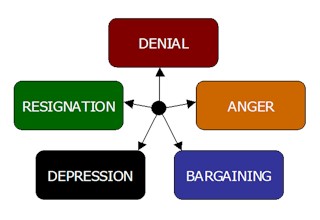
A nice complement to Daniel Solove’s classic guide to grading: “The Five Stages of Grading” at notthatkindofdoctor.com (via David Croson). “Everyone is familiar with Elisabeth Kübler-Ross and her stage model of coping with grief popularly known as the five stages of grief. What you may not know is that Kübler-Ross actually developed her theory as a graduate student, basing her conception of the process of loss on the experiences one goes through over a grading weekend.”
Get Ready for the Slow-Conversation Movement
| Peter Klein |
Conversations today are constantly hijacked by digital fact-checkers. Every fact or statement, it seems, must be checked or augmented in real time with at-our-fingertips online information. We no longer trust each other to come up with good-enough facts or allow each other add colorful embellishment to our stories. Let me give a recent example to make my point. Over lunch the other day, I shared a story with my colleagues — the surreal experience of being accidently given a presidential suite at a Four Seasons Hotel. “This was an amazing room, probably 3000+ square feet with over-the-top appointments everywhere,” I said. No more than two minutes after making the statement, an associate checked on his BlackBerry the size of the presidential suite, correcting me that it was closer to 2000 square feet.
What happened to natural conversations, those based on what is already in our heads, unburdened by verfication? As the fast food movement has seen an opposing slow food movement take hold and shape, I predict we’ll soon see a similar desire for putting down for a moment all the “information enhancements” that come with mobile, digital-sparring tools.
That’s Anthony Tjan blogging at HBR. As someone who reads a lot of student papers — not to mention newspapers, magazines, and blogs — I tend to favor more fact checking, not less. But I see the point.
This is relevant for teaching and public speaking as well. I don’t record my classes, but I suspect that day is not far off (and some of my public talks are already preserved, for better or worse). Will professors be more rigid, overly cautious, less spontaneous, less natural, knowing that everything they say is ripe for verification, by current or future students (or administrators)? What is the appropriate balance between monitoring and governance and classroom spontaneity, ad hocery, and silliness?
More Academic Advice
| Peter Klein |
 Inspired (in some cases, subconsciously) by our post on “How to Read an Academic Article,” several professors have written follow-up or companion pieces offering advice to students and new faculty:
- “How to Review a Literature” by Gabriel Rossman (nice blog template BTW)
- “Writing ‘One Pagers'” by Anthony Evans
- “How to Write Less Badly” by Mike Munger (via Pete Boettke)
- “How to Be Awesome” by Fabio Rojas
Of course there are the classics like Ezra Zuckerman’s “Tips to Article Writers,” Eric Rasmusen’s “Aphorisms on Writing, Speaking, and Listening,” Simon Jones’s “How to Write a Good Research Paper and Give a Good Research Talk,” Kwan Choi’s “How to Publish in Top Journals,” Dan Hamermesh’s “The Young Economist’s Guide to Professional Etiquette,” Richard Hamming’s “You and Your Research,” and George Ladd’s “Artistic Research Tools for Scientific Minds.”
Chris Coyne’s Austrian Course
| Peter Klein |
Earlier I shared the reading list for my graduate course in the Austrian school of economics. Chris Coyne is teaching a similar class and has posted his syllabus here. Chris’s course is laid out differently than mine, with a different mix among types of readings, but I like what he’s done. As Pete Boettke and Joe Salerno have noted, the diversity and variety of course offerings and educational programs in Austrian economics is a sign of the health and vitality of the school.
How to Read an Academic Article
| Peter Klein |
This fall I’m teaching “Economics of Institutions and Organizations” to first-year graduate students. The reading list is rather heavy, compared to what most students are used to from their undergraduate courses and their first-year courses in microeconomics, econometrics, etc. I explain that they need to become not only avid readers, but also efficient readers, able to extract the maximum information from an academic article with the least effort. They need to learn, in other words, the art of the skim.
When I’ve explained this in the past, students have responded that they don’t know how to skim. So a couple years back I put together a little handout, “How to Read an Academic Article,” with a few tips and tricks. I emphasize that I don’t mean to be patronizing, and that they should ignore the handout if its contents seem painfully obvious. But students have told me they really appreciate having this information. So, I reproduce the handout below. Any comments and suggestions for improvement?
How to Read an Academic Article
- Caveat: no single style works for everyone!
- Klein’s basic steps for skimming, scanning, processing…
- Read the abstract (if provided)
- Read the introduction.
- Read the conclusion.
- Skim the middle, looking at section titles, tables, figures, etc.—try to get a feel for the style and flow of the article.
- Is it methodological, conceptual, theoretical (verbal or mathematical), empirical, or something else?
- Is it primarily a survey, a novel theoretical contribution, an empirical application of an existing theory or technique, a critique, or something else?
- Go back and read the whole thing quickly, skipping equations, most figures and tables.
- Go back and read the whole thing carefully, focusing on the sections or areas that seem most important.
- Once you’ve grasped the basic argument the author is trying to make, critique it!
- Ask if the argument makes sense. Is it internally consistent? Well supported by argument or evidence? (This skill takes some experience to develop!)
- Compare the article to others you’ve read on the same or a closely related subject. (If this is the first paper you’ve read in a particular subject area, find some more and skim them. Introductions and conclusions are key.) Compare and contrast. Are the arguments consistent, contradictory, orthogonal?
- Use Google Scholar, the Social Sciences Citation Index, publisher web pages, and other resources to find articles that cite the article you’re reading. See what they say about it. See if it’s mentioned on blogs, groups, etc.
- Check out a reference work, e.g. a survey article from the Journal of Economic Literature, a Handbook or Encyclopedia article, or a similar source, to see how this article fits in the broader context of its subject area.
An Industry Study for the Beautiful People
| Peter Klein |
It’s Beauty Imagined: A History of the Global Beauty Industry by Geoffrey Jones (Oxford University Press, 2010). From the blurb:
This book provides the first authoritative history of the global beauty industry from its emergence in the nineteenth century to the present day, exploring how today’s global giants grew. It shows how successive generations of entrepreneurs built brands which shaped perceptions of beauty, and the business organizations needed to market them. They democratized access to beauty products, once the privilege of elites, but they also defined the gender and ethnic borders of beauty, and its association with a handful of cities, notably Paris and later New York. The result was a homogenization of beauty ideals throughout the world.
Sounds like a great study of entrepreneurship, industry dynamics, clustering and network effects, and the relationship between business and culture. Reviewer Ingrid Giertz-Mårtenson says it’s “one of the more fascinating stories in modern business history,” the journey of an industry once seen as “fickle, superficial, and feminine” to a “brand-driven global power house.” The book should make a beautiful addition to your collection!
Austrian Economics PhD Course
| Peter Klein |
This semester I am teaching a PhD course in the Austrian school of economics. Here’s a preview. Visitors to Columbia, Missouri are welcome to sit in!
Excerpt from the syllabus:
It is difficult to cover an entire school of thought in one semester. Austrian economics, after all, is not an applied field like development economics or international trade policy or biotechnology but an alternative approach to all fields of economics. The course objective is not to provide a comprehensive review and critique of the entire Austrian tradition, but to give students a sampler of high-quality Austrian writings, classic and modern, on a variety of issues and topics. One goal is to show that while Austrian economists share a common conceptual framework, theoretical core, and historical context, the Austrian literature contains tremendous variety, both stylistic and substantive. Like any living, breathing tradition the Austrian literature continues to expand and diversify, often at a dizzying pace.
Add to: Facebook | Digg | Del.icio.us | Stumbleupon | Reddit | Blinklist | Twitter | Technorati
Students: Do It for the Panda
| Peter Klein |
Words — and pictures — of wisdom for the new academic year:
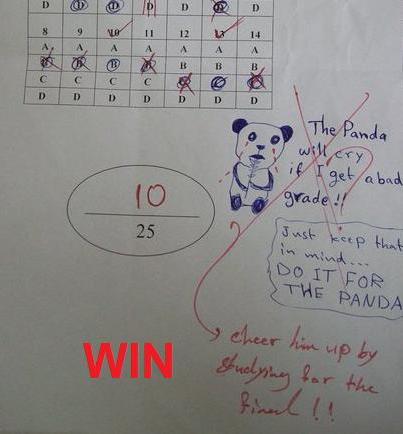
An epic win, courtesy of FAIL Blog.
Add to: Facebook | Digg | Del.icio.us | Stumbleupon | Reddit | Blinklist | Twitter | Technorati
Academy of Management Conference Open Thread
| Peter Klein |
 Much of the O&M extended family is heading home from Montréal, site of the Academy of Management Annual Meeting. I presented one paper, discussed several more, facilitated a research roundtable, and spoke at a doctoral student consortium. Then there are business meetings, editorial board pow-wows, and planning sessions. Plus the really important stuff: socializing, networking, exchanging gossip, and enjoying good food and drink. It was great to see so many O&M bloggers, former guest bloggers, regular and occasional commentators, lurkers, and secret admirers.
Several sessions dealt with pedagogy, data sharing, research collaboration, and other issues being transformed by the web/wiki/blog/tweet/Facebook revolution. There was even a session on academic blogging featuring some of our friends from That Other Site. Clearly the O&M community is on the cutting edge of organizational research, teaching, and policy.
What did you think of the conference? What were your favorite sessions, papers, discussions, and activities? What could be done to improve future conferences? (Believe it or not, many high-ranking AoM muckety-mucks are regular O&M readers, so now’s your chance to be heard!)
Add to: Facebook | Digg | Del.icio.us | Stumbleupon | Reddit | Blinklist | Twitter | Technorati
Hayek Interviews
| Peter Klein |
 In 1983 the Earhart Foundation sponsored a lengthy set of interviews with F. A. Hayek in Los Angeles. The transcripts have long been available (and form the basis of the interview parts of Hayek on Hayek), but the complete set of videos has just now been put online, courtesy of the Universidad Francisco Marroquín. The interviewers are an impressive lot as well: James Buchanan, Armen Alchian, Axel Leijonhufvud, Robert Bork, Tom Hazlett, Jack High, Bob Chitester, Leo Rosten, and Earlene Craver. (I hardly recognized the youthful Hazlett!) You can also get the transcripts, if you prefer plain text.
Add to: Facebook | Digg | Del.icio.us | Stumbleupon | Reddit | Blinklist | Twitter | Technorati
Duke LLM in Law and Entrepreneurship
| Peter Klein |
We mentioned before Vanderbilt’s PhD program in law and economics and Arizona’s program in law and entrepreneurship. Now Duke Law School is offering an LLM degree in law and entrepreneurship. “Open to an inaugural class of about 20 JD graduates, the curriculum will blend rigorous academic study relating to the legal, business, institutional, strategic, and public-policy frameworks and considerations that apply to entrepreneurs and innovation, with practice and research opportunities that allow each student to develop skills in representing clients.” Obviously, this is a program for lawyers, not for entrepreneurship scholars or management practitioners, but there may be lessons here for business schools and other academic units seeking to offer interdisciplinary programs in entrepreneurship studies. I particularly appreciate the Duke program’s broad, functional concept of the entrepreneur: “[T]he entrepreneurship LLM will not only be ideal for the entrepreneur, but also for those in large institutions and firms who operate with the spirit of an entrepreneur.”
Add to: Facebook | Digg | Del.icio.us | Stumbleupon | Reddit | Blinklist | Twitter | Technorati
Study this Summer with Klein
 | Peter Klein |
I’m participating in a distance-learning experiment this summer — no, not Bootsy Collins’s Funk University, but the Mises Academy, a new Mises Institute service offering short, non-degree courses to university students, management professionals, and the general public. Everything’s online — lectures, readings, discussions, assignments. I’m teaching “Entrepreneurship in the Capitalist Economy,” a course based on my favorite book (as Mankiw would put it). The course runs for 9 weeks from 7 June to 7 August and costs a mere $255 — that’s less than one or two of Nicolai’s books!
The course is pitched at the undergraduate/MBA level, with no formal prerequisites except intellectual curiosity, a good work ethic, and a sense of humor. Perhaps I’ll offer special extra-credit assignments for O&M readers. . . .
Drop me a line if you have any questions. I’d love to have you join me on this journey!
Add to: Facebook | Digg | Del.icio.us | Stumbleupon | Reddit | Blinklist | Twitter | Technorati
Share with First-Year MBA Students
| Peter Klein |
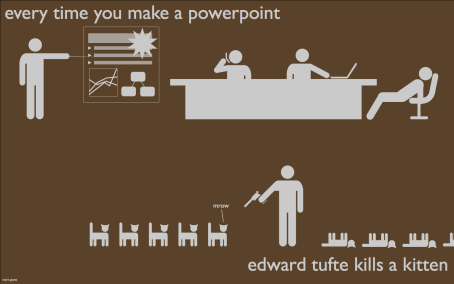
Mark Goetz’s new wallpaper (via Lynne Kiesling). Cory Doctorow translates: “Militant arm of the infoviz movement gets serious about PowerPoint.”
Ross Emmett on Innovation
| Peter Klein |
Here are some provocative videos on innovation from Ross Emmett. The series is called “The Constitution of Innovation.” The first three are posted at vimeo:
- Why “Picking Winners” Robs Us All of a Better Future
- National Innovation Systems: Too “National”; Not “Constitutional”
- The Promise of Failure
See Ross’s website for more information.
I, Taco
| Peter Klein |
Some California design students tracked the ingredients in their favorite local taco and came up with this cool image.

Of course, it’s supposed to show us the horror of all those food miles, but what I see is the miracle of the market.
Scott Galloway Is My New Hero
| Peter Klein |
For this brilliant performance in his Brand Management class at NYU (via Cliff). Says he to whiny MBA student:
You state that, having not taken my class, it would be impossible to know our policy of not allowing people to walk in an hour late. Most risk analysis offers that in the face of substantial uncertainty, you opt for the more conservative path or hedge your bet (e.g., do not show up an hour late until you know the professor has an explicit policy for tolerating disrespectful behavior, check with the TA before class, etc.). . . .
In addition, your logic effectively means you cannot be held accountable for any code of conduct before taking a class. For the record, we also have no stated policy against bursting into show tunes in the middle of class, urinating on desks or taking that revolutionary hair removal system for a spin. However, xxxx, there is a baseline level of decorum (i.e., manners) that we expect of grown men and women who the admissions department have deemed tomorrow’s business leaders.
And the life lesson:
Getting a good job, working long hours, keeping your skills relevant, navigating the politics of an organization, finding a live/work balance . . . these are all really hard, xxxx. In contrast, respecting institutions, having manners, demonstrating a level of humility . . . these are all (relatively) easy. Get the easy stuff right xxxx. In and of themselves they will not make you successful. However, not possessing them will hold you back and you will not achieve your potential which, by virtue of you being admitted to Stern, you must have in spades. It’s not too late xxxx. . . .
Bravo!





 Organizations and Markets
Recent Comments