Posts filed under ‘Teaching’
Tips for Presenting Your Research
| Peter Klein |
One of the most important skill young scholars must develop is the ability to give a technical presentation to a non-specialist audience. Everyone likes to strut his stuff but dissertation committee members, prospective academic employers, seminar audiences in various contexts, and others to whom you expose your work don’t necessarily want the gory details. Background, context, motivation, results, and implications are usually the most important parts of a presentation, but often the most neglected.
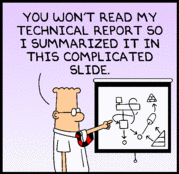 Two cartoons in my local paper today, this from Dilbert and this from Pickles, highlight that theme. Also, check out this article from Web Worker Daily, “10 Tips for Working with the Not-So-Tech-Savvy,” illustrated beautifully with an abacus. It’s written for techies working with regular folk, but many of the principles — avoid jargon, use analogies, include visuals, reference case studies, link to current events, be patient — apply to scholarly communication.
See also: Fabio’s Grad Skool Rulz.
Wikicheatia
| Peter Klein |
Facebook founder Mark Zuckerberg, reports the NY Times, skipped his college art history class:
When it came time for the end-of-term study period, he was too busy building the prototype of Facebook to bother to do the reading. So in an inspired last-minute save, he built a Web site with all of the important paintings and room for annotation. He then sent an e-mail to the students taking the class offering it up as a community resource.
In a half an hour, the perfect study guide had self-assembled on the Web. Mr. Zuckerberg noted that he passed the course, but he couldn’t remember the grade he received.
The pointer is from Joshua Gans, who calls this “an example of Wikicheatia or of Study Group 2.0.”
New Center for the History of Political Economy
| Peter Klein |
Bruce Caldwell is joining Duke University’s HOPE group as founding Director of a new Center for the History of Political Economy. Bruce explains:
The purpose of the Center is to promote and support both research in and the teaching of the history of political economy, broadly defined. Though operating on a somewhat reduced scale next year (AY 2008-2009), we anticipate that once it is up and running it will include an active visitors program for post-docs and more senior fellows, both short and long term; a regular seminar series; and programming, possibly in the summer, aimed at promoting teaching in the field.
The Center’s web page is not yet up but you can contact Bruce for more information.
More Free Stuff: Herbert Simon and Edward Banfield
| Peter Klein |
In my list of Cowles monographs I forgot to include several classics by Herbert Simon, including his 1951 paper “A Formal Theory of the Employment Relationship,” issued by Cowles as a discussion paper in 1950. Here’s the full set of Simon materials at Cowles. Also, from a commentator over at orgtheory.net I learn that several of Edward Banfield’s books, including The Moral Basis of a Backward Society (1958) and The Unheavenly City (1970) are available as PDFs at this site.
Austrian Economics Study Guides
| Peter Klein |
Jérémie Rostan has produced a study guide for Menger’s Principles of Economics, a nice complement to Bob Murphy’s study guides for Man, Economy, and State and Human Action (see the study guide links after each chapter title). And there’s always Percy Greaves’s Mises Made Easier.
When will someone write Foss Made Easier? I would buy a Foss Companion.
Economists on Interdisciplinarity
| Peter Klein |
I missed the ASSA/AEA session “What Should Be the Core of Graduate Economics?” featuring Susan Athey, Ed Gleaser, Bo Honoré, Blake Lebaron, Derek Neal, and Michael Woodford but there is a write-up in the Chronicle (gated, though a free version is temporarily available here). Gleaser offers perhaps the most interesting comment for the O&M crowd:
“We actually shouldn’t be thinking narrowly in terms of first-year economics.” . . . “We should be thinking about first-year social science. The whole division between economics, sociology, and political science feels like a hangover from the 19th century. So many of the people in our profession are working on problems that have traditionally been seen as part of sociology or political science.
“We should probably be rethinking from the ground up all of the social sciences,” Mr. Glaeser continued. “A more attractive model might be a first-year course sequence that trains a social scientist to work on anything, rather than having separate first-year economics, sociology, and political science course work. But maybe that’s a discussion for a different panel.”
My guess is that such a first-year sequence would have two much economics-based sociology, economics-based political science, and the like to satisfy our friends at orgtheory.net. But it is an intriguing possibility. (more…)
O&M Classic: Grading Essay Exams
| Peter Klein |
This classic post from last year deserves another go.
Ben Hermalin’s Teaching Materials
| Peter Klein |
Many years ago I had the pleasure of taking Ben Hermalin’s class on mechanism design and agency theory. In those days (around 1990) Ben was a baby-faced assistant professor (now a baby-faced chaired professor), just arrived from MIT where, according to rumor, he had single-handedly proofread — and therefore solved — all the exercises in Tirole’s Theory of Industrial Organization. Naturally, this gave him a certain aura among the PhD students. I also recall that, during Ben’s first year at Berkeley, George Akerlof audited his mechanism design course, leading Ben to joke that he would always remember Akerlof as one of his brightest students.
I happened to be on Ben’s website today and discovered that he’s posted a set of lecture notes (see the bottom of this page) from his PhD theory courses. See, in particular, his notes from Economics 201B, the second course in the first-year micro theory sequence. Very useful material for economics PhD students (and their instructors).
Also worth a read is this entry on contract law by Hermalin, Avery Katz, and Richard Craswell (in the new Handbook of Law and Economics, not to be confused with the earlier Encyclopedia of Law and Economics). Check it out.
The Perils of Microcelebrity
| Peter Klein |
I was pleased to learn that I might be a microcelebrity: someone “extremely well known not to millions but to a small group — a thousand people, or maybe only a few dozen.” This definition comes from Clive Thompson, who suggests in the current issue of Wired that anyone with a blog, a Facebook page, a Flickr account, or a similar web presence can be a microcelebrity in this sense. “Odds are there are complete strangers who know about you — and maybe even talk about you.”
Okay, in my case perhaps “nanocelebrity” is the better term. The broader point, according to Thompson, is that in today’s highly transparent, densely networked, web 2.0 world in which more and more of our personal information ends up preserved for posterity in the Google cache, people may be reluctant to say or do anything that could be controversial.
Blog pioneer Dave Winer has found his idle industry-conference chitchat so frequently live-blogged that he now feels “like a presidential candidate” and worries about making off-the-cuff remarks. Some pundits fret that microcelebrity will soon force everyone to write blog posts and even talk in the bland, focus-grouped cadences of Hillary Clinton (minus the cackle).
As a university professor I worry about this from time to time. Will some off-hand remark made in class end up on a student’s blog? Some students record my lectures on their mp3 players (usually, though not always, with prior permission). Will audio clips — or, heaven forbid, video clips — of me fumbling and stumbling over some difficult concept end up on YouTube?
Teaching Social Responsibility
| David Hoopes |
I am on the planning committee and the goals committee here at Cal State Dominguez Hills. At a recent meeting it came up that one of the schools goals was academic excellence and social responsibility. I suggested that they are two very different topics but was roundly rebuked. I have a few problems with considering social responsibility to be part of the same goal as academic excellence for college professors.
My first complaint is that “social responsibility” is not very easy to define or operationalize. Usually, it seems to imply donating money to some left wing cause. I might be able to find some left wing causes I like. However, I’m not sure how teaching students to tithe is similar to teaching students a course of study or an academic discipline.
My second complaint is that I don’t think academicians are qualified to teach social responsibility. I admit to being jaded and cynical. But I do not find academicians to be shining examples of virtue. Getting a Ph.D. in management, economics, or sociology hardly qualifies one to determine what students should consider to be socially virtuous.
I do think colleges (especially state funded) have some obligation to promote citizenship and promote and encourage ethical and moral behavior. Additionally, I am very happy to have those who specialize in ethics and related topics to teach them (the philosophy department?).
However, again, I don’t see this as our primary mandate. I might feel better about this if I felt that academics were paragons of ethical and moral behavior. On the contrary, I am continually disappointed in the standards to which academicians hold themselves. Having worked a variety of odd and not so odd jobs before heading to the academy I feel pretty comfortable saying that academicians certainly do not appear to have superior ethical and moral behavior.
What, you might ask, makes me think of academics as being ethically or morally lacking? Well that’s for another post.
. . . And If You Can’t Teach, Teach Gym
| Peter Klein |
You know the old adage: If you can, do; if you can’t, teach. Is it true for business?
A paper in the August 2007 Academy of Management Perspectives, “Do Business School Professors Make Good Executive Managers?” by Bin Jiang and Patrick Murphy (full text; abstract; press release), identifies 217 firms with former business-school professors in management positions and finds that these firms have higher revenues-per-employee than a control group matched by industry, location, and firm size. Faculty making early exits from their academic careers appear to be the most valuable, while neither academic area nor business-school ranking seem to matter. Conclusion:
Executive managers learn from past experiences when they draw the right lessons from those experiences. But experience alone is not enough. Given the rigorous training professors receive in order to design research that objectively parses error and data, one final supposition is that they may be particularly competent at delineating patterns in complex management and organizational experiences. They may also be especially capable of continually developing innovative questions that lead to information useful for executive decision-making amidst uncertainty.
I enjoyed reading the paper. Certainly I like to think that I’d command a high salary if I chose to give up my cushy professor lifestyle for the real world. However, I don’t find the empirical analysis convincing. Here’s why: (more…)
A Professor’s Influence
| Peter Klein |
As a professor, you never know how much influence you have. Sometimes you hear from former students, years later, thanking you for some remark you made in class, for challenging or inspiring them, for helping them see things in a different way. (You rarely hear from the ones you damaged for life, but forget the sample bias. . . .)
Most of us don’t get thanked on national TV, however. During the fourth quarter of last weekend’s Tennessee-Georgia game the ESPN crew showed an old picture of Tennessee head coach Philip Fulmer from his playing days in the 1970s, then mentioned former history professor Milton Klein, described by head announcer Ron Franklin as Fulmer’s mentor, a professor who “took a young Philip Fulmer under his wing and helped guide him” through his student days. Way to go, Dad! (Thanks to my brother Ed, whose company created ClipShack, host of the clip linked above.)
Update (26 October): Mom gives the football team a back-handed compliment in the local paper (scroll down to the second letter).
More Presentation Tips
| Peter Klein |
More for our ongoing series on PowerPoint:
You can find good tips at Presentation Zen. A nice rule of thumb is 6×6, though I favor 1×6.
Especially with a technical topic one is ensnared to use bullet points. It doesn’t help. It doesn’t stick. As the speaker, you will read the list point by point, with some intermediary “and” and “uh”, and bore the audience. Do it like Steve, not like Bill!
Animations? Cease and desist!
This is from Andreas Zwinkau’s tips on technical presentations.
How to Give a Guest Lecture
| Peter Klein |
Steve Carrell shows how it’s done on one of my favorite episodes of The Office. Seeing him rip up an economics textbook is classic. And how often do you hear the words “Herfindahl Index” on prime-time TV?
Update (7 November 2007): NBC’s lawyers made YouTube take down the clip. But here’s another (albeit incomplete) version.
The Best Business Book I’ve Read This Year
| Peter Klein |
It’s Phil Rosenzweig’s The Halo Effect (mentioned previously here). Rosenzweig systematically, but politely, demolishes the pretensions of best-selling management books and projects such as In Search of Excellence, Built to Last, Good to Great, and the Evergreen Project. These studies, Rosenzweig patiently explains, engage not in serious research — despite their pseudo-scientific pretensions (what Rosenzweig calls “The Delusion of Rigorous Research”) — but in storytelling.
The most common problems are sampling on the dependent variable (i.e., choosing a sample of high-performing companies and explaining what their managers did, ignoring selection bias) and using independent variables based purely on respondents’ ex post subjective assessments of strategy, corporate culture, leadership, and other “soft” characteristics. The latter is the “Halo Effect” of the book’s title. When a company’s financial or operating performance is strong, managers, consultants, journalists, and management professors tend to rate strategy, culture, and leadership highly, while rating the same strategies, cultures, and leadership poorly when a company’s performance is weak. It’s as if the authors of “guru” books have never taken a first-year graduate course on empirical research design. Or, as Rosenzweig puts it (p. 128): “None of these studies is likely to win a blue ribbon at your local high school science fair.” Ouch. (more…)
Teaching Game Theory
| Nicolai Foss |
Game theory is fun to teach because the real world applications, exemplifations, etc. are legion, and the theory so often does more than merely redescribe the situation, but actually brings new insight. If, however, you are out of good examples, you may want to check out Game Theory.net’s list of game theory in film, music and fiction.
SDAE Sessions
| Peter Klein |
Sessions from the SDAE section of the upcoming Southern Economic Association annual meeting (New Orleans, 18-20 2007) that may interest our readers:
- Peter Lewin (University of Texas at Dallas) and Howard Baetjer Jr. (Towson University),“Can Ideas be Capital? Can Capital Be Anything Else?”
- Per-Olof Bjuggren and Johanna Palmberg (Jönköpings International Business School), “Swedish Listed Family Firms and Entrepreneurial Spirit”
- Joseph T. Salerno (Pace University), “The Entrepreneur: Real and Imagined” (more…)
More Podcasts: Gordon, Weingast, Salerno-Klein
| Peter Klein |
- The History of Political Philosophy: From Plato to Rothbard by former O&M guest blogger David Gordon. A ten-lecture series delivered in June 2007 covering Plato, Aristotle, Aquinas, Hobbes, Locke, Rousseau, Kant, Hegel, Mill, Spooner, Spencer, Rawls, Nozick, Rothbard, and more. Only David Gordon could be an expert on all of these.
- Russ Roberts’s interview with Barry Weingast about the new book by North, Wallis, and Weingast, A Conceptual Framework for Interpreting Recorded Human History (what a title!). Weingast has become so prominent in political science it is easy to forget that he has an economics PhD (from Cal Tech) and started his career as an economics professor at Washington University in St. Louis. (His critics have not forgotten.)
- Fundamentals of Economic Analysis: A Causal-Realist Approach. Economics in the tradition of Carl Menger, starting with the basics of scarcity, choice, value, and exchange then moving to pricing, entrepreneurship, capital, competition, money, banking, and the business cycle. Joe Salerno and I give the lectures. You can also get these as videos in a handsome DVD set.
Defending the Book
| Peter Klein |
Books teach more than videos, PowerPoint presentations, and similar substitutes, writes Alan Wall (via Mark Brady):
[H]owever central the computer might have become in our lives, in a literary education, the book remains our main technological tool, and none of us should be bullied into apologizing about the fact. The book represents one of the greatest technological innovations in history, and its fitness for its task, its versatility, its convenience, mean that it will surely continue well into the future. It is also a remarkably democratic technology, in educational terms. If a teacher is giving a power-point presentation, as we teachers are now being exhorted to do, at every available opportunity, then that teacher dictates what is available in the form of knowledge to everyone in the room. She or he presses the keys on the laptop that change whatever text or image is up there on the screen. She decides what I can see and when. But if I am a student and I have a book in front of me, then I can answer back. I can turn my own pages in my own good time, and remind myself of my own marginalia. “Excuse me, but I don’t agree. What you said about Dorothea in Chapter Five might well be true, but if you’d care to turn to Chapter Nine, I think you might find. . . .”
Many power-point demonstrations are mechanical and halting, because the presenter or lecturer spends much of the time staring at a laptop screen, instead of engaging with the audience. In terms of teaching literature, there is also a limit to the usefulness of any visual material. I can have a picture of Milton, or Charles I heading for the scaffold, or Cromwell displaying his legendary wartiness, but sooner or later we have to buckle down and read Paradise Lost.
Some of you are thinking, “That’s fine for literature, but not economics or sociology or management. Besides, nobody in these fields writes books anyway, just articles.” Still, training students (and colleagues) to grapple with ideas through long, sustained arguments, rather than short bullet points, is a worthy goal for scholars in all disciplines, especially management.
Should B-School Students Pay More?
| Peter Klein |
Business professors earn more than their faculty counterparts in history or music. Why shouldn’t business majors pay higher tuition than history or music majors?
That’s the reasoning many US public universities are employing, reports this New York Times piece. Undergraduates majoring in business, engineering, journalism, and other professional programs are starting to face tuition premia. Faculty salaries vary, by discipline, according to supply and demand (at least within limits set by the university cartel), and tuition and fees are starting to adjust to match. An interesting move for institutions that have long resisted using the price mechanism to allocate resources among and within operating units.
Update: See Brian McCann’s commentary here.





 Organizations and Markets

Recent Comments