Posts filed under ‘Theory of the Firm’
Temin on Landes
| Peter Klein |
We reported a while back on David Landes’s book Dynasties: Fortunes and Misfortunes of the World’s Great Family Businesses. Here is a review by the eminent economic historian Peter Temin of MIT. Excerpt:
[Landes] acknowledges the force of Chandler’s emphasis on managerial capitalism, but he argues that family firms have a prior role in economic development. In this claim, he associates himself on the one hand with Marc Bloch, who argued that Europe picked itself up from chaos in the tenth century by relying on the value of family connections. Landes associates himself on the other hand with modern economics and its concerns with asymmetric information and principal-agent problems. Landes argues that the failure of many development programs has been the neglect of the information and loyalty that are qualities of families — in his word, dynasties.
The stories illustrate these points, but Landes’s urge to tell a good story is at gentle odds with this justification for them. Most of the dynasties in this book have ruled over substantial enterprises. These enterprises employed many people other than family members. Normal business practice prevailed once these enterprises became major banks, auto firms, or mining companies. The importance of asymmetric information must have been concentrated in the early years.
Open-Source Cola
 | Peter Klein |
This is what the Linux-heads are drinking these days instead of Coke or Pepsi. No joke. People can download the “source code,” modify it to their liking, and produce their own stuff, under the terms of the GNU General Public License. (Will somebody put the cocaine back in?)
I’ll bet this is Don Tapscott and Anthony Williams’s drink of choice!
Risk, Uncertainty, and Baseball
| Peter Klein |
Frank Knight meets Abner Doubleday in this this item from the Hardball Times.
When we try to predict the outcome of a baseball season, whether as fans or pretend-general managers, there’s a whole lot of stuff we just don’t know. In fact, if you want certainty, we don’t know anything: any player in major league baseball could blow out his arm, crash into a teammate, or just plain lose the skills necessary to hit a slider.
Of course, most of those things won’t happen. When guessing the outcome of a team’s season, it’s a safe bet that somebody will get hurt, some players will underperform expectations, and others will overperform. One mark of a good general manager is identifying the situations in which those are most likely to happen, and then providing the best insurance he can.
Invoking the Knightian distinction between risk and uncertainty, baseball analyst Jeff Sackmann continues:
In a game of Strat-O-Matic, baseball is risky — you could calculate the likelihood of every event before you roll the dice. In real life, baseball is uncertain — no number of dice (or spreadsheet) is going to tell you Chris Snelling’s 2007 OPS. However, when it comes to the game on the field, there’s a continuum between risk and uncertainty, and that’s what I’m interested in. [Links added by PK for the benefit of our non-baseballophilic readers.]
Returning to Steve Postrel’s thoughts on the value added of management, one can perhaps conceive the problem in Knightian terms. In a world of probabilistic risk, “management” is, in principle, a simple problem of contract design. Nor would there be a reason for entrepreneurs to own assets. In a world of Knightian uncertainty, however, there is a role for managerial skill and for entrepreneurial judgment. Indeed, as Sackman notes, baseball “statheads don’t always agree with general managers” on personnel matters.
NB: If you think this is a rather silly example, you haven’t been keeping up with the literature. The academic analysis of sports is a rapidly growing field. Check out the Journal of Sports Economics, for example. Here is a short sportometric piece by yours truly.
The Vertical Dis-Integration of Organized Crime
| Peter Klein |
It’s said to be happening in manufacturing, services, and even higher education; why not organized crime? The Financial Times reports that Japanese gangs are relying increasingly on part-time mobsters. According to Japanese police statistics part-timers now make up 51 percent of total gang membership, up from 33 percent in 1991.
One explanation: the Dilbert-style bureaucracy of the established gangs:
Part-time gang members may also be opting out of the hierarchical world that full-time membership entails. Onerous duties include making cash payments to the oyabun, a young hoodlum’s father-figure boss, and keeping long hours, for instance by preserving a henchman’s precious parking space.
Similarly, in regular business, many young Japanese prefer bouncing between part-time jobs to joining a rule-bound company. Like yakuza gangs, Japanese businesses tend to be hierarchical, with strict dress codes, mind-numbing duties and compulsory overtime.
Would these mob Bosses pass Bob Sutton’s test?
Responding to such pressures, the gangs have learned to outsource (presumably “non-core”) tasks to contract workers. Says one Japanese lawyer familiar with underworld issues: “These guys are the best entrepreneurs in the country, certainly the most responsive to change in business conditions.” (HT: PSD Blog)
The University of Phoenix and the Economic Organization of Higher Education
| Peter Klein |
The Sunday New York Times features a lengthy, and mostly unflattering, look at the University of Phoenix, the world’s largest for-profit university. The tenor of the Times piece is set by the headline, “Troubles Grow for a University Built on Profits” — the p-word clearly chosen to shock the Times’s modal reader. (Where were the stories on the Times’s Judith Miller scandal titled “Troubles Grow for a Newspaper Built on Profits”?)
What’s remarkable about the article is not the conclusion, which is largely predictable, but the form of the argument. There is no attempt to evaluate the University of Phoenix’s efficiency or profitability, the quality of its product, or the value added of its degree. (Just a few quotes from disgruntled students, taken at face value; obviously no one at the Times reads RateMyProfessors.com.) Rather, the focus is on the production function. Because Phoenix uses an unusual production technology, the Times implies, its product is suspect. (more…)
Open Innovation Site
| Peter Klein |
For something serious on “open” architecture and innovation, see Henry Chesbrough’s Open Innovation site (named for his 2003 book). There’s a nice bibliography, research page, and the official site for Chesbrough’s edited volume (with Wim Vanhaverbeke and Joel West) Open Innovation: Researching a New Paradigm (Oxford, 2006).
The Wikified Firm
| Peter Klein |
Openness is surely the prevailing fetish of our times. In the tell-all memoir, in the airiness and transparency of modern architecture, in the porousness of national borders and, lately, in the flashier theories of business, the overwhelming appeal of openness is nearly a closed question.
Thus opens Daniel Akst’s review of Don Tapscott and Anthony D. Williams’s Wikinomics: How Mass Collaboration Changes Everything from the Saturday W$J. It’s actually a pretty good review considering the book’s underlying flakiness. “Firms that cultivate nimble, trust-based relationships with external collaborators are positioned to form vibrant business ecosystems,” write Tapscott and Williams. “For individuals and small producers, this may be the birth of a new era, perhaps even a golden one, on par with the Italian renaissance or the rise of Athenian democracy.” Notes Akst: “Somehow it seems a little premature for Botticelli to roll over and tell Demosthenes the news.”
The basic problem with Wikinomics, and others in this genre, is the failure to take a balanced, comparative approach to the effect of technology on transaction costs. Of course, information technology has the potential to lower the costs of transacting between firms. But it can also lower the costs of organizing activities within firms (through improved communication, better monitoring, more effective coordination, and so on). The net effect on firm size and vertical integration is ambiguous. (See more discussion here.)
Does anyone else think that “wiki” and its derivatives should be added to the banished words list?
Update: Tapscott published an op-ed on Viacom’s tiff with YouTube in Monday’s WSJ.
“Disturbances” in Transaction Cost Economics
| Nicolai Foss |
One of Oliver Williamson’s key and most cited contributions is his 1991 paper in the Administrative Science Quarterly, “Comparative Economic Organization: The Analysis of Discrete Structural Alternatives.” The paper introduces a number of themes that had until then only been present in a rather embryonic form in Williamson’s work (e.g., the 1985 locus classicus, The Economic Institutions of Capitalism: 1) Governance structures are fully characterized as discrete structural alternatives, 2) full(er) account is taken of “hybrids,” and 3) economic organization is cast in a dynamic setting, the discussion of which seems heavily inspired by Hayek’s work on economic change and the use of knowledge in society. (more…)
Peter Abell’s Organization Theory Textbook
| Peter Klein |
Peter Abell’s textbook Organisation Theory: An Interdisciplinary Approach is available on the web for free. (Technically it’s not a textbook, but a London School of Economics “subject guide.”) Congratulations to Peter for his fine work. (HT: Teppo)
Syllabus Exchange
| Peter Klein |
As a new semester begins professor-bloggers are sharing their notes and class syllabi. We previously mentioned Thom Lambert’s opening lecture in his Business Organizations class. Here are some syllabi that might interest O&M readers:
- Kieran Healy’s Economic Sociology (Arizona)
- Teppo Felin’s Microfoundations of Strategic Organization (BYU)
- Pete Boettke’s Austrian Theory of the Market Process II (George Mason)
- Cory Doctorow’s Is Everyone on this Campus a Copyright Criminal? (USC)
- Henry Farrell’s Institutions and Politics (George Washington)
Coase and Hayek in Law School
| Peter Klein |
My colleague, law professor Thom Lambert, begins his Business Organizations class with Hayek (1945) and Coase (1937). Coase is obviously extremely well known in legal circles, but I doubt Hayek is assigned in many law-school classes. Thom’s students are fortunate.
(Thom’s blog entry also alerts me to Henry Manne’s “Hayek, Virtual Markets, and the Dog that Did Not Bark,” which I hadn’t seen before, and which seems to deal with market-based management.)
How Does Management Affect Capabilities?
| Steven Postrel |
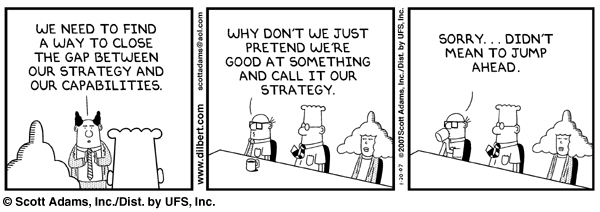
What contribution does management make toward producing output? If you watch Federal Express commercials, or read Dilbert, or listen to many technical workers when they talk to each other, the answer is “nothing.” Management is seen as purely an obstruction to the accomplishment of useful work.
If we take “management” as a sociological category, denoting a set of pointy-haired individuals disconnected from actual technical problem solving, then one could perhaps defend this position. But if we think of “management” as a collection of activities and practices, those practices seem essential, and many people, from computer programmers to chemists to special effects wizards, engage in them. But just how does management increase output? (more…)
AEA Papers on Organizations
| Peter Klein |
A selection of papers on firms, contracts, organizations, and institutions from this weekend’s American Economic Association meeting in Chicago.
Incomplete Contracts and Ownership: Some New Thoughts
Hart, Oliver (Harvard University)
Moore, John Hardman (University of Edinburgh)
Diversity of Governance Governance-Organization Architecture Linkage: Complementarities and Human Assets Essentiality
Aoki, Masahiko (Stanford University)
Firms, Nonprofits, and Cooperatives: A Theory of Organizational Choice
Herbst, Patrick (Goethe University, Frankfurt)
Prufer, Jens (Goethe University, Frankfurt)
Firm Boundaries in the New Economy: Theory and Evidence
Subramanian, Krishnamurthy (Emory University)
The Virtual Church
| Cliff Grammich |
Peter asks below about research “on the impact of technology on the existence, boundaries, an internal structure of religious organizations.” This is, to my knowledge, a nascent field, but there are some resources on this, listed below, of greater and lesser relevance to Peter’s question. (more…)
The Golden Decade
| Peter Klein |
Our friends at orgtheory.net are discussing the year 1977, in which several classic works in organization theory were published. I can’t be that precise, but I can vouch for the 1970s — a “golden decade” for organizational economics research. Coase’s “Nature of the Firm” appeared in 1937, of course, but it remained — in Coase’s words — “much cited, little used.” It was only in the 1970s that the modern theory of the firm, or the new economics of organization, emerged. Consider this list: (more…)
The New Model CEO
| Peter Klein |
The firing of Home Depot’s Robert Nardelli, whose Saban-esque compensation package was a flashpoint of controversy during his six-year tenure as CEO, dominates the front page of Thursday’s WSJ. Alan Murray’s column, “Executive’s Fatal Flaw: Failing to Understand New Demands on CEOs,” neatly summarizes the New Corporate Governance:
What Mr. Nardelli missed . . . is that in the post-Enron world, CEOs have been forced to respond to a widening array of shareholder advocates, hedge funds, private-equity deal makers, legislators, regulators, attorneys general, nongovernmental organizations and countless others who want a say in how public companies manage their affairs. Today’s CEO, in effect, has to play the role of a politician, answering to varied constituents. And it’s in that role that Mr. Nardelli failed most spectacularly.
Here’s the problem: Do we really want CEOs to be politicians? If we accept Hayek’s argument that in the political marketplace, the worst get on top, what kind of leader becomes our New Model CEO? (more…)
Agency Costs in Corporations
| Peter Klein |
Law professors are calling this “the best corporate law cartoon ever.” (Click to enlarge.)

Transaction Costs and the Church
| Peter Klein |
James Emery White, president of the highly regarded Gordon-Conwell Theological Seminary, is thinking about Ronald Coase. In a year-end reflection he writes that the most important phenomena of 2006, for religious organizations, may be the wiki, the blog, and the virtual firm.
[W]hat began with eBay, MySpace, Wikipedia and YouTube may not stop with revolutionizing how companies such as Goldcorp or Proctor and Gamble operate (or are even identified). The heart of the change involves the ever-widening rejection of professional/intellectual elites, and the diminution of those organizations which exist as either the gathering of such elites, or serve as the repositories of their supposedly exclusive knowledge. Further, those organizations that were once thought necessary for basic transactions of other natures — such as communal transactions — may also face a rude awakening.
Such as the church.
As posed by [an article in] USA Today, “So if a core reason companies exist is to lower transaction costs, what happens if that reason goes away?” Do we have reasons for such institutions as a school, newspaper, court of law, or church beyond “transaction costs?” And my great fear is for the church, particularly in light of the woefully inadequate and often heretical ecclesiology present within the Christian faith at large which is already reducing both the value and definition of the church to utilitarian forms.
The economics of religion is a growing field (see Larry Iannaccone’s resource page), but I’m not aware of much work by economists or sociologists on the impact of technology on the existence, boundaries, an internal structure of religious organizations. Any suggestions?
Top Posts of 2006
| Peter Klein |
As 2006 draws to a close we reflect on our most popular posts of the year. (Actually, we’ve only been in operation since April, so these are our most popular posts of all time, but you get the idea.) Here’s the list, followed by some commentary:
1. Is Math More Precise Than Words?
2. Intellectual Property: The New Backlash
3. Dilemmas of Formal Economic Theory
4. We Need Some Economics of Pomo
5. The New Bashing of Economics: The Case of Management Theory
6. Has Corporate Corruption Increased?
7. HRM in Heaven and Hell
8. Yale’s New MBA Curriculum: “Perspectives,” Not Functions
9. Malthus and the “Dismal Science”
10. Formal Economic Theory: Beautiful but Useless?
11. Why Do Sociologists Lean Left — Really Left?
12. The SWOT Model May Be Wrong
13. Multi-Culturality and Economic Organization
14. What Do We Really Know About Organizations?
15. Academic Insults: CCSM Edition
16. A Nobel for Entrepreneurship?
17. Price as a Signal of Quality
18. Economics: Puzzles or Problems?
19. Another Irritating Practice
20. Market-Based Management
Now, we’re talking small numbers here — the Drudge Report we ain’t — so the ranking is highly sensitive to random events, like an incoming link from Marginal Revolution. Nonetheless, some clear patterns emerge. (more…)





Recent Comments