CFP: “Managing Wicked Problems: The Role of Multi-Stakeholder Engagements”
| Peter Klein |
O&M friend Brent Ross sends along this CFP for a track session of the 2012 Wageningen International Conference on Chain and Network Management. The session, “Managing Wicked Problems: The Role of Multi-Stakeholder Engagements for Resource and Value Creation,” is linked to a special issue of the International Food and Agribusiness Management Review. Info below the fold: (more…)
Can a Strong Central Government Credibly Commit Not to Intervene?
| Peter Klein |
When the subject is large financial or industrial companies, the answer is clearly no. Government promises not to rescue failing banks or large firms are cheap talk, not credible commitments. A central government strong enough to bail out politically connected organizations will bail them out; the only government that can credibly commit not to intervene is one that is not legally empowered to intervene. And no modern state is willing to give up that discretionary authority. Here is evidence from Korea:
Ending “Too Big To Fail”: Government Promises vs. Investor Perceptions
Todd A. Gormley, Simon Johnson, Changyong Rhee
NBER Working Paper No. 17518, October 2011Can a government credibly promise not to bailout firms whose failure would have major negative systemic consequences? Our analysis of Korea’s 1997-99 crisis, suggests an answer: No. Despite a general “no bailout” policy during the crisis, the largest Korean corporate groups (chaebol) – facing severe financial and governance problems – could still borrow heavily from households through issuing bonds at prices implying very low expected default risk. The evidence suggests “too big to fail” beliefs were not eliminated by government promises, presumably because investors believed that this policy was not time consistent. Subsequent government handling of potential and actual defaults by Daewoo and Hyundai confirmed the market view that creditors would be protected.
Papers of Interest from the NSF’s Call for Long-Term Research Agendas
| Peter Klein |
The NSF recently commissioned a set of papers on long-term research agendas in economics:
This is a compendium of fifty-four papers written by distinguished economists in response to an invitation by the National Science Foundation’s Directorate for the Social, Behavioral and Economic Sciences (NSF/SBE) to economists and relevant research communities in August 2010 to write white papers that describe grand challenge questions in their sciences that transcend near-term funding cycles and are “likely to drive next generation research in the social, behavioral, and economic sciences.” These papers offer a number of exciting and at times provocative ideas about future research agendas in economics. The papers could also generate compelling ideas for infrastructure projects, new methodologies and important research topics.
Here are a few of particular interest for O&Mers:
Challenges for Social Sciences: Institutions and Economic Development
Daron AcemogluMaking the Case for Contract Theory
Oliver HartResearch Opportunities in Social and Economic Networks
Matthew O. JacksonThe Economics of Digitization: An Agenda for NSF
Shane M. Greenstein, Josh Lerner, and Scott SternThe Productivity Grand Challenge: Why Do Organizations Differ so Much?
John Van Reenen
You can find the whole set at SSRN.
Credible Commitment
| Peter Klein | A rather extreme form of the Schelling strategy of tying one’s own hands: 
Courtesy of the indispensable Fail Blog.
Self Employment, Entrepreneurship and Economic Growth
| Peter Lewin|
Interesting new monograph from the IEA (Institute of Economic Affairs) in the UK on: Self Employment, Small Firms and Enterprise. A pdf is available for free here. And here is the executive summary.
Summary
- Self-employment is a form of contractual relationship which, in certain circumstances, will have greater benefits to the parties involved than an employer–employee relationship. Government intervention, however, may make selfemployment artificially more attractive by raising the costs of employment relationships.
- Certain ethnic minority groups, older people and those without English as a first language tend to be overrepresented among the self-employed. This is partly because of the flexibility the arrangement provides but also because self-employment offers a ‘safety valve’ for those who find it difficult to find employment in the formal labour market.
- It is vital that businesses are not impeded from moving from a situation where the owner is self-employed without employees to a situation where the business has employees. There is evidence that businesses are impeded in this way. In just nine years to 2009, the proportion of micro-businesses with employees fell by almost one fifth. At the same time the proportion of self-employed with no employees rose rapidly.
- Women, individuals from certain ethnic groups, those with young dependants, those with low or no qualifications, those for whom English is not a first language and those who have recently experienced unemployment make up a much greater proportion of the workforce of small firms. For example, whereas 11 per cent of employees of small firms had no qualifications, only 4 per cent of employees of large firms had no qualifications.
- Some workers will prefer to work for small firms because of the greater flexibility they offer in their working practices. In many cases, however, small firms will employ people who are talented but who are not able to negotiate the more formal recruitment processes of larger firms. Micro-businesses therefore perform an important economic and social function – employing people who might be overlooked by larger employers.
- Genuine entrepreneurial insight and discovery tends to come from small firms. Entrepreneurship is crucial for economic growth. The nature of entrepreneurial insight is such, however, that we have no idea where it will come from – not even in the most general terms. Probably only one in every thousand ‘start-up’ firms will become one of the large businesses of the future.
- Policies to promote entrepreneurship must come in the form of removing impediments to business and should not involve the promotion of particular business activities. It is simply not possible for government intervention to pick this tiny number of winners. All government can do is create a climate in which entrepreneurship can thrive.
- The smallest firms are a key driver of job creation. Businesses do not start big. One quarter of employees working in firms that were established ten years earlier are working for firms that started from a position of employing only one person.
- The cost of regulation has grown enormously over the last fifteen years. This particularly affects small firms with employees because regulatory costs act like a ‘poll tax’. Wide ranging exemptions from employment regulation and the minimum wage would be appropriate for small firms. Such exemptions would have the additional advantage of allowing the government to ‘experiment’ with deregulation. Standard terms and conditions of employment could be drawn up which would ensure that employees clearly understood the exemptions. Radical reforms of the tax system would also assist small firms which experience much greater compliance costs than large firms.
- Moves by the government to promote entrepreneurship through the state education system or provide specific tax exemptions and reliefs for particular forms of business activity are wasteful or counterproductive.
Cuba’s First MBA Program
| Peter Klein |
Mises considered the stock market the distinguishing feature of capitalism. “There can be no genuine private ownership of capital without a stock market: there can be no true socialism if such a market is allowed to exist.” But he forgot another capitalist marker: the MBA program. Cuba still lacks a stock market, but the streets of Havana will soon ring with sounds of PowerPointese. The Financial Times has the scoop. Just imagine running some Marxist Revolutionary rhetoric through the MBA Writer!
What Do Boards Really Do?
| Peter Klein |
Coase is fond of telling this story about the economist and the horse:
Economics, over the years, has become more and more abstract and divorced from events in the real world. Economists, by and large, do not study the workings of the actual economic system. They theorize about it. As Ely Devons, an English economist, once said at a meeting, “If economists wished to study the horse, they wouldn’t go and look at horses. They’d sit in their studies and say to themselves, ‘What would I do if I were a horse?’” And they would soon discover that they would maximize their utilities.
Coase, as O&M readers know, prefers direct, hands-on observation to abstract theorizing. As a Misesian [serious, hubba hubba], of course, I can’t endorse this view as a general prescription, though I recognize its value for empirical work. Sometimes it’s best to look at real examples, or to ask real practitioners. Kaplan and Strömberg read through real-world venture-capital contracts to see how control rights were allocated. Genesove and Mullin used the minutes of trade-association meetings, not modeling, to figure out how members of the US sugar cartel maintained compliance.
Here’s another interesting example: “What Do Boards Really Do?” by Miriam Schwartz-Ziv and Michael Weisbach.
We analyze a unique database from a sample of real-world boardrooms – minutes of board meetings and board-committee meetings of eleven business companies for which the Israeli government holds a substantial equity interest. We use these data to evaluate the underlying assumptions and predictions of models of boards of directors. These models generally fall into two categories: “managerial models” assume boards play a direct role in managing the firm, and “supervisory models” assume that boards’ monitor top management but do not make business decisions themselves. Consistent with the supervisory models, our minutes-based data suggest that boards spend most of their time monitoring management: 67% of the issues they discussed were of a supervisory nature, they were presented with only a single option in 99% of the issues discussed, and they disagreed with the CEO only 3.3% of the time. In addition, managerial models describe boards at times as well: Boards requested to receive further information or an update for 8% of the issues discussed, and they took an initiative with respect to 8.1% of them. In 63% of the meetings, boards took at least one of these actions or did not vote in line with the CEO.
I think Ronald would approve.
Business and American Literature
| Peter Klein |
Thanks to Shawn Ritenour for the pointer to Algis Valiunas’s National Affairs piece, “Business and the Literati.”
The business of America may be business, but the business of American literature in the past century has been largely to insist that the nation is, in pursuing business, wasting itself on unworthy objects. In the eyes of most novelists and playwrights who deal with the subject, business is not an honorable vocation, but rather an obsessive scramble for lucre and status. Tycoons are plunderers. Salesmen are poor slobs truckling to their bosses, though most of them aspire to be cormorants and highwaymen, too. The mass desire to strike it rich has launched a forced march to nowhere. In short, American literature hates American business for what it has done to the souls of the rich, the poor, and the middling alike.
Right-thinking people now take it for granted that, in criticizing business, American literature has saved (or at least elevated) the nation’s soul. But after a century of slander, that assumption needs revisiting.
strategyprofs.net
| Peter Klein |
At O&M we’ve long prided ourselves on being one of the top academic group strategy blogs. We believed this with great confidence, mainly because we were the only academic group strategy blog. Other blogs deal with strategic issues — Dick Rumelt’s blog, Knowledge Problem, Managerial Econ, Digitopoly, and of course the Good Twin, among others — but the Herfindahl index for academic group strategy blogs has been pretty close to 1.0.
We’re happy now to introduce a new entrant, strategyprofs.net, brainchild of Freek Vermeulen, Karim Lakhani, Mike Ryall, Russ Coff, Steve Postrel, and Teppo Felin. The first posts are already up, and the discussion is extremely interesting. Welcome to the blogosphere, Strategy Profs!
Strategic Entrepreneurship Conference Starts Today!
| Peter Klein |
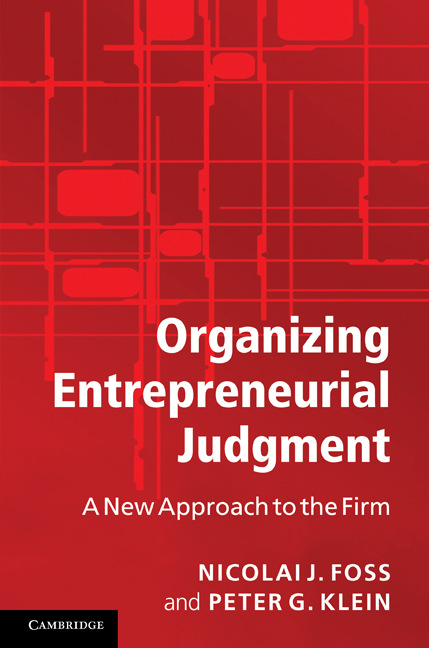
 The SMG-McQuinn conference, “Multi- and Micro-Level Issues in Strategic Entrepreneurship,” starts today. Not sure if live-blogging will be feasible (“Nicolai Foss has stepped to the podium. Blue tie, white shirt. Scans the crowd….”) but we’ll post information when we can. The program is here. Some reflections on last year’s conference are here. Naturally Nicolai and I will be in book-promotion mode, hopefully not obnoxiously so.
Update: Per Bylund is doing some live blogging at the McQuinn blog.
New Book on the Austrian School from Austria, Featuring Schumpeter and Others
| Peter Lewin |
I am reading an interesting new book from the Mises Institute — The Austrian School of Economics: A History of its Ideas, Ambassadors, and Institutions by two living Austrian authors, Eugen Maria Schulak and Hebert Unterköfler. I will leave the task of a full-blown critical review to experts in the history of thought, but a few passing observations might be of interest to this audience.
One might wonder about yet another history of the Austrian School, but there may be a genuine claim for value-added here, certainly in my case. For one thing, this is a translation from the German edition, so the majority of the references are in German. We parochial English speakers often proceed in isolation from important contributions in other languages. I was struck for example by the volume of work Carl Menger has done in German that has never been translated. And this is the case with all of the usual suspects.
As it turns out, this is particularly important in one case: the case of Schumpeter’s Theory of Economic Development — to which one of the short chapters is devoted. The one English edition that exists is a translation of an earlier German edition. So it fails to capture many aspects of Schumpeter’s later vision.
Many things derive from this early work, namely, Schumpeter’s entrepreneur, in its earliest incarnation (and its evolution in subsequent editions), the idea of the entrepreneur as the combiner of capital goods, and, of course, the notion of entrepreneurship bringing gales of “creative destruction.” The authors describe the development of the work through its various editions as Schumpeter matured as a scholar and became more confident, less nuanced, in his assertions. An example is his story of the business cycle — how the innovating entrepreneur was necessarily involved in “credit creation,” which thus precipitated a cycle (Richard Ebeling has recently done some interpretative work on this). At the time he first proposed this idea, he was vigorously criticized by Böhm-Bawerk and others — and our authors see this as the emergence of the first significant breech with the Austrian School. Dare I be so bold as to suggest that the contemporaries might have gotten it wrong, and, along the lines of Ebeling’s interpretation (reference below, also see my blog here and here), that Schumpeter may be understood more plausibly within a modern central bank institutional setting as hatching a variation of the Austrian Business Cycle story? (more…)
Now Ready for Pre-Order!
| Peter Klein |
This is a placeholder page without much detail, but you can pre-order today! The best news is the price: just £55.00 for the hardback and a mere £19.99 for the paperback — less than a family outing to the cinema, and far more rewarding!
Anita McGahan at Missouri
| Peter Klein |
Friend of O&M and leading management scholar Anita McGahan will present the University of Missouri’s Monroe-Paine Distinguished Lecture in Public Affairs, “The Health of Humanity 2050,” Thursday, 27 October 2011. She’ll also do a faculty-student seminar, “Changing the World,” that morning. Besides her important contributions to industry and competitor analysis Anita has become a leading expert in public health, poverty, and economic growth. Local O&Mers, make plans to attend!
Monroe-Paine Distinguished Lecture in Public Affairs
You’re invited to attend
Dr. Anita McGahan
Associate Dean-Research, Director of the PhD Programs, Professor of Strategic Management and
Rotman Chair in Management, Rotman School of Management,
Munk School of Global Affairs, University of Torontowill present
“The Health of Humanity 2050”
October 27, 2011 — 1:30 pm
2501 Missouri Student Center, Chambers Auditorium
RSVP to McGahan Lecture
For more information on Dr. McGahan, please visit the Truman School website.
Dissing Apple, Loving Steve
 | Peter Klein |
Like so many others, I was deeply saddened to learn today about the passing of Steve Jobs. Jobs was a great entrepreneur, a visionary, a social benefactor. Business leaders like Steve Jobs do more good for humanity than most of the do-gooders put together.
In memory of Steve, Apple fans are sharing their memories of Apple products, listing how many Macs they’ve owned, reminiscing about their first Apple II the way they talk about their first kiss. I’m not one of those. Indeed, I don’t much care for Apple products. I used an Apple II as a teenager, and currently own an iPad, the only Apple product I’ve ever bought. Steve Jobs made a particular kind of device — beautiful, specialized, simple to operate, but expensive, impossible to customize, frustrating to use if you want to use it in a different way than Steve intended. That’s fine — à chacun son goût. Isn’t that the beauty of capitalism? Markets aren’t winner-take all. Neither Steve Jobs nor Bill Gates nor Linus Torvalds nor anyone else decided what products we all should use and made us use them. We didn’t vote for our favorite computer or music player or phone, then all get the one that 51% of the voters preferred. No, we can all have the goods and services we like.
I don’t like Apple products, but I love the fact that other people like them, and that people like Steve Jobs provided them. R.I.P.
Addendum: Steve Horwitz makes the same point.
Schumptoberfest
| Peter Klein |
Kudos to former guest blogger David Gerard for helping organize and host the conference with the über-cool name, Schumptoberfest, 21-23 October at Lawrence University in Appleton, Wisconsin. David Hounshell is giving the keynote address, and the rest looks good too.

Reader Bleg: Transaction Costs and the Boundaries of the State
| Peter Klein |
O&M reader VL asks:
I have noticed an interesting link between transaction cost economics and the explanation of the long-term political units size (as Braudel would have said, on “la longue durée”). For example, it is highly probable that classical Greek poleis were being integrated and desintegrated in response to changes in the nature of military and political contracts. I wish to explore that perspective in my own doctoral thesis and I would like to ask for your help. Do you know about any work that examines that matter? I have read books of Coase, Williamson, and North, and further articles of Alchian, Demsetz, and others. But I don’t know of any work treating organization economics from a political anthropological or political historical perspective.
I suggested privately that he look at David Friedman’s 1977 JPE paper and recent work by Alberto Alesina and coauthors, though none of these works from a transaction cost perspective. Can the rest of you offer some suggestions? If not TCE, then how about resource-based, dynamic capabilities, or property-rights perspectives on the boundaries of the polis?
Terminology
| Peter Klein |
An interesting example of scholars in different fields using the same specialized terms to mean entirely different things:
Creating Capabilities: The Human Development Approach
MARTHA C. NUSSBAUMIn this powerful critique, Martha Nussbaum argues that our dominant theories of [economic] development have given us policies that ignore our most basic human needs for dignity and self-respect. For the past twenty-five years, Nussbaum has been working on an alternate model to assess human development: the Capabilities Approach. She and her colleagues begin with the simplest of questions: What is each person actually able to do and to be? What real opportunities are available to them?
Creating Capabilities . . . affords anyone interested in issues of human development a wonderfully lucid account of the structure and practical implications of an alternate model. It demonstrates a path to justice for both humans and nonhumans, weighs its relevance against other philosophical stances, and reveals the value of its universal guidelines even as it acknowledges cultural difference. In our era of unjustifiable inequity, Nussbaum shows how — by attending to the narratives of individuals and grasping the daily impact of policy — we can enable people everywhere to live full and creative lives.
One reviewer suggests the term “capabilitarianism” to describe this approach. Will we soon see management journal special issues on capabilitarianism and dynamic capabilitarianism? Felin and Foss critiques on the lack of microfoundations in capabilitarianism? Calls to join capabilitarianism and transaction costarianism?
Two Finance Papers of Interest
| Peter Klein |
Two recent review-type papers from NBER:
Behavioral Corporate Finance: An Updated Survey
Malcolm Baker, Jeffrey Wurgler
NBER Working Paper No. 17333
Issued in August 2011We survey the theory and evidence of behavioral corporate finance, which generally takes one of two approaches. The market timing and catering approach views managerial financing and investment decisions as rational managerial responses to securities mispricing. The managerial biases approach studies the direct effects of managers’ biases and nonstandard preferences on their decisions. We review relevant psychology, economic theory and predictions, empirical challenges, empirical evidence, new directions such as behavioral signaling, and open questions.
A Brief History of Regulations Regarding Financial Markets in the United States: 1789 to 2009
Alejandro Komai, Gary Richardson
NBER Working Paper No. 17443
Issued in September 2011In the United States today, the system of financial regulation is complex and fragmented. Responsibility to regulate the financial services industry is split between about a dozen federal agencies, hundreds of state agencies, and numerous industry-sponsored self-governing associations. Regulatory jurisdictions often overlap, so that most financial firms report to multiple regulators; but gaps exist in the supervisory structure, so that some firms report to few, and at times, no regulator. The overlapping jumble of standards; laws; and federal, state, and private jurisdictions can confuse even the most sophisticated student of the system. This article explains how that confusion arose. The story begins with the Constitutional Convention and the foundation of our nation. Our founding fathers fragmented authority over financial markets between federal and state governments. That legacy survives today, complicating efforts to create a financial system that can function effectively during the twenty-first century.
2011 Ig Nobel Laureates
| Peter Klein |
The 2011 Ig Nobel Prizes were announced yesterday. No economics prize this year, but several awards recognize work with profound social-science implications. For instance:
MEDICINE PRIZE: Mirjam Tuk (of THE NETHERLANDS and the UK), Debra Trampe (of THE NETHERLANDS) and Luk Warlop (of BELGIUM). and jointly to Matthew Lewis, Peter Snyder andRobert Feldman (of the USA), Robert Pietrzak, David Darby, and Paul Maruff (of AUSTRALIA) for demonstrating that people make better decisions about some kinds of things — but worse decisions about other kinds of things‚ when they have a strong urge to urinate.
REFERENCE: “Inhibitory Spillover: Increased Urination Urgency Facilitates Impulse Control in Unrelated Domains,” Mirjam A. Tuk, Debra Trampe and Luk Warlop, Psychological Science, vol. 22, no. 5, May 2011, pp. 627-633.
REFERENCE: “The Effect of Acute Increase in Urge to Void on Cognitive Function in Healthy Adults,” Matthew S. Lewis, Peter J. Snyder, Robert H. Pietrzak, David Darby, Robert A. Feldman, Paul T. Maruff, Neurology and Urodynamics, vol. 30, no. 1, January 2011, pp. 183-7.
[ . . . ]
LITERATURE PRIZE: John Perry of Stanford University, USA, for his Theory of Structured Procrastination, which says: To be a high achiever, always work on something important, using it as a way to avoid doing something that’s even more important.
REFERENCE: “How to Procrastinate and Still Get Things Done,” John Perry, Chronicle of Higher Education, February 23, 1996. Later republished elsewhere under the title “Structured Procrastination.”
[ . . . ]
PEACE PRIZE: Arturas Zuokas, the mayor of Vilnius, LITHUANIA, for demonstrating that the problem of illegally parked luxury cars can be solved by running them over with an armored tank.
REFERENCE: VIDEO and OFFICIAL CITY INFO
Digitopoly
| Peter Klein |
A new group blog by Erik Brynjolfsson, Joshua Gans, and Shane Greenstein. Should be interesting and informative. The authors
noticed that there were many blogs devoted to digital developments and consumer products but the selection focussing on economic and business aspects of the digital world was very limited. Digitopoly’s mission is to provide an economic and strategic management perspective on digital opportunities, trends, limits, trade-offs and platforms; expanding commentary in this important space.
The blog’s name — Digitopoly — reflects our broad interests in the impact of digital technology on competition. While, in some cases, our concern is the preservation of competition in the face of pressures toward monopoly, in others we see opportunities for greater competition and welfare benefits.
Our logo is deliberately iconic. The heavy set line in the graph could represent Moore’s Law (for processing power as time progresses) or Metcalfe’s Law (for the value of networks as more join). It overtakes the simple linear trend represented by thin, broken line. This reflects the idea that linear ways of thinking rarely serve us well in the digital economy.





 Organizations and Markets
Recent Comments